


Have you ever heard someone say, “If you want something done right, do it yourself?”
Many managers have undoubtedly clung to this phrase, especially when stakes are high or time is short. But that mindset doesn’t scale. In reality, great leadership entails developing others to do more. While effective delegation can be seen as a productivity hack, it is rather a core leadership skill that enables growth, both for the manager and the team.

Image used under license from Shutterstock.com
What is Delegation?
Delegation is the act of assigning responsibility and authority to someone else to complete a task or make decisions on your behalf. In a workplace context, a manager or leader entrusts part of their workload to a team member while remaining accountable for the outcome. However, more than offloading tasks, delegation is about empowering others, building their capability, and ensuring work gets done at the right level. Therefore, it requires communication, clarity, trust, and follow-up.
The goal of delegating is to multiply impact, develop talent, and create space so that you, as a manager, can focus on what matters most. More specifically, delegating properly:
- Frees Up Time for Higher-Impact Work: When you spend your time on work that others could do, you lose the opportunity to focus on strategy, innovation, or long-term planning.
- Builds Team Capability: Delegating stretch assignments helps others learn, grow, and gain confidence. It also signals trust and creates engagement, allowing for a better work environment.
- Prepares Future Leaders: Delegation exposes team members to challenges they’ll face as they advance in their careers.
- Improves Team Agility: The team becomes more responsive and adaptive when work is distributed and not bottlenecked at the top.
- Reduces Burnout Risk: Holding onto everything yourself leads to overload. Delegation is a key part of sustainable management and leadership.

Image used under license from Shutterstock.com
How to Delegate
Many first-time managers, in an effort to prove themselves, continue to do the work that got them promoted. But this is a trap! Effective management is no longer about execution but about enabling others to execute. Thus, to delegate effectively,
- Choose the Right Task: Delegate tasks that others can or can learn to do with the right support. Retain critical or sensitive responsibilities, but don’t hoard everyday tasks.
- Pick the Right Person: Match the task to the person’s skills, interests, and development goals. If well aligned, delegation can be a growth opportunity.
- Clarify the Outcome, Not the Process: Focus on what success looks like. Give context and expected results, but allow autonomy in how the work gets done.
- Communicate Clearly: Define the scope, deadlines, available resources, and decision-making authority. Make sure the person understands their role.
- Provide Support, Not Micromanagement: Stay available for questions, but resist the urge to take over. Trust is key.
- Follow Up and Give Feedback: Check in at agreed-upon milestones. After completion, review the outcome and offer constructive feedback.
- Recognize and Celebrate: Acknowledge the person’s contributions. Recognition reinforces good work and encourages future initiative.

Image used under license from Shutterstock.com
Thought Leaders
Several thought leaders have provided insights and shaped modern leadership practices around delegation. Some of these include:
- Peter Drucker: Considered the father of modern management, he believed effective executives should focus their time and energy where they can have the most significant impact, and delegate the rest. He argued that delegation is a way to ensure that high-level thinking stays at the top, while capable hands manage appropriate tasks below.
- Stephen Covey: Author of The 7 Habits of Highly Effective People, he emphasizes delegation as a key part of effective personal and professional leadership. He distinguishes between gofer delegation (“do this, do that”) and stewardship delegation—entrusting outcomes, not just tasks.
- Ken Blanchard: A co-author of The One Minute Manager, his work focuses on situational leadership. He argues that delegation should match the employee’s development level, offering more support to novices and more autonomy to experts.
- Liz Wiseman: An author, researcher, and executive advisor who teaches leadership to organizations worldwide, in Multipliers, she distinguishes between leaders who amplify the intelligence of others and those who diminish it. Delegation is central to the Multiplier mindset, as leaders who delegate help their teams grow and excel.
- Michael Bungay Stanier: Author of The Coaching Habit, he encourages managers to lead through coaching, which includes asking good questions rather than providing all the answers. This complements effective delegation by fostering ownership and development.
- David Marquet: Former U.S. Navy captain and author of Turn the Ship Around!, he developed a “leader-leader” model where control and decision-making are pushed down the chain of command.
- Michael Hyatt: A former CEO turned leadership mentor, he developed the Freedom Compass, which helps leaders identify what to eliminate, automate, or delegate. He encourages leaders to spend more time in their Desire Zone—where passion and proficiency intersect—and delegate tasks that fall outside it.
- Jocko Willink: A former Navy SEAL and co-author of Extreme Ownership, he teaches that strong leaders develop their teams by giving them real responsibility. He supports the notion of decentralized command, where team members clearly understand their roles and have the authority to make decisions.
Key Frameworks
Structured frameworks can help you to determine what to delegate, how much authority to give, and how to support the team through the process. The following are several practical models that can help you delegate with clarity and confidence.
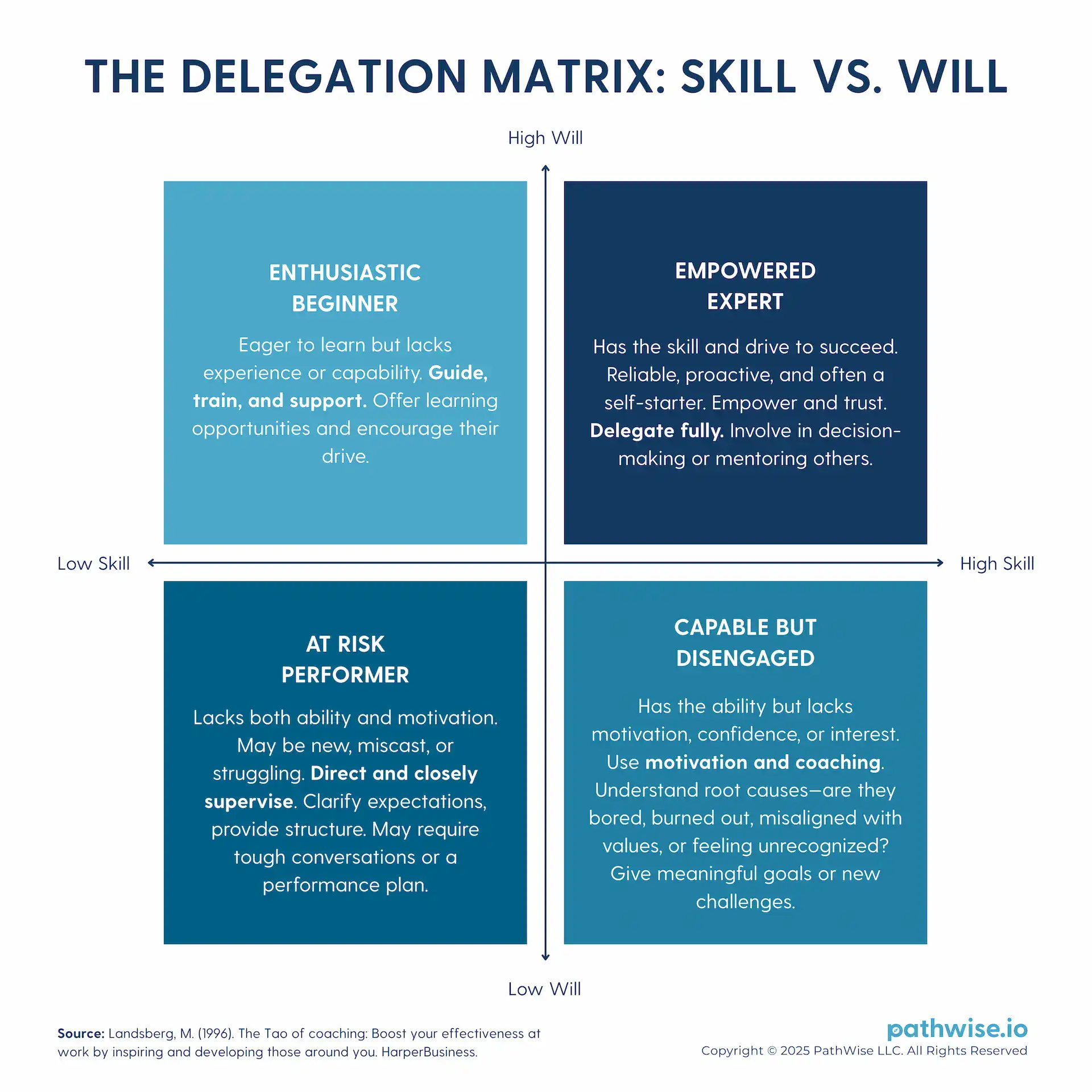
- The Delegation Matrix: Skill vs. Will: This model helps assess how ready someone is to take on a task by evaluating two factors: their skill level and their willingness to do the task. If they’re skilled and motivated, delegate with full autonomy. If they’re skilled but disengaged, offer motivation and regular check-ins. If they’re motivated but inexperienced, provide coaching and guidance. If they lack both skill and will, they may need training or a reassignment.
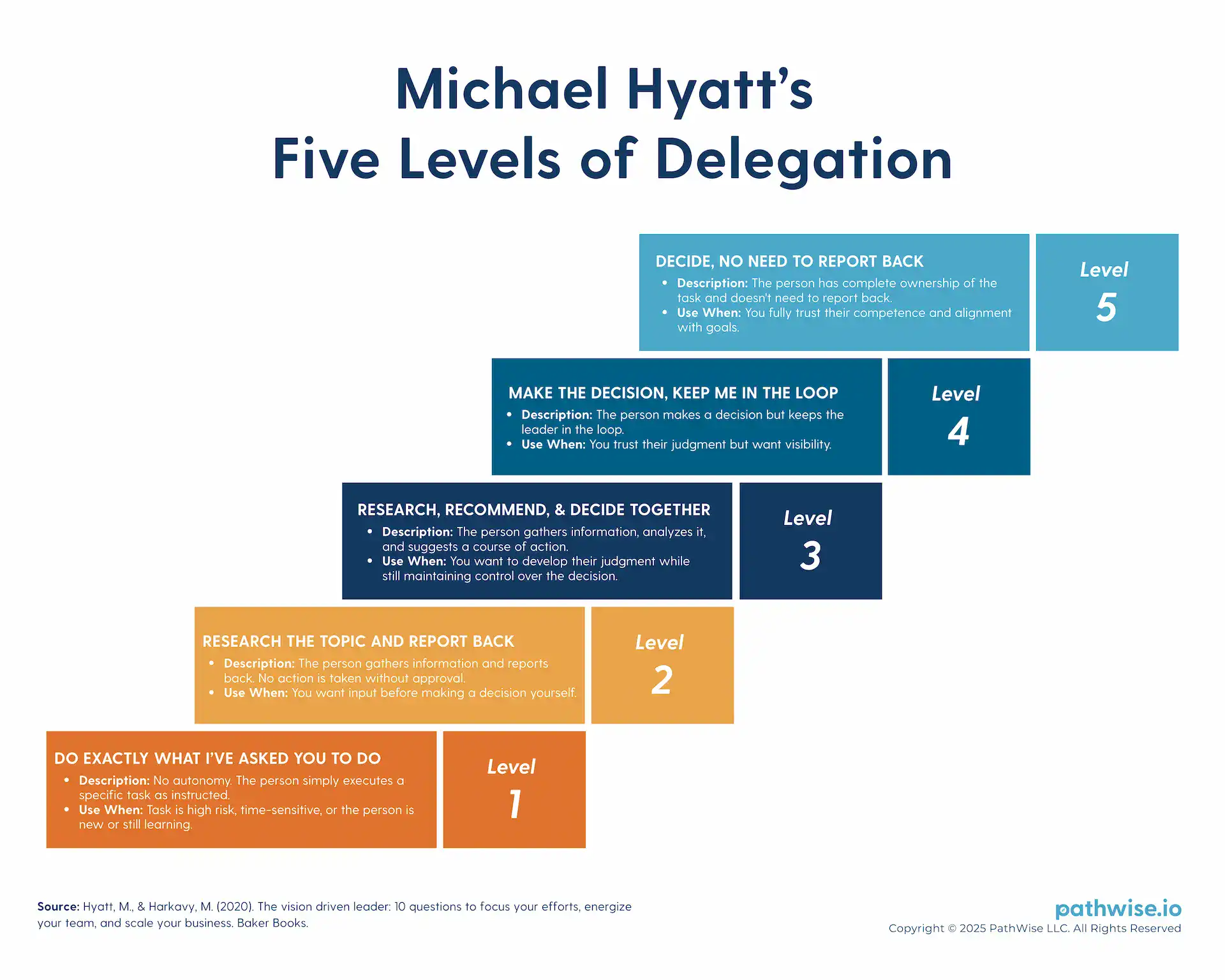
- Michael Hyatt’s 5 Levels of Delegation: Hyatt created a ladder of delegation that clarifies how much control a manager can hand over. When delegation fails, it’s often due to unclear expectations. This model gives both parties a shared understanding of authority and boundaries.
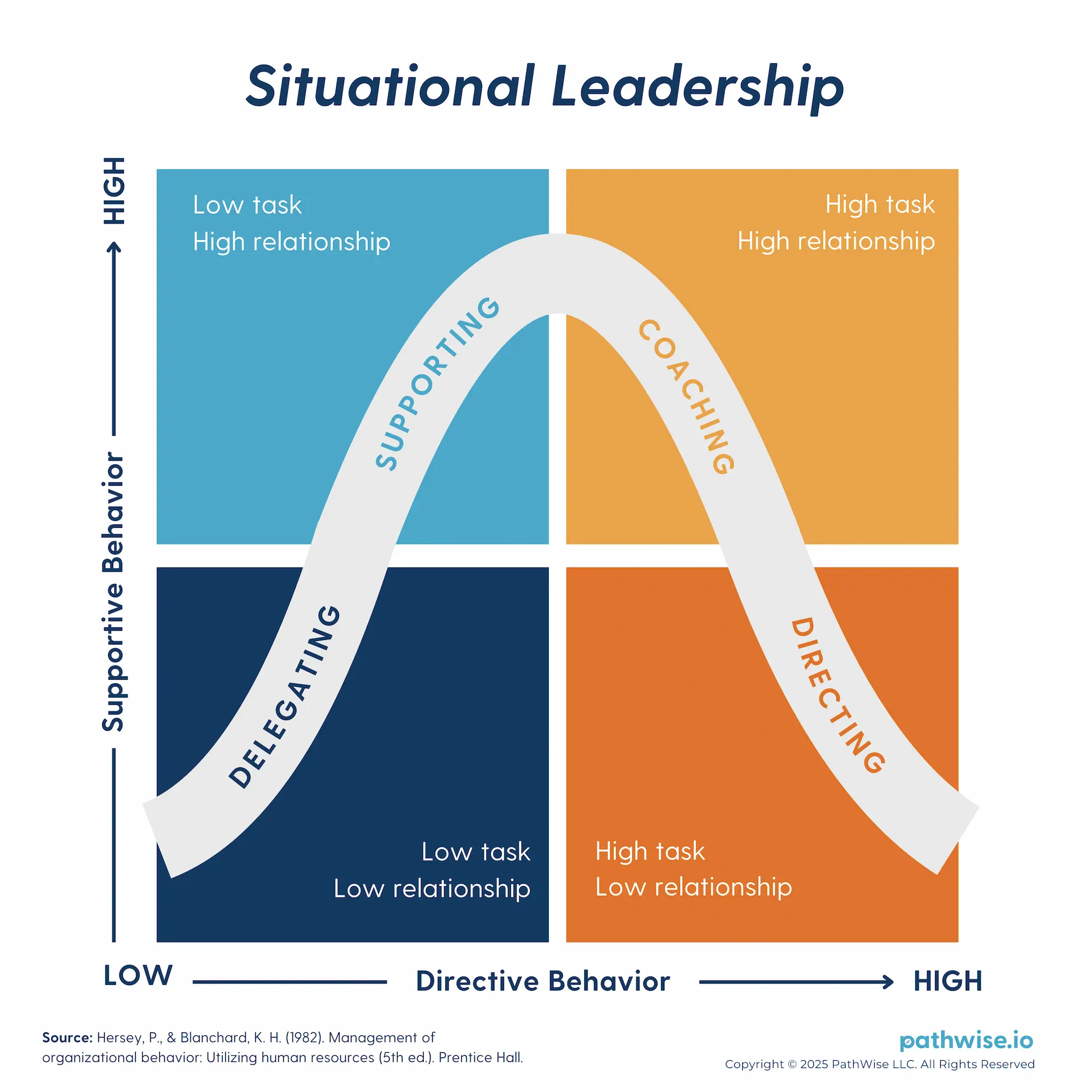
- Situational Leadership: This model encourages managers to adapt their delegation style based on a person’s competence and confidence. They can use a directing style with new or inexperienced employees, a coaching style as they build skill, support as they gain confidence, and full delegation when they can work independently.
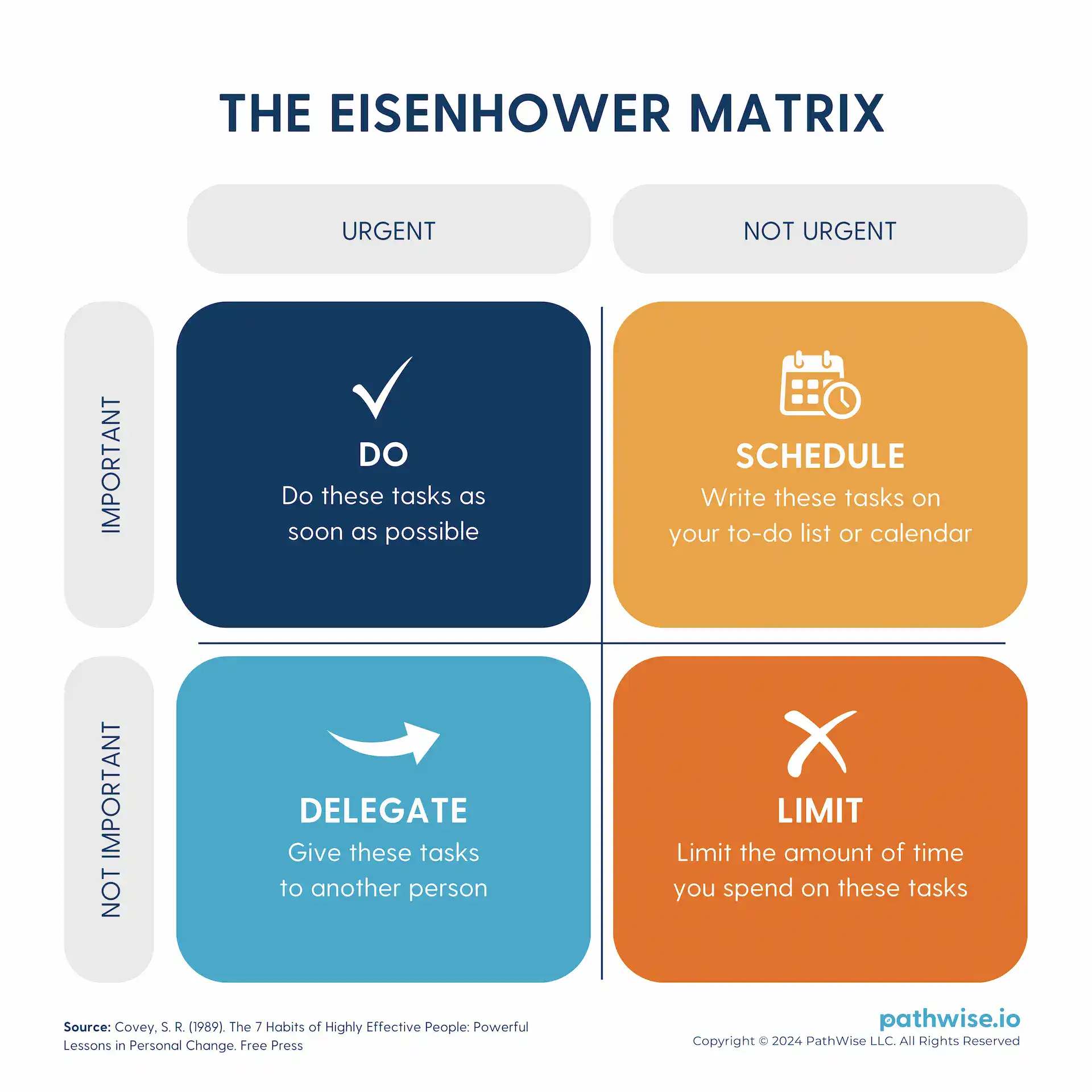
- The Eisenhower Matrix: This time-management tool sorts tasks by urgency and importance. Delegation comes into play in the “important but not urgent” quadrant—these tasks matter, but they don’t require your personal attention.
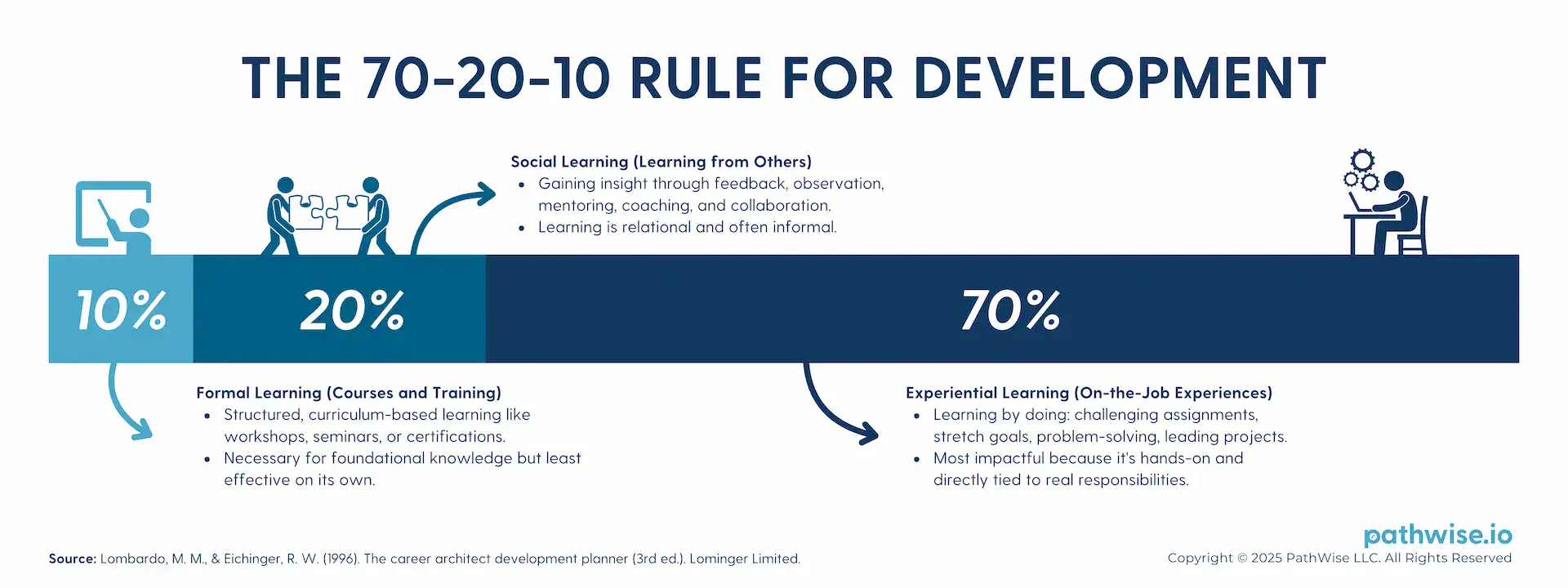
- The 70-20-10 Rule for Development: According to this model, 70% of learning happens through real-world experiences, like stretch assignments or delegated responsibilities, 20% through coaching and feedback, and 10% via formal training or education.
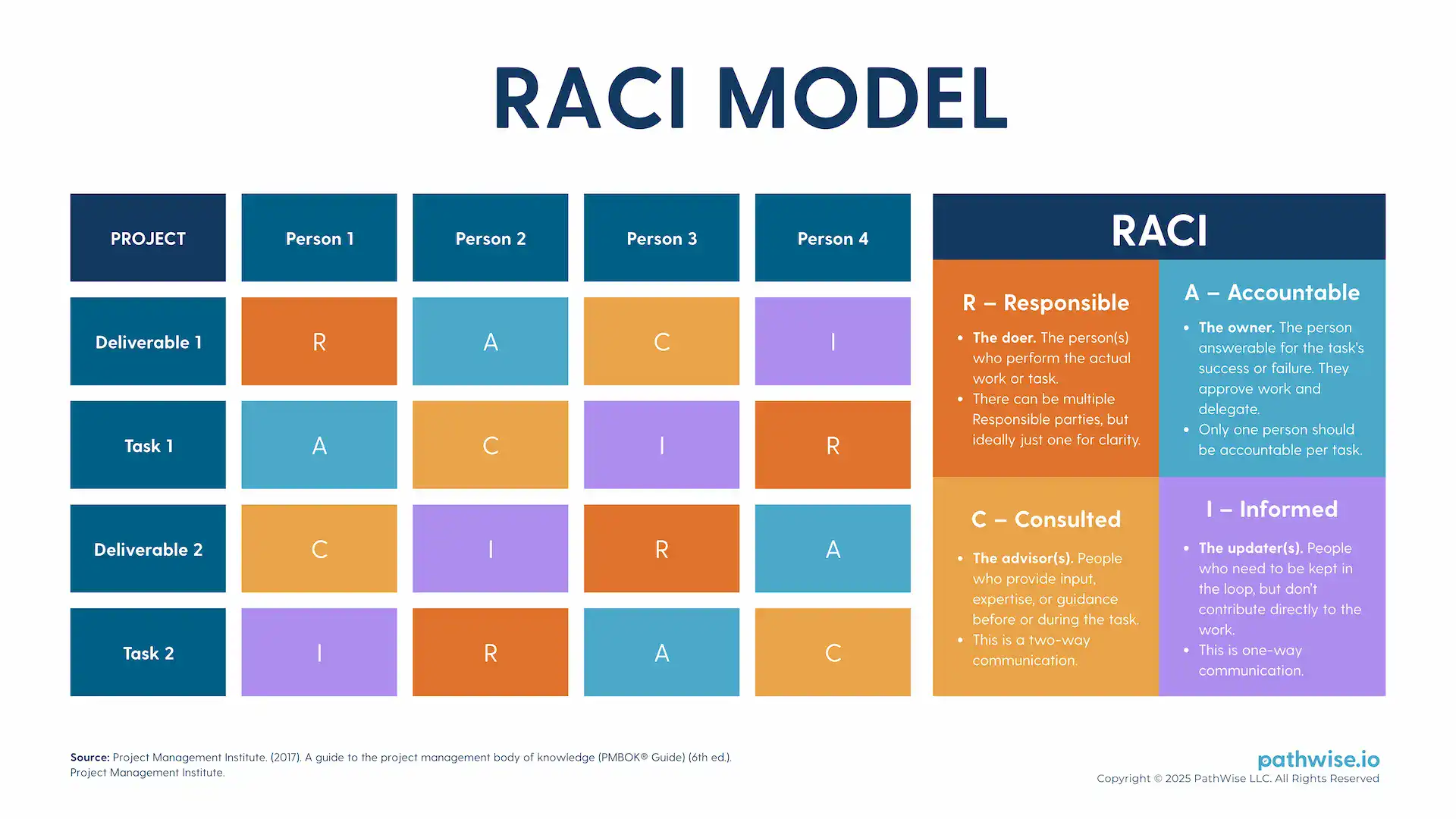
- The RACI Model: This is a role-clarity model that helps you break down a task or decision by identifying who will do the work (Responsible), own the outcome (Accountable), be consulted for input (Consulted), and be kept in the loop (Informed).
Delegation in Leadership
Delegating makes managers better leaders by helping them shift from doing the work to developing people. Specifically, delegating:
- Builds trust and empowerment: Delegation signals trust in team members’ abilities, which boosts morale, confidence, and ownership. A trusted team is more engaged and productive.
- Frees up strategic capacity: By handing off tasks, managers gain time and mental bandwidth to focus on higher-level thinking, long-term planning, and leading rather than reacting.
- Develops team capabilities: Delegation is a form of mentorship. When managers assign tasks thoughtfully, they give team members chances to grow, upskill, and step into more responsibility.
- Reveals leadership potential: Delegating allows managers to spot who handles pressure well, who problem-solves creatively, and who might be ready for a leadership role.
- Encourages humility and trust in others: Good leaders know they don’t have all the answers. Delegation cultivates a collaborative mindset and reduces micromanagement.
- Drives accountability and results: Effective delegation includes setting clear expectations and follow-ups. This strengthens a culture of responsibility and performance.

Image used under license from Shutterstock.com
Delegation in Professional Development
Delegating benefits both the manager and the team member. For team members, being trusted with responsibilities beyond their routine tasks accelerates growth. It allows them to build new skills, gain visibility, and expand their understanding of the business. When delegation is done thoughtfully—matching the task with the individual’s strengths and stretch areas—it challenges team members in a way that fosters confidence, autonomy, and a greater sense of ownership. This process often uncovers hidden talents and can clarify career interests, guiding future development paths.
For managers, delegation is equally developmental. Letting go of tasks pushes managers to refine their ability to assess talent, communicate expectations clearly, and coach others toward successful outcomes. These are foundational leadership skills. Delegation also forces a shift in mindset—from being the “go-to expert” to becoming an enabler of others’ success. This transformation is essential for leaders who want to scale their impact, manage larger teams, or move into more strategic roles, as they learn to prioritize, trust others, and lead through influence rather than control.
Ultimately, delegation strengthens the leadership pipeline at every level. It helps team members become more capable and confident, preparing them for future roles, while helping managers become more strategic and supportive leaders, equipped to handle greater scope and complexity. In environments where delegation is encouraged and done well, professional growth becomes a shared, continuous process.

Image used under license from Shutterstock.com
Conclusion
Think of delegation not as handing off tasks but handing over trust, responsibility, and the opportunity to grow. When done with intention, it’s one of the most powerful tools a manager has to cultivate talent, build a resilient team, and step fully into the role of a leader. Letting go can sometimes be hard. But if you delegate well, you lighten your load while lifting others up.
Other Resources
- PathWise Book Summary: The Coaching Habit
- PathWise Book Summary: Multipliers
- PathWise Book Summary: Turn the Ship Around!
- HBR: Learning to Delegate as a First-Time Manager
- HBR: To Be a Great Leader, You Have to Learn How to Delegate Well
- Forbes: How To Delegate Effectively
- Forbes: Let Someone Else Do It
