

Have you ever wondered why some organizations appear to scale seamlessly while others stumble despite having similar resources? The answer could lie in something other than tools or talent: capability.
Image used under license from Shutterstock.com
What is Capability?
Capability refers to the evolving ability of an organization, team, or process to perform a specific task or function reliably, effectively, and sustainably. A capability is a repeatable, measurable competency that contributes to achieving business or operational goals. The level of capability reflects the degree to which a particular process or function is defined, managed, optimized, and continuously improved. For example, software deployment might be episodic, manual and error-prone in an IT organization at a low capability level. At a high capability level, in contrast, it might be routine, automated and reliable. So, capability, rather than task completion, encompasses how well a task is done, how consistently, and how mature the supporting processes and structures are.
The key capability characteristics include:
- Defined Processes: Formalized procedures, standards, and guidelines that dictate how the capability is carried out.
- Measured Performance: The use of metrics and data to assess the capability’s effectiveness and efficiency.
- Controlled Execution: The management and monitoring of the capability to ensure it operates within set parameters and achieves expected outcomes.
- Continuous Improvement: The presence of feedback loops and learning mechanisms for the ongoing refinement and enhancement of the capability.
- Repeatability: The ability to perform the process or activity consistently and reliably across different people and situations.
- Scalability: The capacity of the capability to grow or adapt to meet broader or more complex organizational needs.
- Portability: The ability of the capability to be applied in other situations, enabling a company to derive additional benefits from it that go beyond the original use case.
- Maturity: The extent to which an organization consistently applies, standardizes, and constantly improves effective practices across its operations.
- Alignment with Goals: The meaningful contribution of the capability to business or operational objectives, ensuring its value.
Note that while capability refers to how well an organization can perform a specific task or achieve a particular outcome in one area of its work (having the necessary skills, processes, and resources to be good at something specific), maturity, is about how consistently and effectively those practices are applied across the entire organization and how committed the organization is to continuously improving them over time. A mature organization has a culture and infrastructure that supports consistently high performance and ongoing improvement in many areas. So, capability is about being good at something specific, while maturity is about consistently being good at many things and always striving to improve.

Image used under license from Shutterstock.com
Thought Leaders
Key thought leaders known for their work in capability maturity, organizational development, and process improvement include:
- Watts S. Humphrey: Known as the “father of software quality,” he developed the original Capability Maturity Model (CMM, see below) while at the Software Engineering Institute (SEI). He later created the Personal Software Process (PSP) and Team Software Process (TSP). His books, such as Managing the Software Process, laid the foundation for modern process maturity models.
- Mark C. Paulk: The lead author of the CMM for Software, he has written extensively on software process improvement and capability models. Paulk co-authored The Capability Maturity Model: Guidelines for Improving the Software Process, a foundational text for those working with CMM and Capability Maturity Model Integration (CMMI).
- Mary Poppendieck: A pioneer in Lean software development, she has helped organizations rethink capability through Lean principles. With her husband Tom Poppendieck, she co-authored Lean Software Developmentand Implementing Lean Software Development, both of which integrate continuous improvement into capability maturity thinking.
- Bill Curtis: A key architect of the People Capability Maturity Model (People CMM), he was a leader at SEI. Curtis has focused on human capital and organizational maturity, especially how workforce practices influence performance and scalability. His work bridges technical process maturity and human systems.
- Ken Schwaber: As a co-creator of Scrum, Schwaber has influenced how organizations think about adaptive capability in complex environments. Through his books, including Agile Project Management with Scrum, and his work at org, he has advanced maturity models suited for agile organizations.
- Carnegie Mellon University Software Engineering Institute (SEI) Team: The SEI team has produced some of the most widely adopted maturity models, including CMMI. The team continues to publish updates, research, and tools that help organizations assess and improve their capabilities across domains.
- Andrew Spanyi: An expert in business process management (BPM), he has written extensively on aligning process improvement with capability development. His book, Business Process Management is a Team Sport,emphasizes cross-functional collaboration as a maturity enabler.
Key Frameworks
Several frameworks help organizations assess, develop, and improve their capabilities in a structured way. These tools are often used to guide transformation efforts, benchmark performance, and align operations with strategic goals. Some of these models include:
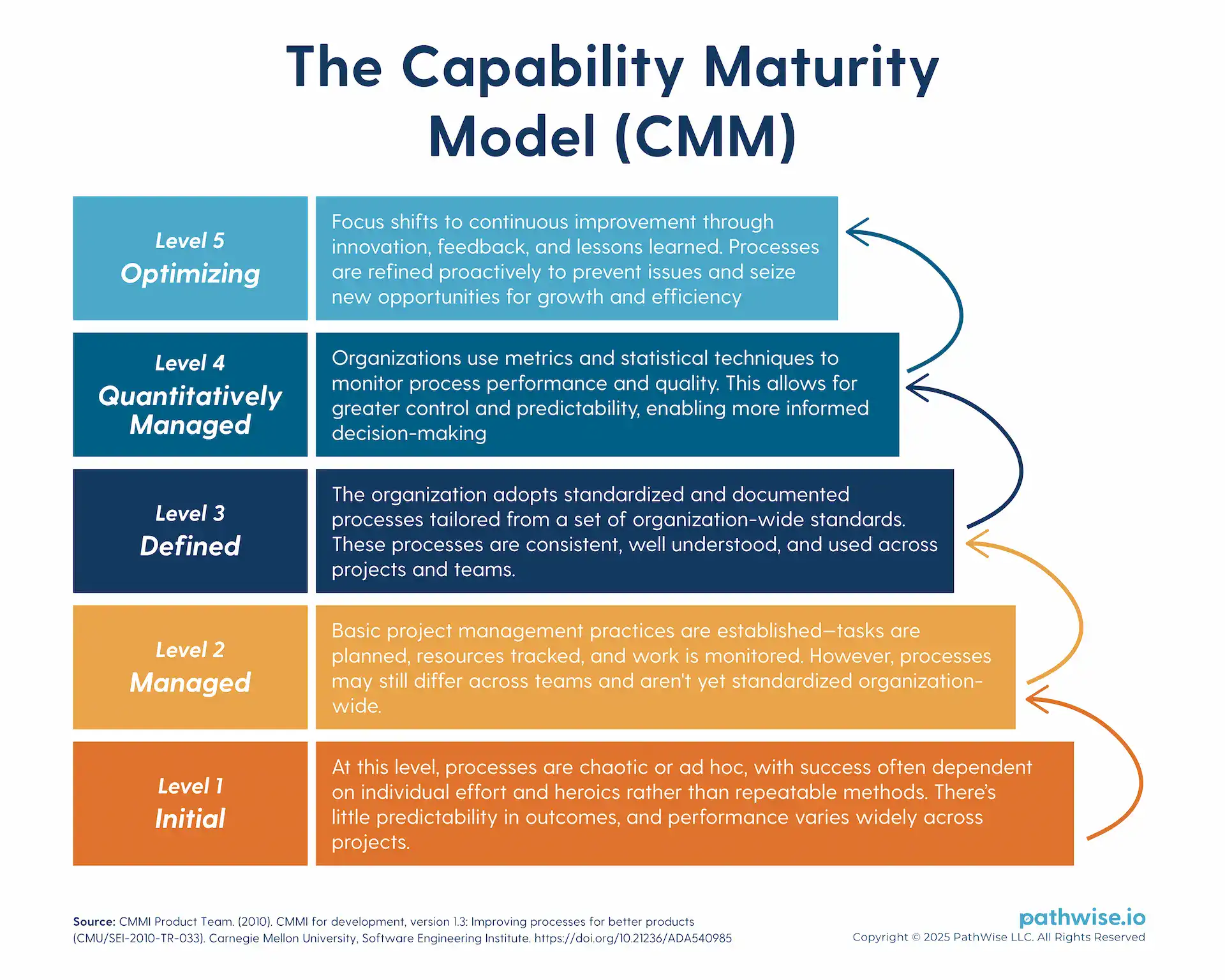
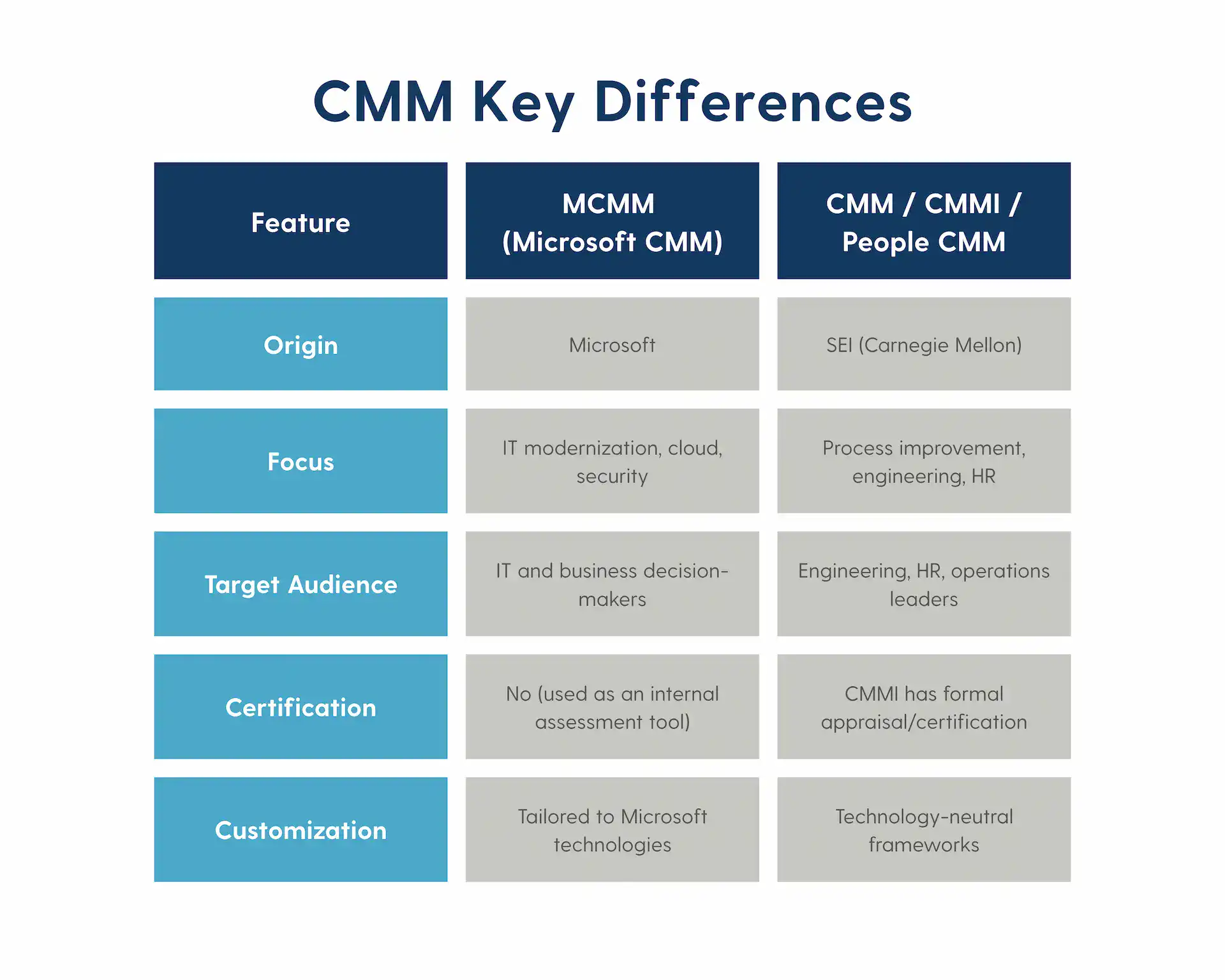
- Capability Maturity Model (CMM): Originally developed by the SEI at Carnegie Mellon University, CMM provides a framework for improving software development processes. It defines five maturity levels, from Initial (ad hoc) to Optimizing (continuous improvement), helping organizations assess and evolve their process capabilities.
- Capability Maturity Model Integration (CMMI): An evolution of the original CMM, CMMI integrates multiple maturity models into a single framework applicable beyond software, including systems engineering, services, and acquisition. It offers a structured approach to process improvement and is widely used in both government and industry.
- Business Process Maturity Model (BPMM): The BPMM is a model for assessing and improving business process capabilities across the enterprise. It aligns closely with Six Sigma and Lean principles and is used to foster operational excellence, efficiency, and agility.
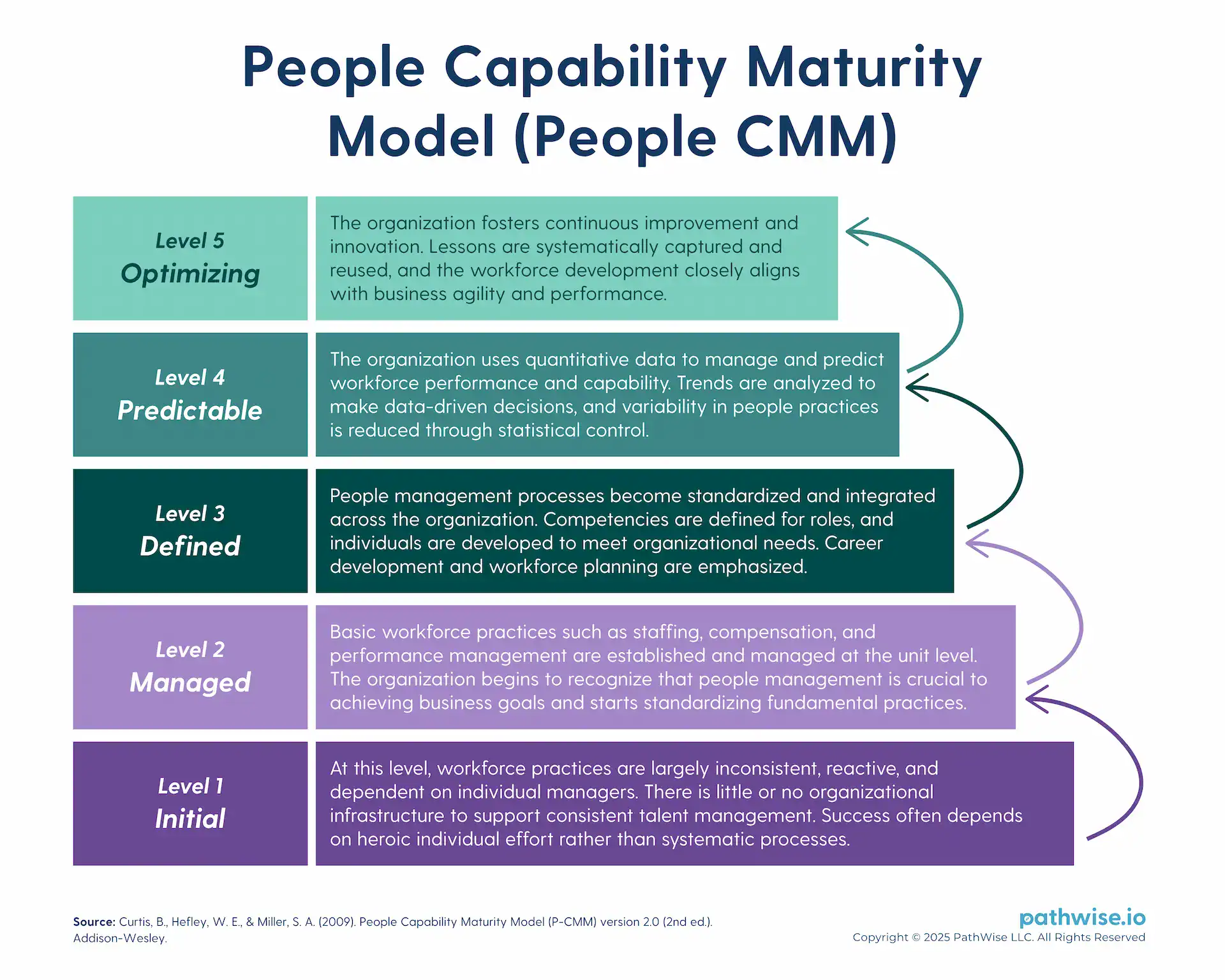
- People Capability Maturity Model (People CMM): Also developed by SEI, the People CMM focuses on the maturity of workforce management and development. It helps organizations systematically improve their human capital capabilities across levels such as staffing, performance, and training.
- TOGAF Capability Framework: Part of The Open Group Architecture Framework (TOGAF), this model defines enterprise capabilities as structured, reusable components of business architecture. It helps organizations assess, prioritize, and develop the capabilities needed to execute their strategic goals.
- Dynamic Capabilities Framework: Introduced by David Teece and colleagues, this academic model focuses on an organization’s ability to integrate, build, and reconfigure internal and external competencies in rapidly changing environments. It’s especially relevant for innovation and strategic agility.
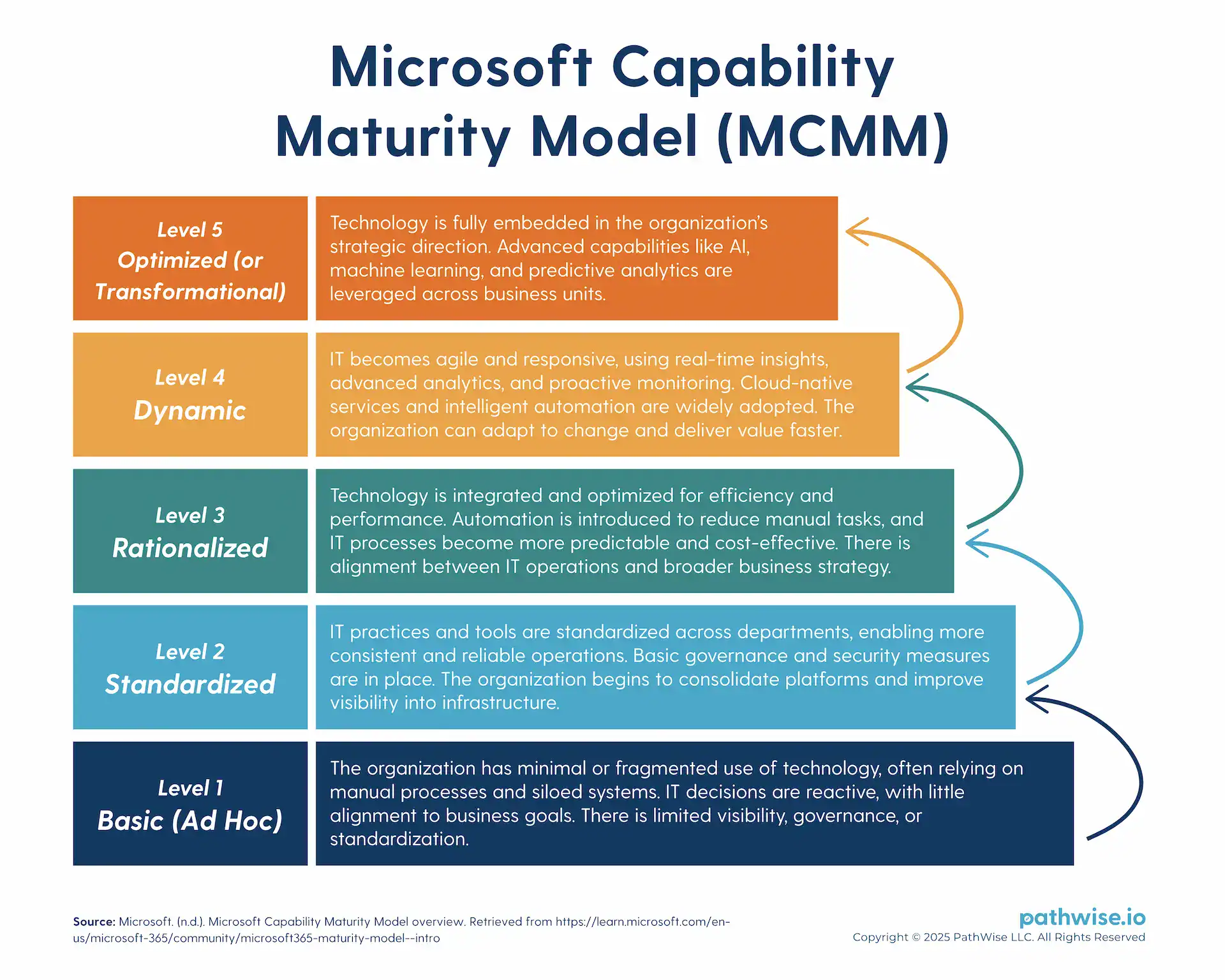
- Microsoft Capability Maturity Model (MCMM): A less formal but widely used model in IT consulting, MCMM was created to help organizations assess their technological and operational maturity in domains such as security, service management, and digital transformation.
Capability maturity frameworks exist for other aspects of business as well, such as in data management.
Capability in Leadership
Capability is deeply intertwined with management because it defines what an organization or team can reliably and effectively do. Understanding and developing capabilities—technical, operational, or human—enables managers to align resources, set realistic goals, and deliver consistent results.
Also, a manager who embraces capability thinking can become a more strategic and proactive leader. Rather than simply reacting to problems, they can focus on building repeatable strengths: improving processes, developing team skills, and using data to guide decisions. This approach fosters a culture of continuous improvement and resilience. It also enhances credibility, as others begin to see the manager not just as someone who gets things done, but as someone who builds lasting systems and empowers others to succeed.
Ultimately, leading with a capability mindset helps managers move from tactical execution to transformational leadership, shaping environments where people and performance thrive over the long term.

Image used under license from Shutterstock.com
Capability in Personal Development
Regarding professional development, capability serves as both a roadmap and a growth engine. It helps us identify the skills, behaviors, and knowledge we need to consistently perform at higher levels of responsibility and impact. Additionally, learning and embracing capability maturity transforms professional development from a potentially ad-hoc and reactive endeavor into a more strategic, focused, and impactful journey. It empowers us to take ownership of our growth, contribute more effectively to our organizations, and ultimately achieve greater professional success. More specifically, capability impacts development by:
- Allowing Self-Assessment and Growth: Capability maturity models outline distinct stages of development, allowing us to assess our current level of competence and the maturity of the processes we are involved in. And, by understanding the characteristics of higher maturity levels, we can pinpoint specific skills, knowledge, and behaviors we need to develop to advance professionally. This provides a clear roadmap for growth, moving beyond vague aspirations to concrete focus areas.
- Enhancing Skills and Knowledge: Embracing a capability mindset encourages us to seek out learning opportunities that directly address the gaps identified during self-assessment or organizational capability assessments. This leads to more focused and impactful professional development activities, such as targeted training, certifications, or mentorship. In addition, understanding capability maturity often requires learning about best practices, standardized processes, and quality management principles. This can broaden our perspective beyond our immediate tasks and help us understand how our work fits into the larger organizational context.
- Fostering a Proactive and Improvement-Oriented Mindset:The emphasis on continuous improvement in capability models can cultivate a lifelong learning and adaptation mindset. We can become more receptive to feedback, actively seek ways to enhance our skills and processes, and embrace change as a positive growth driver. It also strengthens problem-solving skills. So, we can learn to analyze situations systematically, identify underlying issues, and implement sustainable solutions.
- Improving Collaboration and Communication:Capability models often introduce a common vocabulary and understanding of processes and performance. This facilitates more effective communication and collaboration within teams and across departments, as everyone works towards a shared understanding of “how well” things should be done. As processes become more defined and managed, individual roles and responsibilities become clearer. This reduces ambiguity, improves accountability, and fosters more effective teamwork.
- Increasing Professional Value and Recognition: As we develop skills aligned with higher capability levels, we become more valuable to the organization. This can open doors to more challenging roles, leadership opportunities, and career advancement. Additionally, those who embrace a mindset of continuous improvement and are adept at working within well-defined yet adaptable processes are more resilient and better equipped to navigate new challenges.

Image used under license from Shutterstock.com
Conclusion
No organization becomes high-performing by accident. It requires deliberate investment in people, processes, and systems. A maturity model is one of the most effective tools for identifying what’s holding yours back and what will move you forward. Start where you are. Measure what matters. Build capabilities that last.
