


Imagine you’re on a ship, letting the ocean tides determine your course while you stand at the helm, hands off the wheel. That’s how many people move through their careers—drifting from one role or opportunity to the next without a clear sense of direction. But careers, like ships, are easier to steer when you’re actively navigating. Taking hold of the helm means asking where you want to go and how you’ll get there. One practical way to do this is by creating a learning agenda—a simple but structured approach to identifying what you need to learn to grow, adapt, and move forward with purpose.

Image used under license from Shutterstock.com
What is a Learning Agenda?
A learning agenda is a structured plan that outlines key questions an organization, team, or individual wants to answer to improve their work, strategies, or understanding of a specific topic. It defines what needs to be learned, why it matters, and how the information will be gathered and applied. Learning agendas are especially common in government, nonprofits, research, international development, and mission-driven organizations, but they are becoming more widely used in business and education, too.
At its core, a learning agenda helps shift thinking from simply executing tasks to continuous improvement and evidence-based decision-making.
The key components of a learning agenda include:
- Priority Questions: These are the critical questions that, if answered, would help improve strategy, programs, or operations. They usually focus on things like effectiveness, efficiency, equity, scalability, or impact.
- Purpose and Use: This explains why answering each question matters and how the answers will influence future work.
- Learning Activities: These are the methods used to gather insights, such as research, data analysis, literature reviews, pilot programs, interviews, or evaluations.
- Stakeholders: This includes the people who need to be involved, such as decision-makers, practitioners, researchers, and beneficiaries.
- Timeline and Responsibilities: This refers to a rough schedule for when activities will happen and who is accountable for each part of the work.
Why Use a Learning Agenda?
Using a learning agenda helps create a structured path for meaningful improvement. More specifically, organizations and teams benefit from developing one by:
- Focusing Learning: A learning agenda helps prioritize the most important knowledge gaps to close.
- Aligning Teams: A learning agenda creates shared goals and understanding around learning and improvement.
- Informing Decisions: An agenda ensures that any learned insights are used to refine strategy or operations.
- Building a Culture of Curiosity: A learning agenda encourages experimentation and open-mindedness, fostering innovation and growth.

Image used under license from Shutterstock.com
Thought Leaders
Several thought leaders, known for their contributions to the use and promotion of learning agendas, provide resources that help evidence-based decision-making and organizational learning. Some of the most notable ones include:
- Ruth Levine: The former director of the Global Development and Population Program at the William and Flora Hewlett Foundation, she’s an economist and development expert who has been a strong advocate for evidence-informed policy and organizational learning in philanthropy and global development. Under her leadership, the Hewlett Foundation advanced the use of learning agendas across grantees and sectors.
- Dave Snowden: Founder of Cognitive Edge and creator of the Cynefin Framework, he specializes in complexity science and its application to organizational decision-making and learning.
- Michael Quinn Patton: A pioneer in developmental evaluation and founder of Utilization-Focused Evaluation, he advocates for evaluation that directly informs decision-making and adapts to real-time learning needs. He is the author of Developmental Evaluation and Utilization-Focused Evaluation, both of which align with the principles behind learning agendas.
- Amy C. Edmondson: The Novartis Professor of Leadership and Management at Harvard Business School, she is known for her work on psychological safety within teams and organizations. In her recent book, The Right Kind of Wrong, she introduces a framework of three failure types: basic, complex, and intelligent. Notably, she argues that intelligent failure, driven by curiosity and experimentation, is crucial for fostering learning and innovation.
- Gerd Gigerenzer: Director of the Harding Center for Risk Literacy at the University of Potsdam and former Director at the Max Planck Institute for Human Development, his research focuses on decision-making under uncertainty and the use of heuristics—simple rules or mental shortcuts that people use to make decisions. His work has implications for how organizations design learning agendas that are adaptable and responsive to real-world complexities. He is the author of Risk Savvy: How to Make Good Decisions, which discusses how individuals and organizations can make better decisions by understanding and embracing uncertainty.
Key Frameworks
Several frameworks support the development of learning agendas or are highly relevant to fostering organizational learning, decision-making, and adaptive strategies. Some of the most notable ones include:
- Double-Loop Learning: Developed by Chris Argyris & Donald Schön, this framework suggests that, beyond simply fixing errors (single-loop), organizations need to question underlying assumptions, values, and strategies. It encourages deeper reflection and culture change, making it a powerful complement to learning agendas. This framework supports the idea that real learning comes not from doing things right, but from asking whether we’re doing the right things.
- Single-loop learning: This occurs when individuals or organizations detect and correct errors without altering the underlying governing variables (e.g., policies, values, strategies). For instance, an organization can adjust actions to meet a goal but not question whether the goal itself is appropriate.
- Double-loop learning: Learning goes deeper. It involves questioning and potentially changing the underlying assumptions, goals, or values that led to the action in the first place. This allows for transformational change rather than just incremental improvements.
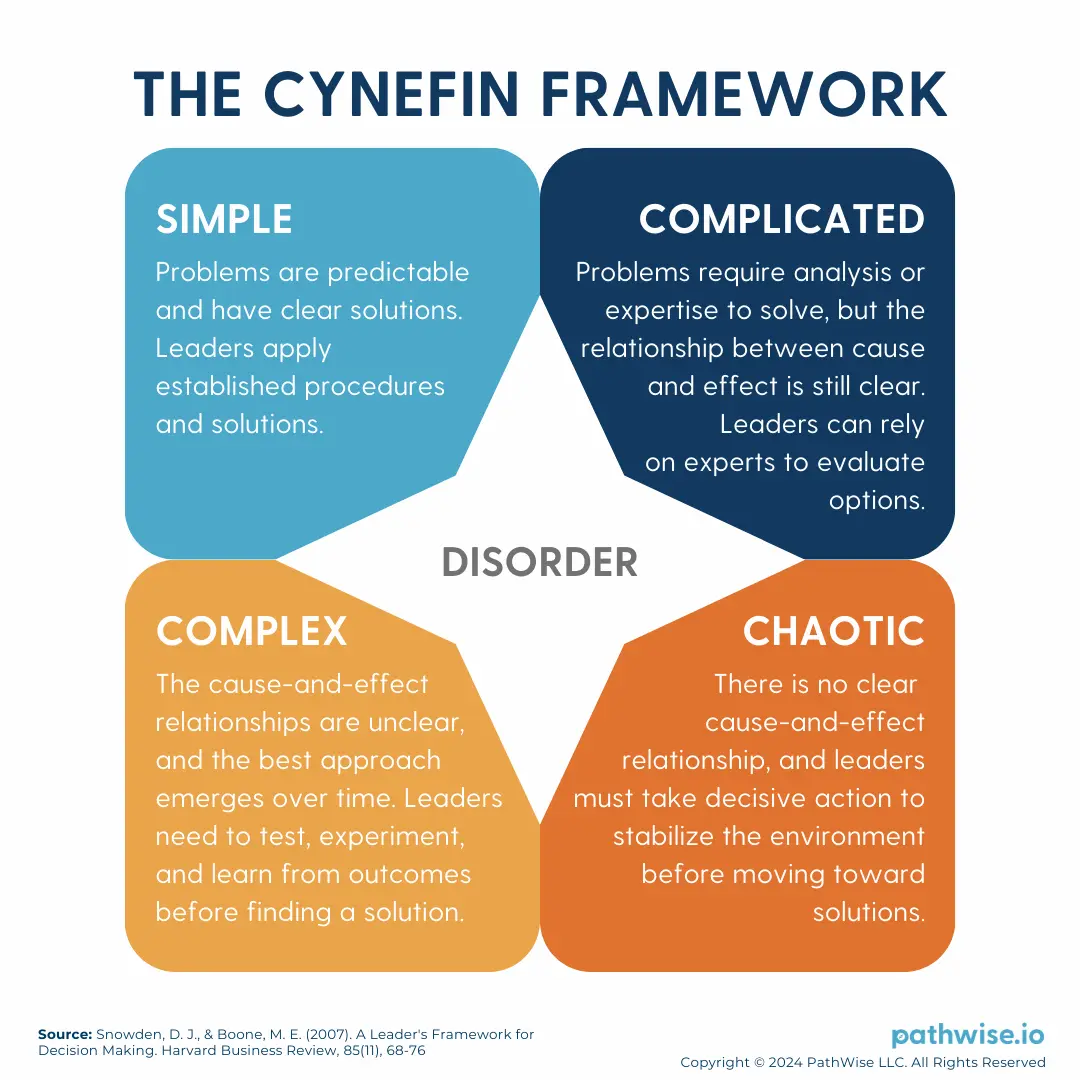
- Cynefin Framework: This framework helps leaders make sense of complex problems by categorizing situations into five domains: clear, complicated, complex, chaotic, and aporetic (confused). It helps understand how different types of problems require different responses. For learning agendas, this framework encourages adaptive learning and experimentation, especially in complex or uncertain environments.
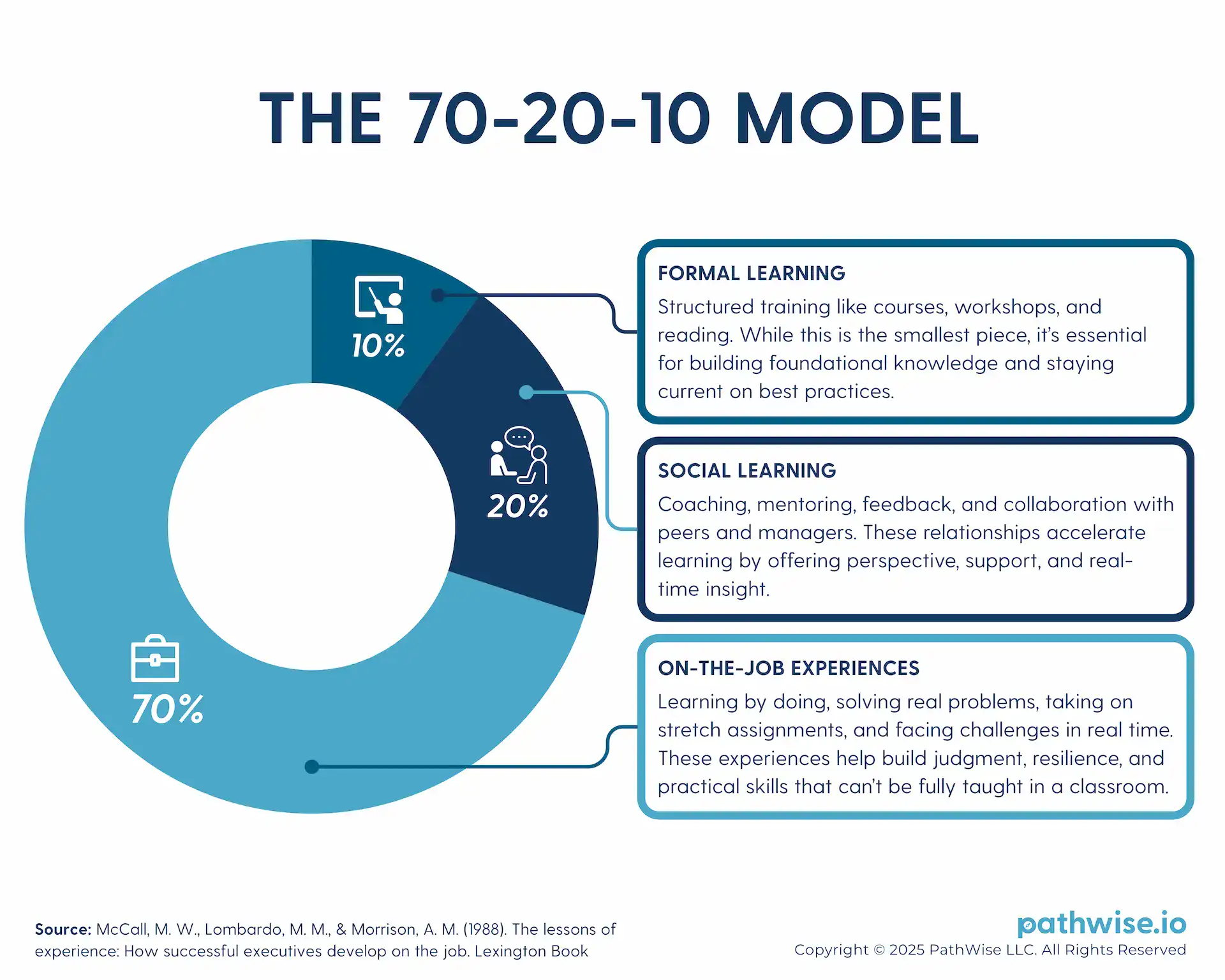
- The 70-20-10 Model for Learning and Development: This model suggests that 70% of learning comes from on-the-job experiences, 20% from interactions with others (coaching, mentoring), and 10% from formal training. It highlights the importance of experiential and social learning, which is crucial when implementing a learning agenda. Organizations using this model often structure their agendas to encourage reflection on work, peer learning, and targeted upskilling.
- Learning Organization: Introduced in The Fifth Discipline by Peter Senge, this model defines a learning organization as one that continuously transforms itself through systems thinking, shared vision, personal mastery, team learning, and mental models. Learning agendas fit naturally within this paradigm, serving as a mechanism for identifying learning needs, aligning them with strategy, and fostering a culture of curiosity and innovation.
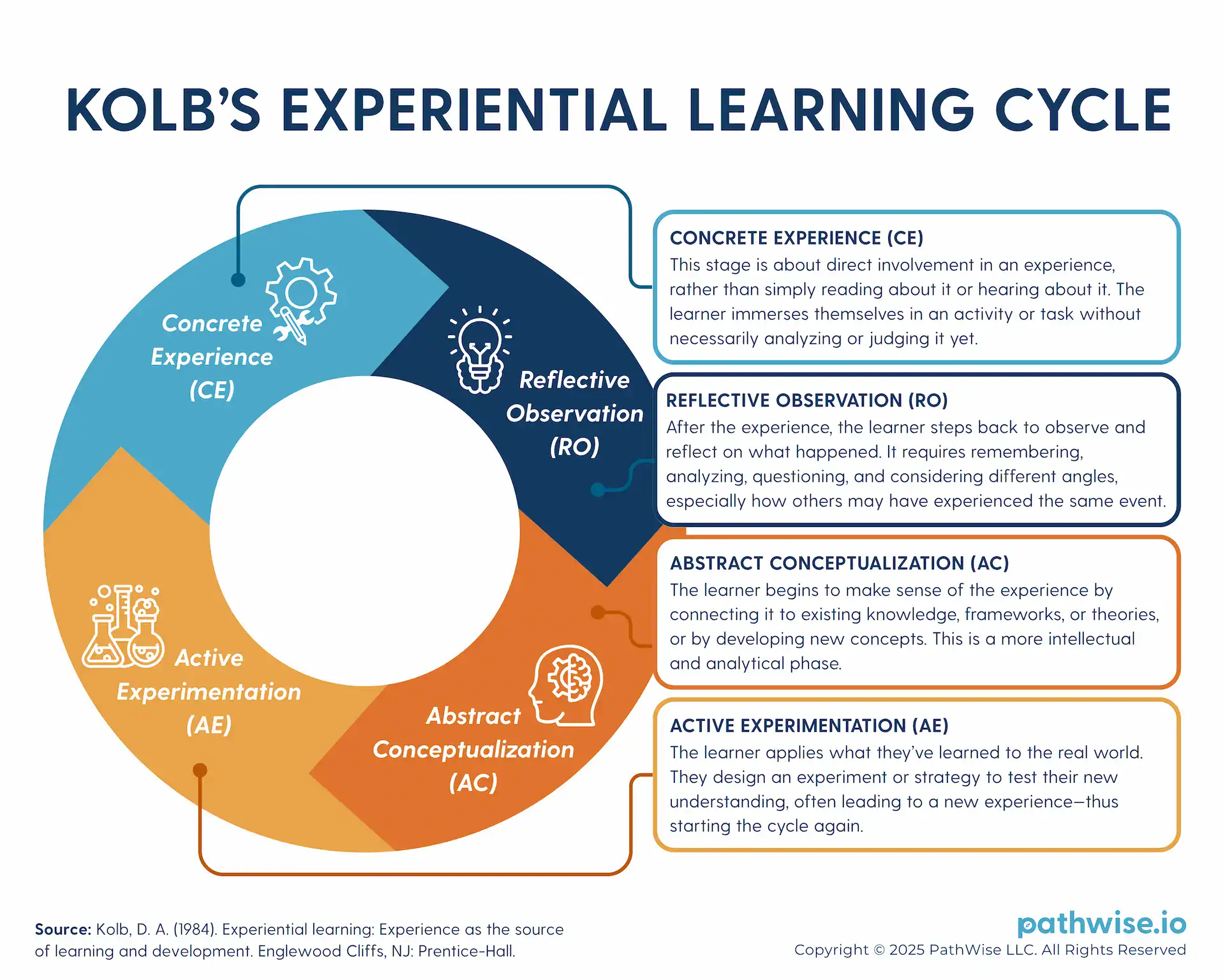
- Experiential Learning Cycle: Created by David Kolb, this model outlines four stages of learning: concrete experience, reflective observation, abstract conceptualization, and active experimentation. It supports learning agendas by offering a practical process for turning experiences into insights and actions. Teams can structure agenda activities to follow this cycle, ensuring that learning is iterative and grounded in real-world practice.
- Outcome Mapping: Primarily used in international development, this model focuses on behavior changes in boundary partners (those whom an initiative seeks to influence). It emphasizes continuous learning, monitoring, and adaptation—key components of a learning agenda. The framework encourages reflection on both intended and unintended changes, helping organizations refine strategy in complex environments.
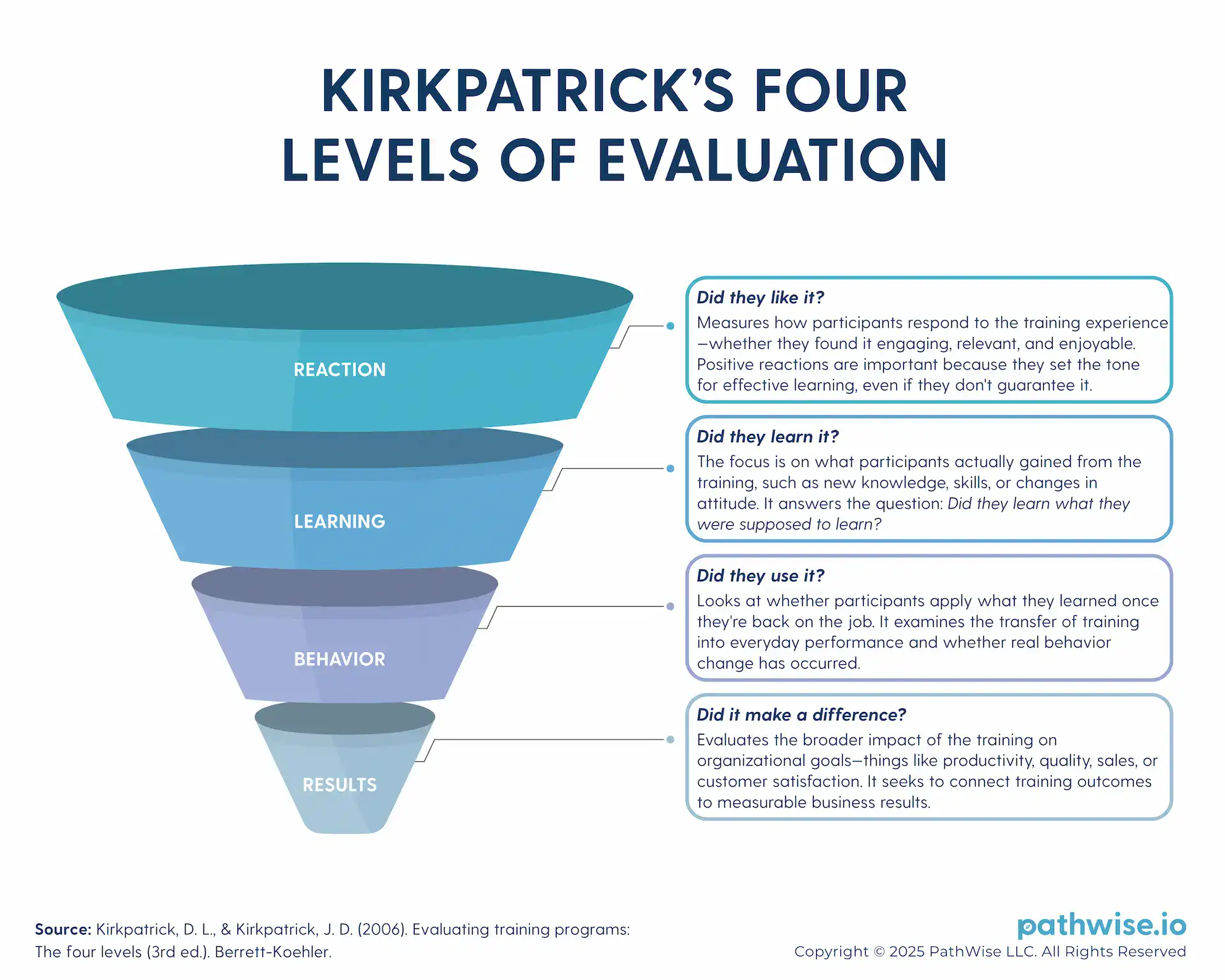
- Four Levels of Evaluation: Developed by Donald Kirkpatrick, this framework, which is often used in training and development, evaluates learning in four stages: reaction, learning, behavior, and results. It helps assess the effectiveness of learning activities tied to a learning agenda. Organizations can align their learning efforts more closely with strategic goals by evaluating whether people liked a training and whether it changed behavior and outcomes.
Learning Agendas in Leadership
Learning agendas make managers better leaders by shifting their mindset from execution-focused to learning-oriented. Instead of only driving toward immediate goals, managers using learning agendas actively seek to understand why certain strategies work, what could be improved, and how their team can adapt and grow. This positions them as strategic thinkers who promote innovation, reflection, and continuous improvement.
More specifically, learning agendas elevate leadership by:
- Fostering curiosity and humility: Managers acknowledge they don’t have all the answers and model a learning mindset, which builds trust and psychological safety.
- Cultivating more thoughtful decision-making: By grounding choices in learning questions and evidence, leaders avoid guesswork and increase strategic clarity.
- Building team alignment and engagement: Involving the team in shaping learning questions gives everyone a stake in improving outcomes.
- Supporting adaptability: Learning agendas help managers lead through uncertainty by continuously testing and refining approaches.
- Reinforcing a culture of growth: Leaders who embrace learning agendas signal that growth is ongoing—not just for the team, but for themselves too.

Image used under license from Shutterstock.com
Learning Agendas in Professional Development
Learning agendas serve as frameworks for those looking to manage their careers with intention. At their core, learning agendas encourage us to ask meaningful questions about our professional growth: What skills do I need to develop? What knowledge gaps are holding me back? What do I need to learn to move into my next role or pivot into a new field? By asking ourselves these questions explicitly and setting a plan to answer them, we can take control of our learning and stay aligned with our long-term goals.
This approach is especially helpful in job roles that evolve quickly and where new technologies or practices emerge constantly. Instead of reacting to change, a personal learning agenda helps us stay proactive, track trends, identify skills to build, and experiment with new ways of working. It also encourages reflection: What worked well in that last project? What would I do differently next time? These reflective habits are a foundation of lifelong learning and adaptability.
Learning agendas also enhance professional development by making growth visible. When we document what we have learned through stretch assignments, mentorship, training, or even failure, we create a narrative of continuous improvement that’s valuable for performance reviews, promotions, and job interviews. Over time, a well-maintained learning agenda evolves into a career roadmap, providing a sense of direction, purpose, and confidence as we navigate our career journeys. However, it also serves as a key tool for identifying, pursuing, and attaining career development opportunities.
Image used under license from Shutterstock.com
Conclusion
Managing our careers requires us to stay curious, set our direction, and learn along the way. A learning agenda gives shape to that process. It helps us focus not just on what’s next, but on how to grow into it, as a learning agenda can keep you moving with intention rather than drifting with the tide. And over time, those small, steady learning efforts can become the clearest sign that you’re at the helm of your own path.
Other Resources
