

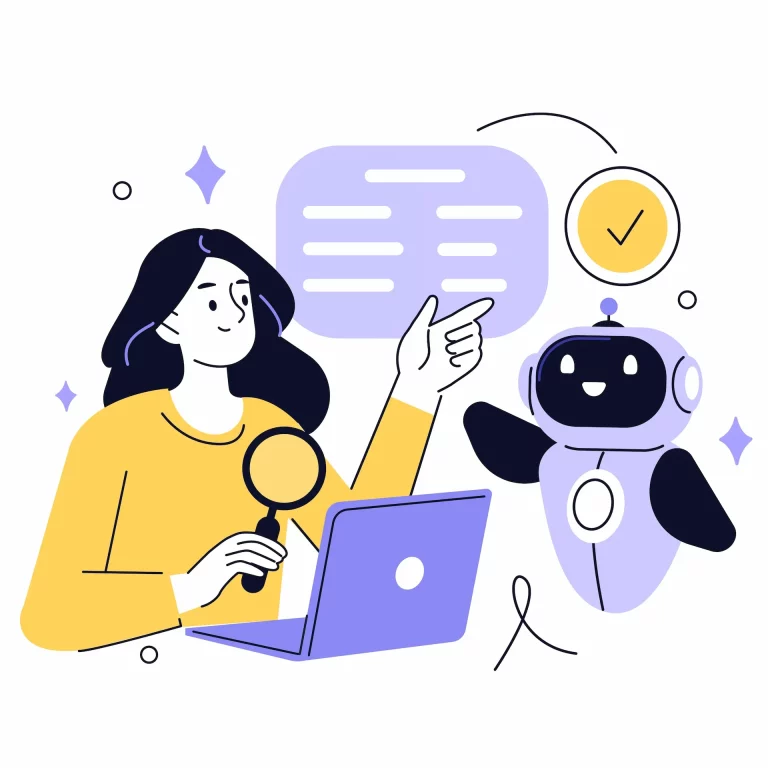
Imagine stepping into the cockpit of your career with a new co-pilot sitting beside you. This co-pilot doesn’t replace you or take the controls from your hands—but it does offer constant navigation tips, highlight unseen obstacles, and suggest faster routes. That’s what Artificial Intelligence (AI) is becoming for today’s professionals: a real-time career co-pilot helping you navigate smarter, faster, and with greater insight.
AI is no longer a futuristic concept—it’s here, and it’s transforming the way we work across virtually every industry.

Image used under license from Shutterstock.com
What is the Impact of AI on Your Career?
One of the most immediate and visible effects of AI on almost anyone’s career is task automation. AI-powered tools are taking over repetitive, time-consuming activities like data entry, scheduling, customer service chat support, and basic reporting. This means that many roles focused on routine work are being redefined, or in some cases, phased out.
However, automation offers a silver lining: job evolution. Those who once spent large parts of their day on low-value tasks are now being freed up to focus on more strategic, creative, and interpersonal work.
AI also enhances human abilities. Tools like AI-powered analytics platforms, large language models, and design software can help us make better decisions, communicate more effectively, and innovate faster. For example,
- Marketers are using AI to analyze customer data and personalize campaigns.
- Financial analysts are using AI-driven forecasting tools to spot trends and risks.
- Healthcare professionals are using AI-assisted diagnostics to improve patient care.
Given that AI is here to stay, success will be more likely among those who know how to leverage AI tools to amplify their expertise. Beyond that, because AI is actively reshaping job roles, the skills employers value are changing as well. Technical skills like data analysis, machine learning, and AI programming are in high demand. At the same time, AI is creating entirely new job categories. Roles like AI Trainer, Prompt Engineer, AI Ethicist, and Human-AI Interaction Designer didn’t exist a few years ago, yet they’re now emerging across industries. Even traditional roles are evolving with an AI twist—for example, project managers are being asked to oversee AI implementation projects, and HR professionals are learning how to use AI for talent acquisition and workforce planning.
However, non-technical skills like critical thinking, problem-solving, and adaptability are equally, if not more, important to foster, as they’re not easily replaceable by AI. Despite its strengths, AI still lacks human emotional intelligence, creativity, and ethical judgment. While it can analyze data or suggest solutions, it can’t build trust, inspire teams, decide based on key values, or think with empathy. This is why roles that require nuanced human interaction—such as leadership, motivation, negotiation, and relationship management—will remain highly valuable. These roles rely on qualities that are uniquely human and difficult, if not impossible, to automate.
How to Stay Relevant in the Era of AI
AI is changing the nature of work, but it doesn’t have to threaten your career. By staying adaptable, committing to continuous learning, and focusing on the skills AI can’t replicate, you can not only stay relevant but thrive. Leaning into your uniquely human strengths—such as creativity, empathy, and strategic thinking—will give you a strong and lasting advantage. To do so,
- Stay curious:Keep up with trends in AI and your industry.
- Build digital literacy:Even basic familiarity with AI tools will set you apart.
- Invest in soft skills:Communication, leadership, and emotional intelligence will matter more than ever.
- Adopt a growth mindset:Be open to change, willing to learn new skills, and ready to pivot when needed.

Image used under license from Shutterstock.com
Thought Leaders
Several experts have dedicated their work to analyzing the effects of AI in the workplace and organizational evolution, while others advocate and work for its progress. Some of these thought leaders include:
- Erik Brynjolfsson: An economist and professor at Stanford University, where he directs the Digital Economy Lab, he has extensively studied how digital technologies, especially AI, impact productivity, employment, and the future of work. He is co-author of The Second Machine Ageand Machine, Platform, Crowd, which explore how AI and automation are reshaping business and labor markets.
- Kai-Fu Lee: An AI investor and former Google China president, he is the author of the bestselling book AI Superpowers: China, Silicon Valley, and the New World Order. In his work, Lee discusses how AI will transform industries, displace certain job categories, and create opportunities for new human-centered roles. He emphasizes the growing need for empathy-driven and creative professions as automation takes over repetitive tasks.
- Andrew Ng: An AI expert, founder of AI, and co-founder of Coursera, he is a former leader of Google Brain and Chief Scientist at Baidu. Through his online courses and work with AI-focused education programs, Ng has played a major role in helping people upskill for the AI era. His public talks and writings, including his popular AI for EveryoneCoursera course, focus on how non-technical professionals can understand, adapt to, and work alongside AI.
- Mary Gray: A Senior Principal Researcher at Microsoft Research and an Associate Professor at Indiana University, she is co-author of Ghost Work: How to Stop Silicon Valley from Building a New Global Underclass, a book that sheds light on the often-invisible human labor that powers many AI systems behind the scenes (e.g., data labeling, content moderation). Gray’s work highlights ethical considerations and labor issues emerging from the gig-like, freelance jobs supporting AI infrastructure.
- Tom Davenport: A professor of IT and Management at Babson College and a fellow at the MIT Initiative on the Digital Economy, he is known for helping business leaders understand how AI and analytics affect organizational strategy and human work. His book The AI Advantage: How to Put the Artificial Intelligence Revolution to Workfocuses on how companies can integrate AI in ways that complement and enhance human roles rather than replace them.
- Daniel Susskind: An economist, researcher, and author specializing in the future of work, his book A World Without Work: Technology, Automation, and How We Should Respondexplores how AI and automation are changing labor markets and what policymakers and individuals can do to prepare. Susskind draws on economic research to discuss both the risks of job displacement and the opportunities for societal reinvention in response to AI-driven change.
- Cathy O’Neil: A data scientist, she is the author of Weapons of Math Destruction: How Big Data Increases Inequality and Threatens Democracy. While her primary focus is on the ethical risks of algorithms, her work is highly relevant for career discussions as it addresses how AI-driven systems impact hiring, performance evaluations, and workplace decision-making.

Image used under license from Shutterstock.com
Key Frameworks
Several frameworks can help you better understand the effects of AI in the workplace and embrace its benefits to improve your career journey. Some of these models include:
- McKinsey’s Skill Shift Framework: This framework analyzes how demand for different skill categories—physical/manual, basic cognitive, higher cognitive, social/emotional, and technological—will change over time due to automation and AI. The framework emphasizes the growing need for technological, cognitive, and interpersonal skills, offering a useful guide for future-proofing our careers.
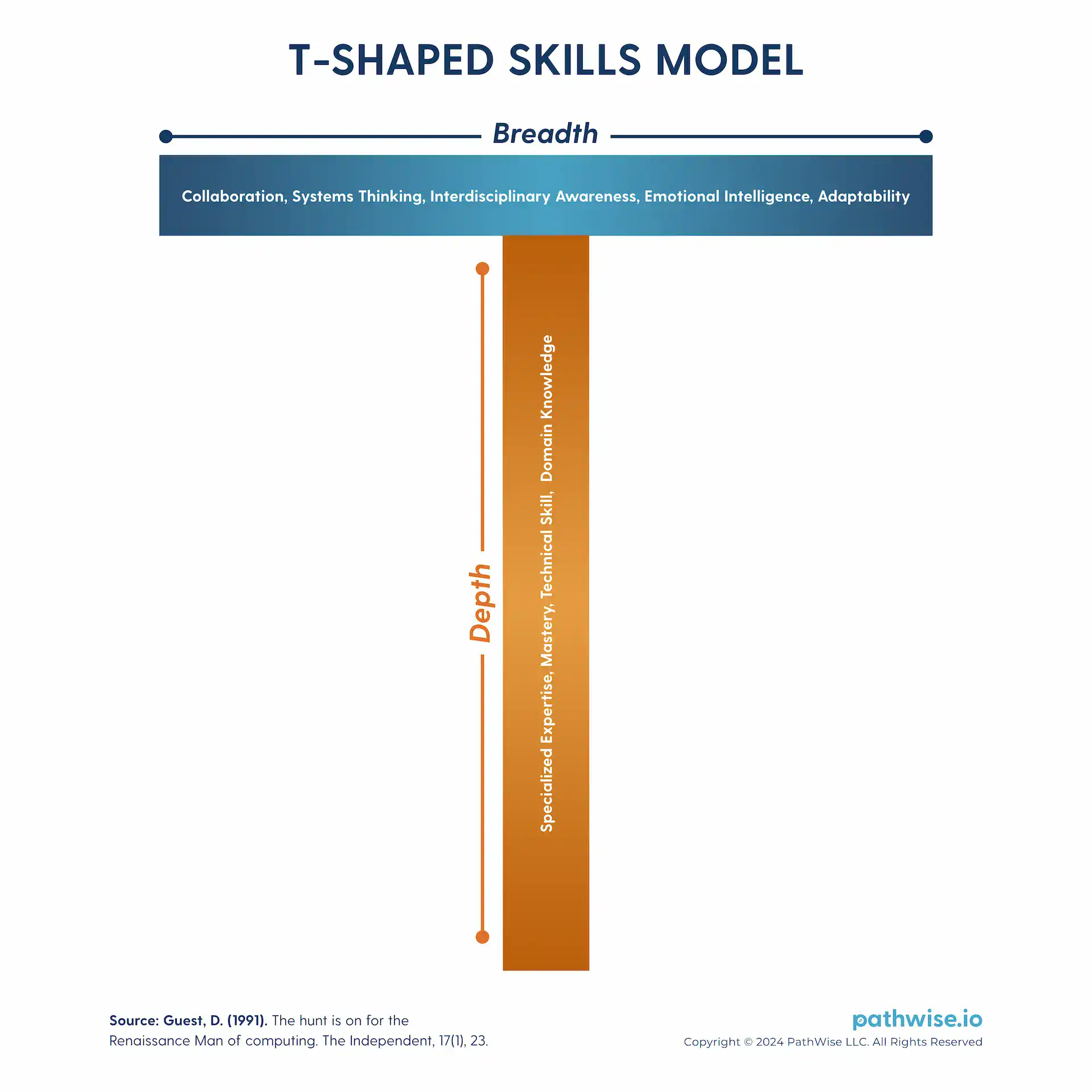
- Gartner Hype Cycle: A technology adoption model that tracks emerging technologies through five key phases: Innovation Trigger, Peak of Inflated Expectations, Trough of Disillusionment, Slope of Enlightenment, and Plateau of Productivity. This framework helps assess where AI technologies stand in terms of maturity and practical value.
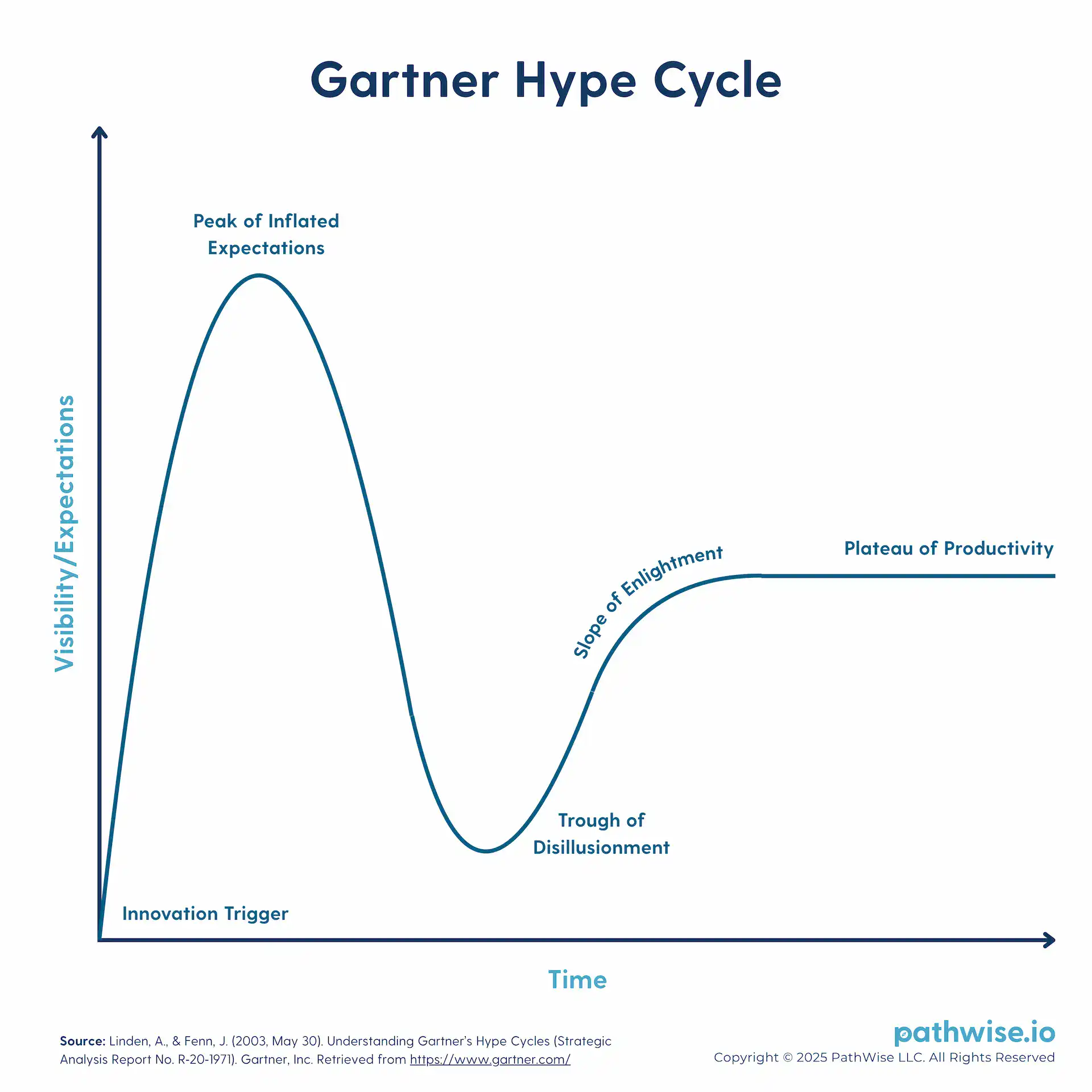
- The T-Shaped Skills Model: The T-Shaped Skills Model, popularized in design thinking and relevant in AI-driven workplaces, emphasizes having deep expertise in one area (the vertical part of the “T”) and broad capabilities across multiple disciplines (the horizontal part). As AI reshapes job roles, building deep domain expertise while gaining cross-functional digital, analytical, and human-centered skills can make us more adaptable collaborators with AI systems.
- The Human + Machine Operating Model (Accenture): From the book Human + Machineby Paul Daugherty and James Wilson of Accenture, this framework introduces the idea of “Missing Middle” jobs—roles where humans and AI collaborate closely. It categorizes new job types like “Trainers” (who teach AI systems), “Explainers” (who help interpret AI decisions), and “Sustainers” (who ensure responsible AI use). This model encourages a rethink of job design in ways that combine human judgment with AI capability.
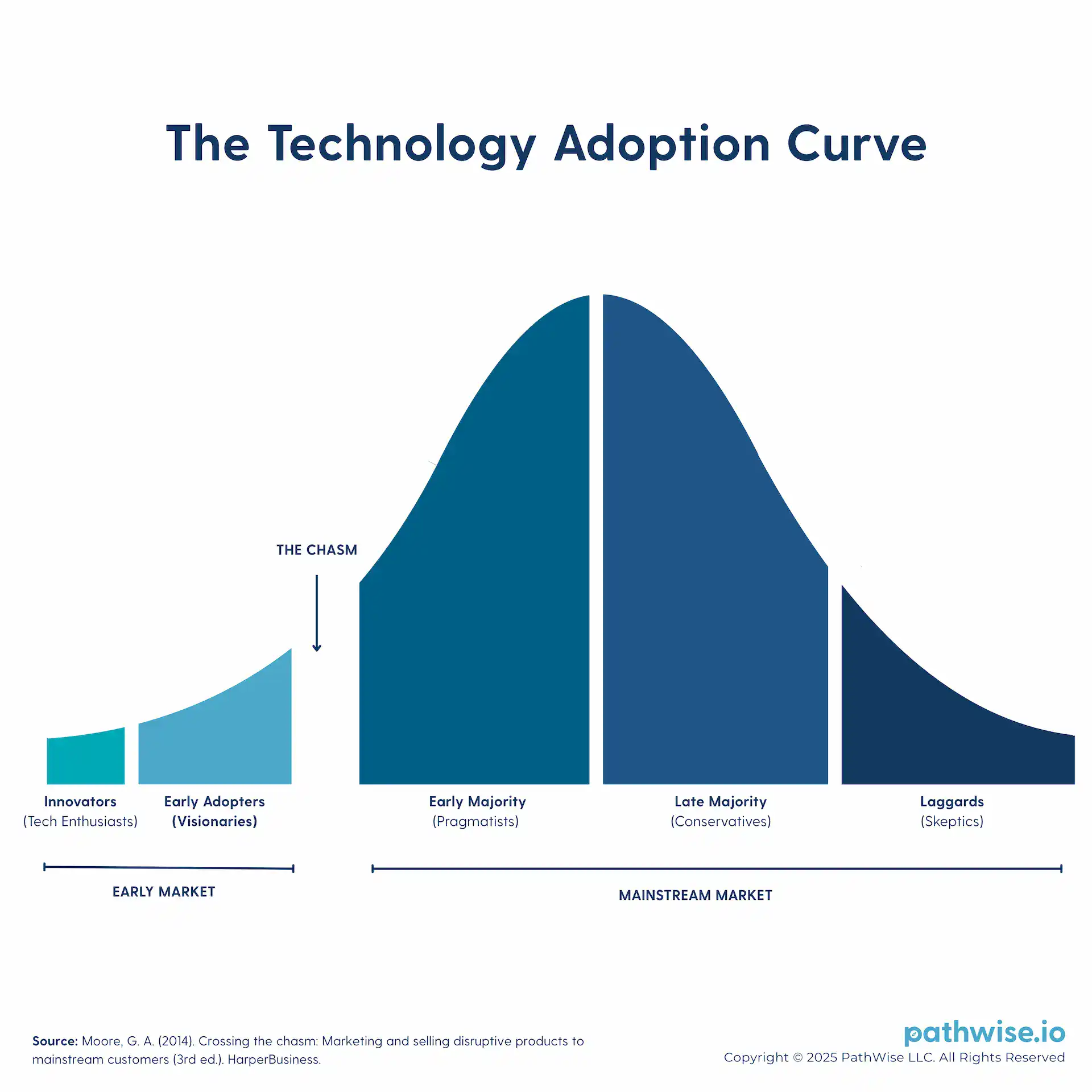
- The Technology Adoption Curve: An expansion (Geoffrey Moore, 1991) of the Diffusion of Innovationstheory (Everett Rogers, 1962), this curve describes how new technologies are adopted over time across five groups: Innovators, Early Adopters, Early Majority, Late Majority, and Laggards. Understanding this framework helps us decide when to adopt new AI tools and technologies in our fields. For example, being an early adopter in relevant AI applications can create career advantages by positioning us as go-to resources within our organizations.
AI in Your Career and Leadership
AI has the potential to make managers better leaders by enhancing decision-making, improving self-awareness, and enabling more personalized leadership approaches. More specifically, it helps in the realms of:
- Data-Driven Decision Making: AI tools can analyze vast amounts of data quickly, providing managers with deeper insights into customer behavior, employee engagement, market trends, and operational performance. This helps them make more informed and timely decisions.
- Enhanced Emotional Intelligence: AI-powered sentiment analysis tools and employee listening platforms can help managers better understand team morale and emotional dynamics. This allows them to respond more empathetically and tailor their communication to their teams’ emotional needs.
- Improved Talent Development: AI can help managers identify skill gaps within their teams and recommend personalized learning paths for employees. This enables more strategic talent development and succession planning.
- Better Time Management: By automating administrative tasks (like scheduling, reporting, and performance tracking), AI frees up managers’ time, allowing them to focus more on strategic thinking, coaching, and relationship-building.
- Scenario Planning and Risk Assessment: AI modeling tools can help managers simulate various business scenarios and predict potential risks. This makes them more proactive and better equipped to guide their teams through uncertainty.
- Bias Reduction in Decision-Making: AI can help flag unconscious biases in hiring, promotions, and performance reviews, helping managers make more equitable and inclusive decisions.
- Faster Feedback Loops: AI-driven feedback tools can provide managers with real-time insights on how their teams are responding to initiatives, leadership styles, and organizational changes, allowing for quicker adjustments.

Image used under license from Shutterstock.com
AI in Your Career and Professional Development
AI is fundamentally reshaping the landscape of personal development and career growth by enhancing our ability to learn, adapt, and make informed decisions. AI-driven platforms provide highly personalized learning experiences, tailoring content and recommendations based on our skill gaps, career goals, and learning preferences. This level of customization enables us to upskill more efficiently and stay relevant. Additionally, AI tools such as intelligent career coaches, resume analyzers, and interview simulators offer targeted feedback and actionable insights, helping us refine our professional profiles and increase our marketability.
Beyond individual skill-building, AI plays a critical role in improving decision-making and strategic career planning. Predictive analytics tools can analyze labor market trends, emerging job roles, and industry-specific demands, allowing us to anticipate changes and align our development efforts accordingly. AI also supports better time management, goal tracking, and productivity through tools like smart calendars and workflow automation. AI empowers us not only to react to external career shifts but to proactively shape our career trajectories with greater foresight and agility.

Image used under license from Shutterstock.com
Conclusion
AI is reshaping the nature of work by automating routine tasks, augmenting human capabilities, and creating demand for new skills. While some jobs may decline, many others will change or emerge, especially in areas like data analysis, AI development, decision-making support, and human-AI collaboration. Success in the AI era increasingly depends on adaptability, digital literacy, critical thinking, and emotional intelligence. Rather than replacing humans entirely, AI is prompting a shift toward more strategic, creative, and interpersonal roles across industries.
