


Emotional Agility

About the Author
Susan David is a psychologist on the faculty at Harvard Medical School. She obtained her Ph.D. in clinical psychological and a post doctorate on emotions from Yale University. She is co-founder and co-director of the Institute of Coaching at McLean Hospital, and CEO of Evidence Based Psychology.
David is a speaker and consultant, and she has worked with the senior leadership of hundreds of major organizations, including the United Nations, Ernst & Young, and the World Economic Forum. Her work has been featured in numerous leading publications, including the Harvard Business Review, Time, Fast Company, and the Wall Street Journal.
Sources: Wikipedia and “About the Author” section of the book
Our one-sentence summary
Emotional agility means acknowledging, accepting, and understanding our emotions so that they don’t overpower but rather provide us with the necessary guidance to navigate life fruitfully.
Publisher’s Summary
“ ‘I am not spending enough time with my kids.’
‘This work presentation is going to be a disaster.’
‘Why is my house always such a mess?’
We all have niggling doubts and worries of this kind: they are an inevitable part of a busy modern lifestyle. But many of us magnify these subjective negative thoughts into unshakeable facts. We feel that, far from being in control of our emotions, our emotions are in control of us.
Over her career as a psychologist and consultant, Susan David has found that the happiest people have exactly the same stresses and setbacks as anyone else. The difference is that they have learned to unhook themselves from unhelpful patterns of thought and behavior. They are emotionally agile.
Drawing on more than twenty years of academic and professional experience, Susan David has pioneered a new way of helping us to make peace with ourselves. Emotional Agility will help you to connect with your emotions, act according to your deepest values, and flourish. ”
Source: Book Jacket
Detailed Emotional Agility Book Summary
Chapter 1: Rigidity to Agility
- Humans don’t have lighthouses that guide us as we navigate through life. What we do have is our emotions – immediate reactions to signals that cause physiological responses. They help us match our behavior to the situation we face.
- While emotions can help us survive and even thrive, they aren’t always reliable. They can cloud our judgments and steer us in the wrong direction.
- Some people react to emotions automatically and operate without true awareness. Others spend too much time trying to control or suppress their emotions. Still, others think emotions impede their progress. “The goal of this book is to help people become more aware of their emotions, accept them, and flourish through emotional agility” (p. 4)
- In this context, agility refers to our thinking and behavioral processes. We all have developed habits that can sometimes keep us from thriving. But becoming flexible with our thoughts and feelings can help us respond optimally to any given situation.
- As the opposite of agility, rigidity refers to “getting hooked” by thoughts and feelings that end up being a disservice to us.
- To become emotionally agile, one needs not to solely think positively. Often, self-help books try to impose happiness, which is not only impossible but can backfire as people can’t turn negative emotions off. And, we sometimes do need our negative emotions.
- Emotional agility isn’t about ignoring difficult emotions or thoughts. It’s about facing them with courage and compassion, and then moving on. There are four elements to gaining emotional agility:
-
- Showing Up – facing our thoughts, behaviors, and feelings willingly but kindly.
- Stepping Out – detaching from our thoughts and feelings to see them for what they are: just thoughts and emotions.
- Walking Your Why – after calming our mental processes, focusing on our goals, values, and aspirations.
- Moving On – making small tweaks to our routines and habits according to our values, and finding the balance between challenge and competence.
- “The ultimate goal of emotional agility is to keep a sense of challenge and growth alive and well throughout your life” (p. 14).
Chapter 2: Hooked
- Within this context, hooked refers to when our negative emotions or thoughts overwhelm and take control over us, influencing our behavior.
- Naturally, we make up stories in our heads to comprehend what surrounds us and our experiences. It’s what keeps us organized and sane. But, often, we get it wrong. We get hooked when we believe these stories as the absolute truth.
- The voice in our heads that narrates these stories is usually biased. That’s why we can easily let our opinions and judgment take over the facts, and why we turn facts into negative evaluations and comparisons.
- Getting hooked is almost inevitable because our responses to stimuli are reflexive. We then let them take over, replaying negative thoughts and feelings in our minds, exhausting mental resources that we could otherwise put to better use.
- Sensory blending is the ability to experience thoughts with visuals, interpretations, judgment, inferences, abstractions, and emotions, all at once. Whether true or not, we experience life subjectively based on our sensory inputs, intrusive ideas, mental habits, and emotions.
- In the past, feeling danger viscerally kicked off the internal systems that let us react to survive: our fight-or-flight response. This system still helps us. In a state of emergency, our brains allow us to see, feel, remember, and hear at the same time so that we can react. But, outside of an emergency, this system predisposes us to get hooked.
- The brain works through the categorization of objects, experiences, and people. When we become too comfortable with our mental categories, we become rigid. Psychologists call this premature cognitive commitment. It creates habitual and inflexible responses to stimuli.
- Heuristics are quick and easily accessible categories in our brains. Some heuristics are reasonable and help us go through routines without wasting mental resources. But other heuristics are blinders and self-limiting (e.g., “I can’t dance”).
- Intuitive responses can be developed from practice and skill, such as a firefighter that knows when it’s time to evacuate. But heuristics that dominate our thoughts and behavior can also lead us to react in inappropriate ways.
- People who are hooked are usually insensitive to their environment. They see the world as they expect it rather than as it actually is.
- The following are the four most common hooks:
-
- Thought-blaming: When we blame our thoughts for our actions or inactions (e.g., “I thought I would sound silly, so I didn’t say anything”).
- Monkey Mindedness: “Monkey mind” is a term from meditation that describes our incessant mind leaping from one topic to another like a monkey swinging on trees. We do this a lot. E.g., when in a conflict, we spend a lot of time thinking and practicing what we are going to say. We eventually become exhausted and feel worn out from the arguments we never had. When we are in a monkey-mind mode, we imagine worst-case scenarios, mentally escalate minor problems, and fail to live in the moment. Monkey-mind is bossy, and has judgmental language, using words like “must” and “should.”
- Old, Outgrown Ideas: Past experiences and trauma (even if mild) create shortcuts in our brains that dictate behaviors that help us survive. These lessons were useful at some point, but now backfire as they no longer apply. (E.g., to protect himself, a child raised by a cold, abusive parent can become distrusting and emotionally closed. As he grows up, he can’t find love because he won’t let anyone in.)
- Wrongheaded Righteousness: Sometimes we hold on to our own idea of justice for too long. Or, we go out of our way to prove that we were right. The need to have our “rightness” validated can take away years of our lives (e.g., there are family feuds that last so long that people don’t even know what the fight was about anymore).
- The solution is to “approach experiences with fresh eyes” (p. 38). Emotional agility means becoming aware of our emotions, accepting them, and learning from difficult experiences. It means going beyond our conditioned ways of thinking (our hooks) to live in the moment.
Chapter 3: Trying to Unhook
- There are seven basic emotions: joy, anger, sadness, fear, surprise, contempt, and disgust (note: the number of emotions will vary depending on the expert with whom you speak).
- We classify five of these as negative emotions, but they have a purpose. That’s why we shouldn’t avoid them and instead should accept them as part of our lives.
- Unfortunately, most people tend to avoid feeling their emotions through common strategies that are not particularly healthy. We suppress them and bottle them up, or we spiral and brood.
- Bottlers try to unhook by putting their emotions aside and focusing on what’s at hand. E.g., a bottler who hates his job will try to rationalize the negative feelings, saying “at least I have a job,” instead of getting out there and finding a solution.
- The problem with bottlers is that they don’t get to the root cause of the negative feelings. Research suggests that suppressing emotions only amplifies them (explaining why we sometimes lash out at the wrong person).
- Bottling makes us feel like we are in control. But it is the opposite. Emotions will eventually surface, leading to an emotional leakage.
- Bottling has been found to affect other people too. When someone suppresses their emotions, their loved one’s blood pressure increases, even if the person “doesn’t know that the bottler is bottling” (p. 45).
- Brooders try to unhook by spiraling in angst. They can’t let go, obsess, and have difficulty compartmentalizing. They lose perspective and make tiny hills into mountains.
- Brooders ruminate on their feelings because they feel that by doing so, they can deal and cope with a difficult situation. They end up blaming themselves and asking questions like, “Why do I always do this?” which takes up a lot of mental energy. They also tend to worry about their worry and stress about their stress.
- Brooders also find someone to whom they can complain. But venting sessions usually offer no resolution, making brooders feel even more annoyed. Meanwhile, the other person might end up with empathy fatigue as brooders dump their emotions on them. Brooders are self-focused, leaving no space for someone else.
- Bottling and brooding are like aspirins that only hide headaches but don’t cure them. By failing to find the root cause of our emotions, we fail to resolve our distress.
- There are instances in which these two coping strategies might be necessary. E.g., if you break up with your girlfriend the day before your bar exam, you might need to move your hurt aside and focus on passing the test. The problem is when these strategies become our default.
- Another common coping strategy is focusing too much on being happy. Positive emotions are associated with a lower risk of chronic illness, greater levels of success, and increased life satisfaction. But, research shows that it is possible to be too happy and to experience the wrong kinds of happiness.
- When we are overexcited or extremely happy, we can neglect important threats or dangers, engage in risky behaviors, and overindulge. The absence of sobering emotions is associated with mania, a symptom of psychological illness.
- Mood affects how the brain processes information. When we are in an extremely good mood, we jump to conclusions and resort to stereotypes in which we put too much emphasis on early information and minimize later details. This is the halo effect.
- Research suggests that focusing too much on happiness increases our perceptions of what life should be, leading us to feelings of disappointment.
- Happiness is also different depending on the culture. Westerners associate it with accomplishment and pleasure, while easterners associate it with social harmony.
- Negative emotions help slow our cognitive processes, increasing skepticism. They make us less prone to errors and distortions, increase our persuasiveness, improve memory, encourage perseverance, make us more polite and attentive, encourage generosity, and make us less prone to confirmation bias – the tendency to seek information that supports what we already believe.
- For instance, guilt leads to reparative behaviors, embarrassment fosters cooperation, and sadness signals to us that something is wrong and to others that we need help.
- Our feelings are messengers that tell us things about ourselves and prompt us in the right life direction.
Chapter 4: Showing Up
- “Our hidden demons are the residue of the perfectly ordinary, and almost universal, insecurity, self-doubt, and fear of failure. […] But they can be enough to hook us into behaving in ways that don’t serve us” (p. 62).
- The first step to improving our emotional agility is showing up: facing and making peace with our demons and finding a way to live with them. By giving them a name, we remove their power over us.
- Research suggests that life satisfaction doesn’t depend on how many inevitable yet sad or regretful experiences we face as much as how we deal with them. When we bottle or brood, they control our behavior. Research also suggests that of all the habits that influence a more fulfilling life, the most strongly associated with satisfaction is self-acceptance.
- Along with self-acceptance, self-compassion is also necessary. Self-compassion isn’t about denying the negatives. It’s about allowing ourselves to be imperfect and forgiving our mistakes.
- Showing up requires courage because we don’t feel comfortable looking inward. It also involves acknowledging our thoughts without necessarily believing that they are the absolute truth. Note that the more we think and repeat statements in our heads, the more we believe they are true.
- We can’t change ourselves or the circumstances that surround us until we accept them. When we stop fighting what we cannot change, we can focus on more constructive and rewarding aspects of life.
- A good strategy to increase acceptance and compassion towards yourself is to look at yourself as the child you once were. You didn’t choose many of the conditions you had to deal with (e.g., who your parents are or your socioeconomic status). You did the best you could with what you were given. And just like you would never judge, blame, or mock a child, you should give your current self the same warmth, kindness, and forgiveness.
- When facing negative emotions, it’s important to distinguish between guilt and shame. Guilt is a sense of burden and regret, usually as a result of doing something wrong. Its purpose is to keep us from making the same mistakes, inspiring reparative behaviors. Shame focuses on a person’s character; it comes from judging not what one did, but who one is as inherently bad or wrong. Shame rarely ever leads to making amends.
- The difference between these two emotions is self-compassion, as it lets you see wrong or bad actions as mistakes, allowing you to learn from them.
- Self-compassion is not about lying to yourself. It’s about looking at yourself from an outside point of view and recognizing challenges and failures as part of being human.
- Self-compassion does not make you weak or lazy. Society pushes us to our limits, propagating a misconception that only the tough can stay competitive. But self-compassion is more effective than self-criticism in motivating improvement. And compassion allows you to remain sane even if you fail to reach a goal.
- Technology has also stimulated a society that constantly seeks to sell. Self-compassion and self-acceptance don’t move any merchandise. Advertising instead focuses on creating comparisons so that we feel like we are lacking.
- The contrast effect suggests that exposure to anyone more attractive, more powerful, or wealthier than us will negatively impact our self-image.
- Research recently found that comparisons alone can cause us to get Even in comparisons where they felt superior, people would get too focused on external validation to lift their own sense of value.
- Emotionally agile people keep their eyes on their own path. Looking at someone who is just a bit better off can be inspiring, but constantly judging yourself or comparing is harmful.
- Focusing on extremely successful people can be devastating. That’s because we naturally focus on the end result rather than on what it took to get there. We also forget we are playing with the cards we are dealt however best we can.
- Part of showing up is getting comfortable with being uncomfortable. To do so, you need to see feelings not as positive or negative, but just as feelings.
- Like a child crying, unable to express himself, adults sometimes fail to use their words. They can’t differentiate and make sense of their emotions.
- Alexithymia is a problem in which people struggle to express their feelings. Correctly defining our emotions makes it easier to find the help we need.
- Trouble labeling emotions is associated with poor mental health, life dissatisfaction, and even physiological issues.
- Our feelings provide us with valuable information. They point us in the directions that we need to avoid or toward situations we need to embrace. They are beacons, not barriers. When you’re trying to decipher what your emotions are telling you, ask yourself, “what the func?” Func here is short for What is the function of the emotion you’re feeling? What’s its purpose? What’s buried underneath it? What is it telling you?
Chapter 5: Stepping Out
- After showing up, emotional agility requires stepping out: creating distance between the thinker and the thought. It is unhooking by taking a new perspective and moving on.
- Research has found that simply writing about emotionally charged experiences can increase satisfaction and improve physical and mental health. Writing helps process negative experiences, making it easier to take action
- It isn’t solely writing that aids this process. Recording yourself, for example, is another way in which the brain rationalizes experiences.
- In the studies, those most successful in overcoming emotional and experiential distress were those whose writing included insights. They included phrases like “I have learned” and “Now I realize” in their writing.
- Within this rationalizing process, people can disentangle thoughts and emotions, and it becomes easier to take a new perspective on the events. When we are hooked, we are enmeshed in our own perspective. But we can purposefully create distance between ourselves and the matter at hand. This is called the meta-view.
- Mindfulness is a technique that helps you pay attention to the present, on purpose, without judging. It has been found to increase focus, competence, memory, creativity, and even improve moods. By paying attention, we become flexible and insightful.
- Mindlessness is the opposite: when we are unaware of our surroundings, navigating life on autopilot. You are in a mindlessness state when you forget someone’s name right after being introduced, when you throw away your wallet and put the food wrapper in your pocket, when you can’t remember if you turned off the stove, or when can’t explain why you’re feeling a given emotion.
- Mindfulness does not come easily to everyone. We tend to get uncomfortable looking introspectively. But mindfulness helps us get to know ourselves. It allows us to become emotionally agile by separating the thinker and the thoughts.
- Mindfulness is about finding balance, openness, and curiosity, all without judgment. It helps us increase our levels of self-acceptance, tolerance, and kindness. To become more mindful:
- Breathe– For a full minute, do nothing else but focus on your breathing. If your mind starts to wander, notice it, don’t get upset, and go back to focusing on your breath.
- Observe– Choose an object and focus on it for a minute. Isolate it and identify various aspects and dimensions of it.
- Reworka routine – Pick something you do daily, like making your coffee or brushing your teeth, and focus on each step, fully aware of sounds, textures, etc.
- Listen– Select a song or music to listen to, and really tune in.
- To help regulate your reactions, use the third-person to refer to yourself. This helps you create distance from the situation, allowing you to look at it as a challenge but not a threat.
- To step out, see yourself as continuously growing. Absolutist statements (e.g., “I’m bad at numbers”) are not your destiny. Other strategies include:
- Embrace uncertainty by accepting contradictions (e.g., loving and hating your hometown).
- Find humor in your mistake or circumstance.
- Change your point of view. Take the perspective of someone else.
- Identify thoughts and emotions for what they are, just thoughts and emotions.
- Learn to let go by taking a new perspective. E.g., a wife gets annoyed at her husband as he drops and leaves his coat on the floor when he gets home from work, even though she has repeatedly asked him not to do it. She starts feeling like the coat symbolizes how he doesn’t care for or listen to her. She’s
- Not begrudgingly or in defeat, she can accept that she loves her husband and decide to focus on all the good things that he does for her. That makes it easier to pick up the coat without getting upset.
Chapter 6: Walking Your Why
- Walking your why refers to living by your own set of values. That is, identifying the values that truly are your own and not imposed on you by culture, family, etc. Your values are not what you “should” care about but what you genuinely care about.
- We all tend to mindlessly go through life, making decisions based on what we are told will lead to satisfaction. Others’ actions influence us more than we are aware of. This phenomenon is called social contagion, and it explains why your chances of getting a divorce, for instance, increase if you’re constantly surrounded by divorced friends.
- If we are not careful, we might end up living life according to someone else’s values. The danger is that even the choices that appear thought-through are not in your best service. E.g., a man might choose to live hours away from work because a bigger house and a bigger garden seem like a good idea. But then he realizes that the commute ended up taking precious time away from his family, and he regrets it.
- Continuity of self refers to our human ability to perceive ourselves as an entity that extends into the past or the future. Researchers found that individuals who were asked to write a letter to themselves 20 years into the future were more likely to report less willingness to commit small crimes than those who wrote to themselves three months into the future.
- This suggests that by connecting to their future selves, people were more likely to make their core beliefs and morals more salient, helping them to make better choices.
- If you know and live your values, you are more likely to live comfortably with who you are. You won’t compare yourself with others because, by your definition, you are successful.
- The following are key characteristics of values:
- You are free to choose them and they should not be imposed on you.
- They are not fixed goals. They are ongoing.
- They guide you.
- They foster self-acceptance.
- To identify your values, ask yourself, “Deep down, what matters to me?” and “If stress and anxiety miraculously disappeared, what would my life look like?”
- When facing a decision, don’t think about it in terms of right or wrong. Think of it in terms of how you want to live your life.
- As you connect with your real self, the gap between how you feel and how you act becomes smaller. You begin to live without regrets and without second-guessing. Living your values helps you increase willpower and grit. It also keeps you from negative social contagion.
- When we are hooked, we are moving away from our values. To avoid this, every time you make a decision, move towards your values.
- Remember that there is always a loss to choice. Sometimes you will feel sad about a decision, but you’ll be less likely to regret your decision if you made it according to your values. And, even if you do feel regret, you’ll navigate the experience with agility because you made the decision for the right reasons.
Chapter 7: Moving On – The Tiny Tweaks Principle
- Research has found that small shifts are the best way to improve your life. Like frames in a movie that are put together to create the film, these small tweaks on their own might not appear like much, but as time passes, they can transform you.
- When we approach problems in an absolutist manner, we become frustrated (I need a new career!). If we make tweaks to our viewpoints, the cost of failure reduces and stress decreases (I am going to talk to people from other fields to learn about their industry).
- There are three areas in which you can make tweaks:
-
- Tweaking Your Beliefs
-
-
- Carol Dweck proposed the idea of fixed versus growth mindsets. Those with a fixed mindset believe that qualities such as intelligence are fixed and cannot be changed. Those with a growth mindset believe these qualities can improve through effort and learning.
- Changing your beliefs, through a growth mindset, can impact your behavior. We perceive change as a one-time event, but most times it’s a process. Focusing on the process lets us learn from mistakes and improve over a long period of time without feeling pressure or guilt.
- Our mindset dictates our position in the world, affecting not just our behavior but our health. Emotional agility requires a malleable sense of self.
- Long-term research has found that those who view aging negatively and as deteriorating are more likely to experience illnesses and chronic conditions.
- Those with a growth mindset see themselves as having autonomy, positively impacting their life.
- We all have aspects of ourselves we wish to change. At times of difficulty, we focus too much on the challenge, seeing it as our unchangeable destiny (e.g., I am fat). Tweaking your beliefs starts with questioning these notions and making the choice to grow and change.
-
-
- Tweaking Your Motivations
-
-
- Autonomy refers to believing that we do what we do out of our own volition and not because we were forced. It’s doing things because we want to and not because we have to.
- Neuroimaging revealed that our brain enters into conflict when we are tempted. The reward-seeking part of the brain and the intellect often clash. The brain is also faster at processing basic attributes like taste and smell than health knowledge. Our brain encourages certain choices (pizza over salad) before our self-control is activated.
- To change these tendencies, the tweaks we must make have to do with our perception of why we do what we do. We must tell ourselves that we want to eat healthily, for example.
- Sometimes, we want to do things but we phrase it in our heads as should or have to. Tweak the way we think and speak. Find the want to. e.g., You most likely became a parent by choice. The next time you find yourself thinking “I have to take the kids to practice” change it to “I want to be there for my kids.”
-
-
- Tweaking Your Habits
-
- When we form habits that were born out of our values, we free up mental space to perform other tasks better.
- Habit is an automatic response to a situation that we commonly face. If we become capable of approaching these situations intentionally, we can create better habits.
- Changing our behaviors requires effort, but the more you do it, the easier it becomes to continue doing it.
- To change bad habits, the first step is to limit exposure to avoid temptation. The second step is to adjust your environment to make it easier to change (and harder to continue the bad habit). Other strategies include:
-
- Switching your surroundings so that at moments of stress, hurry, or hunger, it’s easier to adhere to your values. E.g., if you want to lose weight, use smaller plates. If you want to spend less time watching TV, cancel your streaming service subscriptions. Create space between the impulse and the action.
- Piggybacking a new behavior into an existing habit. This adjustment makes it easier for us to sustain the change.
- Anticipating obstacles and preparing a strategy. Instead of anticipating events and getting hooked, decide how you are going to react according to your values. E.g., To get out of bed when the alarm goes off, commit beforehand. If the brain is committed, you are more likely to follow through.
- When the goal is long-term, don’t focus on the positive as much as on the challenge. Research has found that people in a weight loss program who pictured themselves finishing it with slim bodies, lost fewer pounds than those who were told to picture temptations that would make them cheat on their diets.
- Fantasizing about achieving our dreams tricks our brain into thinking we have achieved the goal. When we realize we have not, we lose motivation.
- It’s important to believe you can achieve the goal, but mental contrasting – being a realist about the obstacles – is essential too.
- Tweaking your mindset, motivation, and habits requires you to stop focusing on the result and instead value and engage in the process.
Chapter 8: Moving On – The See-Saw Principle
- We can become over-competent to the point where we begin to do things on autopilot. We become rigid, disengaged, and bored. We can also become over-challenged. When things are too difficult and we are constantly stressed out, we inhibit our ability to flourish.
- Emotional agility means finding a balance between competence and challenge. This is the see-saw principle. We need to live at the edge of our ability for optimal development.
- We need to gradually and incrementally progress. We can advance in two ways:
- Expanding our breadth – what we do,
- Expanding our depth – how well we do what we do.
- Living on the edge of our ability requires that we become selective in our commitments. We choose challenges based on our values.
- We need to gradually and incrementally progress. We can advance in two ways:
- When we become immobilized because we are out of balance, it’s usually because we are afraid. Our brains are designed to seek comfort and safety. We also have a bias towards familiarity and accessibility; we will favor what we know and what’s easy to understand.
- The curse of comfort refers to our tendency to automatically default to the familiar and accessible. This can keep us from reaching our goals or meeting our needs.
- These biases result in fear of the unknown, the uncertain, limiting the developing of emotional agility.
- Coherence is another way in which the brain feels safe. Our brains will naturally seek it, even if it goes against our best interest. E.g., studies found that people who think poorly of themselves will unconsciously prefer to interact with people who also view them negatively.
- Coherence, along with overvaluing immediate gratification (feeling comfort or pleasure now), also keeps us from flourishing.
- People tend to think that after a while of practicing a skill,
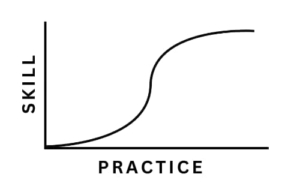
Source: Emotional Agility (p. 174)
we stay at the same level, so we stop. But research has found that after some time of little progress, people begin to improve again. The problem is that only about 25% of people break through that stage – the apparent plateau you can see in the graph to the right.
- Other research found that mastery is not about the time people invest, but rather the quality of the investment. Effortful learning refers to the mindful practice that allows for a continual facing of challenges. It is mindful engagement.
- While chronic stress can be detrimental to our health, the right amount of stress is a great motivator. The following are strategies that can help you overcome the plateau:
- Choose courage over comfort.
- Choose workable options. A workable choice is one that is appropriate given your circumstances and constraints, but also one that lets you keep your values.
- Keep going and keep growing. Expand the range and depth of what you do.
- Know when to say “enough is enough.”
- Grit is a combination of passion and sustained persistence. Grit is necessary for long-term success. Emotional agility can help us develop grit as it helps us get unhooked and identify our values, allowing us to let go of the goals that no longer serve us.
- Sustaining unrealistic goals can also become detrimental to our health. The most adaptive response is to disengage from the goal and find an alternative.
- When feeling like a quitter keeps us from making the right choice, we are hooked. But there’s virtue in knowing when to put an end to things. Instead of looking at these transitions as quitting, look at them as moving on.
- When faced with a quit or grit decision, only self-knowledge can help. Some questions that may help you include: “Do I find joy or satisfaction in what I am doing?” “Does this reflect my values?” “What opportunities am I giving up?” and “Am I being gritty or proud?”

Chapter 9: Emotional Agility at Work
- In the work culture, there’s a mistaken notion that employees and leaders shouldn’t display their emotions, expecting everyone to maintain a stoic and positive attitude.
- This tendency creates unhealthy expectations about work, limits communication, and bounds everyone to fail. Healthy human beings will always feel emotions, and emotions are guides.
- At work, people get hooked easily because of the stories we tell ourselves, especially in intense situations such as having to receive or provide negative feedback. But these stories we hold truthful can have negative consequences.
- E.g., David tells about a coworker who was up for a promotion, due to a restructure in the company. Those who knew couldn’t say anything, but the coworker started to notice people treating her differently. She figured something was wrong and stopped contributing. She got hooked, so instead of the promotion, she got fired.
- A common way managers get hooked is through a micro-focus – fixating on the minutiae, taking task-oriented approaches, and failing to recognize the ultimate goal and their teams’ efforts. Emotionally agile managers know how to focus their planning on the bigger picture.
- Another common hook in the workplace is caring too much. In the past, work was seen as a means to earn money, put food on the table, and only a part of life. Now, the workday is longer, the workplace is our main source of socialization, and our careers nourish our sense of self. In modern times, we find purpose in our work; but we might be losing perspective.
- People who care too much proclaim expertise, always have an answer, can’t admit mistakes, and step on other’s toes. Messages about caring less appear like laziness to them. But letting go opens up more opportunities to enjoy the other parts of life.
- While work provides us with identity and purpose, and caring too much may have negative consequences, working can provide health benefits. Research has found that those who do not have a job or similarly engaging undertakings, are more likely to give up and not engage in other forms of activities, leading to cognitive decline. We need to find a healthy balance.
- Hooks aren’t limited to personal narratives. They include stories we tell ourselves about others. As humans, we are not only biased, but we think we are objective. Many times, we don’t even know we are biased.
- Correspondence bias is being hooked on the idea that someone else’s behavior is due to their personality (while we attribute our own behavior to the circumstances).
- Hooks can also occur at the group level. E.g., David tells the story of a minor nose operation that led to a woman’s death. After a mild complication, doctors overfocused on intubating the patient. Nurses, knowing the brain can’t last more than 10 minutes without oxygen, prepared a tracheotomy kit. But when the doctors brushed them off, they didn’t persist.
- Lack of emotional agility led the doctors to experience tunnel vision (a loss of awareness of the situation due to an overfocus on one aspect, and failing to step back to look at the big picture) and the nurses to remain silent when they should’ve insisted.
- To show up for work, you need to label your thoughts and emotions, seeing them for what they truly are: information and not directives. This will help you create distance and gain perspective so that feelings don’t overpower you.
- Allostatic stress or allostatic load refers to the effect of cumulative chronic stress. In a group environment, everyone adds to everyone else’s allostatic load through social contagion. Like second-hand smoke, second-hand stress can harm our physical and mental health.
- Avoiding stress is impossible, but we can adjust our view on it. We need to acknowledge it, accept it’s never leaving, and understand that stressed isn’t who we are, just what we feel. We also need proper labeling – being able to differentiate it from frustration or exhaustion.
- Aside from typical responsibilities, every job requires emotional labor – the energy that we put into maintaining a good attitude and handling social interactions well.
- This type of labor, especially when we fake it, can lead to burnout. The degree of exhaustion has been found to deplete us from available mental resources, keeping us from enjoying a family meal or having the energy to go to the gym.
- Job crafting refers to looking creatively at your work and circumstances, finding ways to change your situation to make it more fulfilling. To do so, you need to pay attention to what activities engage you the most. You can also change the nature or extent to which you have to interact with others.
- Job crafting has limits. We can’t give up on our duties. We have to figure out a way to do what we most care about while still providing value to the organization.
- Sometimes, crafting is not going to fix your job, especially if you are at a place that is definitely wrong for you. Emotional agility lets you differentiate between the two possibilities, take perspective, and find the right way to adjust.
Chapter 10: Raising Emotionally Agile Children
- In an effort to raise competent children, many parents overprotect them and their self-esteem. The problem is that they are keeping their children from learning valuable experiences such as facing failure and setbacks, moving on, and developing resilience.
- The well-intended tendency to reward children for trying (e.g., participation trophies), can have negative consequences. It also underestimates children’s ability to learn and grow from experiences.
- Parents who micromanage their children are not only keeping them from learning but also increasing their risk of developing anxiety and depression.
- In this increasingly competitive era, the best thing a parent can do is teach their children emotional agility. To do so, parents need to notice and accept their kids’ emotions with compassion, empathy, and curiosity.
- Seeing their child afraid often causes parents to feel scared too. Intending to help, we often push our kids into facing their fears, but we accidentally teach them to bottle it up. For children to thrive, we need to teach them not to do things because they should, but because they want to.
- Whenever your children are frozen by fear, encourage them to show up. Acknowledge their feelings and help them create distance between the emotion and the goal. Explain the natural physical effects of fear, and discover the narratives that are getting them Help them rationalize them.
- The most effective way to teach emotional agility is to model it. It may be hard to do it when your child is upset at you or when they cry because of something that happened at school. But, step out of your own emotions and focus on theirs. Don’t let your emotions take over – be careful not to make the situation about your
- Display rules are the lessons we teach our children about what emotions are appropriate to manifest in given situations. Sometimes, we unconsciously teach display rules when we tell our child, “It’s okay, it’s okay” and dismiss their emotions, even if we do it with love.
- A common mistake parents make is solving their kids’ problems for them. We need to resist so that we don’t accidentally send the message, “I don’t trust you to solve the problem.”
- Secure attachment refers to when a child feels safe, acknowledged, and loved by those around them. To foment it, recognize their emotions and validate them. This will give them the ability to face what life throws at them as they grow.
- A child needs freedom to feel their emotions without fear or punishment. Teach them that emotions will pass and that emotions are teachers providing information that can help them.
- Recognizing and accepting a child’s emotions doesn’t mean tolerating tantrums. Let your kids know their feelings are real, but without suggesting that they all need to be acted upon.
- Help them label the emotions appropriately, gain perspective, and put distance between impulse and action.
- Autonomy, distinct from independence, is living and making choices without coercion or due to difficulty in controlling impulses. To foster it in your kids:
- Honor them for who they really are (and not who you want them to be),
- Whenever possible, give them a true choice,
- When a choice isn’t an option, provide a rationale for the decisions you make, and
- Minimize external rewards.
- When a child misbehaves and you need to teach them a lesson, do not lecture them about what they’ve done wrong as it will lead to defensive behavior. Instead, help them understand the impact their behavior had on themselves, you, and others. A child needs to feel guilty but not ashamed to feel motivated to solve the problem. Then, help them find solutions on their own, making sure they are meaningful to them.
Chapter 11: Conclusion – Becoming Real
- Emotional agility is the absence of pretense. It allows us to be authentic. We reach this level of emotional agility through small steps, every day of our lives. You can start by:
- Appointing yourself as the sole agent of your life,
- Taking ownership for your development, career, etc.,
- Accepting your full self compassionately and courageously,
- Embracing an evolving identity,
- Releasing narratives that no longer serve you,
- Letting go of unrealistic expectations,
- Freeing yourself from the idea of perfection,
- Facing your worries, acknowledging fear for what it is, just an emotion, and
- Choosing courage over comfort.
