

The Earned Life: Lose Regret, Choose Fulfillment
About the Author
Marshall Goldsmith is known as the world’s leading executive and leadership coach. He is also recognized as a New York Times bestselling author, as he has written many successful books including What Got You Here Won’t Get You There and Triggers. He received his degree in mathematical economics from the Rose-Hulman Institute of Technology, his MBA from Indiana University’s Kelley School of Business, and his Ph.D. from UCLA Anderson School of Management. Goldsmith was awarded The John E. Anderson Distinguished Alumni Award and the Distinguished Entrepreneur of the Year in 2010. A founding partner of the Marshall Goldsmith Group, Goldsmith has advised more than two hundred major CEOs and their management teams.
Sources: Wikipedia and the “About the Author” section of the book
Our one-sentence summary
An earned life is a never-ending process of aligning our actions and behavior with our ambitions, which should align with a greater aspiration, which we begin by living in the now and constantly monitoring our progress.
Publisher’s Summary
In his most personal and powerful work to date, world-renowned leadership coach Marshall Goldsmith offers a better way to approach fulfilment that goes against everything we’re taught about achievement. Taking inspiration from Buddhism, Goldsmith reveals that the key to living the earned life, unbound by regret, requires connecting the habit of earning rewards to something greater than our personal successes.
Goldsmith implores readers to avoid the Great Western Disease of “I’ll be happy when….” He offers practical advice and exercises aimed at helping us shed the obstacles that prevent us from creating fulfilling lives. From learning to privilege your future over your present, knowing how to weigh up opportunity and risk accurately, honing your ‘one-trick genius’ and needing to earn credibility twice, the book is packed with transformative insights and tools that will help readers close the gap between what they plan to achieve and what they actually get done – and avoid the trap of existential regret, the kind that reroutes destinies and persecutes our memories.
Full of illuminating stories from Goldsmith’s legendary career as a coach to some of the world’s highest-achieving leaders and reflections on his own life, The Earned Life is a roadmap for ambitious people seeking a higher purpose.
Source: Book Jacket
Detailed Summary
Introduction:
- Life lingers between two polarities: fulfillment and regret. Fulfillment is having purpose, meaning, achievements, relationships, engagement, and overall happiness. Regret is when we think our present could have been better had we done something different in the past.
- To avoid existential regret, we have to focus on our fulfillment.
- Accept that regret is unavoidable but that we can reduce its frequency.
- Reframe how we achieve fulfillment by understanding what an earned life
- “We are living an earned life when the choices, risks, and efforts we make align with an overarching purpose in our lives, regardless of the eventual outcome” (p. xxxii).
- Compared to a “lucky win,” something earned requires us to:
- Make our best choices, supported by the clarity of our goals,
- Accept the risks involved, and
- Put in maximum effort.
- We need to understand that life isn’t always fair, and the payout isn’t always what we deserve. More importantly, we need to keep in mind that our sense of fulfillment and happiness doesn’t last long. Setting goals and earning the outcomes are the first steps, but we need to aim our strivings at a higher purpose (instead of hollow achievements).
- An earned life makes few demands of us:
- Live your own life, not someone else’s version of it.
- Commit to earning it every day – make it a habit.
- Attach each earned moment to a higher purpose.
- Exercise: What does an earned life mean to you?
- Think of a moment when you earned something. Take that feeling and amplify it. Connect the feeling to an objective that goes beyond a transitory goal. Pick an overarching purpose in life. You have an endless list of options. But the process remains the same: make a choice, accept the risk, and get it done.
Chapter 1: The “Every Breath” Paradigm
- Buddha once said, “Every breath I take is a new me.” This is the Every Breath Paradigm – a notion that contradicts how most Westerners view life.
- Most of us struggle with the idea of impermanence. The things we possess, emotions, and thoughts vanish in an instant.
- The Great Westerner Disease is the pervasive notion “I will be happy when…” It’s a paradigm about waiting for something better in the future.
- We believe that whatever our improvement, we stay the same
- Against all evidence, when we achieve our desires, happiness will last. We live in what Buddha called the realm of hungry ghosts. We are always eating, but we are never satisfied.
- In other words, we are constantly looking forward, and looking backward only serves to review a record and take pride in it. But we don’t live in the present moment.
- The connection between the Every Breath Paradigm and an earned life is that when we accept that everything we have earned – from small praise to a good reputation – is impermanent, we must also accept that we need to re-earn these things daily.
- Note that constantly returning to past triumphs is not fulfillment, but rather is regretting their impermanence. Fulfillment cannot be accomplished by living in memories. It can only be earned by the person we are at the present moment, which means that we have to earn it again and again. We are never finished earning our life.
- Exercise: The Two Letters
- Write a letter of gratitude to a previous you. Give yourself thanks for your creativity, hard work, discipline – whatever allowed you to earn something that has made you better today. This exercise will reveal a cause-and-effect link between the two of you.
- Write another letter to future you. Write about the investment, sacrifice, effort, discipline, and whatever you are doing now to benefit the future you. This exercise helps discover your goals. It will also force you to view your efforts as an investment.
Chapter 2: What’s Stopping You from Creating Your Own Life?
- Freedom and mobility are what experts describe as the paradox of choice. We are better off when we have fewer options because it is hard to sift through a myriad of choices.
- Some of the barriers to choice and action that frustrate our lives include:
- We experience inertia by default. Inertia is the active state of persisting in doing the same instead of switching to something else. No choice is a choice too.
- All of us are programmed in some way. If we are not careful, we not only accept the programming, but we adapt our behavior to match it, e.g., when we want to try something new but don’t because we think, “I am not good at…” or “It isn’t me.”
- Obligation directs us on a good path. It becomes a problem when keeping promises we made to others gets in the way of keeping promises we made to ourselves.
- Failure of imagination. Choosing between two or three valid ideas for the life you want is confusing. But some people cannot even imagine one path for themselves, let alone two or three. Curiosity is the key to imagining something new. Be curious, make decisions.
- The pace of change. We tend to believe that at some point, we will be able to slow down and enjoy life. It’s not going to happen. We have to accept that we’ll always have to deal with something. Failing to adapt to the pace of change blocks us.
- Vicarious living. Because of social media and the abundance of technological distractions, we can live life through others. We sacrifice long-term purpose and fulfillment for the short-term dopamine high. This is not healthy. And it isn’t just social media. Sometimes we let fear of what others think guide our decisions.
- Running out of runway. Runway refers to the time we’ve given ourselves to achieve our destiny. Athletes and others who rely on physical vigor probably calculate shorter runways that people who use their brains for a living. A runway can become an obstacle in two different ways. When we are young, we overestimate it and put off things we should start early. When we are old, we underestimate it and let go of opportunities because we think we don’t have time to achieve them.
- Exercise: We now interrupt our scheduled programming…
- To understand your programing, list the adjectives your parents would use to describe six-year-old you. Then, list the adjective you would use to describe yourself now. Has something changed? How? Why?
Chapter 3: The Earning Checklist
- The following are four internal and two external factors necessary for success.
- Motivation. People often confuse motivation with desire. Being motivated is not the emotional state that comes from having a goal. It’s the emotional state and a boosted impulse to do each task required to achieve the goal.
- Two common mistakes are 1) misunderstanding motivation and 2) overestimating our willingness to fulfill it. Other errors you need to learn to anticipate include:
- Not understanding that motivation is a strategy and not a tactic. When you identify your motivation, make sure you also consider the long-term sustainability of it.
- Failing to recognize that you can have more than one motivation. When one motivation is lacking, another keeps you going.
- Treating inertia like motivation. These are not the same. If you find yourself living the same life daily, ask yourself: “Am I living my life how I chose to find fulfillment, or am I going with it because I can’t think of an alternative?”
- Two common mistakes are 1) misunderstanding motivation and 2) overestimating our willingness to fulfill it. Other errors you need to learn to anticipate include:
- Ability. Ability is the level of skill you need to succeed at a given task. It is a common problem for people to feel unmotivated even when doing something they excel at.
- The liability of expertise is when we take a talent for granted. The talent comes so easy that we don’t feel like we earned it, so we discount it.
- Ability is not an isolated talent. It is a combination of skills and personality traits that should match the life you want to live.
- Understanding. This refers to knowing what to do and how to do it. It also refers to understanding your role in a company, firm, event, or situation.
- Confidence. Confidence is your belief that you can succeed. You acquire confidence through experience, repetition, and improvement.
- Support. This refers to the external help you need. It can come from an organization providing money, supplies, or anything valuable. It can also come from a person who coaches or counsels you. It may even come from a defined group of people who support you and help you reach your goals.
- Marketplace. Always make sure that there exists a market for your product or service. If there is no market for what you want to offer, skill, motivation, confidence, and support will not overcome the fact that there is no place for your idea.
- Motivation. People often confuse motivation with desire. Being motivated is not the emotional state that comes from having a goal. It’s the emotional state and a boosted impulse to do each task required to achieve the goal.
- Exercise: Find Your Adjacency
- A cinematographer can become a photographer or a director because these are adjacent professions in terms of ability and understanding. If you feel like you need a change, list twenty people with whom you frequently communicate in your career. What are the qualities you all share? What sets you apart? Appreciate the quality that distinguishes you from others, and you will find adjacent opportunities.
Chapter 4: The Agency of No Choice
- To live any life, you have to make choices. To live an earned life, you have to learn to make choices considering discipline and sacrifice.
- Agency of No Choice refers to the idea of choosing to commit to one choice until you feel like you have no other choice.
- People who say, “I get paid to do for a living what I would gladly do for free” are probably the luckiest. And the second luckiest are those who say, “It was the only thing I was good at.” They don’t regret their path because they had no choice.
- Committing to one idea is not easy. Maybe you have too many ideas. Maybe you lack ideas and have defaulted to inertia. How can you be sure that your decision will lead to fulfillment? Narrow down your options until you reach a point where you don’t have a choice.
- Exercise: Flip the Script
- Think of a time when you gave someone advice so good that it was life-altering. You recognized something in them that they couldn’t see for themselves. Do the same for yourself.
- Ask yourself basic questions. “What do I want to do for the rest of my life?” and “What can I do that is meaningful?” are not basic questions. These are very complicated questions. Basic questions address one factor at a time. For all the major decisions in our lives, like getting married, one reason will do. “Do you love him?” is a basic question.
- Start by asking, “Where do I want to live?” Your choice will tell you about the type of life you want. Keep asking basic questions, and you might find that you’re happy, or you may realize you need a change.
Chapter 5: Aspiration – Privileging Your Future Over Your Present
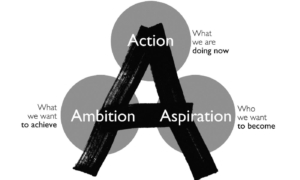
- How do we earn our lives? Look at the diagram below. These are the three variables that guide our progress in living the life we seek.
- Action refers to the activities we perform each day. Whether active or passive, our actions reflect a conscious choice, and often, they point to our ambitions and aspirations.
- Ambition is our pursuit of any measurable, time-bound goal. We can have several ambitions in different domains—e.g., professional, health, spiritual, and financial.
- Aspiration is the pursuit of a greater, unmeasurable goal. It could be serving others, having a balanced life, or searching for constant self-improvement. Aspirations are continuous processes that do not have a
Source: The Earned Life (p. 73)
finish line or end goal.
- The difference between ambition and aspiration is that ambition leads to ephemeral happiness and aspiration can last a lifetime.
- For example, when we desire a promotion and we get it, we celebrate. Then, happiness dissipates. We end up asking ourselves, “Is that it?”
- With aspiration, we look for something lasting and worthy of development. You may choose one self-cultivation project to which you dedicate several years and then decide to move on to another project, but you will always have that knowledge. Only by aspiring for something do you get to enjoy, endure, or despise it. And now you know what you prefer.
- Another distinction between aspiration and ambition is that aspiration is the more effective regret avoidance mechanism of the two. If you are no longer enjoying your aspiration or you feel like you’ve learned enough, you can put an end to it. There is no shame or failure.
- Exercise 1: The Hero Question
- Write down the name of your heroes. Then, think about what makes them heroic. Write down one-word descriptions of their values and virtues. Then, cross out their names and write yours instead. Reread your paper, and your big aspirations will soon appear.
- Exercise 2: Resolve Your Dichotomies
- You need to identify dichotomies that constantly appear in your life, especially if they cause trouble (e.g., procrastinating when you value timeliness). To resolve them, list as many dichotomies as you can think of (e.g., serious vs. fun, quiet vs. loud, confrontation vs. avoidance, pragmatism vs. dreaming). After you’ve come up with about 40, cross out what doesn’t apply to you. Study the remaining dichotomies and determine which of the two reflects you. Are you a follower or a leader? You can ask your friends and partner for their opinions too. The words you end up with are the qualities that influence your aspirations.

Chapter 6: Opportunity or Risk – What Are You Over-Weighting For?
- We all miscalculate risk and miss opportunities. We often fail to balance the two and end up over or under-weighting one over the other.
- Think of the Triple A’s presented before (Action, Ambition, and Aspiration). Another key distinction between the three is how far from today each of the variables is.
- Aspiration has no limit and therefore is infinite.
- Ambition is time-bound and is determined by how long it takes to achieve a goal.
- Action refers to each activity specific to a particular moment. It’s immediate.
- When assessing risk, consider the time horizon it is serving. Does the risk represent an Action that serves your needs? If yes, then does the action align with an Ambition? And does the risk align with your Aspirations? If most of your answers are “no,” rethink the risk.
- “When we overfocus on Action at the expense of our Aspiration and Ambition, we tend to make very poor opportunity vs. risk decisions.” (p.100)
- Putting too much emphasis on the short-term benefits leads to foolish risks. But over-weighing the risk, even if it’s a short-term cost, keeps us from seizing opportunities. Blinded by our fears, for example, we can under-weigh an opportunity.
- When you find yourself afraid of pursuing an opportunity, go back to your time horizon analysis. Try to view the experience from the point of view of a future self. For instance, if you want to ask someone out, the risk you face is rejection. But will rejection scar you forever, or will it be a momentary discomfort?
- When making decisions, always keep in mind that if Ambition and Aspiration are an important part of the process, then the decision is not minor.
- Relying on the Triple A’s time horizon analysis can help you understand whether a seemingly inconsequential decision is actually very consequential.
Chapter 7: Slicing the Loaf to Find Your One-Trick Genius
- To find your “genius,” or that one activity that you can specialize in, whether because you love it or because you’re great at it (or both), you need to understand:
- Finding your genius takes time. It probably takes a decade or two of your adulthood to really resolve this. Experience will tell you what engages and fulfills you.
- The right talent cannot shine in the wrong role. No matter how talented someone is, if they are in the wrong role, they will fail.
- A one-trick genius is not a one-trick pony. The term one-trick pony refers to people who abuse a limited skillset because they have no choice. A specialization is a deeply considered choice based on what you aspire to (rather than what you settled for).
- Your uniqueness can be your genius. Some people have peculiar, specific talents. “A special talent can elevate or torment you.” (p.113) You need to find a way to make it your ally. Sometimes, a potential source of misery can evolve into your specialization. To avoid that, make sure you find the right field or industry.
- Generalists can be specialists too. Often, we begin as generalists and become specialists.
- The benefit of specializing is that when you feel fulfilled, you discover that your narrow expertise applies to a wider array of problems and opportunities.
- Exercise I: How to Hear the “You Can Be More” Speech
- For about a month, keep a log of every time someone says something to you about your talents and potential. It can be praise, a suggestion, or a tough love comment. See how others see you. You’re looking for insights about how to be better.
- Exercise II: The One-Trick Genius Roundtable
- Gather six people that know each other well in one room. Starting with yourself, tell everyone the skill you possess that you think is your special, unique talent. Each of the other people must respond whether they agree with you or not. If they disagree, they must offer another option. Repeat the exercise with each person in the group.
Chapter 8: How We Earn – The Five Building Block of Discipline
- Up to this point, the arguments presented in this book revolve around choice. Now, the focus is on the actions required to earn your life.
- Most people admire discipline and willpower in others. While it is true that these two are admirable and necessary attributes, they are overgeneralized as the essential skills that drive success. But they are more complex.
- The following four building blocks of discipline and willpower are more concrete and easier to grasp. Keep in mind that they are situational (i.e., each resolves a different problem).
- Compliance refers to adhering to the rules, e.g., when a doctor prescribes medication and you follow the instructions properly. Interestingly, 50% of the US population fails to comply – even when it is our health and lives that are on the line. Compliance is easy to understand but hard to do.
- Accountability is our response to our personal expectations, whether private or public. You can give yourself a list of tasks and complete them on your own. But often, it helps to share those tasks with others. It elevates accountability.
- Follow-up. When other people follow up on us, they’re forcing us to assess our progress. Without the follow-up, we might never check how we’re doing. A group meeting where everyone monitors each other is helpful and supportive.
- Measurement refers to keeping track of our progress and following the data, e.g., if you’re trying to lose weight, you rely on a scale. If you’re trying to improve your sleeping patterns, you monitor and track your hours slept. You have numbers and you can compare and measure your improvement.
- Implement the above as strategies to live a life with fewer regrets. Eventually, they will become second nature to you. But the main component that unifies them is A wholly life cannot be achieved in isolation.
Chapter 9: An Origin Story
- To achieve an earned life, “decide what you want life to look like, and work as hard as necessary to make your decisions come true.” (p.137)
- To work hard, you need structure. In the next chapter, Goldsmith presents the Life Plan Review (LPR)– a weekly check-in that will provide you with such structure. But to understand the LPR, there are other notions you need to grasp first:
- Roosevelt Thomas contended that identification with a referent group shapes our behavior via our innate desire for approval. If you know a person’s referent group, you can better understand their values, thoughts, and behavior. If you want to help someone change, go back and examine their referent groups. You can apply the same exercise to yourself.
- Feedforward is a counterpoint to “feedback.” Instead of looking for people’s opinions about the past, feedforward represents the ideas people have that you can use in the future. When you want to change a specific behavior, ask people for suggestions.
- Peter Drucker believed that business starts by understanding who your consumer really is. He broadened the definition of “customer” beyond a typical transaction. The customer is rather the decision-maker and not the person with the money. It is the customer whom you, as a seller, want to make happy.
- Goldsmith proposes stakeholder-centered coaching. Define who in your life is a stakeholder, including those around your personal life.
- Business Plan Review (BPR). When Alan Mullaly was Ford’s CEO, he would meet with his team weekly for a BPR. Alan treated his team as stakeholders in one another’s success. Everyone was accountable to themselves and others, meeting the innate needs we all have of internal validation and belonging to something greater.
- Goldsmith used to host a two-day retreat session called “What’s Next?” The objective was to help clients figure out the next steps in their lives. He discovered that these weekends were the highlight of the year for many, as they created a community of different people sharing about similar situations and supporting each other.
- Daily Questions is a tool that can help you become more consistent in your pursuit of a given goal. It’s a self-monitoring regime with 6 questions, all beginning with “Did I do my best to…” Every day, score each question from 1 to 10 based on your effort.
- Building a community is of particular importance. Goldsmith developed the 100 Coaches community by training five people, who each trained other people, until 25 years later, a community was formed of over 100 coaches support each other and share ideas.
Chapter 10: The LPR
- “The objective of the LPR is to close the gap between what you plan to do in your life and what you actually get done” (p. 152). It helps monitor whether your actions are leading you to your earned life.
- You need to do a weekly review of your efforts, decide beforehand how much fallibility and inertia you’ll allow yourself each week, and share your results with your community.
- Step 1: In your weekly meeting with your community, take turns answering your six “Did I do my best to…” questions on a 1 to 10 scale. Develop these questions based on six of your most important goals.
- Step 2: In the days between the meetings, keep track of the questions and create a habit of self-monitoring. Find the areas in which you need to put more effort and the ones over which you have a lot of control. As you make progress, you’ll notice that you won’t need to track some of your questions anymore. They’ve become a habit.
- Step 3: Review your personal plan weekly; make sure you are not putting a lot of effort into a meaningless goal.
- Step 4: Share with your community – a community with members committed to getting better and sharing with others. Reviewing scores in public adds accountability to yourself and the group.
- When you build your community, try aiming for maximum diversity. The greater the differences, the more surprising the viewpoints.
- Don’t let the meeting run over 90 minutes. And remember, the LPR is not therapy. You’re sharing optimistic goals with successful people (successful meaning they’re not martyrs or victims, but people willing to improve).
- Some of the benefits of the LPR include:
- You can apply it to any goal.
- It’s a safe space with no cynicism or judgment allowed. The “no negativity” rule applies even if you’re talking about yourself.
- Measuring effort makes you realize what really matters to you.
- The LPR has few, yet strict rules: show up every week, be nice, and report your scores. Find a way to make the rigid structure work for you.
- What happens after the LPR meeting is often more meaningful than what happens during the meeting. Apply what you learn.
Chapter 11: The Lost Art of Asking for Help
- “Simply by choosing to participate in the LPR process, we are overcoming one of the biggest obstacles to living an earned life: We are asking for help.” (p.172)
- During his time working at IBM, Goldsmith discovered that IBM’s top performers were described as performing effectively and needed no coaching. And this is very common in many companies. The problem here is that the culture deems asking for help as a weakness, limiting the potential of the workers.
- To create your earned life, you need to ask for help. We all need help. And we all need it more than we know. Beware of two situations:
- Being ashamed of asking for help due to fear of looking ignorant or incompetent.
- Being convinced that you should be able to take care of your problems by yourself.
- Consider all the times someone has asked you for help. Did you refuse, resent, or judge them? No, you probably helped. Now think about how you felt when you helped. Don’t deprive others of that great feeling.
- Exercise: Write Your History of Help
- Make a list of your five to ten proudest achievements. If you were to give a speech for each of these, who would you thank? Why? You’ll find that you did not succeed on your own. Imagine how much more you can achieve if you ask for help.
Chapter 12: When Earning Becomes Your Habit
- An earned life is a long process. Your strategy is to become self-aware and situationally aware so that you can avoid getting burned out until earning becomes a habit.
- Earn your beginnings. In life, we all experience moments in which a phase ends and another begins. Some of these changes are predictable, (e.g., graduation, marriage, parenthood, career changes) but many aren’t. When we start to disengage from a previous self, we have to accommodate the new version of who we want to be. Mark your turning points and earn your new beginning.
- Disengage from your past. Learn from your past but don’t go back visiting every day. If you can disengage or let go of your previous self (including triumphs and failures), creating a new self becomes a lot easier.
- Master the earning response. You have control over your behavior and actions. To change a bad habit, consciously change your response to the stimulus that causes it. Add a thoughtful pause between the stimulus and the response, and creating a new habit becomes easier.
- Play the shot in front of you. “Every set of facts we see is situational” (p.196). We have to deal as best we can with what is in front of us. We also have to learn to live in the now. We fail to play the shot in front of us when we are distracted and not living in the present. And if we fail to take the shot, we fail to transition.
- Earning ends when we accomplish what we set out to do, or when circumstances make it unnecessary to continue. Earning begins when we decide we want to recreate our life, making it our own.
- Exercise: What’s Your “Impossible”?
- Henry Moore once said “The secret to life is to have something you can devote your entire life to, something you bring everything to. […] The most important thing is it must be something you cannot possibly do!” What is your something you cannot possibly do?
Chapter 13: Paying the Price and Eating Marshmallows
- The Marshmallow Test by Walter Michel had nursery kids make a decision: they could have one marshmallow now, or they could wait 20 mins and have two marshmallows then. Follow-up research found that the kids who were able to wait the 20 mins had higher SAT scores, better educational achievement, and lower body mass index.
- Years ago at a conference, Goldsmith heard a speech from a woman who was delivering a hard truth. The message was, “To pursue any kind of fulfilling life, especially an earned one, you have to pay a price.” She wasn’t talking about money. She meant making the maximum effort on the important things, accepting sacrifices, and being aware of the risks.
- Our impulse to avoid loss is greater than our desire to acquire an equivalent gain. We are less likely to pay the price if we perceive the probability of success to be low.
- Another tendency that keeps us from paying the price is failure of vision – our sacrifice today will not yield rewards we can enjoy today. Many people can’t see far ahead enough to foresee themselves being thankful for what they’re sacrificing now.
- A third reason is our zero-sum view of the world. We think winning something means losing another thing. While this isn’t entirely wrong, it’s a bit pointless because we are always sacrificing something.
- A fourth reason why people don’t want to pay the price is they don’t like to get out of their comfort zones.
- To make smarter choices, we need to resolve one main dichotomy: delayed vs instant gratification. The reason why we have to prioritize delayed gratification is that sacrifice leads to valuing the results more. Paying the price also feels good. And there will be no regrets either. “Regret is the price you pay for not paying the price” (p.206).
- Exercise: Take the Delay Out of the Delayed Gratification
- For a day, figure out all of your dilemmas that fit the dichotomy of delayed vs instant gratification. When facing any decision, pause for seven seconds and think, “Can I delay the gratification for the sake of a higher reward in the future, or am I taking the easy way out?”
- Now try another exercise. For a day, tackle high-priority tasks first. You’ll find delayed gratification in doing the lower priority and easier tasks towards the end of the day when you’re tired. By regularly doing this, you can delay the delayed gratification. You can have your marshmallow and immediately eat it – right after you finish the work of the day.
Chapter 14: Credibility Must Be Earned Twice
- “Our mission in life is to make a positive difference, not to prove how smart or right we are” (p. 213). The qualities you need to develop to impact the world are credibility and empathy.
- Credibility comes from reputation, and it is earned over time as people come to trust and believe in you. But it is a two-step process:
- First you need to establish competence in something that people value. You gain their trust by being consistent (e.g., keeping your promises).
- Then, gain others’ recognition and approval for your particular competence.
- Credibility needs to be earned twice. First when you reach a high level of competency, and again when people notice your ability and give you the recognition that leads to credibility.
- In the same way that achievement doesn’t necessarily lead to happiness, earning competence doesn’t automatically guarantee recognition. And credibility requires both.
- Think about the following questions: Will expert recognition allow me to make a positive difference in the world? Does striving for recognition make me uncomfortable? Does my discomfort inhibit me and limit my ability to make a difference? Which is more important: the momentary discomfort or making a difference? Is discomfort a price I am willing to pay?
- Peter Drucker has five rules for earning credibility:
- Make peace with the fact that every decision in the world is made by the person who has the power to make the decision.
- If we need to influence someone to make a positive change, that person becomes our customer, and we are his or her salesperson.
- Our customer doesn’t need to buy. We need to sell.
- Our definition of value is not as important as our customer’s definition of value.
- We should focus on the areas where we can actually make a change. Sell what we can sell and change what we can change. Let go of the rest.
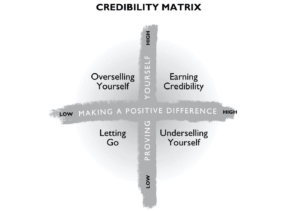
- See the credibility matrix below.
Source: The Earned Life (p. 220)
- In the quadrant “earning credibility,” you’re making a difference and seeking approval.
- The “letting go” quadrant is the “it’s not worth it” quadrant. That’s when proving yourself won’t make a difference and you won’t feel approval.
- The “overselling yourself” quadrant shows you’re winning a game that no one else is playing.
- The “underselling yourself” quadrant is the “I shouldn’t have to…” quadrant. Whether because you expect your ability to speak for itself or because of an impostor syndrome, you’re not expressing the confidence you should.
- This matrix addresses the issue of earning credibility twice.

Chapter 15: Singular Empathy
- Empathy is the second quality that shapes your ability to make a positive impact. It is the act of experiencing what others are feeling or thinking.
- Cognitive empathy is when you understand why and how others think and feel. You understand others’ motivations. You can also experience empathy of feeling when you experience the emotional state of another person. When you go beyond understanding, feeling, and caring, you take action. That’s the empathy of doing.
- “Empathy’s greater utility is how effectively it reminds us to be present” (p.233). we need to compartmentalize our empathy and live in the present. Authentic empathy is doing your best to be the person you need to be for the people who are with you right now.
- “If I could have only one index card to carry with me for the rest of my life [to constantly look at] as a reminder of how I should behave to achieve an earned life, [it would say:] Am I being the person I want to be right now?” (p. 236). When you answer this affirmatively, you’ll discover that you’ve earned the moment.
Coda: After the Victory Lap
- In the exercises presented in this book, there are five recurring themes worth highlighting as they are under your control: purpose, presence, community, impermanence, and results.
- The reward of living an earned life is being engaged in the process of constantly earning such a life.
