


Getting Unstuck: A Guide to Discovering Your Next Career Path

About the Author
“Dr. Timothy Butler is a Senior Fellow and the Director of Career Development Programs at Harvard Business School. He has worked as a teacher, psychologist, psychotherapist, and career counselor for over forty years. Dr. Butler’s research has explored the way in which individuals make meaning in their lives through choices in work roles and work environments. He is an expert in the areas of career self-assessment and career-coaching process. He teaches career coaching and consults to organizations worldwide on career development issues. His books, articles, and teaching engagements have brought his research to academic, professional, and general audiences around the world.”
Sources: “About the Author” section of the book
Our one-sentence summary
To overcome an impasse, we must engage in a deep process of introspective analyses through exercises that will allow us to progress and move forward.
Publisher’s Summary
“You will experience psychological impasse many times in your life. During these times, you have the sensation that you’re stuck or paralyzed. You’re convinced that something must change, whether in your work or personal life. Though this feeling is normal, you need to move beyond it. Failure to “get unstuck” can put your career and personal life—as well as the healthy functioning of your team or organization—at risk.
In Getting Unstuck, business psychologist and researcher Timothy Butler offers strategies for moving beyond a career or personal-life impasse—by recognizing the state of impasse, awakening your imagination, recognizing patterns of meaning in your life, and taking action for change.
Drawing on a wealth of stories about individuals who have successfully transitioned out of impasses, Getting Unstuck provides a practical, authoritative road map for moving past your immediate impasse—and defining a meaningful path forward.”
Source: Book Jacket
Detailed Summary
Introduction
- Sometimes, we feel stuck at predictable moments, such as when we lose a job or end a romantic relationship. But other times, we feel stuck even when we have the perfect job or find ourselves longing for renewal.
- When we are stuck, we are at an impasse. It may appear as a sense of lacking progress or reward. We might feel deflated or bored. But impasse is a necessary crisis that allows us to grow.
- Butler also suggests that impasse allows for vision – not just a plan for the future but a sense of renewed purpose.
- The Cycle of Impasse refers to a pattern with six phases:
- The crisis develops through a painful event or the simple realization that something is missing.
- The crisis deepens. We attempt to rationalize and evade feelings, but they get worse.
- We drop our defenses and open up. We stop denying we are stuck.
- We begin to notice signs about what needs to happen next. We shift our way of understanding our circumstances.
- We begin to recognize patterns of meaning and satisfaction.
- We take action and align our lives with our vision.
- Butler covers each of these phases in greater detail, offering exercises designed to guide readers through the impasse
Part I – Impasse
- When faced with crises, we tend to push forward with old methods until we realize that our strategy isn’t working. We need to learn to recognize the feelings of impasse and accept that they are the beginning of a necessary process for development.
Chapter 1: Facing Crisis
- Childhood, adolescence, and adulthood are each forms of crisis, as they all require adaptation. We all go through these crises and have had to learn new strategies to adapt to the new expectations. E.g., if we face adulthood with adolescent strategies, adjusting becomes even more difficult.
- To grow, sometimes we need to face difficult experiences.
- Most of the time, uncertainty slows us down, as our paths are not clear.
- Uncertainty is uncomfortable, even scary. We want to feel like we know what we are doing and where we are headed. In the face of uncertainty, we get stuck.
- Butler clarifies that being at an impasse is not having clinical depression, even if the symptoms are often similar.
- Sometimes, people see an impasse as a failure and internalize it as evidence of personal deficiency. In such a case, we must remind ourselves that being stuck does not represent who we are. An impasse is only a reminder of where we are at the moment.
- Creative people eventually learn to appreciate times of impasse. It is not that they like them or look for them, but they no longer fear or avoid being stuck because they understand it will lead to improvement.
- To decipher what we need to do next, we need to understand our intuition. Sometimes, cognitive representations help.
- A cognitive representation is an image, whether visual (a picture), physical (sensation), emotional, or intuitive (thoughts), that helps us recognize aspects of our experiences that we might not yet fully understand.
- These images will eventually become amplified. For instance, a friend or a counselor might perceive what your body is trying to tell you and understand its more expansive meaning.
- Exercise: When dealing with an impasse, stop appeasing the feeling of being stuck. Instead, pay attention to your thoughts, images, memories, and feelings. Analyze them in the context of this chapter.
Chapter 2: Feeling Stuck and Doubting Ourselves
- Sometimes impasses come not from new experiences, but from the past reemerging. Butler tells of a patient, Raymond, whose self-image was mostly made up of his experiences as a fifteen-year-old adolescent who was constantly compared to his older brother. Even though he was more successful than his brother, he still felt inadequate.
- As we grow older, we carry our strengths and wounds with us. An impasse offers the possibility of revisiting those wounds and healing them. Distorted self-images sometimes lead us away from our ability to pursue the work and relationships we need for fulfillment.
- Sometimes, parents’ wishes are not communicated clearly to children, resulting in children having difficulty separating what’s theirs from what’s their parents. Unspoken demands often become unconscious drivers of impasse.
- Butler tells of another patient, Karen, the daughter of Japanese parents who grew up in America during WWII. In her self-image and sense of duty, she often felt stuck between her parents’ desire for her to be successful in America without letting go of her Japanese roots.
- Carl Jung, a famous psychologist, believed that as we are socialized, we assume roles that provide us with a sense of our identity – our conscious ego. This ego is what gives us a place in the world. But the narrower the roles, the more we disregard other areas of our identity.
- We all have internalized an irrational critic. It has been called many names: superego, bad parent, inner critic. The artist William Blake called it The Accuser. This is the voice that tells us we are a failure, inadequate, unworthy, or that we have made the wrong choices, are not attractive enough, etc. Its concern is not moral action but to punish us and limit our possibilities.
- We need to learn to recognize The Accuser so that we avoid our feelings of guilt, shame, or inadequacy taking control. Otherwise, we believe its words.
- External voices can magnify The Accuser’s voice. While it may vary per culture, Western societies are more prone to disregard accomplishments in relationships, family, community building, etc., and focus too much on financial success and public recognition.
- As a crisis becomes an impasse, we must develop the skills to quiet The Accuserso that we can move on.
- The first step is to know that The Critic, whether that is our dad, aunt, teacher, or a combination of people, is not us. It helps to give it a name so that when you hear him or her, you can separate yourself from it and disengage.
- The second step is not believing the message.
- The third step is to go back to what was happening before The AccuserThe Critic will most likely attack when we want to take a step forward.
- The fourth step is to send The Accuser Don’t argue with it or defend against it. Just let it go. Use humor if it will help.
- Exercise 1: When at an impasse, consider the stakeholders – the people who might somehow, for better or worse, influence your decision. Make a list of these people and ask yourself what their dreams for you were, how they see your strengths and weaknesses, and what they would approve and disapprove of. With this list, you’ll be more capable of noticing if it is you or someone else making your decisions.
- Exercise 2: Thinking about Butler’s clients, what were your feelings as you read their experiences? Where did your mind go?
- Exercise 3: Sometimes, we have thoughts that are typical attacks from The Accuser. Phrases such as “You are too…” or “If you could only…” How does your mind usually finish those sentences? To silence The Accuser, you need to understand what its messages make you feel. Then, remember you have other voices within you as well.
Chapter 3: Opening Up and Letting Go
- Cognitive map or mental model are terms psychologists use to describe the process through which we make decisions and navigate life. We form mental models as we learn and adjust. These apply to anything, from your understanding of your boss’s personality to planning a family event.
- Mental models provide us with an almost automatic way of dealing with life. The problem is that they lack vision. Vision requires that we focus not on what has worked in the past but on what will work now and in the future.
- Mental models also keep information out of our consciousness. When we are at an impasse, we need to figure out a way to suspend mental models, at least for a while, so that we can let our feelings, mental images, and instincts tell us what we cannot consciously comprehend.
- To let go of past mental models and open new ones, we need to practice free attention – freedom from distraction and alerted presence that requires intense focus.
- Practicing free attention is difficult because we are working against our egos – the part of ourselves that wants to keep things familiar, making us feel safe.
- When we are at an impasse, we need new information. Practicing free attention won’t rid us of our ego, but it will suspend judgment allowing us to intuit deeply.
- Exercise: To practice free attention, you can visit careerleader.com/gettingunstuck. The following section is a brief description of the steps behind this exercise.
- Sitting in a comfortable chair with your feet flat on the ground, focus your attention on your sensations, thoughts, and perceptions, accompanied by judgments.
- Place your attention on your right-hand palm. Don’t look at it, just focus on it. If you feel a flow of sensations, perceptions, feelings, reactions, thoughts, and judgments come to mind, return your attention to your hand.
- Shift your attention to your breathing. Don’t slow it down or speed it up. Note that the competition for your attention is there. If you get distracted, simply go back to focusing on your breathing.
- Your awareness of perception should continue. If emotions start emerging, let them be. Don’t try to change them. Continue bringing your attention back to your breathing. You’re not meditating. You are aware and you are present.
- Pay attention at what emerges. Don’t cling to any images or attempt to analyze them. As you practice free attention, you will be better at recognizing tensions and thoughts that arise.
Chapter 4: Shifting to a New Understanding
- Moving through an impasse requires that we let go (through exercises like free attention) and open up to new information. This shift comes only if we first accept that old models and ways of thinking no longer work.
- The shift to a new understanding can occur in many ways, but we can cultivate an ability to appreciate new perspectives. Sometimes we want to break down and examine each piece of information we have available. But this approach doesn’t always work. We need to move closer to the core of our being.
- An exercise that enables a shift to accessing new information is The One Hundred Jobs Exercise. Note that this exercise only works if we feel the urgency to overcome the impasseand make an effort.
- Exercise: The One Hundred Jobs
- First, read through a list of one hundred occupational roles and select the twelve that feel more exciting, engaging, and meaningful (ignoring financial reward or skillset). Then, rank them from the most to least exciting.
- Going over your list, identify themes that tie the jobs together (e.g., love of technology, entrepreneurship, public service, problem-solving, being in the spotlight, etc.).
- Then, identify dynamic tensions among your list of themes. E.g., two themes that could appear contradictory are maximum financial gain and public service.
- As you work through this exercise, hold your free attention and be on the lookout for spontaneous images that may appear. Write them down.
- Note that this exercise can also be done in small groups with others providing input.
- Once you’ve got your themes, images, and dynamic tensions, you need to amplify them to understand their message. The shift is a deeper form of thinking that helps us find words for things that have been important to us all along but that we have been struggling to decipher.
- Butler provides an example of one of his clients. Christine was about to obtain her MBA, and she still didn’t know what type of job she wanted. After performing this exercise, she realized she had never allowed herself to express her interest in leadership. She wanted to serve others, so she believed she couldn’t be in the spotlight. Butler reminded her of people like Martin Luther King Jr., who helped others by being in the spotlight.
- At some level, Butler argues, all of his clients know what they want. Sometimes it is just hard for them to reach in and access that information hidden within them. The Image Gathering exercise helps tap into this information through three phases:
- The first phase circumvents our conditioned thinking and elicits images associated with our new and emerging vision.
- The second phase requires writing highlights of images for closer inspection.
- The third phase analyzes the first two phases through disciplined imagination.
- While the step-by-step process of the image gathering exercise is not described in detail in this chapter, you can practice it by visiting careerleader.com/gettingunstuck.
- Most of the time, images are preverbal in that we have not yet processed them in the part of our brains that processes language. But they have premonitory qualities. We just need to collect the images and examine the patterns.
- Butler talks about another client who had to take care of her sick father, support her husband in their business, and take care of a teenage daughter and a younger son with learning disabilities. After the image gathering exercise (where she pictured herself in solitude but didn’t feel lonely), Butler helped her understand that, rather than isolation, she just needed space – a time every day that was solely for her. She adopted meditation practice.
- The analytical challenge behind the exercises in this chapter is analyzing the deeper metaphors, themes, and dynamic tensions. Through imaginative analysis, we change how we understand a situation, leading us to feel refreshed while still perceiving it as familiar.
Part II – Vision
- Vision is not a one-time event. We build it throughout our lives.
- All of us have recurring themes that signal what is important to us. These themes let us discern what activities and relationships we find most satisfying. As we grow, these patterns become more obvious.
Chapter 5: Our Deepest Interests
- For many of us, lifelong passions stay hidden through childhood and adolescence. Children and teenagers haven’t had enough opportunities to test what activities are most meaningful to them. Deep interests start to show more consistently in our early twenties.
- Deep interests are how we rank the basic elements of human interest. Such interests help better predict the activities and environments that we find fulfilling. Research suggests lifelong interests are among the most stable features of human personality.
- Butler and Dr. James Waldroop identified eight essential deeply embedded interests. In the book, Butler includes two more, taken from the work of John Holland. The following are the ten basic interests that contain all work that goes into business organizations. Most of us will identify with more than one of these, but one will be the most important.
- The Engineer: An Interest in the Application of Technology
- This function represents interests in technology, systems and processes, and how things work. People with a strong interest in this area enjoy roles in production and system planning, product design, programming, process analysis, development management, use of technology, and mathematical analysis.
- The Number Cruncher: An Interest in Quantitative Analysis
- People in this area are interested in the numbers side of work – from a balance sheet to sales forecasts and market analysis. These are people interested in investment and money management.
- The Professor: An Interest in Theory Development and Conceptual Thinking
- This area represents people who are interested in problem-solving at the conceptual level. These are people who desire constant intellectual challenge to maintain engagement. They are drawn to research, economic theory, model development, competitive analysis, product distribution processes, teaching theory, or imaginative thinking.
- The Artist: An interest in Creative Production
- These individuals are those who others see as “the creatives.” This area represents “blank page” creativity. They are people who aren’t uncomfortable with ambiguity. They appreciate the challenge of having to create something from scratch. They can write a business plan, develop marketing concepts, generate business ideas, etc.
- This function also includes working in the fine arts, from clothing design to film development or medical design.
- The Coach: An Interest in Counseling and Mentoring
- People interested in this core function find collegiality rewarding. These are individuals who enjoy relationship building, from team members to customers or work friends. They like tutoring and mentoring. They also enjoy contributing to the community.
- The Team Leader: An Interest in Managing People and Relationships
- This area represents an interest in working with groups in a leadership position such as a manager, director, or supervisor. This function focuses on the goal of managing people effectively.
- The Boss: An Interest in Enterprise Control
- Those interested in this area find controlling resources to realize organizational visions rewarding. Rather than managing people, they enjoy making a decision that determines the direction a company or organization will take.
- The Persuader: An Interest in Influencing Through Language and Ideas
- These individuals are skillful at language. People whose core function is in ideas and language appreciate oral communication, written communication, one-on-one conversations, delivering speeches, or planning campaigns. They can be good at negotiation, public relations, journalism, or writing works of fiction.
- The Action Hero: An Interest in Hands-on Problem Solving
- This core function refers to interests in work that include action, physical activity, adventure, practical problem solving, craftmanship, outdoor activities, etc.
- The Organizer: An Interest in Ordering Information
- People in this area show interest in high levels of administrative tasks of information management. These are individuals who enjoy planning events, managing schedules, organizing and structuring situations, time management, and processing large amounts of data.
- The Engineer: An Interest in the Application of Technology
- Exercise: Which two or three of the Ten Basic Interests appear most important to you? In Appendix C of the book, Butler offers a list of 100 jobs used in the exercise described two chapters back. To the left of each job, there is a basic interest dimension listed. In this exercise, Butler urges the reader to go through the list and see which dimensions are the most common for the top twelve jobs the reader selected in the previous exercise.
Chapter 6: Learning to Let Our Passions Guide Us
- At some point, we all doubt if we are in the right place doing the right thing. Our deeper interests help us recognize what activities and environments we find the most exciting.
- Fear is among the most common of the many things that can make us doubt our paths. But it is at times of stress that the hard work of self-assessment will pay off.
- If you know what you want and what counts for you, you are less vulnerable to “fight or flight” responses triggered in the heat of a crisis. Take the time to step back and make important decisions based on your deep intrapersonal knowledge.
- In many conversations with clients, Butler is often asked about talent. People fear they won’t have the skills to perform the activities they’re interested in. Preconceptions about talent are often deeply internalized, and we let them define us. Society has also instilled the idea that talent and self-worth are correlated. But talent is not value.
- As careers progress, people develop skills. We get better and continue to improve if we like the activities we perform. That’s why the first question is not whether we have the talent but whether we have the interest and the passion.
- Another common question Butler gets asked during counseling is whether clients should get a job they are good at or one in which they can develop their weaknesses. He argues that life will give us plenty of opportunities to work on our weaknesses. But we won’t be able to face them or improve if we don’t operate from our core strengths.
- We will have a lot to learn in any setting, but we have to have the necessary enthusiasm and motivation to gain improvement.
- Exercise: To help you understand your life interests in more detail, answer the following questions.
- First, recall a time when your daily activities were aligned with your life desires. Where were you, and what were you doing? Were your interests being expressed at work or through your personal life? What activities were the most rewarding?
- Then, think of a time when you made a commitment that had little to do with your deepest interests. What compelled you to make that choice? How long did it take you to realize things were not right? What were the symptoms or warning signs?
- Now that you know your deepest interests, how would you assess the opportunities to express them daily? Does your job fuel these interests? What change can you make to allow these interests to find greater expression?
Chapter 7: Power, People, and Achievement
- There are three social needs (or motivators) that influence life decisions: the need to act in our immediate world (power), the need to belong (people), and the need to achieve (achievement).
- For some, one of the three is dominant and will account for most of their decision-making. For others, two may become particularly important. But very few people will have an even balance among the three. At least one will always dominate.
- Power: The Ability to Act. We all want a sense of agency over our lives. When we think of power, we probably think of jobs such as being the CEO of a large corporation. But it has many manifestations, and it might come to us in different ways: prestige, exhibitionism, ambition, reputation, influence, resistance (e.g., being an advocate), leadership, charisma, and fearsomeness.
- Power allows each person to be unique and a valued contributor to society.
- The need for dominance is the need to exercise power as a goal in itself. Individuals with a deep interest in power are Alpha types whose need for dominance precedes the other two social needs (people and achievement).
- When assessing your own need for dominance, look at past career decisions, the language you use when talking about career goals, and the people who you admire.
- We all have a need for power at some level. Some people need to acknowledge it and let go of the perception that power needs are unacceptable.
- Those with a strong orientation toward power need to be wary, especially those high inEnterprise Control roles. It is normal not to get a position of such responsibility and dominance in the first few years of your career. Be careful that your frustration isn’t perceived as arrogance and power hunger
- Exercise 1: With your free attention, look at the associations that come to mind as you read the following sentence: “We might even say that each of us has our unique manifestation of power that we grow into as we grow up.” Do brief spontaneous writing and think about how your close relatives and friends would describe your power. How is it that you make things happen?
- Exercise 2: Reread the definition of power. Analyze whether your need for power is stronger than your needs for meaningful relationships or achievement. Look at the results of the One Hundred Jobs exercise to help you with your assessment.
- People: The Need to Belong. Everyone longs for satisfying relationships in the realms of family, work, religious groups, social networks, neighborhoods, and larger communities. However, to some people, such a need becomes more important than the other two.
- When you talk about your life, do you tend to describe your experiences based on relationships? For instance, has an otherwise interesting job become undermined by estrangement from colleagues or a culture lacking collaboration and cooperation?
- If you have a high need for affiliation, you will seek work opportunities that require interaction with people.
- If affiliation is important for you, you will likely place a strong value on spending time with family and friends. You might make career choices based on their ability to let you invest time to foster fellowship.
- Exercise 3: Go over the One Hundred Jobs exercise again to help you with your assessment. Do many of the jobs involve interacting with people? Do you have adeep interest in Counseling and Mentoring or Managing People and Relationships? Would you base a job choice on the people with whom you’d work every day?
- Exercise 4: What are you willing to sacrifice in your career to protect the time allotted to family and friends? Compare yourself to two or three friends in terms of willingness to sacrifice achievement and power goals for time spent with family. Where among the three do you fall?
- Achievement: The Desire to Accomplish. Here, the need for achievement refers to the desire to accomplish regardless of the consequences of such an accomplishment. Individuals with a need for achievement are driven by accomplishment as an end in itself. There are three main dimensions of achievement:
- Challenge – a desire to meet either personal or competitive challenges. The first refers to improving one’s ability and pursuing mastery. The second refers to competing with others.
- Learning – an enjoyment of the learning process. Butler tells of many clients who look for career transitions simply because they don’t feel like they are learning anything new.
- Authorship – an interest in recognition of accomplishments beyond immediate working environments. Aside from writing books or any other form of publication, authorship includes any activities that build a personal brand. Many people seek jobs based on how they will build upon their portfolios. Others experience recognition by becoming the expert or go-to person for a given topic.
- Exercise 5: Is challenge a sense of energy and yearning that comes from seeking your personal best?
- Exercise 6: The three achievement dimensions are not mutually exclusive. They overlap. Take time to reflect and think about the past year: what did you do that made you feel most strongly like you had achieved something?
- When analyzing your job selection from the One Hundred Jobs exercise, be cautious. The contents of many roles may not appeal to you in and of themselves. But that doesn’t mean you don’t have a high need to accomplish. In a way, all 100 jobs could attract achievement-oriented people.
Chapter 8: Mapping Our Insights
- Our needs for power, people, and achievement can motivate us, making a difference in our sense of fulfillment and contentment. But we need to know the central source of our social motivation.
- It is too simplistic to assume that we are a “power person,” “people person,” or “achievement person.” We need to assess the relationship between these three motivators by assigning a principal motivator.
- Analyses from our life experiences and the exercises presented in this book can help point us in a specific direction. E.g., if you feel like your dominant need is power, the next step is deciphering on which side of the need for affiliation and achievement spectrums you fall.
- Those with a dominant achievement motivation may find themselves in roles of authority. But it might be an unintended consequence, such as a reporter advancing to editor or a teacher being promoted to principal. Despite that, you need to determine whether such a combination suits you.
- The person with a dominant need for affiliation will be strongly oriented toward organizational culture. So, in a position of power such as a manager, the individual might focus on team dynamics and growth. But if you have low power needs, you might feel uncomfortable in a position of authority that doesn’t let you interact with people often.
- Exercise 1: Draw a graph or map with your personal profile of the key social motivators. Analyze whether this model would apply to a past and future you (see examples below).

Source: Getting Unstuck by Timothy Butler (p. 140)
- Exercise 2: Reflect on your deep life interests and social motivations.
- Arrange your interests as in the table included below. Use proximity to indicate relative importance.
- Then, review the major themes and dynamic tensions that emerged from your One Hundred Jobs exercise and add them to your map.
- Stepping back from your map, reflect on each element. What decisions can you make to bring greater opportunity for expression in such interests? What are you willing to give up or trade to create such an opportunity?
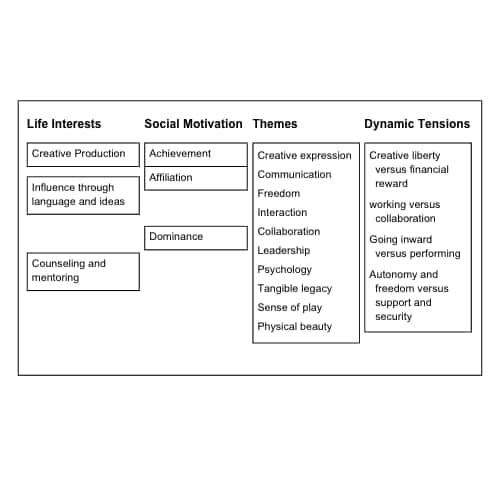
Source: Getting Unstuck by Timothy Butler (p. 149)

- Recurring interests, themes, needs, and tensions, can help us discern the roles, relationships, and environments that will have personal meaning. This process helps us define deeper patterns of the self, which allows us to pursue career changes with more confidence. However, these are only ephemeral images. The next chapter will cover the process of making decisions and meaningful changes.
Part III – Getting Unstuck
- Recognizing deeper patterns of the self isn’t enough. We must also find a will to act, no matter how small the actions are. The final step in dealing with an impasse is integrating what you’ve learned to make a decision and act on it.
Chapter 9: Moving from Impasse to Action
- Working through an impasse will eventually lead to a moment of choice. We need action so that vision doesn’t become a fantasy. Action leads to commitment. But such an action depends on decisions that inherently come with tension.
- When we have difficulty choosing a path to action, the first step is to explore each of the opposing poles in our dynamic tensions. With free attention and free of judgment, focus on one pole and the images that emerge.
- Focusing solely on one pole is difficult because our instinct is usually to flee from this uncomfortable tension. In these situations, compromise is tempting, but this rarely works or satisfies us.
- Exercise 1: Think about a difficult decision you face. Allow yourself to become aware of two or three competing alternatives.
- Every decision implies a loss, so focusing on one possibility seems unappealing. But spend time on each option, practicing free attention, developing images and associations, and noting feelings that emerge.
- Imagine that you made a decision. Think about the feelings that arise as you become aware of what you gave up. Don’t rationalize, just feel. Repeat this process with each option.
- Beyond this exercise, it is also helpful to take preliminary action to inform your final decision. E.g., Butler talks about a client who was torn between job opportunities, as he also felt pressure to go back to his home country. The client spent a summer in Indonesia to inform his final decision.
- Another effective form of preliminary action is talking to people who work in a job located at one of your poles.
- Exercise 2: Continue working on the dilemma you selected in exercise 1. For each alternative, think about people you can talk to get a better sense of what choosing a given direction would mean. Is there information you might be missing about this pole?
- Then, try taking preliminary action. Have a deep conversation with someone, read a book, and spend some time researching on the Internet about others’ experiences.
Chapter 10: Living at the Border
- Working through impasselets us become more comfortable “living at the border.” That is, dealing with uncertainty, ambiguity, and dynamic tensions.
- An impasseoccurs as we continue to avoid the work required in “living at the border.” The crisis is signaling that we need to take action now.
- This book guides you through the impasse process under the assumption that you’ve accepted that you are stuck and need disciplined work to overcome it. The experience is challenging but can become exciting.
- Impasse is an opportunity to “exchange certainty for vulnerability, sentimentality for depth of feeling, and the comfort of the familiar for the energy of a world that, as hard and exciting as it may be, is always beckoning” (p. 172).
Appendix:
- Appendix A: A Continuing Journey
- Butler shares an annotated bibliography: a list of resources and scientific evidence that can help you pursue the ideas presented in this book more deeply.
- Appendix B: A Note on Impasse and Depression
- An impasseoften comes with intense feelings and heaviness of mood. It may seem like your usual strategies to cheer yourself up do not work. You might notice that some impasse symptoms mimic those of depression. But it is critical to differentiate these two experiences, as impasse is never evidence of clinical depression.
- You can find the official definition and symptoms of depression in the Diagnostic and Statistical Manual of Mental Disorders (DSM-V). But summing up, the main difference between impasse and clinical depression is duration and intensity.
- Despite their distinction, neither impasse nor depression should be faced alone. Help can come from friends and loved ones; or, at times, we might need to reach beyond our circle and seek professional help.
- Appendix C: Scoring the One Hundred Jobs Exercise
- Butler shares a list of 100 jobs and the interest category under which each of the jobs falls.
- An impasseoften comes with intense feelings and heaviness of mood. It may seem like your usual strategies to cheer yourself up do not work. You might notice that some impasse symptoms mimic those of depression. But it is critical to differentiate these two experiences, as impasse is never evidence of clinical depression.
