



Introduction
At some point in our lives, we’ve all found ourselves facing a difficult decision, feeling the weight of uncertainty pressing down on us.
Whether it’s choosing between two job offers, making a career change, or even deciding on a major life path, the process can often feel daunting. In some instances, the sheer number of options laid out before us can be overwhelming, each carrying its own set of risks and rewards. Behavioral scientists describe this phenomenon as the paradox of choice – the more choices we have, the less in control of our fate we feel.
We’ve all experienced that sinking feeling of indecision, wishing we could avoid the responsibility that comes with making such pivotal choices. The fear of making the wrong decision looms large, as we know all too well the potential ripple effect it could unleash. Yet it’s in these moments of uncertainty that we find the opportunity for growth, resilience, and ultimately, the chance to shape our own destiny.
Despite its apparent simplicity, decision-making is a skill often overlooked in our journey through life. We tend to take it for granted, assuming that it’s something we inherently know how to do. However, the truth is that effective decision-making is a learned skill, one that requires practice and refinement.
The good news is that it’s never too late to start honing this skill. By consciously embracing the process of making decisions, we become better able to make informed and thoughtful decisions, paving the way for a more fulfilling career journey and life path – one that aligns with our values, aspirations, and ambitions.

What is Decision-Making?
Decision-making is the process of selecting a choice or course of action from multiple alternatives. It involves identifying a problem or opportunity, gathering relevant information, evaluating options based on various criteria, and ultimately making a choice.
Decision-making can range from simple everyday choices, such as what to eat for breakfast, to complex and consequential decisions, such as considering a job offer or buying a new car. In any case, decision-making is a fundamental aspect of human cognition and behavior, influencing both the personal and professional parts of our lives.
Decision-Making in Professional Development
Learning effective decision-making skills is essential for professional success for several reasons:
- Enhanced Problem-Solving Abilities: Decision-making skills enable us to approach problems systematically, without fear or paralysis, and find effective solutions. This ability is crucial in professional settings where complex challenges often arise, such as in project management, customer service, or strategic planning.
- Improved Time Management: Making decisions efficiently can help us manage our time more effectively. By evaluating options and choosing a course of action promptly, we avoid procrastination and ensure tasks are completed in a timely and thoughtful manner.
- Increased Confidence: Developing strong decision-making skills instills confidence that allows us to tackle new challenges and take calculated risks. Confidence in decision-making abilities is essential for leadership roles and for seizing opportunities for advancement, such as promotions.
- Better Leadership Qualities: Effective leaders are skilled decision-makers. Learning to make decisions that consider the needs and perspectives of others fosters trust and respect. And leaders who can make tough decisions confidently and transparently inspire confidence and loyalty.
- Strategic Thinking: Decision-making skills are closely linked to strategic thinking. Professionals who can anticipate potential outcomes, weigh alternatives, and align decisions with long-term goals contribute significantly to organizational success. Strategic decision-making is vital for managers, executives, and entrepreneurs as they navigate competitive business environments.
- Adaptability and Resilience: Learning decision-making skills helps us become more adaptable and resilient in the face of change or uncertainty. They help us more quickly assess situations, make informed decisions, and adjust course as needed.
Key Frameworks
To help you hone your decision-making skills, consider the following models and frameworks that individuals and organizations commonly rely on to make smart choices.
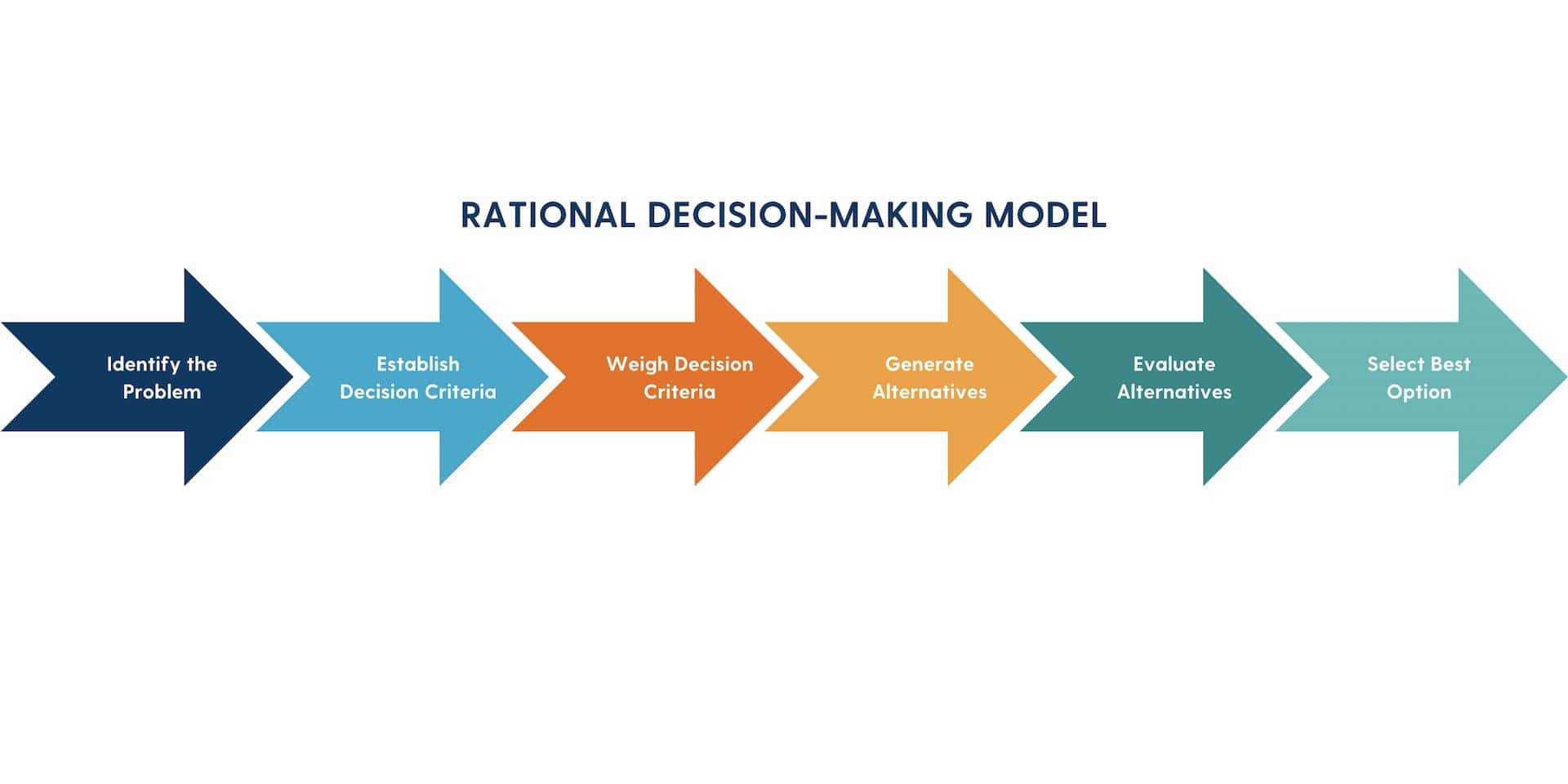
- Rational Decision-Making Model: This model suggests that decision-makers identify objectives, evaluate alternatives based on criteria, choose the best alternative, and implement and monitor the decision. It emphasizes logical and systematic decision-making.
- Normative Decision Theory: This theory provides a framework for evaluating decisions based on expected outcomes and the probabilities of those outcomes. It involves maximizing expected utility or satisfaction.
- Bounded Rationality: Proposed by Herbert Simon, this model acknowledges that decision-makers may not have the time, resources, or cognitive capacity to analyze all possible alternatives comprehensively. Instead, they satisfice, or choose the first acceptable option that meets their criteria.
- Pros and Cons Analysis: This simple yet effective framework involves listing the pros and cons of each alternative and evaluating their relative importance. It helps decision-makers compare options and make informed choices.
- Decision Trees: Decision trees visually represent decisions and their potential outcomes, including probabilities and payoffs. They are particularly useful for complex decisions with multiple possible outcomes and uncertainties.
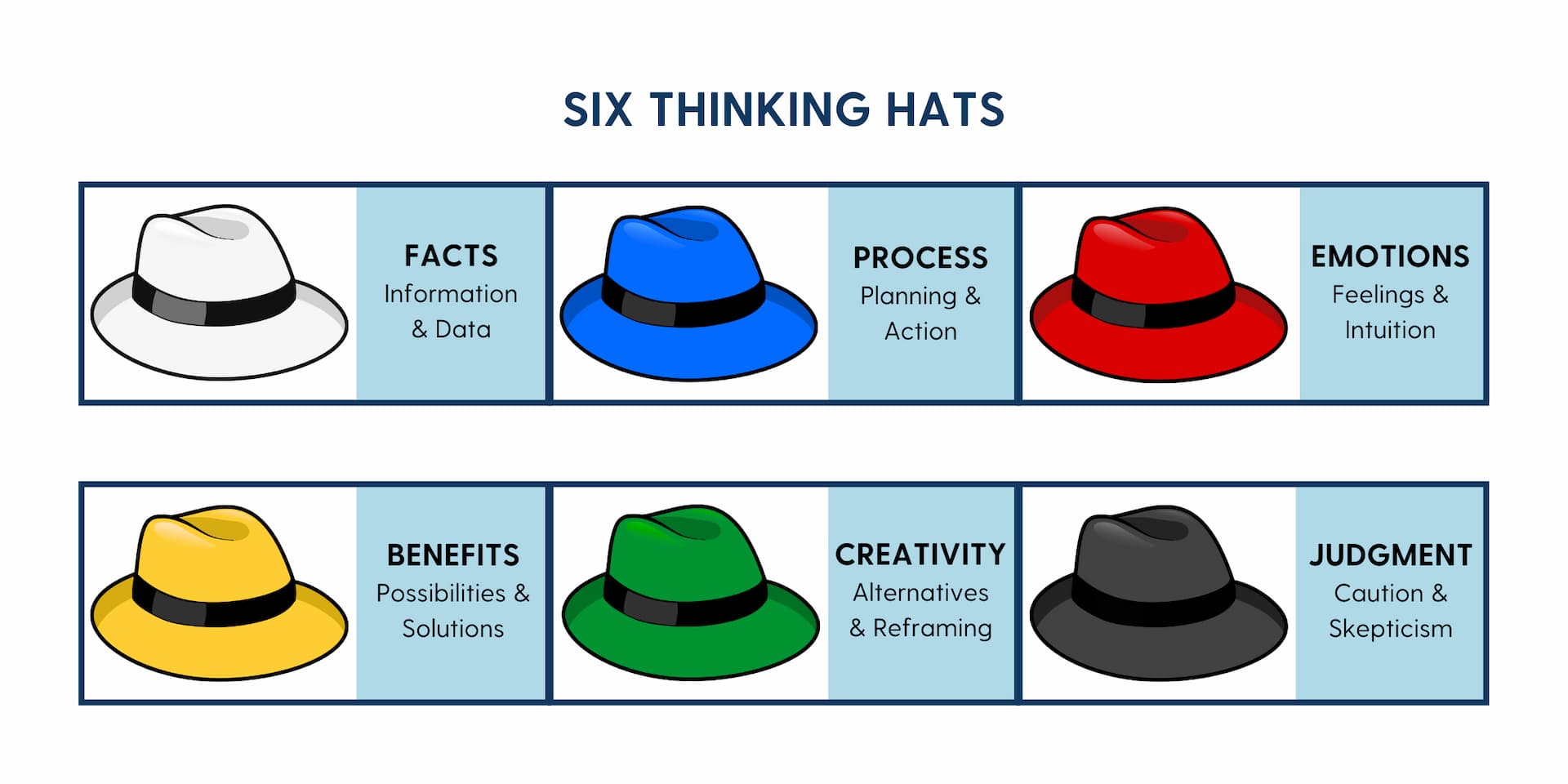
- Six Thinking Hats: Developed by Edward de Bono, this method involves looking at a decision from six different perspectives, each represented by a colored “hat” (e.g., white for facts, red for emotions, black for critical judgment, etc. See below). It helps stimulate creative thinking and consider various aspects of a decision.
- SWOT Analysis: This framework involves analyzing the strengths, weaknesses, opportunities, and threats in a current state to aid in making a decision or choosing a course of action. It helps decision-makers assess internal and external factors and develop strategies to leverage strengths and mitigate weaknesses.
- Multi-Criteria Decision Analysis (MCDA): MCDA involves evaluating alternatives against multiple criteria or objectives. It helps decision-makers consider trade-offs and preferences systematically and quantitatively.
- Game Theory: Game theory models decision-making in competitive situations where the outcome depends on the choices of multiple actors. It helps analyze strategic interactions and predict outcomes in scenarios such as negotiations, conflicts, or market competition.
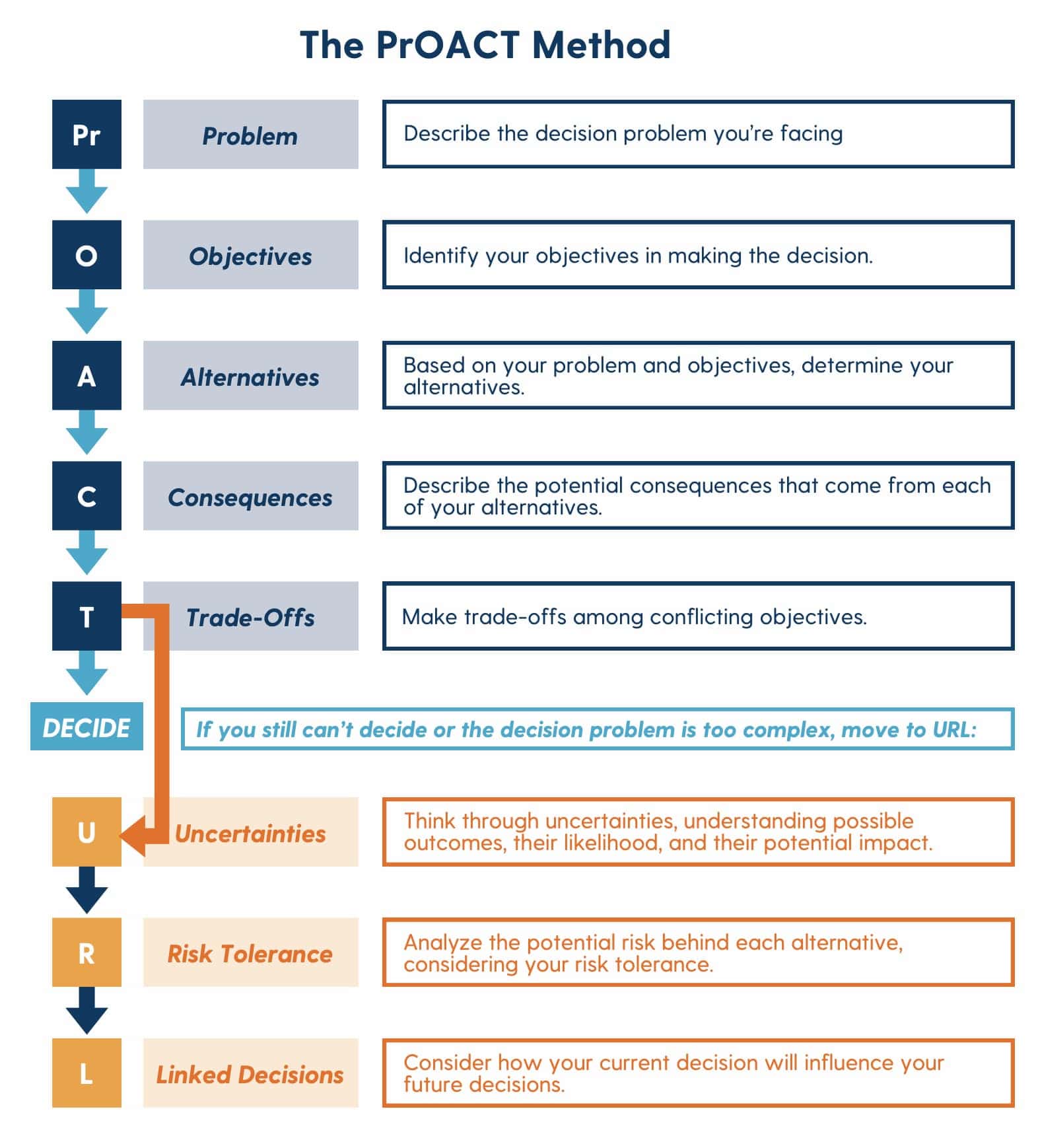
- The PrOACT Method: Outlined in the book Smart Choices, this method is a structured approach to systematic decision-making that focuses on defining the real problem (as sometimes we get caught up in the symptoms or parts of the real problem), analyzing our objectives, examining all possible alternatives, assessing potential consequences, and considering trade-offs. In instances when the decision is highly complex, this method adds three more steps: thinking through uncertainties, analyzing potential risks, and considering linked decisions (those that will need to be made depending on the present one).


These frameworks and models offer different approaches to decision-making, allowing individuals and organizations to select the most appropriate one based on the complexity of the decision, available information, and decision-makers’ preferences and constraints.
Thought Leaders
Some thought leaders who have made significant contributions to the understanding of decision-making processes, biases, and strategies include:
- John S. Hammond: Co-author of Smart Choices and a renowned expert in decision analysis, Hammond has contributed significantly to understanding decision-making processes by providing strategies for systematically making good choices.
- Ralph L. Keeney: Another co-author of Smart Choices, Keeney is known for his work in decision analysis, risk management, and value-focused thinking.
- Howard Raiffa: A third co-author of Smart Choices, and a pioneer in decision analysis, Raiffa’s work has influenced the fields of negotiation, game theory, and decision science.
- Daniel Kahneman: A Nobel Prize-winning psychologist and author of Thinking, Fast and Slow, Kahneman is widely regarded as one of the most influential figures in decision-making research. His work on cognitive biases, prospect theory, and behavioral economics profoundly impacted the understanding of human decision-making processes.
- Amos Tversky: Amos Tversky’s collaboration with Daniel Kahneman produced groundbreaking research on cognitive biases, heuristics, and decision-making under uncertainty. Their work laid the foundation for the field of behavioral economics.
- Herbert Simon: A Nobel Prize-winning economist and cognitive psychologist, Simon made significant contributions to decision-making theory, particularly in the areas of bounded rationality and satisficing.
- Gary Klein: Known for his work in naturalistic decision-making, Klein has studied how experts make decisions under time pressure and in complex, real-world situations.
- Baruch Fischhoff: A psychologist and expert in risk perception and communication, Fischhoff’s research has shed light on how people make decisions in uncertain and high-stakes contexts.
- Cass R. Sunstein: A legal scholar and behavioral economist, Sunstein’s work explores the intersection of law, economics, and psychology, including how policy decisions can be influenced by behavioral insights.
- Gerd Gigerenzer: A psychologist and director of the Harding Center for Risk Literacy, Gigerenzer’s research focuses on decision-making under uncertainty and the role of heuristics in rational decision-making.
Conclusion
Decision-making can often feel like an uphill battle, fraught with uncertainty and anxiety. Despite its constant presence, making decisions is rarely explicitly taught. Yet it’s crucial to recognize that mastering decision-making is not an innate talent but rather a skill that can be cultivated and strengthened over time. Regardless of age or experience, it’s never too late to sharpen these skills. By adopting proper decision-making processes, you can alleviate the stress and overwhelm associated with tough choices and unlock doors to personal and professional growth. Honing decision-making skills can pave the way for a more fulfilling and successful life journey.
Other Resources
- HBR: The Hidden Traps in Decision-Making
https://hbr.org/2006/01/the-hidden-traps-in-decision-making - HBR: How To Make Great Decisions Quickly
https://hbr.org/2022/03/how-to-make-great-decisions-quickly - HBR: What You Don’t Know About Decision-Making
https://hbr.org/2001/09/what-you-dont-know-about-making-decisions - HBR: What Are You Decision-Making Strengths and Blind Spots?
https://hbr.org/2022/08/what-are-your-decision-making-strengths-and-blind-spots - Forbes: How Get Better at Decision-Making as a Leader
https://www.forbes.com/sites/forbescoachescouncil/2023/08/29/how-to-get-better-at-decision-making-as-a-leader/
