



Imagine yourself seated at your desk, surrounded by projects with deadlines looming. As overwhelmed as you might be, there’s something that drives you to push through, even if the path seems daunting. What is that magic force? It’s motivation!
But what’s really behind motivation?
What is Motivation, and Where Does it Come From?
Motivation propels our actions, behaviors, and choices. It’s what compels us to pursue and achieve our goals. Motivation can stem from various sources, including intrinsic factors like personal interests, passions, and values, as well as extrinsic factors like rewards, recognition, and social influence. It plays a crucial role in shaping our attitudes, directing our efforts, and sustaining our commitment toward desired outcomes. Motivation is also what keeps us going when we face challenges and what inspires us to strive for success and fulfillment in life.
Why Is Motivation Important?
Motivation is the foundation of professional and personal development. In a career context, it empowers us to navigate our professional journeys with purpose, resilience, and a pursuit of excellence. By cultivating and nurturing your motivation, you can not only propel your career forward but also unlock a broad spectrum of opportunities for growth, fulfillment, and success.
Motivation specifically leads to personal growth, professional achievement, and long-term success through the following mechanisms:
- Goal Clarity and Direction: Motivation provides clarity on our career goals and aspirations, helping us identify what we want to achieve and the steps needed to get there. It acts as a compass, guiding us along our career paths with purpose and determination.
- Increased Productivity and Performance: Motivated individuals are more likely to be focused, engaged, and productive in their work. With a strong sense of purpose and drive, we’re inclined to tackle tasks with enthusiasm, leading to higher levels of performance and efficiency.
- Resilience in the Face of Challenges: Career development is often fraught with obstacles and setbacks. However, motivation fosters resilience, enabling us to bounce back from setbacks, learn from failures, and persevere in the pursuit of our professional goals.
- Continuous Learning and Growth: Motivated people are inherently driven to seek out new opportunities for learning and skill development, such as pursuing further education, seeking mentorship, or taking on challenging projects. Motivation fuels a mindset of continuous growth and improvement.
- Career Advancement and Opportunities: Motivation distinguishes high performers in the workplace, making them more likely to be recognized for their efforts and considered for advancement opportunities. Proactive individuals who demonstrate initiative and drive are often rewarded with greater responsibilities, promotions, and career advancement.
- Job Satisfaction and Fulfillment: Motivation aligns our career choices with our personal values, interests, and passions, leading to greater job satisfaction and fulfillment. When we’re driven by intrinsic motivations, such as a genuine interest in our work or a desire to make a positive impact, we’re more likely to find fulfillment in our careers.
How Does One Nurture a Sense of Motivation?
Stimulating motivation involves a combination of strategies aimed at tapping into both our intrinsic and extrinsic sources of drive. Here are several approaches:
- Set Clear Goals: Define specific, measurable, and achievable goals that align with your values and aspirations. Having clear objectives provides a sense of purpose and direction, motivating you to take action to achieve them.
- Find Your Why: Connect deeply with the reasons behind your goals. Understanding the underlying purpose and significance of your pursuits can ignite intrinsic motivation, driving you to overcome obstacles and stay committed to your objectives in the long term.
- Break Tasks into Manageable Steps: Break down larger goals into smaller, manageable tasks. Accomplishing these smaller milestones provides a sense of progress and momentum, keeping motivation levels high as you work towards your overarching objectives.
- Create a Supportive Environment: Surround yourself with people who inspire and support your goals. Seek out mentors, peers, or accountability partners who can provide encouragement, guidance, and constructive feedback along your journey.
- Celebrate Progress: Acknowledge and celebrate your achievements, no matter how small. Recognizing progress reinforces positive behaviors and boosts confidence, fueling your motivation to continue moving forward.
- Seek Inspiration: Expose yourself to sources of inspiration that resonate with your goals and aspirations. Whether it’s reading books and articles, listening to podcasts, or attending workshops and conferences, surrounding yourself with inspiration can reignite your passion and drive.
- Practice Self-Compassion: Be kind to yourself and recognize that setbacks and challenges are a natural part of the journey. Treat yourself with understanding and forgiveness, which will allow you to bounce back from setbacks and maintain motivation in the face of adversity.
- Maintain a Healthy Lifestyle: Prioritize self-care by maintaining a balanced lifestyle that includes regular exercise, nutritious eating, adequate sleep, and stress management. A healthy body and mind provide the foundation for sustained motivation and productivity.
- Stay Flexible and Adapt: Remain open to adjusting your goals and strategies as needed. Flexibility and adaptability are essential for navigating unexpected challenges and staying motivated in the face of change.

Image used under license of Shutterstock.com

Is Motivation Contagious?
Motivation plays a key role not just in influencing your success, but also that of your team. That’s because motivation can be contagious. When we see others around us displaying enthusiasm, passion, and drive toward their goals, it can inspire and energize us to adopt similar attitudes and behaviors. This phenomenon is often referred to as social contagion or emotional contagion, where emotions and behaviors spread rapidly within social groups through nonverbal cues, verbal communication, and observational learning.
Additionally, being surrounded by motivated individuals can positively influence our own motivation levels. Witnessing a colleague’s dedication to a project, participating in a team with a shared sense of purpose, or being part of a supportive community all lead to a ripple effect, where we become motivated to set higher goals, work harder, and stay committed to our objectives. However, the opposite is also true. A lack of motivation or negative attitudes within a group can also spread and dampen our motivation. Therefore, surrounding ourselves with motivated and positive influences can help cultivate and sustain our own motivation over time.

Image used under license of Shutterstock.com
Theories, Frameworks, and Models
- Maslow’s Pyramid of Needs: People are motivated to fulfill a hierarchical sequence of needs, starting with basic physiological requirements and progressing to higher-level needs like self-actualization.
- Vroom’s Expectancy Theory: Motivation depends on the expectation that effort will lead to performance, performance will lead to outcomes, and those outcomes will be valued.
- Adams’s Equity Theory: Individuals are motivated when they perceive their inputs (effort, skills) and outcomes (rewards, recognition) to be fair and equitable.
- Locke’s Goal-Setting Theory: Specific and challenging goals lead to higher performance when individuals are committed to achieving them.
- McClelland’s Three Needs Theory: People are motivated by three fundamental needs—achievement, affiliation, and power— the relative weight of each depend on an individual’s dominant need.
- Herzberg’s Two-Factor Theory: Job satisfaction and dissatisfaction are influenced by two sets of factors: hygiene factors (working conditions, salary) and motivators (recognition, achievement), with each having independent effects on motivation and job satisfaction.To learn more, take a look at Dr. Hayley Lewis’s Sketchnote below, where she summarizes and illustrates these theories.
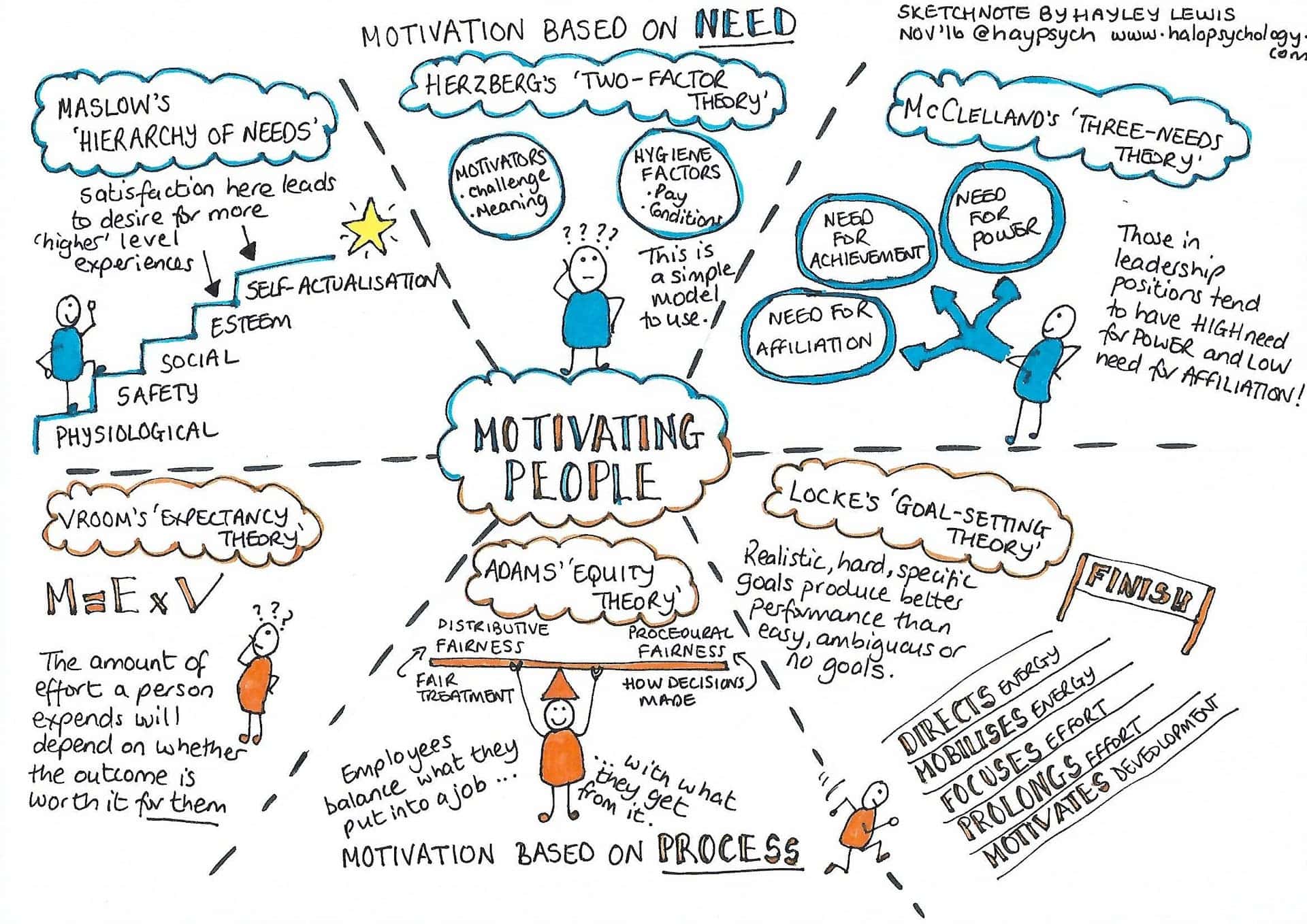
Image used with authorization from Haley Lewis, Ph.D., and obtained from Halo Psychology

- Attribution Theory: People interpret the causes of their own and others’ behavior, and their perceptions of the causes of their success or failure influence their motivation and subsequent behavior.
- Self-Determination Theory (SDT): People are more motivated when they have a sense of autonomy, feel competent in their abilities, and experience meaningful connections with others. You can also check out Dr. Hayley Lewis’s Sketchnote below to learn more about SDT.
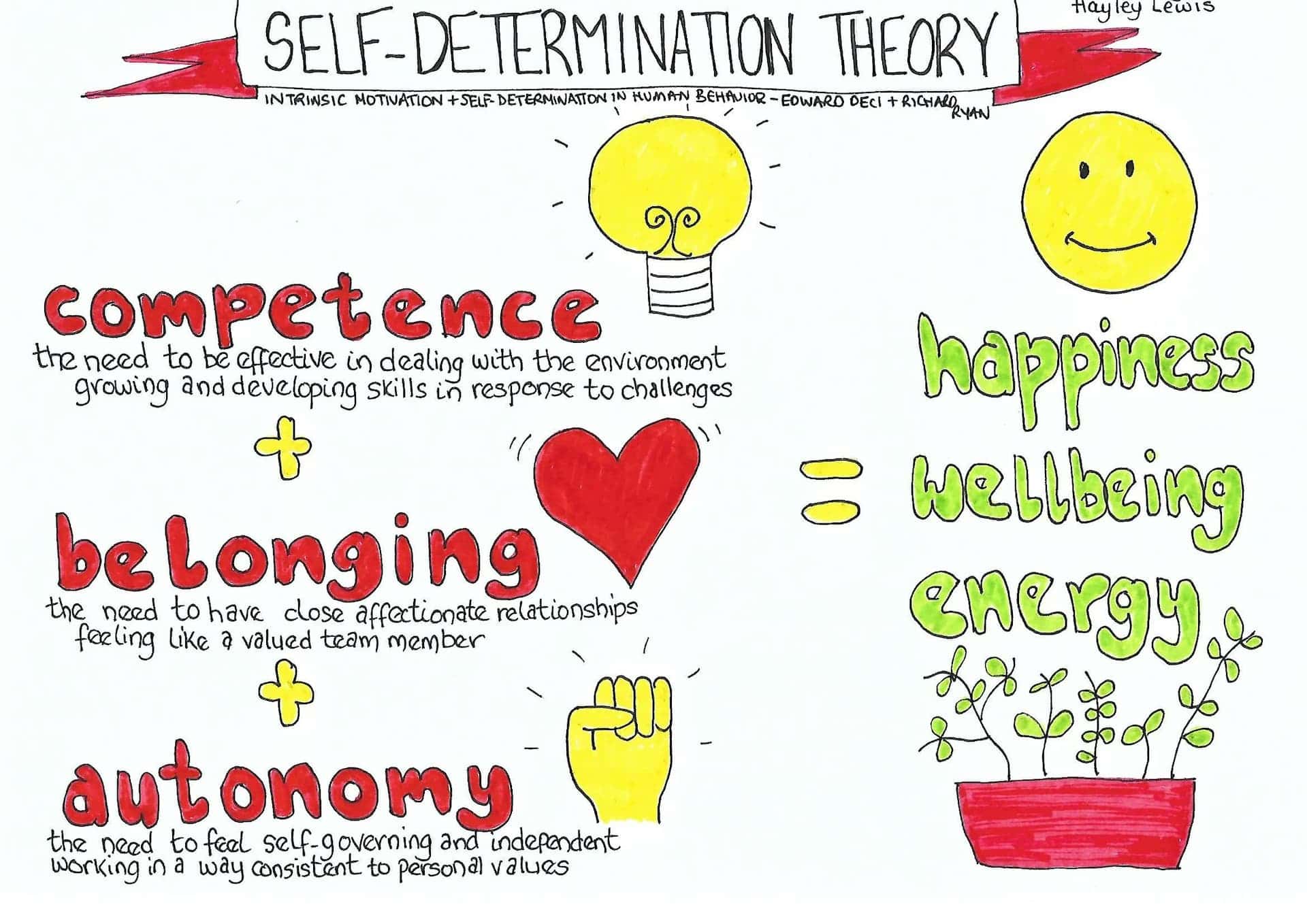
Image used with authorization from Haley Lewis, Ph.D., and obtained from Halo Psychology

Thought Leaders
There are several influential researchers and thought leaders who have contributed to our understanding of human motivation and behavior. Some of these leaders include:
- Abraham Maslow: Maslow was an American psychologist. Throughout his career, Maslow worked as a professor and researcher, focusing on human motivation and personality. He is best known for his work on the hierarchy of needs, which has had a profound impact on psychology, management, and various other fields.
- Frederick Herzberg: Herzberg was an American psychologist who held various academic positions and conducted research in industrial and organizational psychology. His two-factor theory of motivation, published in the book The Motivation to Work in 1959, remains a seminal work in the field.
- Victor Vroom: Vroom is a Dutch-American psychologist. He had a distinguished academic career, teaching at institutions such as the Yale School of Management and the London Business School. He is widely known for his work on expectancy theory, which has influenced research and practice in organizational behavior and management.
- Edward Deci and Richard Ryan: Deci and Ryan are both American psychologists known for their work on self-determination theory (SDT). Together, they have conducted extensive research on human motivation, autonomy, and well-being, contributing to the development of SDT as a leading theory of motivation.
- Edwin Locke: Locke was an American psychologist. He held academic positions at institutions such as the University of Maryland and the University of Utah. He is renowned for his research on goal setting and motivation, which has had a significant impact on organizational behavior and management theory.
- Clayton Alderfer: Alderfer was an American psychologist who held academic positions at institutions such as Yale University and Rutgers University. He is best known for his ERG theory, which builds upon Maslow’s hierarchy of needs and provides a framework for understanding human motivation in organizational settings.
- Stacy Adams: Adams is an American psychologist known for his work on equity theory. He held academic positions at institutions such as the University of Michigan and the University of Washington. His research on equity theory has had implications for understanding motivation, fairness, and social exchange in organizations.
- Daniel Pink: Pink is an author, speaker, and former speechwriter for Al Gore. He has written several bestselling books on topics related to work, business, and human behavior, including Drive: The Surprising Truth About What Motivates Us. Pink’s work often explores concepts such as motivation, persuasion, creativity, and the changing nature of work in the modern world.
- Michael Jensen: Jensen was an economist and professor known for his work in corporate finance, agency theory, and organizational economics. He has made significant contributions to understanding issues related to corporate governance, executive compensation, and organizational structure. Jensen has been affiliated with institutions like Harvard Business School and the Monitor Group.

Image used under license of Shutterstock.com

Motivation in Leadership
Managers are tasked with many responsibilities, but one of the most important is motivating their employees. This multifaceted task requires understanding individual needs, providing support, and creating an environment conducive to growth and fulfillment.
Here are some strategies you can employ to motivate your employees effectively:
- Set a Compelling Vision: Clearly communicate the organization’s vision, mission, and values to employees. Help them understand the purpose behind their work and how it contributes to the larger goals of the organization.
- Provide Autonomy: Empower employees by giving them autonomy and control over their work. Allow them to make decisions, take ownership of projects, and pursue their ideas. Autonomy fosters a sense of responsibility and increases motivation.
- Offer Opportunities for Growth: Provide opportunities for professional development and career advancement. Offer training programs, mentorship opportunities, and challenging assignments that allow employees to learn and grow in their roles.
- Recognize and Appreciate: Acknowledge and appreciate employees’ efforts and contributions. Recognize their achievements publicly and provide constructive feedback to reinforce positive behaviors. Feeling valued and appreciated motivates employees to perform at their best.
- Foster a Positive Work Environment: Cultivate a supportive and inclusive work culture where employees feel respected, valued, and connected. Encourage collaboration, open communication, and teamwork to create a sense of belonging and camaraderie.
- Set Clear Goals and Expectations: Define clear goals, objectives, and expectations for employees. Ensure that goals are challenging yet attainable, and provide regular feedback on progress. Clear goals give employees a sense of purpose and direction.
- Lead by Example: Demonstrate enthusiasm, passion, and dedication in your own work. Be an inspiring role model for your team and embody the values and behaviors you wish to see in others. Your actions will speak louder than words.
- Promote Work-Life Balance: Encourage a healthy work-life balance by offering flexible work arrangements, promoting time off, and respecting boundaries. Supporting employees’ well-being helps prevent burnout and enhances motivation.
- Celebrate Achievements: Celebrate team and individual successes to boost morale and motivation. Whether it’s reaching milestones, completing projects, or achieving goals, take the time to recognize and celebrate accomplishments.
- Listen and Solicit Feedback: Actively listen to employees’ ideas, concerns, and feedback. Encourage open communication and create opportunities for dialogue. Employees who feel heard and valued are more engaged and motivated.
Additionally, leaders can benefit from understanding the elements that encourage an honest desire to obtain success. Parker, Bindl, and Strauss (2010) proposed that there are three motivational states for goal achievement:
- Can Do Motivation: Our belief in our capability to successfully perform the tasks required to achieve our goals. It involves feelings of confidence and self-efficacy regarding our abilities.
- Reason To Motivation: Our perception of the significance and relevance of our goals. It involves having a clear understanding of the purpose behind pursuing the goal and feeling a sense of ownership and control over our actions.
- Energized To Motivation: Our emotional engagement and enthusiasm towards our goals. It involves feeling connected to the goal and experiencing positive emotions such as excitement, passion, and intrinsic motivation.
These three states and underlying needs collectively influence individuals’ motivation and goal pursuit. You can learn more about these three motivational states by checking out Dr. Hayley Lewis’s Sketchnote below.

Image used with authorization from Haley Lewis, Ph.D., obtained from Halo Psychology
A Caveat
Motivation is often touted as the magic ingredient for success, but its perceived importance can sometimes be overstated. While motivation can provide an initial spark and fuel enthusiasm, relying solely on motivation to achieve long-term goals can be problematic. Motivation is inherently transient, fluctuating with mood, external circumstances, and other factors. Moreover, it often wanes over time, leading to inconsistency in effort and progress. In reality, sustained success requires discipline, perseverance, and strategic planning, elements that transcend fleeting motivation. Therefore, while motivation undoubtedly has its place, emphasizing its significance above all else can lead to unrealistic expectations and eventual disappointment. Instead, cultivating habits, setting realistic goals, and fostering resilience are essential components of achieving lasting success.
Conclusion
Motivation serves as a powerful force that drives human behavior and achievement, yet its complexities defy simple explanations. While motivation can provide the initial spark needed to embark on a journey towards our goals, it is often sustained by discipline, perseverance, and strategic planning. Recognizing that motivation is multifaceted and subject to fluctuations, we need to cultivate habits and mindsets that support our long-term aspirations. By harnessing our intrinsic values, leveraging external rewards judiciously, and fostering resilience in the face of challenges, we can navigate the ebb and flow of motivation to realize our full potential. Ultimately, understanding and mastering the art of motivation empowers us to chart our own paths to success and fulfillment in life.
Other Resources
- HBR: Understanding the Power of Intrinsic Motivation
- HBR: Why People Lose Motivation — and What Managers Can Do to Help
- HBR: One More Time: How Do You Motivate Employees?
- HBR: A Guide To Motivating Yourself at Work
- HBR: How to Keep Working When You’re Just Not Feeling It
- Daniel Pink’s Drive
- PathWise Book Summary of Drive
