



Creativity is the backbone of innovation. It helps the individual and the organization achieve goals, grow, and succeed. But how does creativity lead to positive results, and how can we foster our creative side, even if we don’t feel it comes naturally to us?
What is creativity?
In the context of work and career management, creativity refers to the ability to generate new ideas, solutions, or approaches to tasks or problems. It’s thinking outside the box, challenging conventional wisdom, or proposing new perspectives.
In the workplace, creativity can manifest in various forms:
- Problem-solving: Creative people come up with innovative solutions to complex problems by considering unconventional approaches or combining different ideas.
- Product or Service Innovation: Creativity drives the development of new products, services, or processes that meet evolving customer needs or create entirely new markets.
- Process Improvement: Creativity can lead to more efficient workflows, streamlined processes, and increased productivity.
- Adaptability: Creative people are often more adaptable to change because they can think on their feet, explore alternative options, and embrace new challenges with an open mind.
- Communication: Creativity also enhances communication skills, allowing individuals to convey ideas, concepts, or visions in compelling and engaging ways.
- Collaboration: Creativity fosters collaboration by encouraging diverse perspectives and in brainstorming sessions where team members can freely contribute ideas without fear of judgment.

Image used under license of Shutterstock.com
Thought Leaders
Several thought leaders have made significant contributions to the understanding of creativity and its role in the workplace. Some notable figures include:
- Sir Ken Robinson: Renowned author, speaker, and education expert known for his TED Talk Do Schools Kill Creativity? Robinson’s work focuses on fostering creativity in the context of education and promoting environments that nurture innovation.
- Teresa Amabile: Harvard Business School professor and author of The Progress Principle, Amabile’s research centers on creativity, innovation, and motivation in the workplace. She has conducted extensive studies on the factors that influence creativity within organizational settings.
- Mihaly Csikszentmihalyi: A psychologist and author known for his concept of flow, Csikszentmihalyi has explored the conditions that foster creativity and optimal human experiences. His work emphasizes the importance of intrinsic motivation and deep engagement in creative endeavors.
- Adam Grant: An organizational psychologist and author of Originals: How Non-Conformists Move the World, Grant examines the dynamics of creativity, innovation, and success. He explores how individuals can generate original ideas within organizational contexts.
- Scott Barry Kaufman: A psychologist and author known for his work on creativity, intelligence, and personal growth, Kaufman explores the intersection of creativity and well-being, highlighting the role of self-actualization and fulfilling one’s creative potential.
- Tina Seelig: Stanford University professor and author of inGenius: A Crash Course on Creativity, Seelig’s work focuses on opening creative potential and fostering innovation. She offers practical strategies for cultivating creativity in both individuals and organizations.
- David Kelley: Founder of the design firm IDEO and the Stanford d.school, Kelley is a leading figure in the field of design thinking and innovation. He advocates for a human-centered approach to problem-solving and emphasizes the importance of empathy and experimentation in the creative process.
Key Frameworks
Key creativity frameworks in the context of the workplace that provide structured approaches to understanding, fostering, and implementing creative processes include:
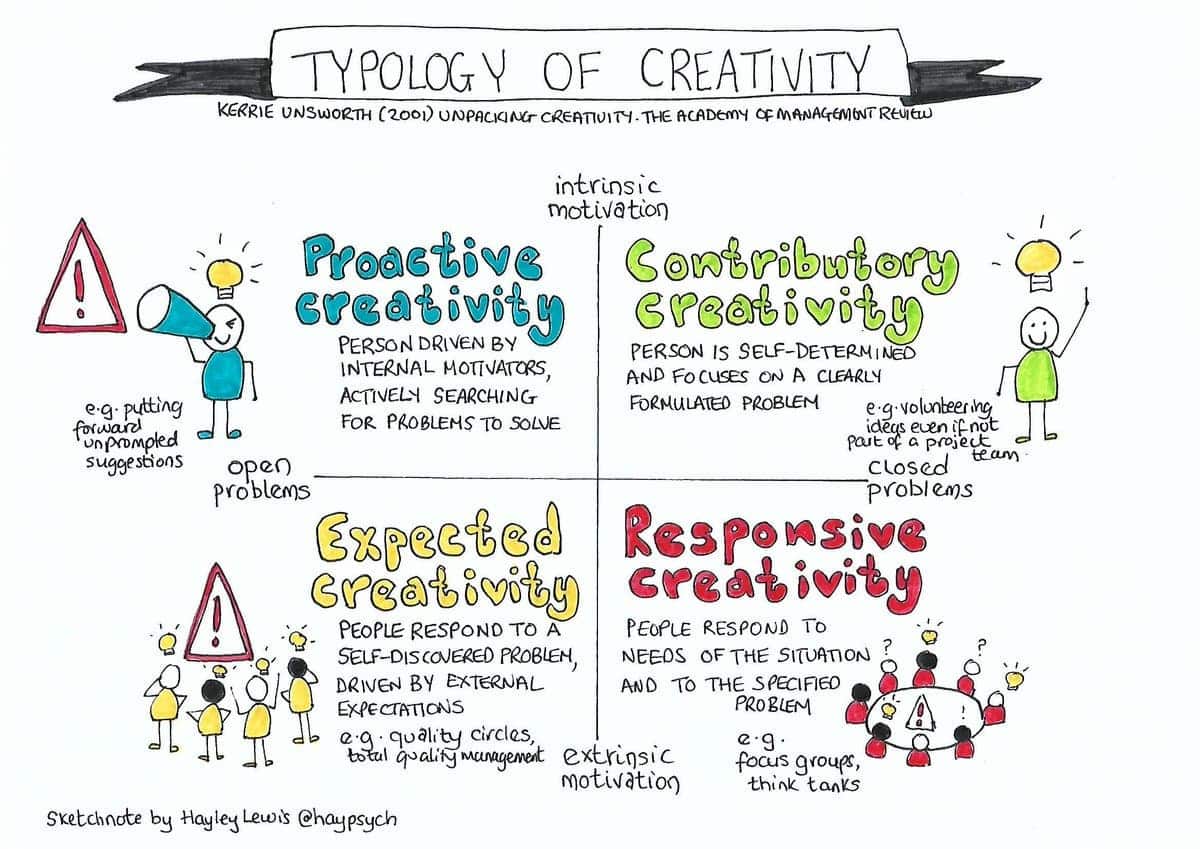
- The Typology of Creativity: Arguing that researchers have mistakenly assumed that creativity is a unitary construct, Kerrie Unsworth proposed a matrix that classifies creativity depending on the problem type and motivation source. To learn more about the four types of creativity, take a look at Dr. Hayley Lewis’s Sketchnote below, reposted with her permission.
- Design Thinking: Design thinking is a human-centered approach to innovation that emphasizes empathy, ideation, prototyping, and testing. It involves understanding users’ needs, generating creative solutions, and iterating based on feedback. Popularized by design firms like IDEO, the design thinking process typically consists of phases such as empathize, define, ideate, prototype, and test.
- Osborn-Parnes Creative Problem-Solving Process: Developed by advertising executive Alex Osborn and further refined by Sidney J. Parnes, this process outlines a structured approach to generating creative solutions to problems. It involves stages such as clarifying the challenge, generating ideas, developing solutions, and implementing an action plan.
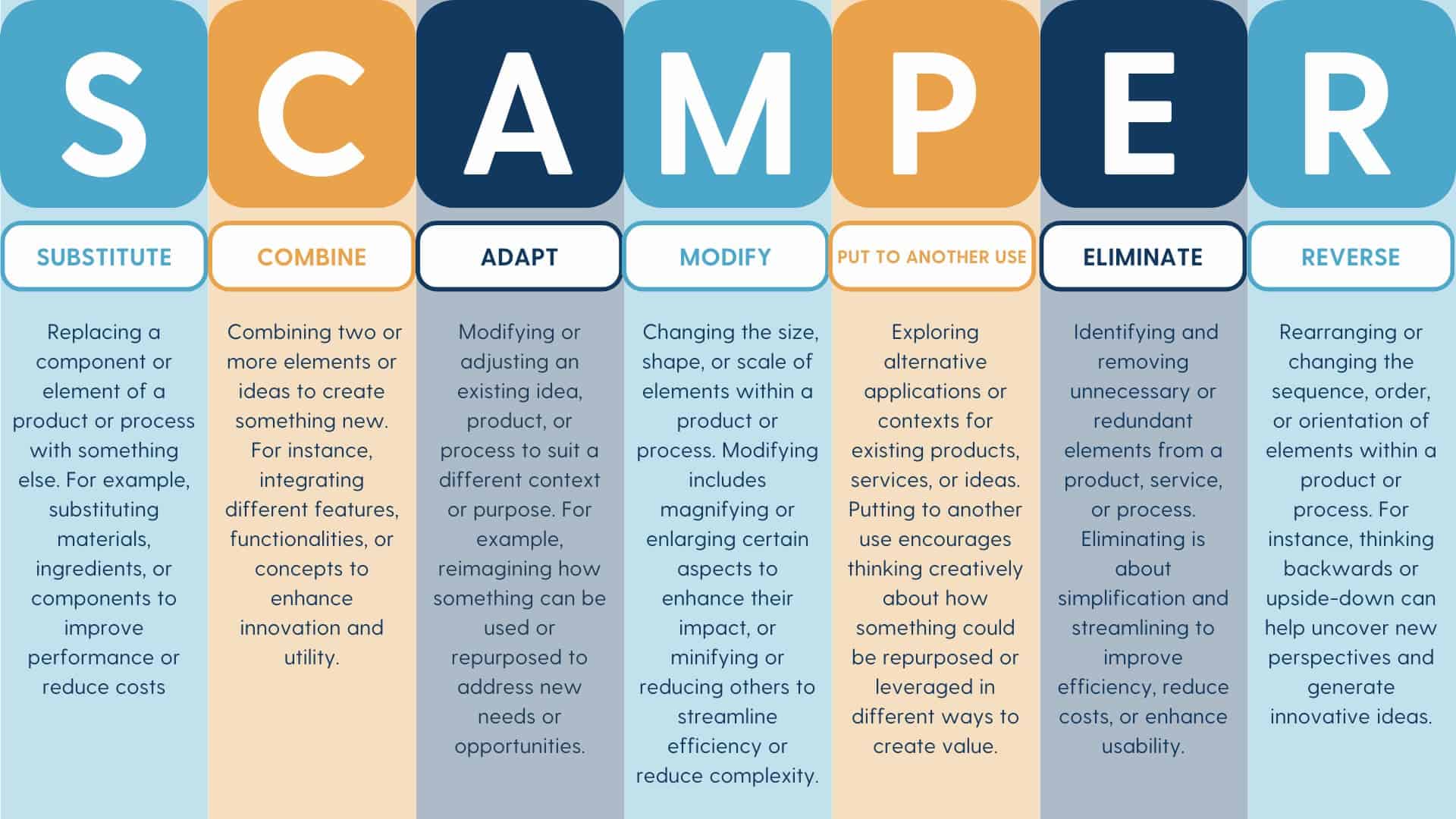
- SCAMPER: SCAMPER is a mnemonic that represents different techniques for generating creative ideas. Each letter stands for a different approach: Substitute, Combine, Adapt, Modify, Put to Another Use, Eliminate, and Reverse. This framework is about exploring ways to modify existing ideas or products to generate new and innovative solutions.
- Lean Startup: The Lean Startup methodology, popularized by Eric Ries, advocates for a build-measure-learn approach to entrepreneurship and innovation. It emphasizes rapid experimentation, iterative product development, and customer feedback to minimize risk and maximize the chances of success.
- Blue Ocean Strategy: Blue Ocean Strategy, developed by W. Chan Kim and Renée Mauborgne, is a framework for creating uncontested market space and making competition irrelevant. It involves identifying and tapping into new market opportunities by offering unique value propositions that differentiate a company from competitors.
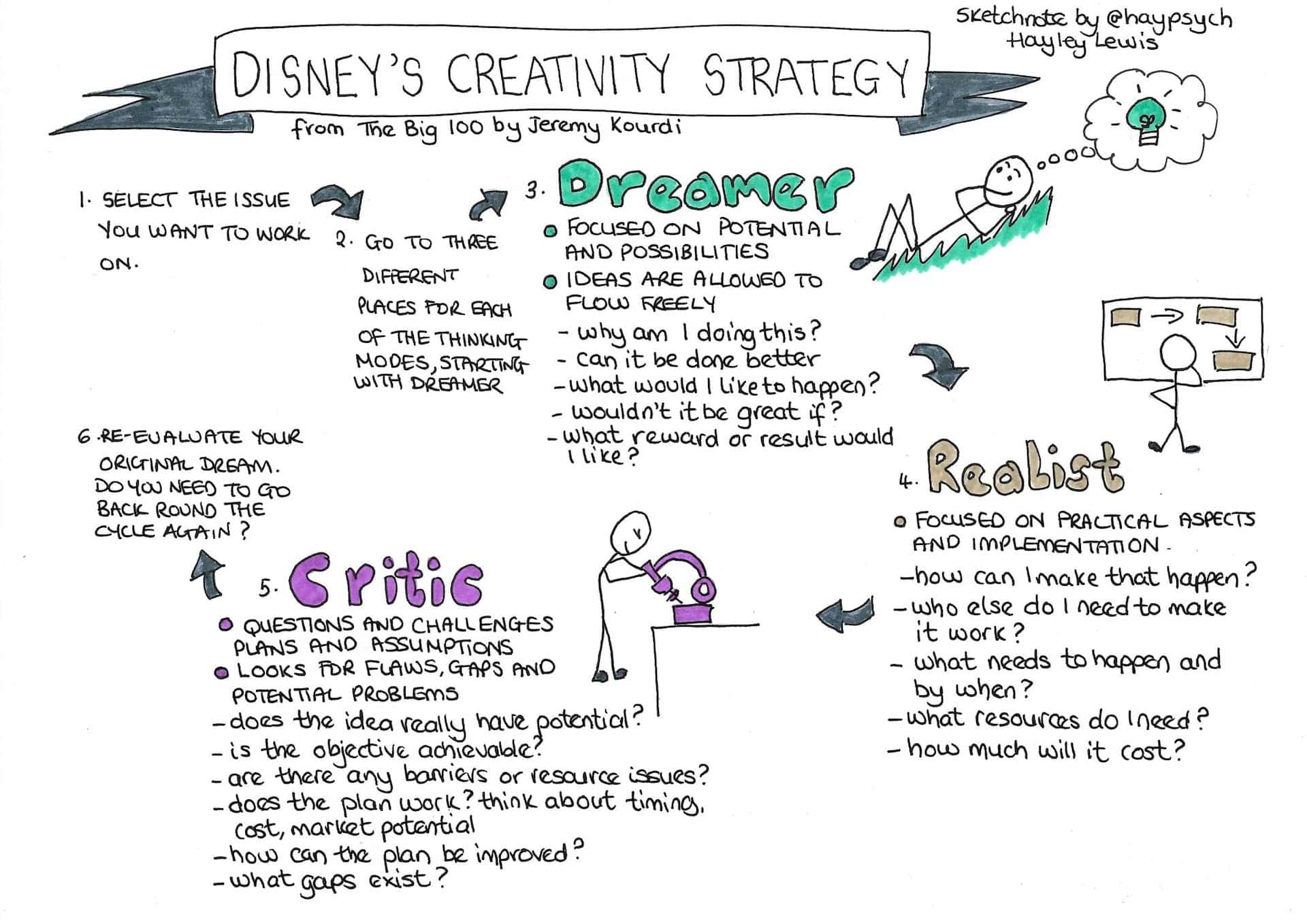
- Disney’s Creative Strategy: In The Big 100, Jeremy Kourdi highlights Disney’s creative strategy –a six-step process that engages our brains to think creatively first and rationally afterward. To learn more about this strategy, check out Dr. Hayley Lewis’s sketchnote below.


Creativity in Your Professional Development
In terms of your career management, creativity can be a valuable asset for personal and professional development:
- Career Exploration: Creative thinking can help you explore different career paths, identify opportunities, and envision your ideal career trajectory. Through divergent thinking – that is, exploring multiple possible solutions or paths – creativity can lead to unconventional or non-traditional career paths. This approach can be used just as well within the context of your current role, as popularized in the concept of “job crafting.”Creativity also helps people become more open to or comfortable with new experiences and ideas. This openness allows you to explore different industries or roles you may not have initially considered. With this approach, setting goals and objectives and defining a path toward their desired outcomes becomes easier.
- Skill Development: Creativity inspires continuous learning and skill development, enabling you to acquire new competencies and adapt to changing job market demands. Part of being creative involves comfort with experimentation and innovation, which also impact skill development.
- Promotions: As explained earlier, creativity fosters problem-solving, innovation, adaptability, strategic thinking, collaboration, and communication skills. These are all qualities that supervisors appreciate, and they’ll likely open doors for you to new roles and opportunities.
- Professional Branding: Creative people can differentiate themselves in the job market by showcasing unique talents, innovative projects, or unconventional approaches to problem-solving. A few ways in which this happens are:
- Unique Value Proposition: Creativity enables you to showcase the real you, including your talents, perspectives, and problem-solving abilities in an innovative way, making yourself more memorable.
- Storytelling and Self-Presentation: Fostering creativity can also help you refine your storytelling and self-presentation skills to communicate your professional journey, achievements, and aspirations effectively. Creativity is key in crafting compelling narratives that resonate with employers or stakeholders, allowing you to convey your personal brand clearly.
- Building a Portfolio: Creativity can help you assemble a work portfolio that innovatively demonstrates your skills, experiences, and accomplishments to potential employers or clients, helping you stand out.

Image used under license of Shutterstock.com
Creativity in Leadership
Creativity enhances leadership skills through several aspects of organizational management and team dynamics:
- Vision: Creative leaders are often visionary, capable of imagining new possibilities and charting innovative paths for their organizations.
- Problem Resolution: Creative leaders approach challenges with a fresh perspective, leveraging imaginative thinking to identify unconventional solutions. They encourage a culture of experimentation and risk-taking, fostering an environment where failure is seen as a stepping-stone to innovation.
- Decision-making: Creativity enhances decision-making by enabling leaders to consider a wide range of options and anticipate potential outcomes.
- Adaptability and resilience: Creative leaders embrace uncertainty, navigate complexity, and pivot when necessary. They foster a culture of resilience, encouraging teams to learn from setbacks and iterate quickly.
- Motivation: Creative leaders inspire teams by articulating a compelling vision, fostering a sense of purpose, and empowering individuals to contribute their unique talents. They lead by example, demonstrating openness to new ideas and encouraging creative expression.
- Team-building: Creative leaders create environments where team members feel empowered to share ideas, collaborate across disciplines, and create innovative solutions. Implicitly, they are establishing psychological safety as well.
- Communication and Storytelling: Creative leaders excel at communication and storytelling, effectively conveying their vision, values, and goals. They engage stakeholders through compelling narratives, analogies, and metaphors, making complex concepts more accessible and relatable.
- Strategic Thinking: Creative leaders are strategic thinkers, capable of synthesizing data, trends, and insights to anticipate future opportunities and threats. They develop innovative strategies that capitalize on emerging trends, disrupt industries, and drive sustainable growth.
Tapping into Your Hidden Creativity
We often perceive creativity as innate, but it can be cultivated and enhanced with practice and the right mindset. Here are several strategies to help you in case you think you’re not creative:
- Change Your Mindset: Like any other skill, creativity can be developed. To do so, embrace challenges and view failures as learning opportunities.
- Engage in Creative Activities: To unblock creative thoughts, spend a few minutes each day writing or journaling about whatever comes to mind. You can try all sorts of activities, such as drawing, painting, or even cooking!
- Consider other Avenues: Visiting new places exposes you to different cultures and ideas, which can inspire creativity. You can also read books, articles, or blogs outside your usual interests. Learning a new skill or hobby can also provide fresh perspectives and stimulate creativity.
- Collaborate and Share Ideas: Engage in brainstorming sessions with others. Group dynamics can often spark ideas you might not have thought of alone. And you can do this online as well!
- Mindfulness and Relaxation: These practices can help clear your mind, reduce stress, and enhance your ability to think creatively. Engage in yoga or deep breathing exercises to maintain a relaxed state conducive to creativity.
Conclusion
Creativity serves as the cornerstone of innovation and success in the workplace, empowering individuals and organizations to navigate challenges, solve problems, and adapt to change with agility and resilience.
Other Resources
- HBR: Cultivating the Four Kinds of Creativity
- HBR: 5 Ways to Books Creativity in Your Teams
- HBR: Creativity and the Role of the Leader
- HBR: So, You Think You’re Not Creative?
- Forbes: Creativity is the Only Investment that Never Fails
- Forbes: Cultivating Creativity: How To Unleash Your Superpower
- Forbes: 8 Common Misconceptions About Human Creativity
