


Problems, paradoxes, challenges, conflict, crises… no matter our field, we’ll face many of these types of issues at some point. The best approach we can take is learning to accept that they’re part of life and building the confidence to work through them effectively. Whether we’re an entry-level employee or a seasoned executive, we need to be able to face challenges, as how we deal with problems shapes our career trajectories and defines our professional growth. It might feel daunting, but what if instead of viewing these challenges as obstacles, we saw them as opportunities for innovation and advancement? Ultimately, embracing problem-solving as a core competency will transform our approach to work, unlocking our potential and driving our professional development.

Image used under license from Shutterstock.com
What is problem-solving?
Problem-solving is the process of identifying a challenge or obstacle, analyzing it, and finding an effective solution, often relying on a mix of creativity, experimentation, ideation, and iteration. Problem solving skill is critical in professional contexts, as it enables individuals and organizations to overcome challenges, achieve goals, and continuously improve.
It involves several key steps:
- Identifying the Problem: The first step is clearly defining and understanding the nature of the problem. This often involves gathering relevant information and recognizing the underlying issues.
- Analyzing the Problem: Next, we need to break down the problem into manageable parts, understand its components, and determine its root cause(s). This step might include research, observation, and consultation with others.
- Generating Possible Solutions: Then, we begin brainstorming potential solutions or approaches to address the problem. Creativity and open-mindedness are essential during this phase to explore all possible options.
- Evaluating Solutions: Step four is assessing the feasibility, risks, and potential outcomes of each proposed solution. This involves considering the resources available, time constraints, and any other relevant factors.
- Choosing the Best Solution: Next, we select the most appropriate solution based on our evaluation. This decision should effectively address the problem while minimizing negative impacts.
- Implementing the Solution: Step six is putting the chosen solution into action. This phase requires planning, organizing resources, and effectively executing the plan.
- Monitoring and Reviewing: Finally, as we implement our solution, we need to assess the process and its results continuously. If the problem persists or new issues arise, the process may need to be revisited and adjusted accordingly.

Image used under license from Shutterstock.com
Thought Leaders
Several thought leaders are recognized for their contributions to problem-solving strategies, frameworks, and methodologies. Here are a few notable ones:
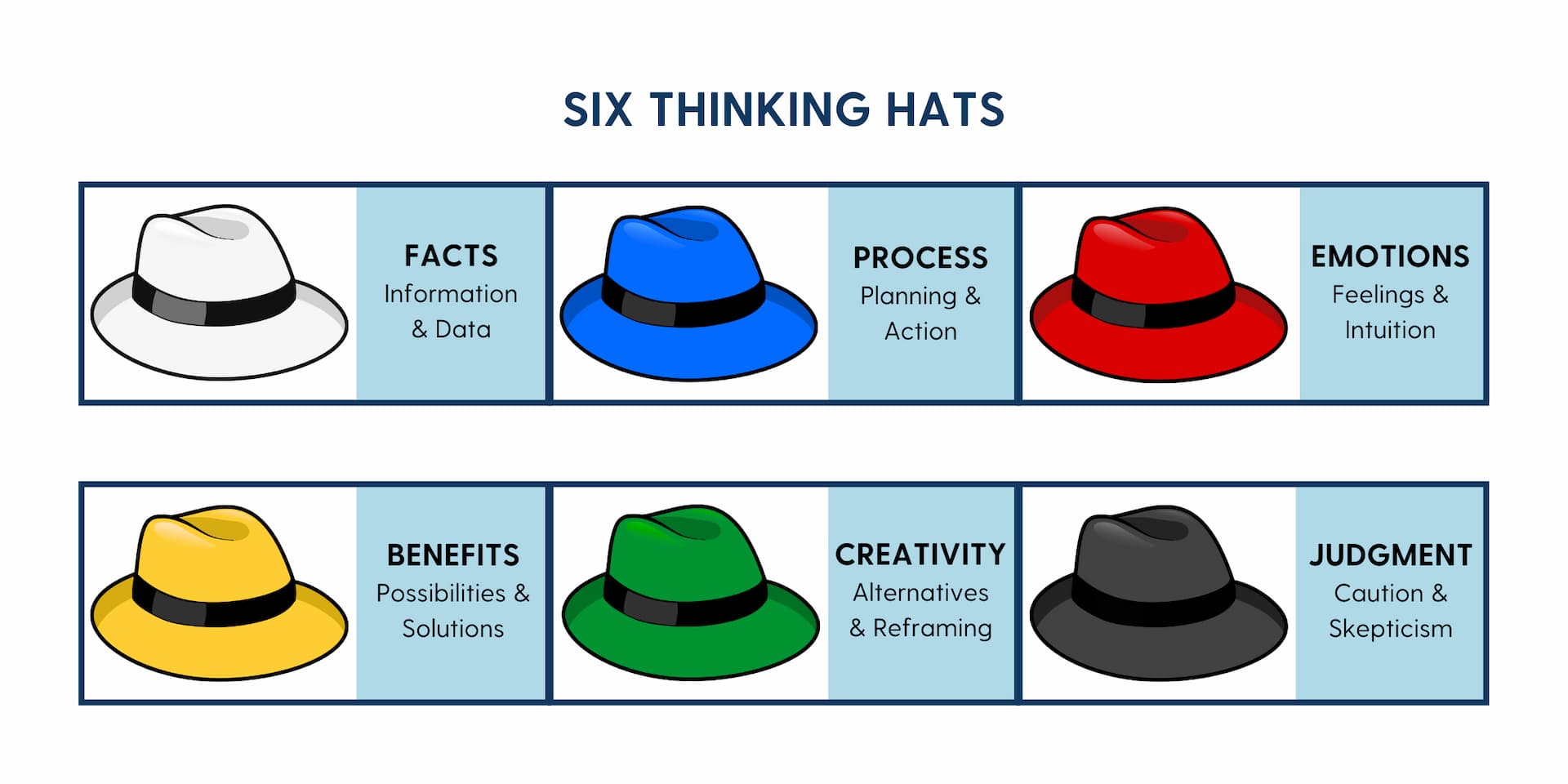
- Edward de Bono: A physician, psychologist, and author, de Bono is best known for developing the concept of lateral thinking. He authored over 85 books on thinking and problem-solving and introduced the Six Thinking Hats methodology (see image in the next section), which encourages a parallel thinking process through the adoption of different perspectives.
- Tony Buzan: A British author and educational consultant, Buzan created Mind Mapping, a visual tool for organizing information, generating ideas, and solving problems. He also wrote numerous books on learning techniques, memory, and creativity.
- Adam Grant: An organizational psychologist and professor at the Wharton School of the University of Pennsylvania, Grant studies topics such as original thinking, creativity, and resilience. His books, including Give and Take and Originals, offer insights into how individuals and organizations can foster innovative thinking and solve problems effectively by challenging conventional wisdom and embracing new perspectives.
- Amy Edmondson: A Harvard Business School professor, Edmondson is known for her research on psychological safety, teamwork, and organizational learning. Her work focuses on the importance of creating safe environments where employees feel comfortable taking risks and expressing ideas, essential for effective problem-solving and innovation.
- Tim Brown: The CEO of IDEO – a global design and consulting firm known for its human-centered approach to innovation and problem-solving – Brown advocates for design thinking, a methodology that involves empathizing with users, brainstorming creative solutions, and prototyping ideas.
- Peter Senge: A senior lecturer at the MIT Sloan School of Management and the author of The Fifth Discipline – which introduced the concept of learning organizations – Senge’s work focuses on systems thinking, which involves understanding the interconnectedness of various organizational components. This holistic approach is essential for addressing complex problems and fostering sustainable innovation.
- Roger Martin: A business strategist and former dean of the Rotman School of Management at the University of Toronto, Martin is known for his work on integrative thinking, which involves considering and balancing opposing ideas to create innovative solutions. Martin’s books, such as The Opposable Mind and Creating Great Choices, provide frameworks for approaching complex problems creatively but in a structured manner.
- Wendy K. Smith: A professor at the University of Delaware and co-author of Both/And Thinking – which explores how individuals and organizations can embrace paradoxes to foster innovation and effective problem-solving – Smith’s research focuses on strategic paradoxes, organizational ambidexterity, and leadership, offering insights into navigating competing demands and driving sustainable success.
- Marianne W. Lewis: The dean of the University of Cincinnati’s Lindner College of Business and co-author of Both/And Thinking, Lewis’s work explores paradoxes in management and leadership, helping organizations leverage tensions to drive creativity and growth.
Key Frameworks
The following models and frameworks provide diverse approaches to problem-solving, catering to different contexts and challenges.
- Both/And Thinking: This framework proposes embracing paradoxes and balancing competing demands to drive innovation and effective problem-solving. The approach involves recognizing and accepting tensions, reframing them as opportunities, and finding integrative solutions that simultaneously satisfy multiple objectives. This method encourages us to move beyond binary thinking and explore creative, holistic solutions. To learn more, check out our book summary here.
- Design Thinking: This is a human-centered approach to problem-solving that involves five stages: empathize (understand the users), define (articulate the problem), ideate (generate ideas), prototype (build tangible representations), and test (evaluate solutions). This iterative process fosters creativity and innovation by deeply involving users in the solution design.
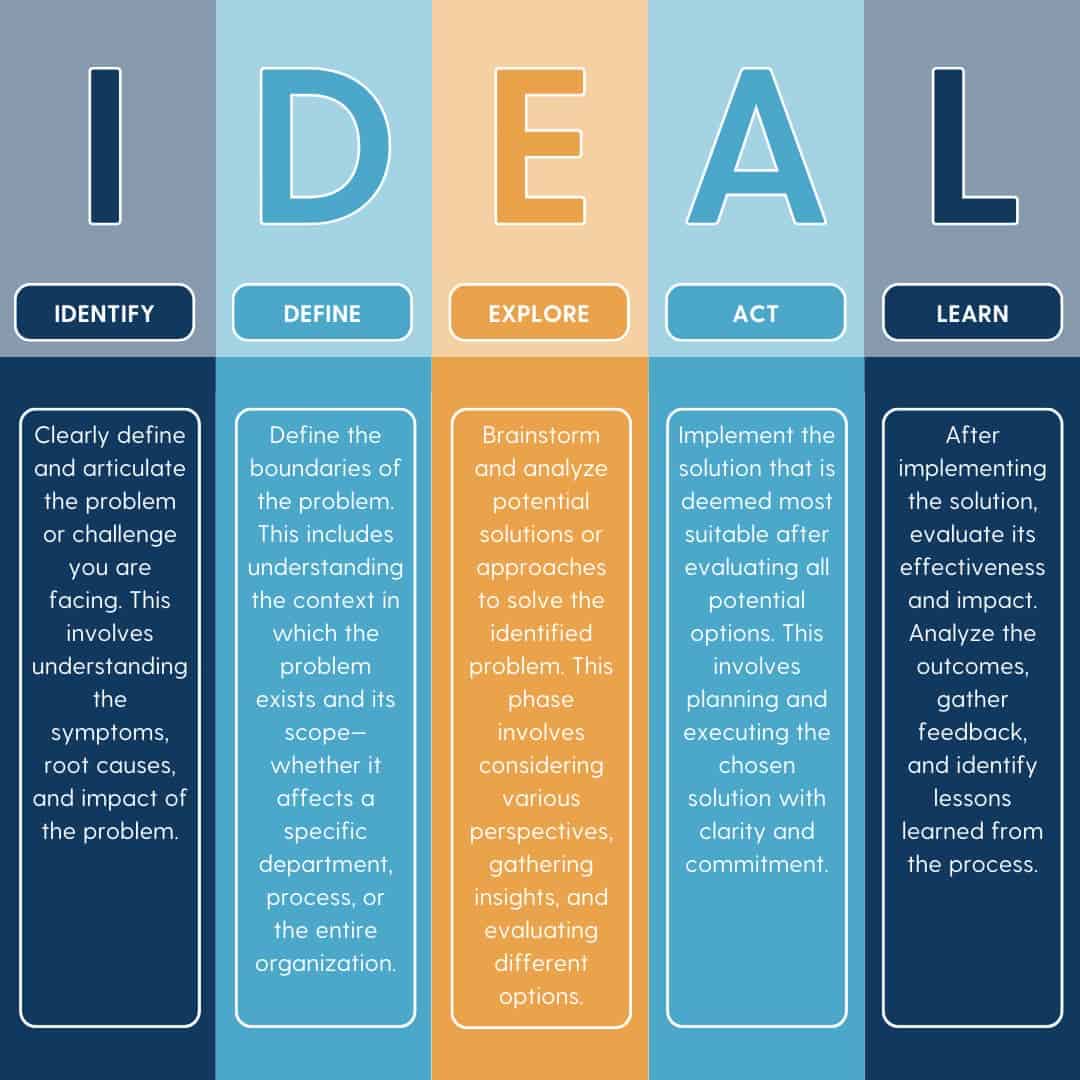
- IDEAL Model: The IDEAL model is a structured approach to problem-solving that involves five steps: Identify the problem, define and represent the problem, explore possible strategies, act on the strategies, and learn or look back and evaluate the effects.
- Lateral Thinking: Lateral thinking proposes approaching problems from new, unconventional angles. It involves challenging assumptions, generating alternatives, and using provocations to break free from traditional linear thinking patterns. This model is useful for generating creative solutions to complex problems.
- Mind Mapping: Mind Mapping is a visual tool for organizing information and ideas around a central concept. It helps in brainstorming, planning, and problem-solving by creating a structured, easy-to-understand diagram that captures and connects various problem elements. This method enhances creativity and clarity when tackling issues.
- Root Cause Analysis (RCA): RCA is a systematic approach to identifying the underlying causes of problems. It involves several steps: defining the problem, collecting data, identifying possible causes, determining the root cause, and implementing corrective actions. Tools such as the 5 Whys, the Fishbone (Ishikawa) Diagram, and Failure Mode and Effects Analysis (FMEA) are commonly used in RCA.
- PDCA (Plan-Do-Check-Act): Also known as the Deming Cycle, PDCA is an iterative four-step management method used to improve processes and products continuously. The steps include Plan (identifying a problem and developing a plan), Do (implementing the plan), Check (evaluating the results), and Act (making necessary adjustments based on feedback).
- Six Thinking Hats (Edward de Bono): This method involves wearing different metaphorical hats to explore a problem from various perspectives. The six hats represent different modes of thinking: White (facts), blue (process), red (emotions and feelings), black (caution and critical thinking), green (creativity), and yellow (benefits). This technique promotes comprehensive and balanced problem-solving.


Problem-Solving in Leadership
Strong problem-solving skills enable managers to become better leaders. With such skills, they can guide their teams more effectively, foster an environment where subordinates thrive, and achieve organizational goals. Specifically, problem-solving skills,
- Enhance Decision-Making: Effective problem-solving equips managers to make well-informed, strategic decisions. This capability is crucial for navigating complex situations and guiding teams toward successful outcomes.
- Build Trust and Credibility: Managers who demonstrate strong problem-solving skills earn the trust and respect of their team members. They establish themselves as reliable and competent leaders who consistently solve challenges.
- Foster Innovation: Problem-solving encourages creative thinking and innovation. Managers who excel in this area are better able to inspire and cultivate a culture of innovation within their teams, leading to continuous improvement and competitive advantage.
- Improve Team Collaboration: Effective problem-solving often involves collaboration and input from various team members. Managers who facilitate this process help build stronger, more cohesive teams capable of tackling challenges together.
- Helps Teams Achieve Goals: Effective problem-solving helps managers achieve organizational goals more efficiently. By identifying and addressing obstacles promptly, managers ensure that their teams stay on track and maintain progress toward key objectives.

Image used under license from Shutterstock.com
Problem-Solving in Personal Development
Learning problem-solving skills is a crucial component of professional development, as these skills empower us to navigate the complexities of the modern, high-tech, and continually evolving workplace. In any career, challenges and obstacles are inevitable, and the ability to effectively address and resolve these issues sets successful professionals apart. Additionally, problem-solving skills enhance critical thinking, allowing us to analyze situations from multiple angles and devise innovative solutions. This helps overcome immediate hindrances and anticipate and mitigate future challenges, thus contributing to long-term success.
Strong problem-solving abilities also help us build confidence. By demonstrating our competence, we position ourselves as valuable assets to our organizations, which can lead to increased recognition, career advancement opportunities, and leadership roles. Mastering problem-solving skills equips us as professionals with the tools we need to thrive in our careers, ensuring we remain competitive in a continually evolving job market.
Other Resources
- PathWise Book Summary: Both/And Thinking
- HBR: To Solve a Tough Problem, Reframe It
- HBR: Are You Solving the Right Problem?
- HBR: When Your Go-To Solving Approach Fails
- Forbes: Tips And Techniques For Problem-Solving And Decision-Making
