



Power is an integral part of every workplace, whether we hold a leadership position or not. It shapes interactions, drives decision-making, and influences the direction of teams and organizations. But the way power is exercised can vary dramatically—some use it to uplift others, while others may use it to dominate or control. Understanding the role power plays and how to wield it effectively is essential for building a successful career, navigating our organizations, and fostering a positive work environment.

Image used under license from Shutterstock.com
What is Power?
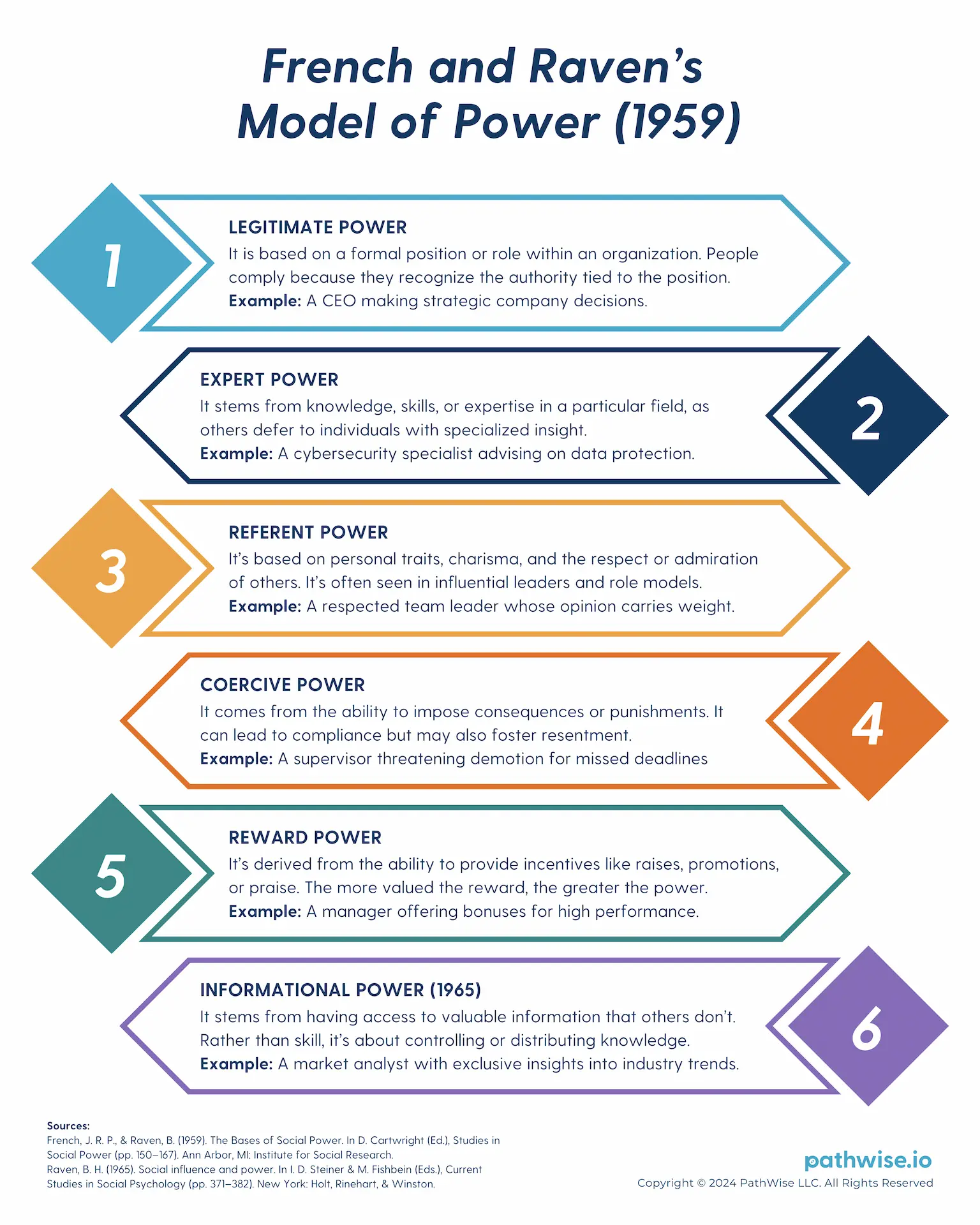
In the workplace, power is the ability to influence others, make decisions, and control resources to achieve goals. It can stem from various sources, including formal authority, expertise, relationships, and personal characteristics. Taking from French and Raven’s Power Model, power can be categorized into different types:
- Legitimate Power: Derived from a formal position or role within the organization (e.g., managers, executives).
- Expert Power: Based on knowledge, skills, or expertise in a particular field.
- Coercive Power: The ability to enforce consequences or punishments to influence behavior.
- Reward Power: The ability to grant benefits, promotions, raises, or other incentives.
- Referent Power: Stemming from personal charisma, relationships, and influence over others.
- Informational Power: Gained by controlling or having access to critical information that others don’t.
How Can One Build Power?
Building power in the workplace requires a combination of strategic actions, relationship-building, and skill development. Ways to cultivate power effectively include:
- Develop Expertise: Become highly skilled in your field by continuously learning and improving. Stay updated on industry trends, best practices, and emerging technologies, and share your knowledge through presentations, mentorship, or writing.
- Build Strong Relationships: Network internally and externally to expand your influence and cultivate trust and credibility by being reliable and supportive. Make sure you engage with mentors, sponsors, and key decision-makers.
- Increase Visibility & Influence: Take on high-impact projects that demonstrate leadership and initiative. You can start small by speaking up in meetings, contributing ideas, and offering solutions. Also, focus and align your work with organizational goals and priorities.
- Master Communication & Persuasion: Develop strong verbal and written communication skills and improve your storytelling abilities. Learn to present ideas persuasively and adapt messages to different audiences. On the flip side, make sure you actively listen and understand the needs of others to build rapport.
- Demonstrate Leadership & Decision-Making: Show confidence in taking responsibility and making informed choices. Be proactive in solving problems and taking ownership of results. Develop a reputation for fairness, integrity, and accountability.
- Leverage Rewards & Recognition: Recognize and appreciate others’ contributions to build goodwill, particularly if you’re a manager. Advocate for team members and help them advance in their careers. Create opportunities for people to succeed under your leadership.
- Navigate Organizational Politics Strategically: Escaping organizational politics is nearly impossible. Rather than avoiding them, focus on understanding your organization’s power structures and dynamics, identifying key influencers and decision-makers, and aligning yourself with individuals and initiatives that enhance your credibility and impact.

Image used under license from Shutterstock.com
Thought Leaders
Several thought leaders have contributed to our understanding of power, leadership, and influence in the workplace and the role they play in organizational success. Some of these experts include:
- Jeffrey Pfeffer: A professor at Stanford Graduate School of Business, Pfeffer is a leading expert on power dynamics and leadership. His book Power: Why Some People Have It—and Others Don’texplores how individuals can build and wield power effectively in organizations. His research focuses on organizational behavior, workplace influence, and career success.
- Robert Cialdini: A social psychologist known for his work on persuasion and influence, Cialdini authored Influence: The Psychology of Persuasion, which outlines six principles of persuasion. His insights are widely used in business, marketing, and leadership to enhance negotiation and decision-making skills.
- Deborah Gruenfeld: A professor at Stanford Business School, Gruenfeld studies the psychological effects of power and status in organizations. Her research explores how power influences behavior and relationships, and she co-authored Acting with Power, which examines how people can effectively project authority.
- Dacher Keltner: A psychologist at UC Berkeley, Keltner researches power, emotions, and social behavior. His book The Power Paradoxargues that while power is often gained through empathy and generosity, it can be lost through self-interest and misuse. His work highlights the ethical dimensions of power and leadership.
- John Kotter: A Harvard Business School professor and leadership expert, Kotter is known for his work on change management and organizational leadership. His book Power and Influenceprovides insights into how leaders can develop and use power effectively to drive transformation. His 8-Step Process for Leading Change is widely used in corporate strategy.
- Amy Cuddy: A social psychologist and former Harvard professor, Cuddy studies power dynamics, nonverbal behavior, and confidence. Her book Presenceexplores how body language and mindset influence personal power and success. Her TED Talk on power poses is one of the most-watched talks of all time.
Key Frameworks
In addition to French and Raven’s Power Model, several other frameworks and theories explain power and influence in various contexts, such as leadership, organizations, politics, and social interactions. Some of the key ones include:
- Pfeffer’s Model of Power in Organizations: Developed by Jeffrey Pfeffer, this model emphasizes that power is a key driver of workplace success. He argues that power comes from controlling resources, building alliances, and managing perceptions rather than just formal authority. This framework explains power by categorizing as follows:
- Position Power: Authority from one’s role.
- Control of Resources: Access to valuable resources.
- Control of Decision-Making: Ability to influence key decisions.
- Control of Information: Access to exclusive information.
- Centrality in Networks: Being a critical connector in a network.
- Personal Power: Charisma, skills, and expertise.
- Managing Uncertainty: Ability to reduce uncertainty for others.
- Kotter’s Power and Influence Framework: John Kotter suggests that effective leadership requires a mix of power, influence, and coalition-building to drive organizational change. His framework emphasizes the importance of credibility, strategic networking, and vision in mobilizing support and overcoming resistance.
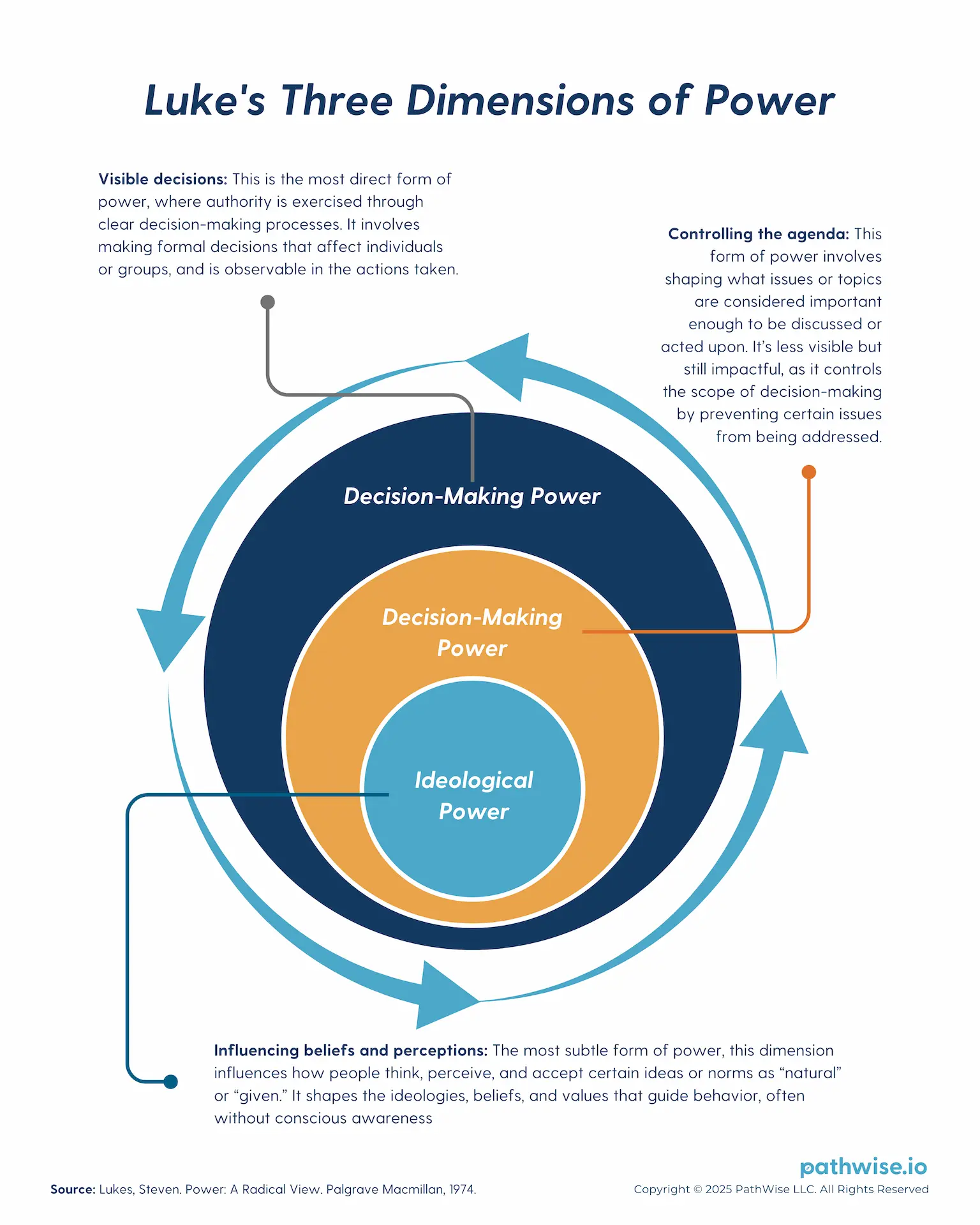
- Lukes’ Three Dimensions of Power: Steven Lukes proposed that power operates on three levels: decision-making power, which involves directly influencing choices; agenda-setting power, which shapes what issues are even considered for discussion; and ideological power, which influences societal norms and beliefs to shape perceptions.
- Raven’s Interpersonal Influence Model: Expanding on French and Raven’s work, Bertram Raven developed a model focused on influence strategies rather than just sources of power. He categorized influence into soft tactics (e.g., rational persuasion, consultation, and inspirational appeals) and hard tactics (e.g., coercion, pressure, and legitimization). This model helps analyze how different leadership styles and workplace strategies affect power dynamics.
- Cialdini’s Six Principles of Influence: Robert Cialdini identified six psychological principles that drive influence:
- Reciprocity: People feel obligated to return favors.
- Commitment and Consistency: People tend to stick to their commitments.
- Social Proof: People follow what others are doing.
- Authority: People respect and obey authority figures.
- Liking: People are more influenced by those they like.
- Scarcity: People desire things that are perceived as limited or rare.
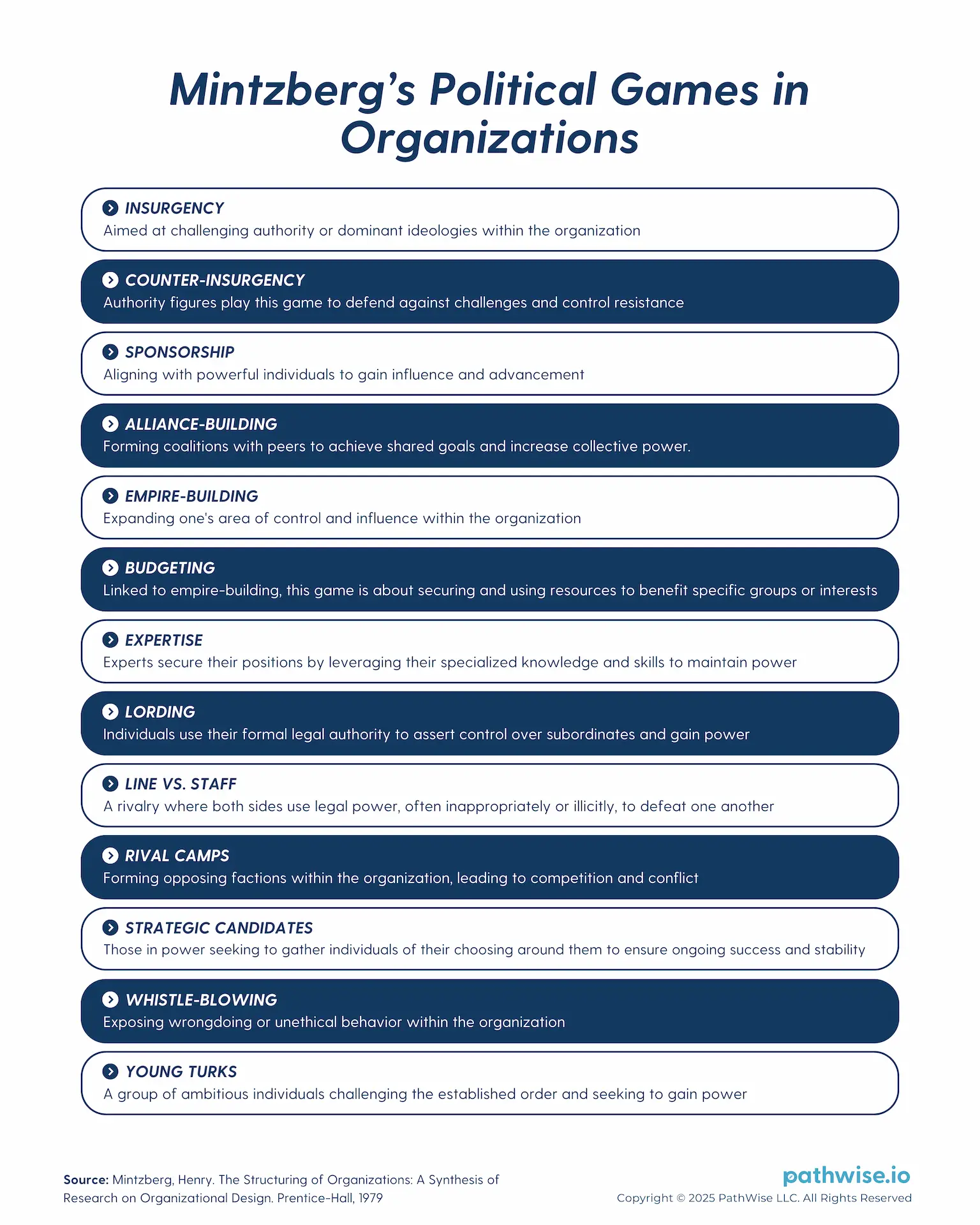
- Mintzberg’s Political Games in Organizations: Henry Mintzberg identified common political games played in workplaces to gain power and influence. His model explains how informal workplace politics shape decision-making and career advancement.
Power in Leadership
Power plays a significant role in a manager’s ability to lead effectively, but how it’s used can make a big difference in their success. The key lies in how they wield their power. When used wisely, it can elevate them from simply being a manager to being a great leader who inspires, motivates, and empowers others. More specifically, power can influence leadership through:
- Influence and Motivation: A manager with power can inspire and motivate teams by setting clear expectations, aligning goals, and driving performance. They can leverage their position to create an environment where people are motivated to perform at their best.
- Decision-making Authority: Power gives a manager the authority to make decisions that can positively impact the team or organization. A good leader uses this power to make fair, thoughtful decisions that benefit individuals and the collective.
- Building Trust and Respect: Power can be used to gain respect if a manager exercises it with empathy, integrity, and fairness. Employees are more likely to follow and trust a leader who doesn’t misuse their power but instead uses it to advocate for the team’s success and well-being.
- Conflict Resolution: In leadership, power is important for managing conflicts and creating a sense of order. A manager with power can address issues decisively and maintain harmony, but this requires a balanced approach where power is used to mediate and solve problems rather than to dominate.
- Empowerment: A good leader recognizes that power isn’t just about control; it’s also about empowering others. A manager can delegate authority and trust their team, giving them the power to make decisions within their roles. This builds confidence and fosters a sense of ownership and accountability.

Image used under license from Shutterstock.com
Power in Personal Development
Using power constructively to advance in our careers involves focusing on building trust, credibility, and strong relationships with others. When we wield power with empathy and fairness, we inspire those around us, create opportunities for collaboration, and establish a positive, inclusive work environment. Constructive power is about using influence to mentor others, foster teamwork, and make decisions that benefit the larger organizational goals. By empowering colleagues, recognizing their contributions, and encouraging innovation, we can position ourselves as leaders who uplift others and drive collective success. This strengthens our professional reputation and creates a supportive network that can help us navigate challenges and advance in our careers.
On the flip side, using power destructively can hinder our progress and damage our professional standing. Using our position to manipulate, control, or intimidate others may yield short-term results, but it will likely lead to long-term consequences. Destructive power often creates a toxic work culture where collaboration is stifled, creativity is suppressed, and trust is eroded. Colleagues may become wary, disengaged, or even resentful, undermining any potential for future growth. Additionally, those who use power destructively may find that their success is built on unstable foundations, limiting their opportunities for meaningful advancement. Power used in this way can isolate us, diminish our influence, and ultimately stifle our career potential.
To truly advance in our careers, it’s essential to understand that the most lasting success comes from using power with integrity and a sense of responsibility.

Image used under license from Shutterstock.com
Conclusion
Power is an inevitable and influential aspect of the workplace, but its impact is largely determined by how we choose to use it. When used constructively, power can inspire, empower, and lead to personal and collective success, fostering an environment of trust and collaboration. When misused, it can create toxic cultures, stifle innovation, and ultimately damage relationships and career prospects. To truly thrive in our careers, it’s essential to approach power with integrity, empathy, and a sense of responsibility—recognizing that how we wield it defines our professional path and the work environment we help create.
Other Resources
- PathWise Book Summary: Influence by Robert Cialdini
- HBR: Understanding “New Power”
- HBR: A New Prescription for Power
- HBR: Power, Influence, and CEO Succession
- Forbes: Power vs. Influence – Knowing the Difference Can Make or Break Your Company
- Forbes: It’s Okay to Want Power and Influence
- TED-Ed Talk: How to Understand Power by Eric Liu
