

Atomic Habits: An Easy and Proven Way to Build Good Habits and Break Bad Ones

About the Author
“James Clear is a writer and speaker focused on habits, decision making, and continuous improvement. He is the author of the #1 New York Times bestseller, Atomic Habits. The book has sold over 5 million copies worldwide and has been translated into more than 50 languages.
Clear is a regular speaker at Fortune 500 companies and his work has been featured in places like Time magazine, the New York Times, the Wall Street Journal and on “CBS This Morning.” His popular “3-2-1” email newsletter is sent out each week to more than 1 million subscribers.”
Source: “About the Author” section of the book
Our one-sentence summary
To create new (break old) habits, we need to embrace bit by bit progress, employing environmental and personal strategies that make behaviors obvious (invisible), attractive (unattractive), easy (difficult), and satisfying (unsatisfying) to perform.
Publisher’s Summary
“No matter your goals, Atomic Habits offers a proven framework for improving every day. James Clear, one of the world’s leading experts on habit formation, reveals practical strategies that will teach you exactly how to form good habits, break bad ones, and master the tiny behaviors that lead to remarkable results.
If you’re having trouble changing your habits, the problem isn’t you. The problem is your system. Bad habits repeat themselves again and again not because you don’t want to change, but because you have the wrong system for change.
Clear is known for his ability to distill complex topics into simple behaviors that can be easily applied to daily life and work. Here, he draws on the most proven ideas from biology, psychology, and neuroscience to create an easy-to-understand guide for making good habits inevitable and bad habits impossible. Along the way, readers will be inspired and entertained with true stories from Olympic gold medalists, award-winning artists, business leaders, life-saving physicians, and star comedians who have used the science of small habits to master their craft and vault to the top of their field.
Atomic Habits will reshape the way you think about progress and success, and give you the tools and strategies you need to transform your habits – whether you are a team looking to win a championship, an organization hoping to redefine an industry, or simply an individual who wishes to quit smoking, lose weight, reduce stress, or achieve any other goal.”
Source: Book Jacket
Detailed Summary
Introduction: My Story
- Clear suffered an accident during his sophomore year in high school. He was hit in the face with a baseball bat. Unequipped to handle the situation, the local hospital sent him to a larger hospital in Cincinnati in a helicopter.
- He had several seizures and difficulty breathing, and his brain became extremely swollen. The doctors put him into a medically induced coma and on a ventilator.
- The recuperating months after he left the hospital were very hard for him. He had to learn basic motor skills again, such as walking in a straight line. But Clear was determined not to let the injury keep him from living.
- He sometimes felt depressed and overwhelmed. It was very difficult for him when he was cut from his varsity baseball team during his junior year. But he managed to make it back during his senior year. And although he was rarely on the field, he worked hard and became a college athlete at Denison University.
- “I knew that if things were going to improve, I was the one responsible for making it happen” (p. 5). Clear worked hard on developing good habits: he slept and ate healthily, put effort into classwork, and went to the gym regularly. His habits allowed him to become team captain, and he was voted the top male athlete at his university. He was also given the highest academic honor, the President’s Medal.
- Everyone faces challenges. One of Clear’s biggest challenges was overcoming this injury. But it taught him a valuable lesson, that “changes that seem small and unimportant will compound into remarkable results…” (p. 7).
- In this book, Clear provides a step-by-step plan to build better habits, supported by academic research. The following content serves as a manual that considers external stimuli and internal emotions in the process of developing healthy habits.
Part I – The Fundamentals: Why Tiny Changes Make a Big Difference
Chapter 1: The Surprising Power of Atomic Habits
- In 110 years, Britain had never won a cycling event. But in 2003, the British Cycling Organization hired Dave Brailsford. What distinguished him from other coaches was his commitment to the aggregation of marginal gains strategy – a philosophy that proposes searching for tiny improvements in everything you do.
- He set to improve anything that was related to cycling by at least 1%, even in unexpected areas. They redesigned bike seats to make them more comfortable, found the best massage gels for muscle recovery, and even taught cyclists how to wash their hands properly to keep them from getting sick.
- Five years after hiring Brailsford, the British team dominated road and track cycling in the Olympic Games, winning 60% of the gold medals. In the next Olympic Games in London, they set nine Olympic records and seven world records. That same year, in 2012, Bradley Wiggins became the first British cyclist to win the Tour de France.
- It’s easy to overestimate one important defining moment and underestimate the value of small daily improvements. We think that success requires massive action because 1% improvements are rarely noticeable. But they are the most meaningful.
- The effects of small habits compound over time. Like money that multiplies through compound interest, habits are the compound interest of self-improvement. But this is not easy to appreciate in daily life.
- We easily dismiss small changes because they don’t appear to matter (e.g., saving a few dollars today will not make you a millionaire by tomorrow).
- This is true for bad habits too. If you eat one unhealthy meal today, you won’t gain noticeable weight by the next day. Because we don’t immediately notice the effects of those little changes, we replicate poor decisions and duplicate mistakes over time.
- Like an ice cube that won’t melt when you gradually increase the temperature until you reach 32 degrees, breakthrough moments are the result of many previous actions that eventually unleash a major change. Habits don’t appear to make any difference until we cross the critical threshold.
- We get frustrated when we spend months feeling like we’re going nowhere, but the most powerful changes are delayed.If you struggle to create good habits or break bad ones, it’s not that you’ve reached the top of your ability. You just haven’t crossed the Plateau of Latent Potential (see image below).
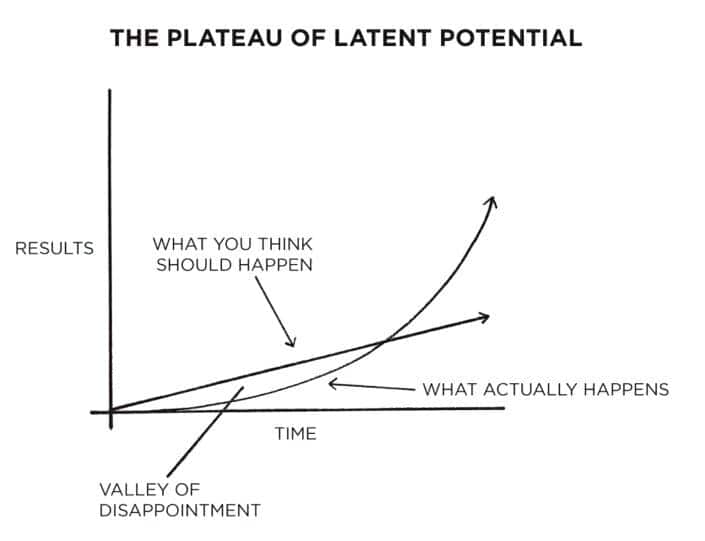
Source: Atomic Habits by James Clear p. 22
- We expect progress to be linear and results to come quickly. But it can take years to realize the value of the work we put in beforehand. Those years are the valley of disappointment, the point where people lose faith and get discouraged. But your work was stored, and it will be revealed.
- To break through the plateau, forget about the goals and focus on the system. Society has instilled in us the idea that the best way to achieve what we want is to set specific and actionable goals. But results have little to do with the goals you set and almost everything to do with the system you’re following.
- Goals set a direction, but systems allow you to make progress. Some of the problems that arise when we overfocus on our goals are:
- Everyone, both successful and unsuccessful people, sets the same goals. Every Olympian wants a gold medal, for example. The difference between those who do and don’t obtain it isn’t goal-setting. It’s the implementation of a successful system.
- Achieving a goal is a momentary change. If your goal is to have a neat and organized room, you might gather the energy to tidy up. But if you don’t have a system and keep your bad habits, eventually your room will be messy again, and you will need to find a way to gather the energy to clean up again. So, it’s not about changing the result. It’s about changing the system that will impact the result.
- Goals restrict happiness. We constantly put off feeling happy until we achieve a goal. We create an “either-or” conflict, where “either I achieve my goal and become happy, or I fail and become a disappointment.” With a good system running, you can be satisfied anytime, and you’ll become successful in many forms, not just in the way you envision.
- When your motivation comes from a goal, once you achieve it, you will revert to old habits. E.g., runners who trained for months quit running after they finished a marathon. There’s no race to motivate them anymore.
- “You do not rise to the level of your goals. You fall to the level of your systems” (p. 28).
- An atomic habit is a tiny change, a marginal gain, a 1% improvement. It’s small but mighty.

Chapter 2: How Your Habits Shape Your Identity (And Vice Versa)
- There are two main reasons why changing habits is difficult; we focus on changing the wrong thing, or we try to change them in the wrong way. This chapter focuses on the first of these two challenges.
- There are three levels of behavioral change:
- Changing your outcomes or your results.
- Changing your process or your system.
- Changing your identity, self-image, and worldview (via your beliefs).
- “Outcomes are about what you get. Processes are about what you do. Identity is about what you believe” (p. 31-32). It’s not that one level is better or worse than another. What we need to focus on is the direction of the change.
- Most people try to change by focusing on what they want (the outcomes), but the best approach is to start with who you wish to become.
- E.g., someone trying to quit smoking gets offered a cigarette. He might say, “No, thanks. I’m trying to quit.” But, a small difference, such as, “No, thanks. I’m not a smoker,” can make a big difference because it signals a shift in identity.
- Behavior incongruent with our beliefs and identities will not last. To change habits, you need to change the underlying beliefs that trigger past behaviors.
- The best form of intrinsic motivation is identity. The prouder you are about a specific aspect of your identity, the more motivated you’ll be to maintain the actions and habits associated with it. Your goal should not be to read more, for example, but to become a reader.
- Research suggests that people with a strong sense of their identity are more likely to act according to the associated belief. When your behavior and identity align, you act like the person you already believe yourself to be.
- While this is true for self-improvement, it is also true for bad habits associated with negative beliefs. E.g., “I’m terrible with directions,” or “I’m not good with technology.” These stories you believe to be true create internal pressure to maintain a consistent self-image. The biggest barrier to change is identity conflict.
- Every belief is learned from past experiences. As habits develop, they reflect our beliefs and embody our identity. The more we repeat a behavior, the more we reinforce our beliefs. Our actions serve as proof of our identity. E.g., if you go to the gym even on vacation or when it’s snowing, you have evidence that you’re committed to your fitness.
- To begin changing your habits, follow a simple two-step process:
- Decide who you want to be.
- Prove it to yourself by taking small steps to reinforce that identity.
- E.g., if you want to write a book, ask yourself, “What type of person writes books?” You’ll conclude that it’s someone consistent and reliable. Now, you need to shift your focus away from the outcome (the book) and into who you want to be.
- Feedback loops refer to the process by which your habits shape your identity, and your identity shapes your habits. The key is to start by letting your identity drive your results.
- Building better habits is not about finding great life hacks. Habits are not about having something but about becoming someone.
Chapter 3: How to Build Better Habits in Four Simple Steps
- Habits begin forming through a process of trial and error. Whenever you face a new situation, your brain spends a lot of energy trying to respond to it. It learns the most effective course of action and creates shortcuts to save some of these resources in the future. Sometimes, you also stumble into these solutions and receive unexpected rewards.
- E.g., after a long day of work, one day you decide to play a video game and discover that it relaxes you. Upon the reward, your brain makes a habit out of this behavior.
- With habits, your brain skips the trial-and-error process and creates mental rules. Habits reduce cognitive load and free up space or mental capacity so that you can allocate your attention to other important tasks. Contrary to what many people think, habits do not restrict freedom. They create it. With the basics of life handled through healthy habits, your mind is free to face new challenges and master new abilities.
- Developing habits takes four steps (see also The Power of Habit by Charles Duhigg):
- Cue. The first step is your brain initiating a behavior upon a trigger. Your mind is always analyzing internal and external stimuli, looking for hints of where we can find rewards. A cue is the first indication that a reward is close, so it triggers a craving.
- Craving. The second step is the motivation behind every habit: craving a change that gives you a reason to act. You don’t crave the habit itself but what it delivers (e.g., you don’t crave smoking, you crave the relief it gives you).
- Every craving stems from a desire to change internal states. These cravings differ among people (e.g., the sound of slot machines might trigger a desire to gamble for someone but might be background noise for someone else). Thoughts, feelings, and emotions transform cues into cravings.
- Response. The third step is the action you perform – the habit. Whether you develop a habit or not depends on your level of motivation and the number of barriers you face. If it requires more mental or physical effort than what you’re willing to expend, you won’t engage in the behavior. And, if you lack the ability, you can’t develop the habit.
- Reward. The final step is the end goal of every habit: a reward that will either satisfy us or teach us what actions are worth remembering in the future.
- Whenever any of these steps’ purpose is not met, the behavior won’t become a habit. If there’s no cue, the behavior won’t start. If there’s no craving, you won’t have motivation. If the behavior is too difficult, you won’t act. And if the reward is not satisfying, you won’t repeat the behavior. That is, without the first three steps, the behavior won’t occur. Without the fourth, you won’t do it again.
- Based on these steps, Clear developed the Four Laws of Behavior Change, a framework that provides simple rules to create new habits (see table 1) or break bad ones (see table 2).
| Table 1: How to Create Good Habits | |
| The First Law (Cue) | Make it Obvious |
| The Second Law (Craving) | Make it Attractive |
| The Third Law (Response) | Make it Easy |
| The Fourth Law (Reward) | Make it Satisfying |
| Table 2: How to Break Bad Habits | |
| Inversion of the First Law (Cue) | Make it Invisible |
| Inversion of the Second Law (Craving) | Make it Unattractive |
| Inversion of the Third Law (Response) | Make it Difficult |
| Inversion of the Fourth Law (Reward) | Make it Unsatisfying |
Source: Atomic Habits p. 54
Part II — The 1st Law: Make It Obvious
Chapter 4: The Man Who Didn’t Look Right
- Clear writes about a paramedic who, upon seeing her father-in-law, urged him to go to the hospital even though he felt fine. He was at immediate risk of a heart attack and arrived just in time for surgery. She couldn’t explain it, but she knew something wasn’t right.
- Military analysts can distinguish blips on radar screens as either enemy missiles or planes from their fleet even though they look identical. Museum curators can differentiate between authentic masterpieces and counterfeits even though they can’t tell what details signaled the fake.
- Our brains are constantly analyzing information and learning. Whenever you repeat a behavior or experience, your brain becomes capable of noticing what’s important and sorts details and relevant highlights.
- This ability is also the foundation of every habit.
- When noting a cue, your brain reacts to it without being aware. As habits develop, your actions become automatic. You create behavioral patterns without realizing it. The more you repeat them, the less likely you are to question them.
- The first step to changing any behavior is to become aware of it. If a habit remains mindless, you can’t improve it. “Until you make the unconscious conscious, it will direct your life, and you will call it fate” (originally by psychologist Carl Jung, p. 62).
- The Japanese railway is among the best ones in the world. They have a unique system known as Pointing-and-Calling, in which every detail about operating a train is identified, pointed at, and named aloud. The system has reduced errors by 85% and accidents by 30%.
- Pointing-and-Calling is also effective to raise awareness of your unconscious habits. You need to involve your senses to make them conscious.
- The Habits Scorecard is an exercise that helps you become aware of your actions. Create a list of your daily habits, starting from the moment you wake up. Then, classify each behavior as a good, bad, or neutral habit.
- Note that no habit is inherently good or bad. They all serve a purpose. But if you have a specific goal in mind, some habits are more effective than others in helping you reach it. Categorize them in terms of how they benefit you.
- The goal of the Habits Scorecard exercise is to notice your behavior. Simply observe it but don’t judge it (neither blame it for your faults nor praise it for your successes).
- Then, try Pointing-and-Calling. Hearing your actions out loud, along with their consequences, helps perceive them as more real.
- These two exercises help you verbalize your behavior to recognize your habits more easily and acknowledge the cues that trigger them.
Chapter 5: The Best Way to Start a New Habit
- There are several different forms of cues that trigger habits. The two most common are location and time. Implementation intention refers to a phenomenon researchers observed in which planning where and when to act increases the likelihood of people following through, making them effective for reaching behavioral goals.
- We tend to set goals by saying, “I’m going to eat healthier,” without including when or where. We leave it to hope and chance. Implementation intentionmakes a vague notion more precise and provides a concrete plan of action.
- To apply this strategy, say “I will [behavior] at [time] in [location].” E.g., I will exercise for one hour at 5 pm in my local gym. Specificity helps avoid distractions.
- The goal is to make time and location obvious enough that, through sufficient repetition, you get the urge to perform the behavior at the given moment.
- You can also use humans’ inherent connectedness of behavior to create new habits. Habit stackingrefers to identifying an established habit and pairing a new behavior with it. To apply this strategy, say “After I [current habit], I will [new habit].” E.g., After I pour my cup of coffee, I will meditate/pray for a few minutes.
- Once you master the basic structure, you can stack more habits, creating a chain. E.g., After I pour my cup of coffee, I will meditate/pray for a few minutes. After meditating/praying for a few minutes, I will write my to-do list for the day.
- This strategy works best if you choose to tie the new habit with a behavior you do daily. It’s also important to select the moment carefully. If you have kids, and mornings are chaotic, that’s probably not the best time to meditate or pray.
- You can use your Habits Scorecard to brainstorm your list of current habits and find the right trigger for the new one.
- Make sure you’re not too vague when selecting your cue. “When I take a break for lunch, I’ll do ten pushups” isn’t very clear. It’s better to be specific, “When I close my laptop to go to lunch, I will do ten pushups next to my desk.”
Chapter 6: Motivation is Overrated; Environment Often Matters More
- “Environment is the invisible hand that shapes human behavior” (p. 82). Habit is also context-dependent. Choice architecture refers to readjusting your environment in a way that facilitates better decision-making.
- Environments often encourage us not to do certain actions because we lack cues.
- Experts estimate that half of our brain resource is dedicated to our vision. Visual cues are usually the strongest triggers of behavior. A small change in what you see can have a big impact on what you do.
- Creating visual cues can shift our attention to our habits. E.g., in the early 1990s, the cleaning crew at Schiphol Airport in Amsterdam installed a small sticker at the center of each urinal in the restrooms. Men aimed for what appeared like a bug, and the stickers significantly reduced “spillage” and cleaning efforts.
- You can alter your space to increase exposure to positive cues and reduce negative ones. Over time, habits can become associated with an entire context. When readjusting your space, think in terms of your interaction with the environment.
- E.g., to help insomniacs, experts recommend that they don’t get into bed until they’re tired. If they can’t sleep, they should sit someplace else until they become sleepy. Eventually, their brains will associate the bedroom with sleeping, and it will become easier to fall asleep.
- If you are having difficulty changing a habit, shifting your environment can help escape triggers. Go to a different place and create new routines there. E.g., if you’re trying to be healthier, try a new grocery store where you won’t know where everything is and won’t purchase the same food automatically.
- If you can’t find a new place, reorganize or rearrange a current one.
- When possible, avoid using the same context for two different habits. E.g., avoid working on the couch where you watch TV when you need to rest. If you mix environments, you will mix habits. If you have limited space, designate small areas for each specific activity.
- The stabler the environment, the easier it will be to form better habits.
Chapter 7: The Secret to Self-Control
- During the Vietnam War, some American soldiers became addicted to heroin. Follow-up research uncovered that only 5% of those who used heroin in Vietnam continued to use it when they returned to the United States. Meanwhile, 90% of typical people who use heroin become readdicted when they get back home from rehab.
- Contrary to popular belief, the Vietnam studies provide evidence that habits associated with unhealthy behaviors are not a sign of moral weakness or lack of self-control. Yet, society tells us that discipline solves most of our problems.
- Research suggests that those with a lot of self-control are not more disciplined than everyone else. They’re just people who know how to structure their lives so that they won’t rely on willpower and self-control. They set their context to spend less time in tempting situations.
- Once our brain internalizes a cue and encodes a habit, it’s ready to use whenever a situation arises. Most unwanted habits are autocatalytic. E.g., worrying about your health makes you worried, so you smoke to ease your nerves, but then smoking makes you worry about your health, and now you’re anxious again.
- Cue-induced wanting refers to external triggers causing uncontrollable desires to repeat unhealthy behaviors. As soon as you notice something, you feel like you want it. To break a habit, you need a positive environment that reduces exposure to the triggering cue.
- This is the inverse of the First Law of Behavior Change: Make it Invisible. E.g., if you cannot concentrate on your work, leave your phone in another room. If you play video games for too long, unplug the console and store it in a closet after each use. By removing the cue, the habit fades away.
- Self-control is a short-term strategy that rarely works. Instead, spend your time and energy optimizing your environment. “Make cues of your good habits obvious and the cues of your bad habits invisible” (p. 95).
Part II — The 2nd Law: Make It Attractive
Chapter 8: How to Make a Habit Irresistible
- Supernormal stimuli are exaggerated cues that result from a heightened version of reality, eliciting stronger responses than usual. E.g., junk food agitates our reward system. After our ancestors spent years hunting and looking for food in the wild, our brains developed a high regard for salt, sugar, and fat; calorie-dense food that was rare in ancient times.
- Today, these types of food are abundant, and they’re no longer healthy, but our brains still crave them. The food industry takes advantage of this and continues to sell junk food, impacting our overeating habits. This is an example of the Second Law of Behavior Change: Make it Attractive.
- To increase our chances of changing behavior, we need to make it attractive, especially as other stimuli compete for our attention: social media, advertising, technology, etc.
- To change our behavior, we also need to understand the role of dopamine. Research has found that without dopamine, although pleasure remains, desire disappears. And without it, actions won’t occur. Meanwhile, excessive dopamine impulses extreme action (e.g., the average slot machine player spins the well 600 times an hour).
- Habits are driven by dopamine spikes. Contrary to common belief, dopamine isn’t released when we experience pleasure. It happens when we anticipate pleasure
- With the dopamine increase, you become more motivated to act. E.g., gambling addicts experience dopamine spikes before placing a bet, not when they win.
- Making our habits attractive works because it is the expectation of the reward that motivates us to act. Our brains allocate many resources to the areas responsible for cravings and desires. Every action we take is in anticipation of the response.
- Temptation bundling refers to linking the behavior you want to do with the activities you enjoy doing. E.g., Ronan Byrne, an engineer, enjoyed watching Netflix but needed to exercise more. He hacked his stationary bike, connected it to his laptop and TV, and made it so that Netflix wouldn’t run unless he kept pedaling.
- You’re more likely to engage and continue a behavior if you do one of your favorite activities at the same time.
- You can combine this strategy with the stacking strategy: “After I [current habit], I will [needed habit]. After [needed habit], I will [wanted habit].” E.g., after I get my morning coffee, I will pray/meditate. After I pray/meditate, I will read the news.
- The goal is for you to eventually look forward to the needed habit because it means you get to engage in the wanted one.
Chapter 9: The Role of Family and Friends in Shaping Your Habits
- Humans are social creatures. We strive to fit in, bond with others and earn respect and approval. These needs are engrained in our survival. That’s why some of our habits are learned from our surroundings: our communities, culture, families, etc. We often follow these behaviors without even thinking. These habits can be classified into three groups:
- Imitating the Close. Proximity impacts our behavior, whether physical environment (see chapter 6) or social environment. We pick up habits from the people around us.
- If you want to change a habit, joining a culture that performs the given behavior will help. Either join a culture where the behavior is normal or where you have another interest in common.
- E.g., Steve Kamb founded Nerd Fitness, a company that helps “nerds” lose weight and get healthy. Many people feel out of place when they go to the gym for the first time, but surrounded by people with similar interests, continuing to go becomes easier and more appealing.
- Imitating the Many. Solomon Asch performed a series of experiments about conformity to social norms. In his experiments, participants were asked questions with very easy answers. But when a group of actors pretending to be other participants voiced a wrong answer, the subject would change their mind and go with the crowd.
- This phenomenon is helpful in cases of product reviews, for instance. But it can also backfire. Normalized behavior often overpowers us. The reward of being accepted is often greater than our own desire to change behavior. If changing means rejection, then the change becomes unattractive.
- Imitating the Powerful. As a survival instinct, humans pursue power, prestige, and status. Once we fit in, we look for ways to stand out. That’s why we often seek to imitate the habits of those who are highly effective. “If behavior gets us approval, respect, and praise, we find it attractive.”
- Imitating the Close. Proximity impacts our behavior, whether physical environment (see chapter 6) or social environment. We pick up habits from the people around us.
Chapter 10: How to Find and Fix the Causes of Your Bad Habits
- Clear tells of a friend who quit smoking after reading a book. Out of curiosity, Clear read it and said, “By the time you get to the end of the book, smoking seems like the most ridiculous thing in the world to do.” This book helps smokers quit through an inversion of the 2nd Law of Behavior Change: Make it Unattractive.
- A craving is just a manifestation of a deeper motive. E.g., t The underlying motives behind human action have remained the same since ancient times.
- There are different ways to address the same need. One person might reduce anxiety by smoking and others by running.
- Habits are about the association. Our behavior depends on our interpretations of events and not necessarily the objective reality of the given events.
- Feelings and emotions help us understand our experiences. They transform the cues we perceive into signals that trigger actions. When feelings and emotions become impaired, people lose the ability to make decisions.
- Habits are attractive when we associate them with positive feelings, so we can use this to our advantage to change habits. A good strategy is a slight shift in your mindset. For instance, if you have to wake up early for work and are having difficulty getting out of bed, try changing just one word. Instead of “I have to go to work,” try “I get to go to work.”
- Reframing your habits to highlight their benefits rather than drawbacks is a way to reprogram your mind and make them appear more attractive. E.g., Instead of “I am nervous,” tell yourself, “I am excited.”
- If you want to take it further, try a motivation ritual. Practice associating your habits with something you enjoy. You can use them as cues for motivation. E.g., Clear tells of a friend who noticed that his concentration improved simply by putting on his headphones, even if he hadn’t put on music yet. He had conditioned himself.
The key to finding the causes of your bad habit is to reframe these associations. That way, you reprogram your predictions and transform a bad habit into an attractive one.
Part III — The 3rd Law: Make It Easy
Chapter 11: Walk Slowly, but Never Backward
- Clear posits a key distinction between being in motion and taking action. When you’re in motion, you’re planning, strategizing, and learning. When you take action, you’re engaging in the actual behavior that results in a given outcome.
- E.g., outlining ideas for articles you’d like to write is motion. Sitting down and writing the articles is action.
- While motion is sometimes useful, we often get stuck in it because we feel like we are making progress. But the truth is we are just preparing to get something done. We over-plan and procrastinate, avoiding the risk of failure.
- If you want to master a habit, start with repetition. You don’t need to be perfect, and you don’t need to plan every single detail.
- Habits are behaviors that progressively become automatic as we repeat them. Long-term potentiation is the neurological term for the strengthening of neural connections in the brain. Like muscles responding to training, particular regions of the brain become larger with use and atrophy with disuse.
- E.g., a study found that taxi drivers in London tend to have a larger hippocampus (a region of the brain associated with spatial memory) than non-taxi drivers.
- Habits form based on frequency rather than time. Instead of wondering how long it will take to build a new habit, we should ask how many repetitions are required for a behavior to become automatic.
- Ultimately, it doesn’t matter how long it takes to build a habit. What matters is that we take action and make progress.
Chapter 12: The Law of Least Effort
- As a society, we value the idea of motivation too much. We believe that if we really wanted something, we’d actually do it. But the reality is that we are naturally lazy. Human nature has wired us to conserve energy. We are motivated to do what’s easy.
- Creating a habit is difficult because what we want is not the habit itself but the outcome it brings. The harder it is to perform the habit, the greater the friction and the harder it is to obtain the desired result. That’s why we need to make them easy to perform.
- Practice environment design. We need to make cues obvious (see Ch. 6) and optimize our environment to make actions easier to perform.
- Addition by Subtraction refers to reducing the points of high effort so that we can achieve more through less energy expenditure. While we reduce friction associated with good habits, we can also increase friction associated with bad habits.
- When organizing a space, you can prime it so that actions become easier. E.g., if you want to cook a healthy breakfast, place the skillets and utensils you’ll need to cook the healthy meal on the counter the night before.
- To make bad habits difficult to perform, you can also adjust your environment. E.g., if you want to reduce the time you spend watching TV, unplug the television or remove the batteries from the remote.
Chapter 13: How to Stop Procrastinating by Using the Two-Minute Rule
- Research suggests that about 50% of our daily actions are habitual. Habits are automatic choices that influence the conscious decisions we make. That is, they shape the actions that you’ll take in a few minutes or hours.
- E.g., simply putting on your gym clothes might make the difference between spending the afternoon working out or ordering in and watching TV. These little choices are decisive moments that stack up, determining the trajectory of your day.
- Habits are an entry point. But too often, instead of starting small, we get excited and try to do too much too soon. The problem is that a habit must be established before we can improve. Doing too much from the beginning leads us to give up prematurely.
- When you start a new habit, it should take less than two minutes to do. This is the Two Minute Rule. E.g., “Read before bed each night” can become “read one page.”
- The idea is to make the habit very easy so that it becomes a gateway into a more productive path. E.g., doing the same warm-up makes it easier to start the workout.
- You can also try doing something for two minutes and then stopping. The goal is to end the behavior before it starts feeling like a chore.
- Once you establish a habit through this strategy and make it part of your identity, you can combine the Two Minute Rule with a technique that’s called habit shaping: progressively advancing through the steps that lead up to the desired behavior.
Chapter 14: How to Make Good Habits Inevitable and Bad Habits Impossible
- Sometimes success comes not from making good habits easy but from making bad habits difficult to perform. This is an inversion of the 3rd Law of Behavior Change: Make It Difficult.
- E.g., Victor Hugo once devised an odd plan to keep himself from procrastinating. He gave his assistant all his clothes and asked him to lock them away. With nothing appropriate to wear, he was forced to remain in his house and write. That’s how he published The Hunchback of Notre Dame.
- A commitment device is a choice you make now to control your future actions. E.g., Clear tells of a friend who purchased an adapter and placed it between his internet router and the power outlet. At 10 pm each night, the adapter turns off the power of the router. With no internet, everyone in his house has no choice but to go to bed.
- The best way to break a bad habit is to make it so impractical that you feel you don’t even have the option to act. You can take advantage of technology to help you with this strategy. When you automate as much as possible, you can spend more time doing the things machines cannot yet do for you.
- We need to be wary of our use of technology, as it can backfire. Binge-watching becomes a habit, for instance, because we have to put so little effort into continuing to watch and a lot more into stopping.
Part IV — The 4th Law: Make It Satisfying
Chapter 15: The Cardinal Rule of Behavior Change
- The likelihood that we will repeat a behavior increases when the experience is satisfying. Pleasure signals the brain that the action is worth remembering and repeating.
- E.g., the sales of toothpaste improved when manufacturers added flavors such as spearmint. While flavors don’t make toothpaste more effective, they made the experience more pleasurable as they created a feeling of a cleaner mouth.
- If an experience is not satisfying, or brains find no reason to repeat it. The Cardinal Rule of Behavior Change is what’s rewarded is repeated, and what’s punished is avoided. Positive emotions will nurture habits and negative ones will end them.
- The first three laws of behavior change increase the likelihood that we will perform a given behavior in the moment. The fourth law, Make It Satisfying, increases our chances of repeating the behavior in the future. The key is finding immediate satisfaction.
- Nowadays, making a decision solely brings immediate reward. Most of the behaviors we engage in are focused on the future. This is called a delayed-return environment.
- E.g., we do a good job at work so that we get paid at the end of the month. We save money so that we can have enough for emergencies or retirement.
- But our brains have not yet evolved to a life of delayed-return environments. Our ancestors placed great value on instant gratification because it was the only way to guarantee survival. In ancient times, the distant future was not of great concern.
- Today, we still value instant gratification, meaning that we value the present more than the future. This bias might lead to problems. This bias also explains why we sometimes engage in behaviors that increase the risk of harmful outcomes. Often, the consequences are delayed, and the rewards are immediate (e.g., smoking calms the nerves now, even if it increases the risk of cancer in the future).
- With good habits, the reverse is true: the immediate outcome isn’t enjoyable, but the long-term results will feel good. “The costs of your good habits are in the present. The costs of your bad habits are in the future” (p. 189).
- With that in mind, Clear proposes updating the Cardinal Rule of Behavior Change to be what’s immediately rewarded is repeated, and what’s immediately punished is avoided.
- To improve your habits, add immediate pleasure to the behaviors you’re seeking to repeat and add immediate pain to the ones you don’t want to repeat.
- This strategy is particularly useful with habits of avoidance: behaviors you want to stop doing. E.g., Clear tells of a couple who wanted to stop eating out and decided to transfer $50 to a savings account aimed for a trip to Europe each time they stayed in.
- Immediate rewards will help reinforce behaviors until they become customary and the long-term rewards begin to show.
Chapter 16: How to Stick with Good Habits Every Day
- Making our progress visual helps increase satisfaction. Moving paper clips or marbles from one jar to another each time you make a sales call, for instance, lets you keep track of your progress while reinforcing the behavior.
- A habit tracker measures whether you did a habit or not. The most basic version of it is crossing off days in a calendar when you performed the behavior.
- E.g., Jerry Seinfeld explained in a documentary that he writes jokes every single day with the objective of “never break[ing] the chain.”
- Habit tracking is powerful because it addresses several laws of behavior change.
- Tracking habits is obvious. When you record your last action, you trigger a next one. Habit tracking provides visual cues that spark the urge to continue. It also keeps you honest. As humans, we tend to think we act better than we do in reality, so tracking our behaviors helps us overcome this bias.
- Tracking habits is attractive. Progress motivates us. If we see progress and improvement, we’ll feel motivated to continue. Each win, no matter how small, feeds our desire to persevere.
- Tracking habits is satisfying. Tracking itself can become a reward, as it is satisfying to cross off items from a to-do list, complete entry logs, and mark our calendars.
- To make tracking your habits a bit easier, consider making the measurement process automated. Also, record measurements immediately after the habit happens.
- You can implement the habit-stacking strategy (Ch. 5) to help you: After I [current habit], I will [track my habit.] E.g., after I hang up the phone from a sales call, I will move one marble over to the other jar.
- Keep in mind that life events will interrupt you at some point. Whenever this happens, remind yourself it’s more important to never miss twice. That’s because the first mistake will rarely ruin you. It’s the spiral of repeated mistakes that will.
- “Missing once is an accident. Missing twice is the start of a new habit” (p. 201).
- Also remember that it’s about consistency and not perfection. E.g., bad workouts can be the most important ones because they maintain compound gains.
- The negative side to tracking a behavior is that we may end up becoming driven by the measurement instead of the purpose behind it. This appears to be human nature as well. E.g., we often prepare students for standardized tests instead of teaching them critical thinking. We tend to optimize for what we measure.
- Consider too, that there are other forms of measurement beyond numbers.
- E.g., when you make a habit out of exercising, you might notice you become stronger or faster, your skin may look better, or your moods might improve, all before you see the scale numbers change.
Chapter 17: How an Accountability Partner Can Change Everything
- As previously explained, when a behavior is satisfying, we are more likely to repeat it. When it’s painful, we’re more likely to stop. Therefore, pain is a good teacher. What leads to extreme pain often results in a learning experience, otherwise, we simply ignore it.
- If you want to prevent or eliminate bad habits, adding an instant negative consequence to the action helps reduce the chance of repeating it. The key is avoiding gaps between the action and the consequence.
- E.g., students are more likely to go to class if missing it impacts their grade. Ultimately, we adapt our behavior to avoid pain or negative consequences.
- Another important aspect is to make sure the severity of the “punishment” matches the strength of the behavior it is trying to eradicate.
- To add immediate costs to any bad habit, create a habit contract. This is a verbal or written agreement between you and trusted friends or family members, in which you state your commitment to a behavior and the punishments you’ll face if you fail to follow through. These individuals are your accountability partners.
- Clear offers the example of a friend who had his wife and personal trainer sign a contract to indicate seriousness. His friend was able to lose a significant amount of weight by employing this strategy.
- If a contract seems like too much to make your bad habits unsatisfying, simply having accountability partners is helpful. As social creatures, we’re interested in what others think about us to a certain degree. We need that for survival. Knowing that someone is watching or expecting a given result can be enough of a motivation to keep us going.
Part V — Advanced Tactics: How to Go from Being Merely Good to Being Truly Great
Chapter 18: The Truth About Talent (When Genes Matter and When They Don’t)
- Habits are easier to perform and maintain when they align with your natural abilities. Everyone is born with different abilities. Most people at the top are not only well-trained but also well suited to the task. To be truly great, we need to select the right area of focus.
- Genes don’t determine your destiny, but they do determine opportunity. The key is to align ambition with ability. To do so, you first need to understand your personality. One of the most accepted personality theories, the Big Five, breaks traits into the following spectrums:
- Openness to experience: curious vs inventive.
- Conscientiousness: organized and efficient vs easygoing and spontaneous.
- Extroversion: outgoing and energetic (extroverted) vs reserved (introverted).
- Agreeableness: friendly and compassionate vs challenging and detached.
- Neuroticism: anxious and sensitive vs confident, calm, and stable.
- Don’t feel bad or guilty about your traits. These are biological underpinnings that you need to be aware of to work with them and build habits according to your personality.
- Start with something easy. Through trial-and-error, explore different options.
- As you go through this process, you can answer the following questions to help you narrow down options: What feels like fun to you but work to others? What makes you lose track of time? What comes naturally to you?
- If you can’t find a specific area, create one. Scott Adams (the cartoonist known for Dilbert) once said that everyone has a few areas where they’re in the top 25% with some effort.
- In his case, he could draw better than the average person, although he wasn’t an artist. He was also funnier than most people, even though he wasn’t better than any comedian. But, he was among the few people who are both funny and good at drawing. The combination was so rare that he became a cartoonist.
- “Our genes don’t eliminate the need for hard work. They clarify it. They tell us what to work hard on” (p.226).
Chapter 19: The Goldilocks Rule – How to Stay Motivated in Life and Work
- Why do some people maintain their habits long-term while others have difficulty staying motivated? Research suggests that to sustain motivation, the tasks we perform need to be manageably difficult.
- The Goldilocks Rule states that humans will experience peak motivation when the tasks they perform are on the edge of their ability: not too hard, but not too easy.
- At first, we need to make the behavior as easy as possible to ensure we engage in it. But after the habit has been established, you need to advance and improve to keep yourself engaged (see image to the right).
- Flow State refers to the experience of being in the zone: when you’re fully immersed in an activity. Scientists believe that to achieve this state, a task must be about 4% beyond your ability. Behaviors need to stay novel to remain attractive. Otherwise, we get bored.
- We tend to believe that successful people are never unmotivated, so when we feel like that, we get frustrated or depressed. But successful people lack motivation too. They just find a way to continue to show up even when they feel bored.
- The sweet spot of desire is a 50/50 split between failure and success. You need a degree of winning and a degree of wanting to experience desire.

Source: Atomic Habits by James Clear p. 232
Chapter 20: The Downside of Creating Good Habits
- Creating habits comes with a cost. When a habit becomes automatic, you might fall into endless repetition, becoming less sensitive to feedback. When autopilot gets you good enough results, you might stop thinking about strategies to improve.
- Research shows that as we begin to master a skill, there is a slight decline in performance over time. Minor dips don’t really matter when the habit is something like having your morning tea. It becomes a problem when you want to master a behavior.
- Habits are necessary but not enough for proficiency. You also need deliberate practice.
- To refine and improve, you need to stay conscious of your performance over time too. To do this, you can set up a system for reflection and review.
- This strategy helps you become aware of your mistakes and consider different approaches for improvement.
- Consider an Annual Review. Examine what went well this year, what didn’t go well, and what can you learn from that.
- Also consider an Integrity Report. In it, answer questions such as, what are your core values? How are you living with integrity? How can you set higher standards?
- These reports don’t take long to perform, and they are crucial for refinement as they’re also a reminder to revisit your identity and the the habits that will facilitate becoming who you want to become.
- As you build your identity through your habits, consider what beliefs might hold you back. Sometimes, pride gets in the way of improvement, not letting us notice our weaknesses.
- To avoid this, try not to make any one single aspect of your identity the biggest part of who you are. When we cling too tightly to one aspect of our identity, we risk losing ourselves when something causes us to lose that part of who we are.
- E.g., If someone’s identity is wrapped around the idea of being a soldier, what happens when their period of service ends?
- “Lack of self-awareness is poison. Reflection and review is the antidote” (p.249).
- To avoid this, try not to make any one single aspect of your identity the biggest part of who you are. When we cling too tightly to one aspect of our identity, we risk losing ourselves when something causes us to lose that part of who we are.
Conclusion: The Secret to Results that Last
- To transform your life, you can’t depend on one tiny change. The cumulated 1% improvements and the bunch of atomic habits stacking up lead to transformation.
- Success is not a goal that we will eventually reach. Rather, it’s an endless process of refinement and improvement. There is no finish line or permanent solution, just a continuous process.
- Habits don’t add up, they compound. And that’s the power of atomic habits; tiny changes lead to remarkable results.
Appendix
- What Should You Read Next?
- Clear encourages readers to subscribe to his newsletter for reading recommendations.
- Little Lessons from the Four Laws
- Clear reveals insights about human behavior such as:
- Awareness comes before desire.
- Happiness is the absence of desire.
- We chase the idea of pleasure.
- Emotions drive behavior.
- We can only be rational after being emotional.
- Clear reveals insights about human behavior such as:
- How To Apply These Ideas to Business
- Clear encourages readers to visit his website to obtain practical business strategies in bonus chapters.
- How to Apply These Ideas to Parenting
- Clear encourages readers to visit his website to obtain practical parenting strategies in bonus chapters.
