

Getting to Yes: Negotiating Agreement Without Giving In
About the Authors
Roger Fisher was an influential American academic and negotiation expert, best known for his work in conflict resolution and co-authoring of the seminal book Getting to Yes: Negotiating Agreement Without Giving In. The Samuel Williston Professor of Law at Harvard Law School and director of the Harvard Negotiation Project at Harvard Law School, Fisher pioneered the concept of principled negotiation, advocating for solutions that focus on mutual interests rather than rigid positions. His career included advising governments, businesses, and organizations in resolving disputes and fostering collaboration in challenging environments.
William Ury is an American author, anthropologist, and negotiation expert, who, alongside Roger Fisher, co-founded the Harvard Negotiation Project. Ury has been a leading voice in the field of negotiation and mediation. His work focuses on preventing conflict through creative negotiation strategies, and his book Getting Past No builds on these principles. Ury is also known for founding global peace initiatives, like the Abraham Path, which fosters cultural understanding in conflict regions. His background in anthropology informs his cross-cultural approach to negotiation and conflict resolution.
Sources: williamury.com, hls.harvard.edu, and “About the Authors” section of the book.
Our one-sentence summary
Principled negotiation consists of finding mutually beneficial solutions by separating people from the problem, focusing on interests rather than positions, finding inventive solutions, and exploring options for mutual gain.
Publisher’s Summary
“One of the key business texts of the modern era, Getting to Yes has helped millions of people learn a better way to negotiate. Based on the work of the Harvard Negotiation Project, a group that deals with all levels of negotiation and conflict resolution, it offers readers a straightforward, universally applicable method for reaching mutually satisfying agreements – at home, in business, and with people in any situation.”
Source: Book Jacket
Detailed Summary
Introduction
- Whether we realize it or not, we are continually negotiating. Negotiation is a means of getting what we want from others through communication until we reach an agreement.
- Because we differ, we are bound to negotiate to handle differences. This can be in business, government, or family.
- Despite happening every day, it’s not easy to negotiate well.
- The most common ways of negotiating are:
-
- Soft negotiation: Conceding to reach an agreement to avoid personal conflict. This can result in feelings of exploitation or bitterness.
- Hard negotiation: Seeing the process as a contest and seeking to win, often at the cost of the relationship with the other side.
-
- The authors propose a third way to negotiate: principled negotiation. It involves looking for mutual gains whenever possible and, when interests conflict, insisting that the result be based on fair standards independent of either side’s will.
PART I – The Problem
Chapter 1: Don’t Bargain Over Positions
- People routinely engage in positional bargaining: each side takes a position, argues for it, and makes concessions to compromise.
- Three criteria should judge any method of negotiation:
-
- It should produce a wise agreement
- It should be efficient
- It should improve or at least not damage relationships
-
- Taking positions helps define what you want, provide an anchor in uncertain or pressured situations, and yield terms of agreement. However, other means can achieve these purposes while attaining a wiser, more efficient, and amicable agreement.
- Arguing over positions intensifies egos, making it less likely to reach an agreement. The more attention we pay to positions, the less we devote to the underlying concerns.
-
- The result is frequently an agreement that’s not satisfactory (or less than what it could have been) or no agreement at all (when there could have been one).
-
- Taking positions is also inefficient. It creates incentives that stall settlements, as most people start bargaining with an extreme position, stubbornly holding onto it, deceiving the other party about true motives, and making small concessions one at a time.
- Positional bargaining can damage relationships. Resentment is common when one side bends to the will of the other while their legitimate concerns are unaddressed.
- Negotiations often involve more than two people (each side may respond to constituents, a board of directors, a committee, etc., or negotiations can consist of more than two parties), which intensifies the drawbacks of positional bargaining.
-
- When a group has many members, coalitions are likely to form, making it harder and more inefficient to develop and agree on a position.
-
- In the best-case scenario, soft bargaining risks producing a sloppy agreement; in the worst case, the person becomes vulnerable to someone playing hard, leading to an unwise agreement.
- Negotiation occurs at two levels: the substance and the procedure for dealing with the substance. For example, a negotiation may concern a salary increase at the first level, but at the second, it concerns the process or procedural rules.
-
- This process often goes unnoticed unless we’re dealing with someone from a different cultural background.
-
- Principled negotiation is “a negotiation method designed to produce wise outcomes efficiently and amicably” (p. 11). It consists of four propositions:
-
- People: Separating people from the problem.
-
- Humans are emotionally driven and have difficulty communicating. Taking positions makes this worse. Separating people from the problem facilitates communication.
-
- Interests: Focusing on interests, not positions.
-
- Taking positions obscures the real negotiation interests. The result is often a compromise that does not address those interests.
-
- Options: Inventing multiple options, and looking for mutual gains.
-
- In the presence of an adversary and under pressure, our vision becomes narrow and our creativity inhibited. Therefore, we must invent options for mutual gain before being in the heat of a negotiation.
-
- Criteria: Insisting that the results be based on objective standards.
-
- When interests are opposed, negotiators become stubborn, rewarding intransigence and producing arbitrary results. Insisting on objective standards leads to fairer solutions.
-
- People: Separating people from the problem.
- Negotiation can be divided into three stages: analysis, planning, and discussion.
-
- During the analysis stage, diagnose the situation by gathering information, organizing it, and thinking about it. Consider the people, emotions, and unclear communication, and identify your interests and those of the other side.
- During the planning stage, generate ideas and decide what to do. How will you handle the people, problems, interests, etc.?
- During the discussion stage, look toward agreement. Acknowledge differences, feelings of frustration, and communication difficulties.
-
PART II – The Method
Chapter 2: Separate the People from the Problem
- In the heat of negotiation, it’s easy to forget that we’re dealing with unpredictable human beings who have emotions, values, backgrounds, and viewpoints. We’re all prone to cognitive biases, blind spots, and leaps of logic.
- Most negotiations take place in an ongoing relationship where we want to foster future relations and negotiations. In many instances, the ongoing relationship is more important than the outcome of a particular negotiation.
- To untangle a relationship from the substance of a negotiation, base it on mutually understood perceptions and clear two-way communication, express emotions without blame, and have a forward-looking, purposive outlook.
- Understanding the other side’s thinking is understanding the problem. Conflict rarely lies in objective reality but rather almost always in people’s heads. When objective truth does exist, solutions and differences are still in people’s thinking.
-
- To influence others, empathetically understand their viewpoints and emotions.
- This might lead you to revise your own perceptions, allowing you to reduce conflict and advance in a newly enlightened self-interest.
-
- Avoid assuming the other side’s intentions or fears. Don’t blame the other side for your problems. Even if justified, blaming is counterproductive: they will become defensive and resist you. When discussing an issue, separate symptoms from the person.
- When perceptions differ, make them explicit and discuss them. Doing this frankly and honestly will lead to more collaboration (at that moment or in the future).
- Involve the other party to give them a stake in the outcome. Even if the terms are favorable, the other side may reject them because they were not part of the process and will be suspicious. Ownership of ideas will lead to a better agreement.
-
- To give them a sense of participation, involve them early, ask for their advice, and give credit generously for ideas.
-
- Make your proposals consistent with the other side’s values. Sometimes, negotiations continue because people want to avoid feeling like they backed down.
- When the stakes are high, people can feel threatened, which stirs up emotions and can lead to an impasse. To avoid this, recognize your emotions and theirs by asking yourself what’s causing them.
-
- In negotiations, emotions are usually driven by five core concerns: autonomy, appreciation, affiliation, role (purpose), and status. Overlooking these interests generates negative emotions, but tending to them builds rapport.
- Another key driver of strong negative emotions is threats to one’s identity, self-image, or self-respect. If the counterpart’s behavior is oddly out of character, think about how or why they might be experiencing a threat to their identity.
-
- Make the emotions explicit and acknowledge them as legitimate. You can talk about your own feelings as well.
- When the other side is angry or frustrated, allow them to release those feelings. Help them describe their protests so that they can talk rationally later. Even if it seems they are attacking you, listen without responding, occasionally asking to continue.
-
- Use symbolic gestures, such as a note of sympathy or a statement of regret, to defuse emotions. “An apology can be one of least costly and the most rewarding investments you can make” (p. 35).
-
- There are three main problems in communication:
-
- A negotiator may not be talking to be understood.
- Even if you’re clear and direct, the other side might not be listening.
- Misunderstandings or misinterpretations are common.
-
- To address these issues, listen actively and acknowledge what is being said. Listening can be hard when under pressure, but make an effort to understand perceptions and emotions and hear what the other side is trying to say.
-
- Collaborating is easier when they realize you’re trying to understand them.
- Many think that not paying too much attention to the other side is a good tactic, but a good negotiator will admit legitimacy in the other side’s point of view.
- If they don’t feel understood and you propose a counteroffer, they may think you missed their point. Instead of considering your perspective, they’ll likely focus on reinforcing their argument to make sure you understand them better.
-
- Sometimes, talking too much can backfire. Before making a significant statement, know what you want to communicate. Have a purpose for speaking.
- “The best time for handling people problems is before they become people problems” (p. 39). Foster a relationship with the other side. Build the working relationship before negotiations begin. Find ways to meet them informally.
- For negotiations to work, change the focus from face-to-face to side-by-side. This will make it desirable for them to join. It helps if you sit on the same side of the table.
Chapter 3: Focus on Interests, Not Positions
- Two men in a library argue over whether to keep a window open or closed—one wants fresh air, and the other wants to avoid a draft. Unable to compromise, they ask a librarian, who solves the issue by opening a window in another room.
-
- This Mary Parker Follett’s story illustrates how, when we take positions, our goal becomes agreeing on a view, and negotiations only reach an impasse.
- Position is what you have decided; interests are what caused you to decide.
- Interests define the problem: each side’s needs, desires, concerns, and fears.
-
- Behind the opposed positions lie shared interests. Close examination of underlying interests will reveal the existence of many more shared or compatible interests than opposed ones. It’s because these differ that agreements are possible.
- To identify interests, put yourself in the other side’s shoes, examine their position, and ask yourself, “Why?” You can also ask the person directly. If you do, clarify that you’re trying to understand their needs.
-
- Another way to uncover interest is to identify the basic decision they probably see you asking them for and then asking yourself why they have not made that decision. What interest of theirs could stand in the way?
-
- Note that each side will probably have multiple interests. And don’t assume that each person on the other side has the same interests.
- To understand interests, look for the main concerns that motivate all people: security, economic well-being, sense of belonging, recognition, and autonomy. If you can meet these needs, you’ll increase your chances of an agreement.
-
- This is true at the individual level and also for groups and nations.
-
- Creating a list of potential interests as they come to mind can enhance the quality of your assessments and help you prioritize them as you gather new information. This process will also spark ideas on how to best address these interests.
- Explain your interests so that the other side will consider them. For instance, if you’re a concerned citizen complaining about a construction project in your neighborhood, explicitly sharing your interest in children’s safety will help your cause.
-
- Share your interests specifically with concrete details.
- Don’t imply that the other side’s interests are not important.
- Invite the other side to participate by saying, “Correct me if I’m wrong…” It shows openness, and if they do not correct you, it implies that they accept your situation description.
- State your interests in a way that shows the legitimacy of your demands.
-
- During the discussion, acknowledge their interests as part of the problem. People listen better if they feel you understand them. Acknowledge that their interests are part of the overall problem you’re trying to solve.
-
- For them to listen to and understand your reasoning, communicate your interests and reasoning first and your conclusions or proposals afterward.
-
- Instead of arguing about the past or asking people to justify themselves, talk about what you want to happen in the future.
- While you want to know where you’re going, you must remain open to new ideas. To convert interests into concrete options, ask yourself, “If the other side agrees tomorrow to go along with me, what do I now think I would like them to go along with?”
-
- Treat each option you come up with as illustrative to remain open.
- Have one or more specific options to meet your legitimate interests, but keep an open mind. “An open mind is not an empty one” (p. 55).
-
- Commit fully and advocate strongly for your interests. You can be as hard about your interests as you would be in defending your position. However, when dealing with people, be soft: listen respectfully, show support, offer courtesy, express appreciation, etc.
-
- Negotiating hard for your interest does not mean being closed to the other side’s point of view. Take their interests into account and show yourself as open to their suggestions. Successful negotiation requires being both firm and open.
-
Chapter 4: Invent Options for Mutual Gain
- Two children quarrel over an orange and eventually split it in half to settle the dispute. After dividing it, one child eats the fruit and throws away the peel, and the other throws away the fruit and uses the peel to bake.
-
- Many negotiations are like this story: A better solution was available that could have addressed both the children’s needs.
-
- Good negotiators can invent new solutions that are advantageous to both sides. But four major obstacles inhibit our ability to invent new solutions:
-
- Premature Judgment: When negotiating, people are usually using critical thinking skills. This inhibits creative thinking and imagination use. Under pressure, it becomes even harder to invent new solutions.
- Searching for a Single Answer: People think negotiation is about narrowing the gap between positions rather than broadening the available options. They fear that such an approach would delay and confuse the process.
- The Assumption of Fixed Pie: Most people view negotiation as either/or. They think options are obvious and that satisfying the other party comes at their own expense.
- Thinking that Solving their Problem is their Problem: When each side is concerned only with its own interests, they can’t think of solutions that benefit all parties.
- To create options, you need to:
- Separate Inventing from Deciding: Separate the process of thinking out possible decisions from selecting among them. Because this is not easy, consider a brainstorming session.
-
- Before Brainstorming:
-
- Define your purpose and determine with you want to walk out of the meeting having accomplished.
- Choose participants. Make sure the group is large enough to provide stimulating interchange but small enough to encourage individual participation (five to eight people).
- Choose a time and place different from where you usually have discussions.
- Choose a facilitator—someone who keeps the meeting on track, ensures everybody speaks, stimulates discussions, and enforces rules.
-
- During Brainstorming:
-
- Seat participants side by side, facing the problem, to reinforce the mental attitude of tackling a problem together.
- Clarify ground rules, including a no-criticism rule.
- Explain the purpose of the meeting and brainstorm a long list of ideas..
- Record the ideas in full view to give the group a sense of achievement. This also keeps you from repeating ideas and stimulates other ideas.
-
- After Brainstorming:
-
- Relax the no-criticism rule to begin filtering out the least promising ideas.
- Seek improvements for the more promising ideas.
- Set up a time to evaluate ideas and decide.
-
- Before Brainstorming:
-
-
- Consider brainstorming with the other side, but be careful not to say something that prejudices your interests or discloses confidential information.
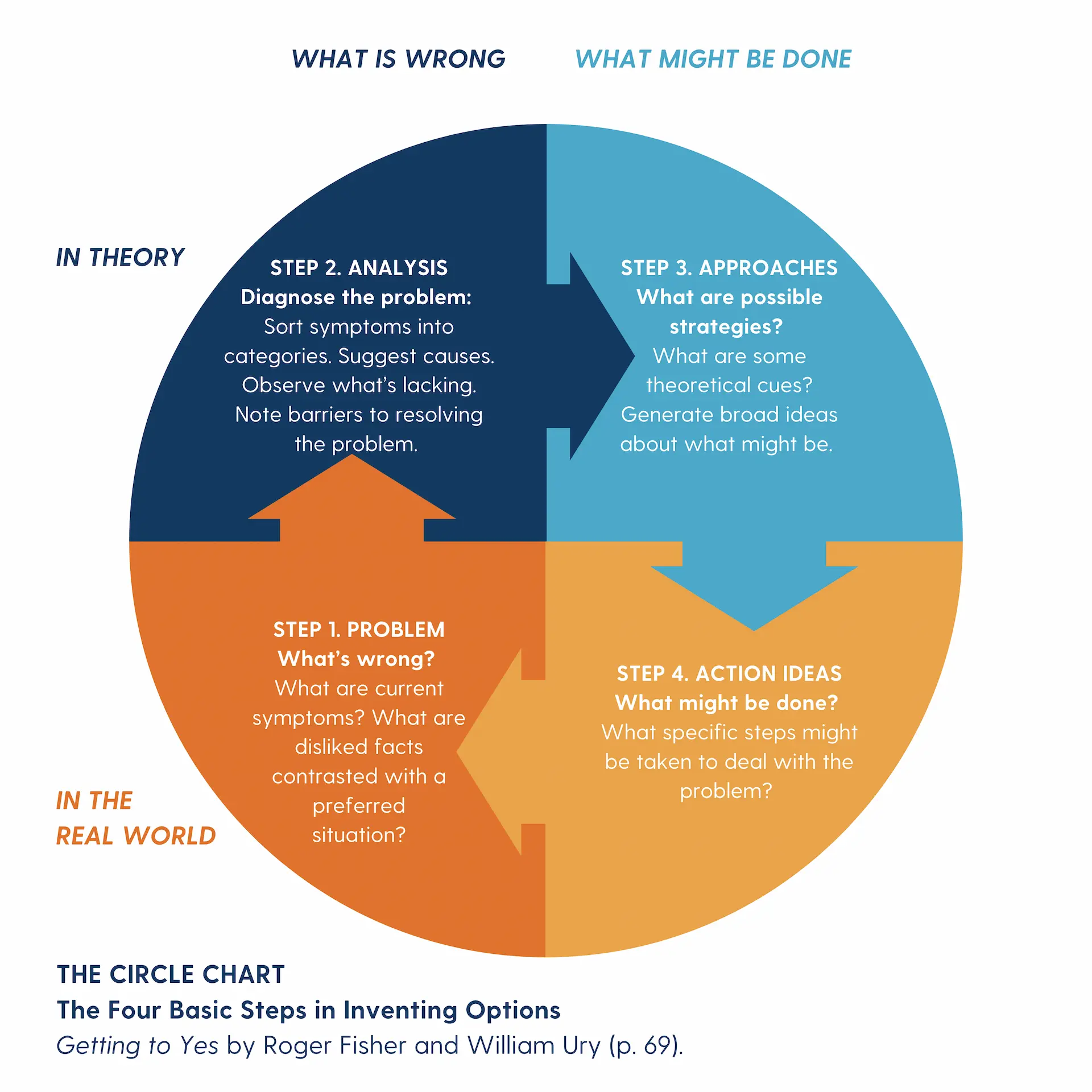
- Broaden your Options: Inventing options involves four types of thinking: what is the particular problem, why it exists, what better options are possible, and what should be done.
-
- The Circle Chart illustrates these four types of thinking and provides an easy way to use one good idea to generate others (see below).
- Another way to generate multiple options is to examine your problem from the perspective of different professions and disciplines.
- Invent agreements of different strengths. If you cannot reach a first-order deal, there might be a second-order one (that is, agree to disagree so that both sides know the issue in dispute and can move to a third alternative).
- The Circle Chart illustrates these four types of thinking and provides an easy way to use one good idea to generate others (see below).
- Search for Mutual Gain: The assumption of a fixed pie is the idea that the less for one, the more for the other. But this assumption is rarely ever true.
-
- Identify shared interests. Look for solutions that satisfy the other side as well. Shared interests lie latent in every negotiation.
- Dovetail different interests. Think back to the children and the orange. A satisfactory agreement would have been possible as each side wanted different things, yet most people assume differences create problems.
- To devise creative solutions, focus on differences in interests, beliefs, the value placed on time, forecasts, or aversion to risk.
- Make their Decisions Easy: Focus on making things easier for the other side. Be clear about who you are trying to influence. You cannot negotiate with a company; you negotiate with a person. See the problem from their point of view.
-
- When negotiating, a great strategy is to offer them an answer rather than a problem. Make the decision easier for them.
- Another strategy is to shape the solution in terms of being fair, legal, honorable, etc.
- Consider the consequences of following a decision from their point of view. If you were they, what results would you fear most? What would you hope for?
- Without using threats or warnings, make offers that focus on showing the other side the consequences they can expect based on their decisions. Emphasize how those outcomes can be improved from their perspective.
Chapter 5: Insist on Using Objective Criteria
- No matter how well you apply the previous strategies, you’ll eventually encounter a conflict of interest. Negotiators tend to resolve these conflicts via positional bargaining.
- When conflicting interests would result in a costly settlement, the solution is to negotiate based on objective criteria, independent of either side’s preferences.
-
- The goal is to reach a commitment based on principle and not pressure.
- Standards of fairness, scientific merit, or precedence allow for a greater chance of producing a wise and fair solution.
-
- Like any other method, principled negotiation is most effective with thorough preparation. During this process, identify multiple objective criteria that can serve as neutral grounds for agreement.
-
- Consider market value, precedent, professional standards, cost, tradition, moral standards, equal treatment, efficiency, etc.
- Consider the classic method for fairly dividing a cake between two children: one cuts and the other chooses.
- Another approach for resolving differences is to use simple procedural solutions, such as taking turns, drawing lots, or having a neutral party decide.
-
- To discuss your objective criteria with the other side,
-
- Frame each issue as a joint search for objective criteria: You can start by suggesting one or more criteria and then ask for the other person’s suggestions. You can ask, “What is your theory?” Agree on principles before considering the terms.
- Reason, and be open to reason: Join the meeting with an open mind.
-
-
- Principled negotiation does not mean using the phrase, “It’s a matter of principle,” as an excuse to be stubborn or to base the agreement on your criteria.
- If at any point you and the other side cannot accept a proposed criteria as the most appropriate, suggest testing them. Find a mutually agreed-upon impartial party to evaluate the criteria and determine its fairness.
- “A principled negotiator is open to reasoned persuasion on the merits; a positional bargainer is not” (p. 91).
-
-
- Never yield to pressure, only to principle: Pressure can take many forms: bribes, threats, manipulative appeals, or stubbornness. Regardless, respond by inviting them to explain their reasoning, proposing objective criteria, and standing firm on your position unless the requirements are met.
- If the other side remains uncooperative after employing all these strategies, further negotiation is futile. At this point, the situation becomes fixed and non-negotiable, presenting a take-it-or-leave-it decision.
PART III – Yes, But…
Chapter 6: What If They Are More Powerful?
- In some negotiations, there are realities that we cannot change. Sometimes, all the power or leverage lies on the other side. Your goal is to protect yourself against an agreement you should reject and help you make the most out of any agreement you do strike.
- To avoid accommodating the other side too quickly for fear of losing the deal, many negotiating parties establish in advance a worst-acceptable outcome. If buying, they determine the higher price they would pay; if selling, they determine the lowest amount they would accept.
-
- Having a bottom line – your worst acceptable outcome – helps you resist pressure and temptation. However, this involves a high cost: It limits your ability to benefit from what you learn during the negotiation.
- Your bottom line is ultimately a position that cannot be changed. Therefore, it keeps you from being open-minded, inhibits your imagination, and interferes with your ability to invent new solutions.
-
- Negotiating aims to secure an outcome that exceeds what you could achieve without engaging in the process – something that can be restricted if you focus solely on your bottom line.
- An alternative to the bottom line is your BATNA: Best Alternative To a Negotiated Agreement. Your BATNA is a benchmark to evaluate any proposed agreements, ensuring that the deal offers better value than your fallback option.
-
- A BATNA is flexible enough to allow for the exploration of other solutions. You can compare any proposal with it to see whether it satisfies your interest.
- Not having a clear BATNA puts you at risk of being too optimistic and assuming you have other choices that might not be available. You might not view the consequences of reaching an agreement as seriously as they are.
- In other cases, the danger is becoming too committed to reaching an agreement and being pessimistic about what would happen if the negotiations broke off.
- Your BATNA, ultimately, helps you make decisions. Whether you agree or not on something in a negotiation depends on your best available alternative.
-
- Another option is formulating a trip wire. Identify one far-from-perfect agreement that is better than your BATNA. Before accepting any agreement worse than this trip wire, take a break and reexamine the situation. This provides you with a margin in reserve.
- Rely on your BATNA to maximize your leverage in a negotiation. For instance, walking into a job interview with other offers puts you in a stronger position than having no offers. This advantage significantly impacts how salary negotiations unfold.
- To develop your BATNA, make a list of the actions you might take if no agreement is reached, improve the more promising ideas and convert them into practical alternatives, and tentatively select the best alternative.
-
- Disclosing your BATNA depends on your assessment of the other side’s thinking. For example, if you have another client, it might be best to let them know. But if your BATNA is worse than what they think, sharing it will weaken you.
-
- Think about the other side’s BATNA. The more you know about their alternatives, the better prepared you’ll be for the negotiation.
- When the other side is too powerful, you’ll benefit by negotiating on the merits. “To the extent that they have muscle and you have principle, the larger a role you can establish for principle the better off you are” (p. 107).
-
- Your BATNA allows you to negotiate based on the merits. By leveraging your knowledge, time, resources, connections, and strategy, you can focus on finding the best solution for yourself, regardless of whether the other party agrees.
-
Chapter 7: What If They Won’t Play?
- You might face times when the other side does not cooperate in a collaborative approach to negotiation. To turn them away from positions and move them toward the merits, there are three basic approaches:
-
- Focus on what you can do. Principled negotiation is contagious. You can often change the game simply by playing it differently.
- If that doesn’t work, focus on what they may do. This is called negotiation jujitsu.
- If neither principled nor jujitsu negotiation work, seek a third party.
-
- If the other side pushes you hard during a negotiation, you might be tempted to push back. But if you do, you’ll end up in a positional bargaining game. Rejecting their position will lock them in, and defending yours will lock you in.
- When they attack you, break the cycle by refusing to react. In oriental martial arts, people avoid directly pitting their strength against others and instead use their skill to turn others’ strength to their ends. The same is true for negotiation jujitsu.
- In positional bargaining, you might face three maneuvers: the other side might assert their position forcefully, attack your ideas, or attack you.
-
- When they assert their position forcefully, don’t reject or accept it, but treat it as one possible option. Look for interests behind it and seek ways to improve it.
- If they attack your ideas, don’t defend them. Instead, invite criticism and advice. Examine their negative judgments to find out their interests and improve your ideas from their point of view. Use their criticism to work toward agreement.
- If they attack you, allow them to vent. Listen, show you understand, and when they’re done, reframe their attack as criticism of the problem. Let them know you’re on the same team, working together towards a shared concern.
-
- Negotiation jujitsu relies on two key techniques: asking questions and using silence. While statements often provoke resistance, questions encourage dialogue, helping you understand the other side’s perspective without being confrontational.
- Silence is equally powerful. When faced with an unreasonable proposal or weak response, silence can prompt the other party to elaborate or rethink its position.
-
- When asking questions, pause. “Some of the most effective negotiating you will ever do is when you’re not talking” (p. 114).
-
- When you cannot change the negotiation process to seek a solution based on the merits, seek a third party that can help. A skillful mediator can separate the people from the problem and direct the discussion to interests and options.
- A one-text procedure is a process where a third party helps separate invention from decision-making, reduces the number of decisions required to reach an agreement, and allows parties to know what they will get when they decide.
-
- For example, spouses with differing ideas on a house design can use an architect as a third party. The architect can draft a design based on both inputs, allowing the couple to focus on refining the plan rather than debating directly.
-
Chapter 8: What If They Use Dirty Tricks?
- There are many tricks that people can use to take advantage of you. These range from illegal to unethical to unpleasant and include lies, psychological abuse, or pressure tactics.
- When people notice tricky bargaining tactics, they usually respond in one of two ways:
-
- They put up or go along with it. Sometimes this works, but most often, it fails.
- They respond in a similarly tricky way, and the negotiation fails.
-
- To effectively counter tricky bargaining, use principled negotiation and agree on fair rules for moving forward. There are three main steps:
-
- Recognize the Tactic: Simply recognizing a tactic is often enough to neutralize it. For example, if the other side attacks you to impair your judgment, your noticing frustrates the effort.
- Raise the Issue Explicitly: After recognizing a trick, communicate it to the other side without being aggressive. Discussing the tactic makes it less effective and may cause the other side to worry about alienating you.
- Question the Tactic’s Legitimacy and Desirability: The goal of bringing the tactic up explicitly and questioning the trick’s legitimacy and desirability is to shift the focus to discussing the negotiation rules. To do so,
-
- Separate the people from the problem.
- Focus on interests, not positions.
- Invent options for mutual gain.
- Insist on using objective criteria.
-
- One of the most common tricks is misrepresenting facts. Unless you have a good reason to trust someone, don’t. If you catch someone misrepresenting information, start by disentangling the person from the problem.
-
- Practice verifying factual assertions to reduce people’s incentive for deception and your risk of being cheated.
-
- The other side might also misrepresent authority, making you think they hold the authority to compromise when they don’t. This is when, after pressuring you to make an agreement, they announce that they have to consult someone else for approval.
-
- To avoid falling for this technique, never assume that the other side has authority just because they are the ones negotiating.
- Before starting the negotiation, figure out who’s in charge. Do some research or simply ask, “Just how much authority do you have in this particular negotiation?”
-
- Another common trick is treating what seemed like a final agreement as a point for more negotiation. If they unexpectedly do that, insist on reciprocity. Say, “If your boss approves this by tomorrow, I’ll honor it. Otherwise, we should both feel free to suggest more changes.”
-
- Another way to prevent this problem is to clarify early in the negotiation that nothing is agreed until everything is agreed.
-
- When there’s a misinterpretation of intentions to comply, you can build compliancy features into the agreement itself.
-
- Note that good faith in negotiation doesn’t require total disclosure.
-
- Psychological warfare is when the other side employs tactics to make you uncomfortable so that you unconsciously want to end the negotiation as promptly as possible.
-
- Contrary to common belief, meeting on the other side’s territory can be beneficial. It may make them more comfortable and open to your ideas. This also gives you an easier exit if needed.
- If you let the other side choose the setting, be mindful of its impact on you. Regularly assess whether you feel stressed and why. Factors like noise or uncomfortable temperatures may be deliberate tactics to pressure you into rushing the negotiations.
- Your job is to identify the problem, raise it with the other side, and, in an objective and principled fashion, negotiate better physical circumstances.
-
- In addition to manipulating the environment, the other side can use verbal and nonverbal communication to make you uncomfortable. They can say something like, “Looks like you were up all night. Are things not going well at the office?”
-
- They can attack your status, imply you’re ignorant, refuse to listen, deliberately avoid eye contact, etc. Recognizing these tactics can nullify their effects, and bringing them up explicitly will prevent reoccurrence.
-
- The good-guy/bad-guy technique, common in police movies, is often used in negotiation. You won’t be tempted to fall for the good guy’s pitch if you recognize it.
- Threats are one of the most overused tactics in negotiation, but they can damage relationships. Instead of simplifying decisions for the other side, they often complicate things. Skilled negotiators rarely rely on threats.
-
- If necessary, real warnings are more legitimate. Make sure that your actions are intended to safeguard your interests and not coerce or punish the other side.
-
- Another type of bargaining tactic is positional pressure, which involves structuring a situation so that only one side can make concessions. One example of this is refusing to negotiate. To counter this tactic, set preconditions for negotiations.
- Another approach is to discuss their refusal to negotiate directly or via third parties. Find out their interests for not negotiating and suggest solutions.
- If a negotiator makes an extreme demand, their goal is likely to lower your expectations. They’re probably working under the theory that the negotiation will end by splitting the difference between positions. Here, ask for principled justification of their position until it looks ridiculous even to them.
- In cases when a negotiator continually escalates demands or reopens issues that have already been settled, call it to their attention and take a break while you consider whether and on what basis you would continue negotiating.
- The lock-in tactic, as described by Thomas Schelling with the example of dynamite trucks speeding toward each other, highlights the paradox of strengthening your position by limiting your control over the situation. Essentially, these are gambles.
- In the truck example, one driver throws their steering wheel out the window, forcing the other to choose between a crash or veering off the road.
- Like a gamble, you can call the other side’s bluff, pressuring them into a concession they must then explain to their stakeholders.
- This tactic relies heavily on communication—if the other driver doesn’t see the steering wheel go out the window, for instance, the pressure to avoid the collision won’t fully shift to them.
- In such cases, avoid committing and deemphasize their lock-in, allowing the other side a way to back down gracefully.
- A calculated delay occurs when one side postpones making a decision until a time they find more favorable. For example, labor negotiators often stall until the last few hours before a strike deadline.
- The “Take it or leave it” tactic is not negotiation. There’s nothing inherently wrong with it; you can use it at the end of a negotiation but express it more politely.
- Don’t be a victim in negotiations. Be ready to counter tricky tactics. You can stand firm and uphold principles when faced with unfair approaches.
Part IV – Conclusion
- If you have any experience negotiating, the contents of this book are probably not new. You likely were familiar with them at some level of your experience.
-
- By organizing what stems from common sense and experience, this book offers a framework for thinking and acting during negotiations.
-
- Like any other skill, reading about negotiation will help you learn, but it is through practice that you’ll become an expert.
- In negotiation, there shouldn’t be any “winning.” Your goal is to achieve a better process for dealing with differences.
-
- Principled negotiation will produce outcomes as good as or better than you are likely to obtain using any other negotiation strategy. Still, it will also help you build and maintain healthy relationships.
-
PART V – Ten Questions People Ask About Getting To Yes
- Does positional bargaining ever make sense?
-
- Principled negotiation is more effective and will take you further, as positional bargaining limits joint gains.
- Bargaining causes the least harm when done after identifying both parties’ interests, creating mutual options, or discussing fair standards.
- What if the other side believes in a different standard of fairness?
-
- In negotiation, there is no “right” or “fairest” answer. Agreement on the best standard isn’t required. While values, culture, and experience guide agreements, external standards can help bridge differences when those factors diverge.
- Should I be fair if I don’t have to be?
-
- This book isn’t about morality but focuses on successful negotiation. It suggests that using independent standards to assess fairness can help both parties achieve fair outcomes and avoid exploitation.
- If you can gain more than what seems fair, be cautious. Consider not just the ethical implications but also the potential harm to the relationship from an unfair outcome.
- What do I do if the people are the problem?
-
- This question often arises from misinterpreting the advice to “separate the people from the problem.” Separating people from the problem doesn’t mean ignoring people issues.
- The principle holds true, even if people problems are central to the negotiation:
-
- Build a working relationship regardless of agreement.
- Negotiate the relationship itself.
- Separate your treatment of others from how they treat you.
- Handle perceived irrationality with rationality.
-
- Should I negotiate even with terrorists or someone like Hitler? When does it make sense not to negotiate?
-
- Regardless of with whom you’re negotiating, unless you have a better BATNA, your question is not whether to negotiate but how.
- Negotiating with terrorists is about influencing their decisions (you are negotiating even if you’re not talking to them). Negotiation is not giving in. There are costs to paying ransom or blackmail, for instance.
- Whether you should negotiate with someone like Hitler depends on the alternative. Some interests are worth fighting or dying for, but if nonviolent means can achieve a substantial part of your interests, it’s worth considering.
- Deciding whether to negotiate and how much effort to invest depends on your BATNA and the likelihood that negotiation will yield better results.
- How should I adjust my negotiating approach to account for differences in personality, gender, culture, etc.?
-
- All human beings have the same basic needs. However, we all vary in interests and communication styles. When negotiating, be sensitive to values, concerns, norms of behavior, and even the mood of those with whom you’re dealing.
- Pay attention to beliefs and customs, but avoid stereotyping.
- How do I decide where to meet, how to communicate, who should make the first offer, and how high I should start?
-
- To answer these questions, be prepared and do some research. For example, where you meet depends on what you’re worried about. If you’re concerned about interruptions, find a secluded place. If you need a whiteboard, find a conference room.
- Whenever possible, try to meet face to face.
- Concretely, how do I move from inventing options to making commitments?
-
- The authors don’t think there is one best process, but they offer general principles:
-
- Think about closure from the beginning. Envision what a successful agreement looks like beforehand to figure out what issues may arise during the negotiation and how to resolve them.
- Consider crafting a framework agreement. Sketch an outline of what the agreement might look like as part of your preparation.
- Move towards commitment gradually. As the negotiation proceeds and you discuss options, seek a consensus proposal that reflects all the points made and meets each side’s interests.
- Be persistent in pursuing your interest but not rigid in pursuing any particular solution.
- Make an offer that naturally unfolds out of the discussion.
- Be generous at the end. Give the other side something you know will be valuable to them while remaining consistent with the basic logic of your proposal.
-
- The authors don’t think there is one best process, but they offer general principles:
- How do I try out these ideas without taking too much risk?
-
- Start small. Experiment in negotiations where the stakes are low, you have a good BATNA, or the other side is likely to be amenable.
- Practice, review your performance, and prepare ahead of time.
- Can the way I negotiate really make a difference if the other side is more powerful? How do I enhance my negotiating power?
-
- No matter how skilled you are, there are limits to what you can get through negotiation. Don’t expect success unless you can make the other side an offer they find more attractive than their BATNA.
-
- If that’s impossible, the negotiation doesn’t make sense. Concentrate instead on improving your BATNA and perhaps changing theirs.
-
- Try not to ask who’s more powerful. If you conclude that’s you, you may relax and not prepare as well as you should. If you find it’s them, you risk being discouraged and not devoting sufficient attention to how you might persuade the other party.
- It is through principled negotiation that you will enhance your negotiation power.
- Remember, effective communication is powerful. Craft your message with a punch, listen to the other side, and show that you’ve heard to increase persuasiveness.
- As President John F. Kennedy once said, “Let us never negotiate out of fear. But let us never fear to negotiate” (inaugural address, January 20, 1961).
- No matter how skilled you are, there are limits to what you can get through negotiation. Don’t expect success unless you can make the other side an offer they find more attractive than their BATNA.
