


Managing Transitions: Making the Most Out of Change
About the Authors
William Bridges (1933 – 2013) was a preeminent authority on change and managing change in the workplace. A former American literature professor, he was educated at Harvard, Columbia, and Brown, where he received his PhD in 1963 in American Civilization. He initiated his own career change, founding William Bridges Associates in 1981. He consulted with organizations and individuals dealing with major business, professional, and personal changes, focusing on transition management, the human side of change.
As an internationally known author, speaker, and consultant, William Bridges’ expertise has been utilized in several hundred organization mergers, reorganizations, leadership changes, and cultural shifts by companies, including Baxter Healthcare, Cisco System, Apple, Intel, Microsoft, the US Department of Energy, BankBoston, Saudi Aramco, Transamerica, Stanford University, Visa USA, Astra Zeneca, McKesson, and Harvard Business School. The Wall Street Journal listed him among the top ten independent executive development presenters in the United States.
Susan Bridges, President of William Bridges Associates, consults with leaders and organizations facing significant challenges as a result of the nonstop change. Her key focus is providing insight and tools to make change less disruptive, capitalizing on the opportunity for development and innovation that change and its resulting transition offer.
Previously, she held senior management positions with international consulting firms, where she provided leadership and guidance through startup, turnaround, and growth periods. Her clients have included a broad range of industries in the public, private, and nonprofit sectors, including Blue Cross/Blue Shield, Hewlett-Packard, Applied Biosystems, Chevron, Procter & Gamble, Levi Strauss, Bank of America, YPO, and Montessori. She holds a BA and an MA in Communications, with a focus on neurolinguistics and psychology, from the University of Colorado.
Sources: “About the Authors” section of the book
Our one-sentence summary
Managers need to navigate the human side of change—transitions—by focusing on, addressing, and managing the psychological process inherent to them, ensuring successful organizational transformations.
Publisher’s Summary
“The business world is constantly transforming. When restructures, mergers, bankruptcies, and layoffs hit the workplace, employees and managers naturally find the resulting situational shifts to be challenging. But the psychological transitions that accompany them are even more stressful. Organizational transitions affect people; it is always people, rather than a company, who have to embrace a new situation and carry out the corresponding change.
As veteran business consultant William Bridges explains, transition is successful when employees have a purpose, a plan, and a part to play. This indispensable guide is now updated to reflect the challenges of today’s ever-changing, always-on, and globally connected workplaces. Directed at managers on all rungs of the corporate ladder, this expanded edition of the classic bestseller provides practical, step-by-step strategies for minimizing disruptions and navigating uncertain times.”
Source: Book Jacket
Detailed Summary
Introduction
- Since the first edition of Managing Transitions was published 25 years ago, organizational change has become faster and more constant.
- Due to the advent of technology, organizational leaders are now confronted with the problem of moving teams and employees in quickly transforming landscapes while dealing with high degrees of economic uncertainty.
- While the changes we are currently facing are unprecedented, the essentials behind the transition process presented in the first edition of this book remain effective.
- This edition is supplemented with what the author has learned through decades of consulting with organizations of all kinds.
PART I – THE PROBLEM
Chapter 1: It Isn’t the Changes that Do You In
- “It isn’t the changes that do you in; it’s the transitions” (p. 3). Change is a situational process; transition is a psychological one. Transition is a three-phase process that requires internalizing and accepting the new situation.
- Phase one involves letting go of old ways and identities. At this stage, leaders need to help people deal with loss.
- Phase two is in an in-between period when the old is gone, but the new isn’t fully operational – the neutral zone. This is when psychological realignments happen.
- The last phase is emerging from the transition and creating a new beginning. Here, people develop a new identity and discover a new sense of purpose.
- Companies often manage change by combining staff, resources, or products but forget the transition and neglect employees.
- The success of any change depends on the people. Companies that don’t help employees through these phases won’t succeed.
- Using the terms “transition” and “change” interchangeably can cause people to overlook the psychological nuances behind any change-related decision. This guarantees that the transition will be mismanaged.
- “Transition starts with an ending” (p 9). Transitions begin when something ends, as you have to let go of it. For instance, if you’re promoted, you must let go of your previous job and your identity to start a new one.
- Failing to recognize and prepare for endings leads to further problems in the transition.
- The neutral zone doesn’t feel comfortable because identities are shifting. This is emotionally exhausting and leads to uncertainty.
- It’s important to understand the neutral zone. Otherwise, people will get discouraged and assume the discomfort is a sign that something’s wrong.
- During the neutral zone period, employees might quit, trying to escape the anxiety caused by the confusion. However, at this stage, people can be the most creative and have an opportunity to renew themselves.
- Note that calling these stages “phases” makes the transition sound like a linear process. But they are separate, even if the transition cannot be completed until all three occur.
Chapter 2: A Test Case
- To apply the concepts provided in Chapter 1, Chapter 2 describes a case study.
- A software company is undergoing a change. Their customer service was made up of three tiers or units. Level 1 consisted of technicians trained to answer basic questions, level 2 consisted of more trained and experienced technicians, and level 3 consisted of expert programmers.
- The system was flawed, with poor coordination among the three levels.
- There was mistrust and rivalry among units.
- Customer satisfaction wasn’t an issue until a competitor successfully launched a new product.
- To address the issue, a change was executed: Units were reorganized into teams of people from all three levels. However, a few months after implementation, they realized the program was not working.
- The old levels system was still fixed in technicians’ minds, and customers were still being transferred around levels or dropped without any coordination.
- The remainder of the chapter is an exercise where the reader is prompted to review a list of action items and classify each one under one of the five categories below. The following are the answers:
-
- Category 1: Very important. Do this at once.
-
- Determine how behaviors and attitudes need to change to make teams work.
- Analyze who stands to lose something under the new system.
- Rather than selling the solution, sell the problem so that technicians understand the solution as theirs.
- Let them see the problem first-hand (put them in contact with upset clients).
- Talk with technicians and ask what problems they have with teaming.
- Explain the transition process described in Chapter 1.
- Hold regular team meetings.
-
- Category 2: Worth doing, but takes time. Start planning it.
-
- Redo compensation systems to reward compliance with the changes.
- Create temporary policies, procedures, roles, etc., while in the neutral zone.
- Use the neutral zone to try new and improved ways of delivering the service.
- Change spatial arrangements from cubicles to group spaces.
- Reconceive the general manager’s job as that of a coordinator.
- Send technicians to visit other organizations where teams operate successfully.
- Change the bonus system from individual contribution to team performance.
-
- Category 3: Yes and no. Depends on how it’s done.
-
- Bring in a motivational speaker.
- Appoint a change manager.
- Give everyone a T-shirt with a new teamwork logo on it.
- Give everyone a training seminar on how to work as a team.
- Change spatial arrangements from cubicles to glass or low partitions.
- Give bonuses to the first team to process 100 calls successfully.
-
- Category 4: Not very important. It may even be a waste of effort.
-
- Explain the changes again in a carefully written memo.
- Give everyone a copy of the new organization chart.
-
- Category 5: No! Don’t do this.
-
- Turn the power over to the people.
- Break the change into smaller stages.
- Place the best people in a unit together as a model team.
- Scrap the plan and find a less disruptive one.
- Threaten with disciplinary action.
PART II – THE SOLUTION
Chapter 3: How to Get People to Let Go
- People don’t like change or endings, as they struggle with identity shifts.
- Whenever things change in an organization, at least some of the employees and managers will have to let go of something. To identify who’s losing what, answer the following questions in sequence:
- Describe the change in as much detail as possible. What is actually going to change?
- What are the secondary changes that your initial change will probably cause? What further changes will those secondary changes cause?
- Create a list of cause-and-effect collisions and think of the people whose familiar way of doing things will be affected. For each case, who will have to let go of something? What exactly must they let go of?
- Take time to consider losses that aren’t concrete losses (e.g., sense of competence).
- Is there something that is over for everyone?
- If the change is already happening, ask people what they’re losing. Remember that loss is subjective, and the objective view is irrelevant.
- If you perceive that people are overreacting, remind yourself that changes cause transitions, and transitions cause losses.
- Overreactions also occur when a small loss is perceived as the first in a process that will end with a drastic change (e.g., they may fear being fired).
- Learn to look for the loss behind the loss to deal with the underlying issue.
- Once you understand your employees’ losses, acknowledge them openly and empathetically. You can say, “I know that switching to the new platform is going to leave a lot of you feeling like beginners again. I feel that way myself, and I hate it!” (p. 32)
- When endings happen, people experience negative emotions. Don’t mistake them for bad morale. They are signs of the grieving process.
- Denial is a natural first stage in the grieving process. It doesn’t require action unless people stay in denial for too long.
- When dealing with anger, listen to people and acknowledge that their anger is understandable. But don’t take on the blame if it is being misdirected towards you. Distinguish between acceptable feelings and unacceptable behaviors.
- When bargaining, people try to make some sort of deal, but you must help them distinguish their efforts from real problem-solving.
- When it comes to anxiety, whether silent or expressed, keep sharing as much information as possible and empathize with people.
- For sadness, encourage people to speak up and share their feelings—share yours, too. Don’t reassure people with unrealistic suggestions of hope.
- For confusion, give people support and the opportunity to express themselves.
- If possible, compensate for the loss. Ask yourself, “What can I give back to balance what’s being taken away?” Think of status, team membership, recognition, etc.
- While management might rationalize not communicating (e.g., “They don’t need to know yet. We’ll tell them when the time comes. It’ll just upset them now.”), give people as much information and as often as possible.
- There will be instances when information must be withheld. Ensure it isn’t because leaders are uncomfortable sharing it.
- If you notice that people are confused, define what’s ending and what’s not. If you’re unclear, people will try to do both the old and the new simultaneously, and they’ll overload. They might also make their own decisions about what to discard and what to keep, leading to inconsistency.
- After discussing what’s ending, create an activity to dramatize and mark the end.
- Don’t get so excited about the future that you demean the past. People identify with the way things used to be done.
- If possible, allow people to take a piece of the old way with them. For instance, a Procter & Gamble plant put together a yearbook during the last year of its operations.
- The authors clarify that their advice is not to be taken as an urge to slow things. “Whatever must end must end. Don’t drag it out. Plan it carefully, and once it is done, allow time for healing” (p. 42).
Chapter 4: Leading People through the Neutral Zone
- The neutral zone can take months or even years.
- This difficult time is characterized by neither the old nor the new working satisfactorily.
- Some pitfalls to watch out for during this time include:
- People’s anxiety will rise, and their motivation will fall. There will be disorientation and self-doubt.
- Absenteeism will be more common.
- Weaknesses that were previously patched or compensated for will reemerge.
- People will be overloaded, get mixed signals, and systems will be unreliable.
- Priorities will get confused, information will be miscommunicated, and important tasks can go undone.
- People can become polarized, with some wanting to rush forward and others wishing to return to old ways.
- Your company will be vulnerable to competitive threats.
- To overcome it successfully, you need neutral zone Your task is to get people through this phase and capitalize on the confusion by encouraging innovation.
- A benefit of this zone is that employees have no fixed ideas from established practices, so the lack of a clear system makes this zone more welcoming to new ideas.
- To make the most out of the neutral zone, normalize this as a time of reorientation and redefinition. Help employees recognize that it is normal to feel nervous and confused.
- Another strategy to effectively manage this phase is redefining the neutral zone. For example, in a manufacturing plant that was being closed, people started talking in terms of a “sinking ship.” Management changed the metaphor to “the last voyage.” Words can influence people’s perspective of a situation.
- With the change of words, they also put together training programs and reassignment policies that translated them into action.
- To manage the neutral zone, temporary systems should be created to give structure and strength. You can do so by,
- Protecting people from further changes.
- Reviewing policies and procedures to see if they are adequate during this phase.
- Readjusting roles, reporting relationships, or any sort of configuration of teams.
- Setting or establishing checkpoints to give people a sense of achievement and movement as they work to reach the ultimate goals.
- Not making promises to upper management about high levels of output.
- Finding out what supervisors need to learn to function successfully.
- The neutral zone tends to be lonely. This is a time to focus on rebuilding group identification and connectedness.
- Be wary of any activities that show preferences over one group; you want to avoid creating further division and resentment.
- Communication can be challenging during the neutral zone, and decision makers don’t always get the information they want or need. To avoid this risk, create a transition monitoring team (TMT) with no decision-making power that facilitates upward communication.
- The TMT should create a sense of trust in listening to ideas and concerns.
- Don’t give this role to a group of upper-level managers. Set up a special group that represents all constituencies in the organization. However, ensure that the team includes someone from leadership or someone with access to leadership.
- Make it clear that this is a time-limited group.
- To use the neutral zone to foster creativity,
- Help people understand that this is a time to question the status quo.
- Provide opportunities for people to step back and take stock.
- Encourage learning in the areas of discovery and innovation.
- Encourage experimentation.
- Reframe setbacks as opportunities for growth.
- Look for opportunities to brainstorm new answers to old problems.
- Restrain the impulse to push prematurely for certainty and closure.
Chapter 5: Launching a New Beginning
- “The beginning will take place only after people have come through the wilderness and are ready to make the emotional commitment to do things in a new way and see themselves as new people” (p. 66).
- New beginnings are the final phase of the transition process. It is not dates but people’s minds that set their timing.
- People tend to resist beginnings even if they’re attracted to them because:
- Beginnings reactivate old anxieties originally triggered by the ending. They established that the ending was real.
- Beginnings can be like gambles: there is always the possibility that the change won’t work.
- The prospect of a risky new beginning will resonate with the past.
- To some, new beginnings wreck pleasant experiences from the neutral zone (for example, a sense of lack of pressure).
- To encourage new beginnings, focus on Purpose, Picture, Plan, and Part—the 4 Ps. Explain the basic purpose behind the outcome you seek. Paint a picture of how the outcome will look and feel. Lay out a step-by-step plan for phasing in the outcome. And give each person a part to play.
- Don’t communicate solely in terms of your preferred P. People are different, so you need to cover all your bases when discussing new beginnings.
-
- Clarify and communicate the purpose: What is the idea behind what you’re doing? Explain your purpose clearly.
- Sometimes, people have trouble understanding the purpose because they don’t know what problems the organization is facing. Sell the problems before selling a solution.
- Other times, the purpose is unclear because it wasn’t communicated effectively regarding what it means to the individual.
- After a purpose, a picture: Purposes tend to be abstract. Most people need something they can picture to feel like they can work towards it. Paint a picture that helps them understand their destination, even if it is only in their imaginations.
- What will the outcome of the change look and sound like? How will people get their work done?
- Don’t overwhelm people with a picture that is so difficult to imagine that they become intimidated rather than excited about it.
- Then, create a plan: For operationally minded people, the picture can be interesting and exciting, but they need more to understand what they need to do.
- Outline a plan focusing on the transition, not the changes. Describe the steps in which people will receive the information, training, and support they need.
- Address the change on the personal rather than the collective level. Focus on the process, not the outcome.
- Start where people are and work forward, step by step, through the process of leaving the past behind, getting through the neutral zone and profiting from it, and emerging with a new attitude, behavior, and identity.
- Select, design, and schedule events, actions, and projects to guide the transition.
- Finally, a part to play: A group of people will need what the purpose, picture, and plan all omit: a part for them to play.
- Explain people’s roles and their relationships to others. Without that information, they can’t begin the adjustment process.
- Having a part to play gives people insight into the real problems, helps them become allies, brings out their knowledge, and implicates them in the outcome.
- Clarify and communicate the purpose: What is the idea behind what you’re doing? Explain your purpose clearly.
- To reinforce a new beginning, be consistent. Every message, procedure, or priority sends a message; you need to be careful they’re not conflicting ones.
- Because the neutral zone can damage people’s confidence, find ways to give them quick success.
- Through this process, create something that symbolizes the new identities being established (e.g., a company going through a merger changed badge colors to make sure people didn’t identify with one or the other organization but the new one).
- Celebrate it when the transition is over. Let people take away a memento of the transition process.
Chapter 6: Transition, Development, and Renewal
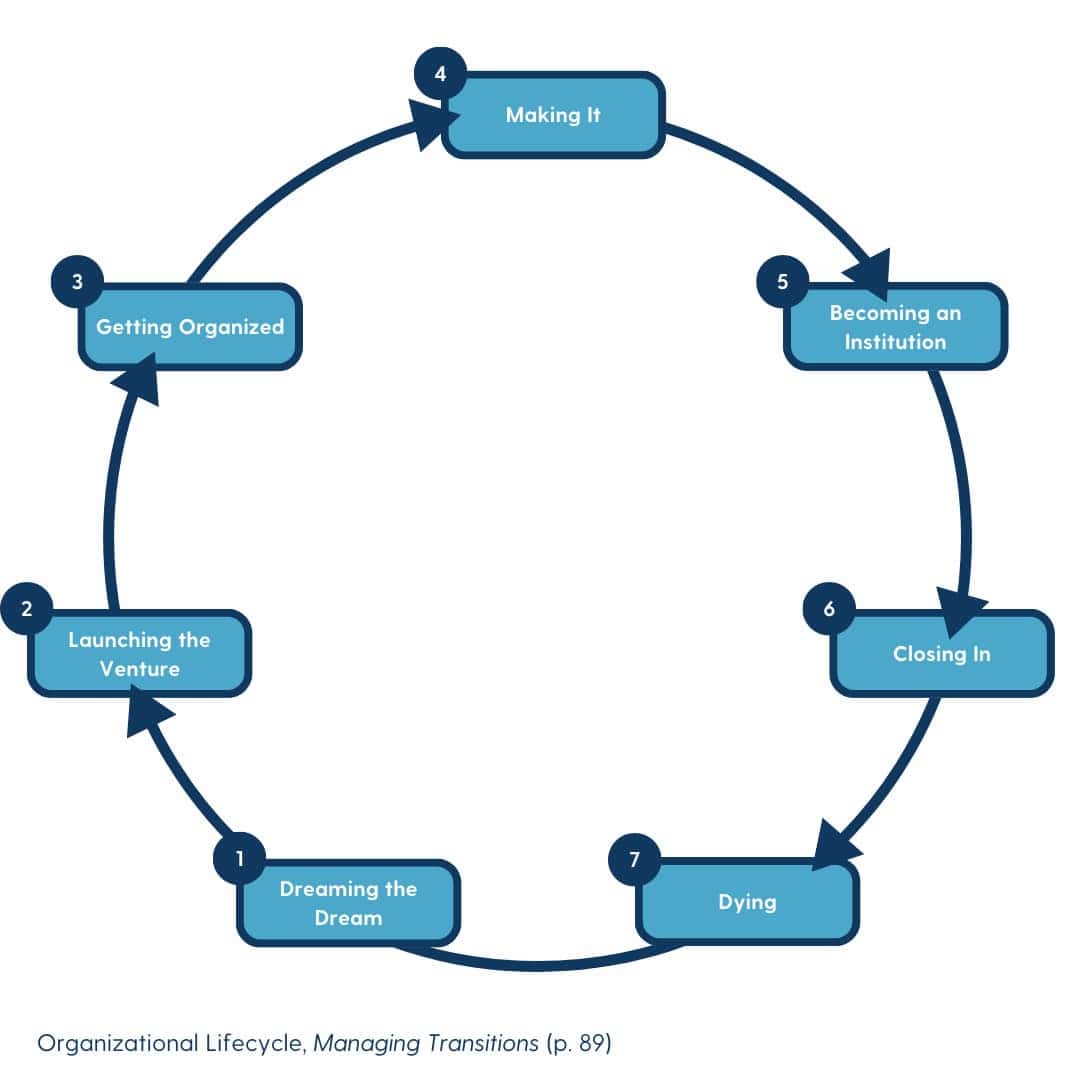
- Every organization experiences stages of life. The following stages are not predestined realities, but they help represent fixed times in organizations’ lives (see diagram below).

-
- Dreaming the Dream: This is a time of conceptualization and planning. The organization is more than an idea, but its activities are still being articulated.
- Launching the Venture: This is the organization’s early years (childhood). Some organizations may already have customers at this stage, but they are still ventures because there are no formal systems yet.
- Getting Organized: To some, this stage might feel like going backward as you slow down and begin to standardize processes. Roles become more specialized and defined. The hiring process changes as experience starts to become more important.
- Making it: Adulthood begins at this stage. The organization is significant within its market. Companies can expand and grow for a long time without leaving this stage.
- Becoming an Institution: At this stage, the emphasis moves from doing to being. The organization has an established reputation. This phase can last long, but it is the beginning of the process of decline.
- Closing In: This phase marks the loss of the vital tensions between an organization and its environment. It can be kept alive for a while, but the final outcome is closing in. This phase often grows almost imperceptibly out of the self-satisfaction that marks the previous phase.
- Dying: At this stage, organizations are acquired, pieces are split off and sold, and slowly, the organization ceases to exist.
- Transitions occur in between the seven stages of organizational life. Their function is to close out one phase and work on the beginning of the next stage.
- The following are the five laws of organizational development through the lifecycle:
-
- “Those who were most at home with the activities and arrangement of one phase are the ones who are the most likely to experience the subsequent phase as a severe personal setback.
- The successful outcome of any phase of organizational development triggers demise by creating challenges that it is not equipped to handle.
- In any significant transition, the organization needs to let go of what has brought it this far.
- Whenever there is a painful, troubled time in the organization, a developmental transition is probably going on.
- During the first half of the lifecycle, organizations become concerned with their stability through the Making It stage.” (pp. 95-97).
- Failing to understand the organizational lifecycle can lead to the belief that each stage’s issues are simply problems to be fixed rather than natural behaviors of each life stage. When approaching its end, an organization doesn’t need problem-fixing but renewal.
- Renewal refers to taking the organization back to the start of its life cycle. This is embedded in the organizational lifecycle, but managers have to choose Renewal over Closing In (see diagram below).
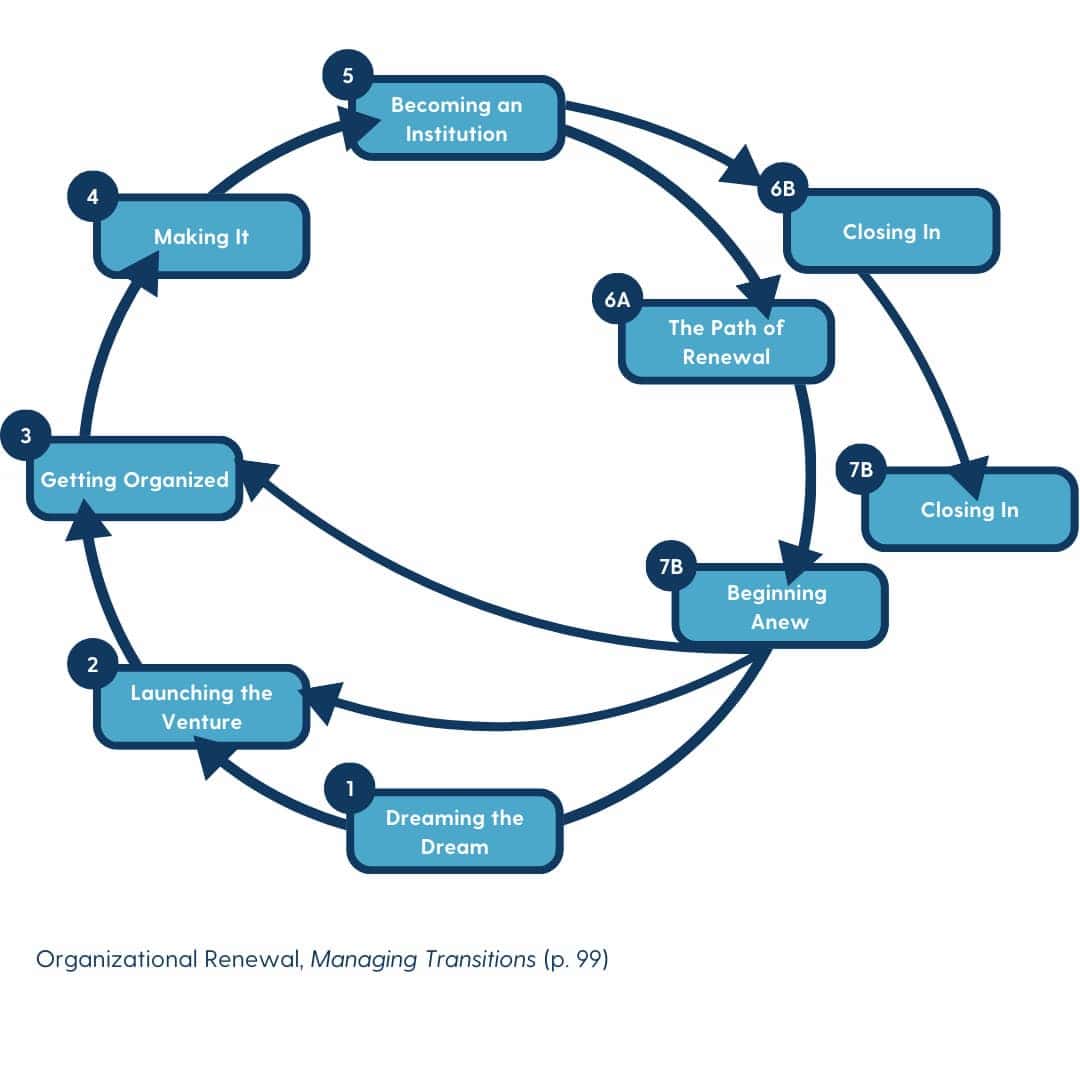

- The renewal process involves finding ways to recapture and reinvigorate the energy of the first three phases of the organizational cycle:
-
- Redreaming the Dream: The new dream should involve a new central idea around which to build the organization’s activities and structures.
- Recapturing the Venture Spirit: This is usually done through a new cultural emphasis or style of leadership. It’s about redefining functions and decision-making processes and creating closer customer linkages.
- Getting Reorganized: This phase involves remodeling the policies, roles, and structures with the goal of recovering rather than creating.
- The first four stages of the organizational lifecycle involve growth. It is in the fifth stage – Becoming an Institution – that issues begin to arise. This is the beginning of the downside. Here, leaders must start thinking about transitions by asking themselves:
- What is it time for us to let go of?
- How will we spend our time in the neutral zone?
- What is this new beginning going to require of us?
PART III – DEALING WITH NONSTOP CHANGE IN THE ORGANIZATION AND YOUR LIFE
Chapter 7: How to Deal with Nonstop Change
- Today, change seems nonstop and increasingly complex. While the idea of transition, as covered in this book, might sound like an ideal, it is nonetheless useful.
- Most people are overwhelmed by transitions and pay little attention to them, but transitions are always around them. Only by isolating them in their simplest form can they be identified. Only by understanding pure and simple transitions can one understand dynamic ones.
- Conceptually, we picture transition as an ending, a neutral zone, and a new beginning. But these phases don’t have clear boundaries. They each start before the preceding one ends, which means one can be in more than one phase at a time.
- To handle continuous organizational change, you need an overall design with the various changes integrated as component elements. These usually have a shared underlying common purpose that can help you connect them:
- The need to save money.
- The need to recapture markets lost to a competitor.
- The need to respond creatively to a new climate of public opinion.
- The need to speed up decision-making by decentralizing authority.
- “The hardest thing to deal with is not the pace of change but the changes in the acceleration of that pace” (p. 112).
- To manage change, postpone the extra, unnecessary changes that are often thoughtlessly piggybacked on top of the original, needed one.
- Forecast as much as you possibly can. There are two problems with forecasting to keep in mind, though:
- Interrelationships can be so complex that outcomes are often unpredictable.
- Forecast-based plans create a bandwagon effect, where your plans change the conditions on which the forecasts themselves were based.
- Two kinds of forecasting that can help are:
- Relying on the lifecycle stages to forecast the unavoidable issues that come with each phase of the organization’s life.
- Building into every plan a contingency clause. Focus on thinking about what would happen if things didn’t turn out as you hoped or planned.
- To manage transitions in fields where change is nonstop, make change a norm by having continual little transitions. But make sure that people understand that the point of change is to preserve what doesn’t need to be changed.
- To create a sense of stability through change, people need to be clear about what you’re trying to do. People should also know what their role is.
- Be careful not to confuse purpose with objectives.
- Organizations sometimes have to change their objectives to preserve their purpose (e.g., if a company’s purpose is to create high-quality preserved food, one of their objectives can be shifting from canning to freezing).
- Make sure people don’t identify with the objectives but with the purpose.
- Key within this process is rebuilding trust. Building trust takes time, so start early.
- Do what you say you’ll do. If for any reason you can’t follow through, warn the team as soon as possible and explain the circumstances clearly.
- Listen to people carefully and tell them what you think they’re saying. People trust those whom they believe understand them.
- Understand what matters to your team and work hard to protect that.
- Be honest, always tell the truth, and remain authentic.
- Ask for feedback.
- Don’t push people to trust you more than you trust them. Trust is mutual.
- Don’t confuse trustworthiness with friendship.
- Don’t be surprised if people view you suspiciously in the beginning. Asking people to let go of an old mistrust of managers is a transition in itself.
- If you’re trying to make change a norm, selling the problem should go beyond selling every change. Your goal is for your team to understand the organization’s real problems so that they can seek solutions.
- Problems are solved faster when everyone recognizes the problem.
- If your team is aware of the problem, the solution will more likely meet everyone’s needs.
PART IV – THE CONCLUSION
Chapter 8: A Practice Case
- To apply the concepts provided throughout the book, chapter eight describes a practice case.
- You work for Apex Manufacturing, formerly the world’s foremost company in the field of specialized gasoline motors.
- Three new firms have entered the market and invested in new plants and equipment, and they are becoming increasingly strong.
- Governmental abatement standards have forced Apex to redesign its motors. Competitors foresaw this, but Apex didn’t.
- Given the circumstances, Apex made a few decisions:
- Two out of five plants will close, but they need them to produce motors for eight more months while the other plants prepare to take up the slack in production.
- There will be a 20% reduction in employment.
- You are assigned the role of transition manager and asked to implement the closure and create a plan for handling reductions.
- Upper management’s main concerns are:
- Apex hasn’t had a layoff in the last 20 years, as it was continually growing.
- There are people who work in the closing plants whom they don’t want to lose.
- Leadership favors fair, across-the-board cuts but worries about uneven staffing.
- Hourly employees perceive senior managers aren’t sharing enough of the company’s burdens.
- They’ll announce the closure and downsizing decisions tomorrow in an e-mail that leadership has already drafted.
- The remainder of the chapter is an exercise where the reader is prompted to review a list of action items and classify each under one of the five categories below. The following are the answers:
-
- Category 1: Very important. Do this at once.
-
- Rewrite the announcement to convey more sensitivity.
- Get the CEO to make a public statement acknowledging the company’s slow response to industry changes.
- Make it clear up front that Apex is heading into a protracted period of change.
- Sell the problem that forced the changes.
- Help the CEO put together a statement about organizational transitions.
- Brief all site managers and directors. Don’t let them leave until they understand that there’s no better way to handle the situation.
- Make a video explaining the problem and the response to it. Then, hold meetings at company sites to answer questions.
- Appoint a change manager.
- Set up a transition monitoring team in each plant.
-
- Category 2: It is worth doing, but it takes more time. Start planning it.
-
- Explain the purpose of the announced changes, provide a picture, create a plan, and describe the parts people will play.
- Analyze who stands to lose what.
- Give managers training on the emotional impact of change.
- Set up a website to give employees current and reliable information.
- Help people whose jobs are being threatened or lost.
- Plan closure ceremonies for the two plants.
- Institute a reward program for cost-saving suggestions from employees.
- Find ways to normalize the neutral zone and redefine it.
- Use the time the company spends in the neutral zone to redesign the business.
-
- Category 3: Yes and no. Depends on how it’s done.
-
- Order an across-the-board 20% budget cut throughout the company.
- Get the executive team to agree to a one-year 20% cut in their own salaries.
- Plan all-hands social events in each company location.
- Make a video in which the CEO gives a fiery, motivating speech.
- Set up a downsizing suggestion plan through which everyone can have input.
- Fire the CEO.
-
- Category 4: Not very important. It may even be a waste of effort.
-
- Launch a plan to buy Apex’s domestic competitors to gain market share.
- Reorganize the executive team and redefine the CEO’s job as team coordinator.
- Put all managers through quality-improvement training.
- Redo the compensation structure to reward compliance with the new system.
-
- Category 5: No! Don’t do this.
-
- Cancel the memo, and don’t distribute communications until plans are set.
- Dispel fears by assuring workers that the plant closures are the only big changes.
- Set new, higher production targets for the next quarter.
- Circulate a news release saying that this plan has been in the works for years.
- Give everyone in Apex a “We’re number 1!” t-shirt.
Chapter 9: Conclusion
- In any organizational transition, no matter how successful, three main groups will arise:
- Some people will be wounded by the changes they’ve been through,
- Others will grieve what they lost in the change,
- Still others will feel like their loyalty and ethics were compromised.
- Those who stay will need as much help as those who leave. Companies should recognize that those who stay need to rebuild disrupted teams and relationships.
- As a manager, you’ll have to deal with the aftermath of transitions, particularly if they were mismanaged. To remind yourself of its characteristics, use the acronym GRASS:
- Guilt: Managers will feel guilty about terminating, transferring, or demoting workers. Those who didn’t lose their jobs will also feel guilty. This lowers morale.
- Resentment: People will feel angry at the organization for the pain the transition caused. While this is natural, it will deepen and lengthen if it isn’t managed correctly. Resentment can lead to sabotage and payback.
- Anxiety: Those who struggle to let go of the past will become anxious. This reduces energy and motivation and makes people unwilling to try new things.
- Self-absorption: Anxiety often leads to self-absorption, where people stop thinking about others (colleagues and customers) and focus solely on themselves. This reduces collaboration, teamwork, and service quality.
- Stress: Stress can lead to illness, which is common during transitions.
- Not managing transitions properly and taking shortcuts will become more costly than what they appear to save at the moment. Shortcuts will leave behind an exhausted and demoralized workforce struggling to be successful or creative.
- Because change is unavoidable, transitions are unavoidable. The good news is that you can learn to manage them.
