


Radical Candor

About the Author
“Kim Scott is the author of Radical Respect: How To Work Together Better as well as Radical Candor: Be a Kick-Ass Boss Without Losing Your Humanity. She is the co-founder of an executive education firm and workplace comedy series, The Feedback Loop, based on her book, Radical Candor. Also, along with Jason Rosoff, Scott co-founded the company Radical Candor to help rid the world of bad bosses.
Scott was a CEO coach at Dropbox, Qualtrics, Twitter, and other tech companies. She was a member of the faculty at Apple University and before that led the AdSense, YouTube, and DoubleClick teams at Google. Earlier in her career Kim managed a pediatric clinic in Kosovo and started a diamond-cutting factory in Moscow. She lives with her family in Silicon Valley.”
Sources: “About the Author” section of the book and Amazon’s “About the Author” bio.
Our one-sentence summary
Radical Candor offers a framework for achieving effective leadership by promoting honest and empathetic communication while providing actionable strategies for building trust and achieving better results within teams.
Publisher’s Summary
“Radical Candor has been embraced around the world by leaders of every stripe at companies of all sizes. Now a cultural touchstone, the concept has come to be applied to a wide range of human relationships.
The idea is simple: You don’t have to choose between being a pushover and a jerk. Using Radical Candor―avoiding the perils of Obnoxious Aggression, Manipulative Insincerity, and Ruinous Empathy―you can be kind and clear at the same time.
Kim Scott was a highly successful leader at Google before decamping to Apple, where she developed and taught a management class. Since the original publication of Radical Candor in 2017, Scott has earned international fame with her vital approach to effective leadership and [she] co-founded the Radical Candor executive education company, which helps companies put the book’s philosophy into practice.
Radical Candor is about caring personally and challenging directly, about soliciting criticism to improve your leadership and also providing guidance that helps others grow. It focuses on praise but doesn’t shy away from criticism―to help you love your work and the people you work with.
Radically Candid relationships with team members enable bosses to fulfill their three core responsibilities:
- Create a culture of Compassionate Candor
- Build a cohesive team
- Achieve results collaboratively
Required reading for the most successful organizations, Radical Candor has raised the bar for management practices worldwide.”
Source: Book Jacket
Detailed Summary
Preface to the Revised Edition
- After an episode of HBO’s Silicon Valley and a Dilbert cartoon, Scott noticed people had misinterpreted the terms Radical Candor. To the author, “radical” indicates a management philosophy, not because words are radical, but because it is different from what managers used to do when praising or giving feedback.
- In the past, managers tended to behave in a somewhat intimidating fashion. The idea that “Command and Control” was the best managerial approach permeated into leadership. However, it actually hinders innovation and harms teams’ ability to succeed.
- Without radical candor, collaborating and innovating is difficult because human relationships are not based on trust, but on intimidation and bureaucracy. Radical Candor is not about being offensive or aggressive. It’s about caring personally while challenging directly. See the image below.

Image Source: https://www.radicalcandor.com/our-approach/
- Recognizing that she needed to rebrand the word “radical,” Scott has developed visuals where she changed the term to “Compassionate Candor.” However, it’s important to still make a distinction between Compassionate Candor and Ruinous Empathy.
- When taken to the extreme, empathy can be over-focused on to the point where we stop thinking rationally. Empathy also focuses on the now, keeping us from visualizing the long-term effects of our current actions (e.g., failing to give proper feedback or criticisms that keeps employees from growing, leading them to being fired). That’s Ruinous Empathy.
- Excessive empathy also has negative effects on the manager. It can cause a lot of stress and even burnout. In some cases, it leads to withdrawal and apathy.
- Thus, Scott chose the word “compassion” because, while it requires empathy, it also requires action. Compassionate Candor engages the heart – you Care Personally. But you’re also challenging your subordinates.
- This was the point of the term Radical Candor. But Scott has come to realize that “radical” does not communicate this concept.
Introduction
- Based on her experiences working for a rude boss, then being too gentle of a boss in her own company, later as a manager at Google, and later as an educator at Apple, Scott concluded that good relationships are at the heart of being a good boss.
- Part I of this book seeks to establish how being a boss is hard for everyone, no matter how successful we look on the outside. It helps understand that improving our leadership approach is a lot less difficult than what we’d think.
- Part II provides a step-by-step approach for building radically candid relationships with your reports. It also explains how Radical Candor can help us fulfill our responsibilities as managers.
Part I – A New Management Philosophy
Chapter 1: Build Radically Candid Relationships
- It is common for us, as a society, to underestimate the emotional toll inherent to managerial positions. But it’s the key to being a successful boss.
- People have all sorts of questions that arise from the three managerial responsibilities:
- People dread feedback, and managers often forget they need to solicit guidance from others and encourage it between them.
- Teambuilding: Figuring out the right people for the right roles. Once you do, it’s about the deciphering how to keep them motivated.
- Driving Results: Achieving goals. Managers who are frustrated increase the size of the team but a team two times as large seldom obtains results that are twice as good.
- Scott argues that the most important question doesn’t usually get asked: “How can I build a relationship with each of my team members quickly, so that I can trust them and they can trust me?”
- Each relationship is going to be different. It’s impossible to know how each connection between boss and report will go. But Scott has identified two main dimensions that, when paired together, help managers move their teams in the right direction.
-
- The first is Caring Personally. This is about really caring for your staff, sharing more than just your work self, and encouraging everyone to do the same. To have a good relationship, you need to care deeply.
- The second is Challenging Directly. This involves telling people when their work isn’t good enough, but also when it is. It’s about delivering hard feedback, making hard calls, and holding a high bar for good results.
- Radical Candor stems from putting Care Personally and Challenge Directly together. It builds trust and opens the door for a type of communication that helps achieve the results that your organization is looking for.
- Radical Candor works because, when people trust you, they’re more likely to accept your praise and criticism, and to act on it. They will tell you what they really think about you, and they’ll provide feedback to one another. They’ll embrace their roles in their teams. And they’ll focus on getting results.
- Scott explains that she chose the term “radical” because many of us are conditioned to avoid saying what we really think. But, in this context, it’s necessary to communicate clearly enough so that there’s no room for interpretation. The key is being humble.
- Scott chose “candor” instead of “honesty” because there’s not humility in believing what we think is the sole truth.
- It’s common for people to fear being candid, as it might make people angry. Scott has found that you might get an initial anger or resentment, but those emotions tend to be fleeting when the person knows you really care for them.
- There are two main reasons why people fail to Care Personally. First is an internalized idea of being professional. Second is ego. Unconsciously or consciously, many new managers tend to feel like they’re better than their subordinates.
- But “Caring Personally is the antidote to both robotic professionalism and managerial arrogance” p. 13.
- Radical candor is not:
- A license to be harsh, hurting, or offensive. It is not radical candor if you don’t show that you care personally.
- An invitation to nitpick.
- Applied hierarchically. Be radically candid both vertically and horizontally.
- Schmoozing
- Excessive extroversion that exhausts the introverts in your team.
- Unique to Silicon Valley, or American. It’s human.
- Radical Candor is human, but it does vary interpersonally and culturally. We need to adjust depending on the individual’s background. It works only if the other person understands that your effort is about caring and challenging in good faith.
- Radical Candor requires adjustment when you change cultures both in terms of countries and from one company to another.
Chapter 2: Get, Give, and Encourage Guidance
- Caring Personally and Challenging Directly at the same time is radical candor. When you fail in one dimension, you might fall into Ruinous Empathy or Obnoxious Anger. And when you fail at both, you fall into Manipulative Insincerity.
- The names of each quadrant are not personality traits. At some point, we all fall into each of the four quadrants.
- Radical Candor. We don’t have to spend a lot of time getting to know a person or building trust before being able to offer radically candid guidance. In fact, a great way to get to know someone and to build trust is to offer radically candid praise and criticism.
- Radically candid praise needs a why. It also needs to be contextualized, personal, and specific.
- Obnoxious Aggression: When you criticize someone without taking a moment to show you care, your guidance will feel aggressive.
- If you cannot be radically candid, being obnoxiously aggressive is the second best option, as people will at least know what you think and where they stand.
- However, Obnoxious Aggression is debilitating. When bosses belittle or embarrass employees, it gets in the way of achieving results long term.
- Personalizing – talking about the person’s character rather than the issue – is a common way in which Radical Candor becomes Obnoxious Aggression.
- Note that praise can be obnoxiously aggressive too.
- Manipulative Insincerity: This happens when you don’t care enough about a person to challenge them directly.
- Manipulatively insincere guidance seldom expresses the speaker’s true thoughts, as it triggers emotions for personal gain.
- When we make a mistake and get called off for it, we’ll tend to be less genuine and more political. That’s when we move from aggression to Manipulative Insincerity.
- Ruinous Empathy: Ruinous Empathy is actually what causes most of management mistakes. People who want to avoid tension or conflict fail to provide proper and prompt feedback.
- Without honest feedback or constructive criticism, employees may unknowingly underperform, leading to potential termination.
- Excessive empathy prevents supervisors from actively seeking criticism. So they remain oblivious to issues until an employee decides to resign.
- Praise that’s ruinously empathetic is not effective, as its goal is to make the person feel better, rather than to point out great work and push for more.
- To move into the Radical Candor quadrant, you need to develop the appropriate culture. Start by explaining the idea of Radical Candor. Then, ask people to be radically candid with you. That’s because:
- It shows that you are not only aware that you are often wrong, but that you want to improve and be challenged.
- You’ll learn a lot, as no one scrutinizes you as much as those who report to you.
- The more experience you have with how it feels to receive criticism, the better you’ll become at providing it.
- Asking for criticism is a great way to build trust and strengthen relationships.
- If a person criticizes, don’t critique their criticism. But if you see somebody criticizing other team members inappropriately, say something.
- Don’t react defensively.
- When it’s your turn, start with praise, finding balance between praise and criticism.
- We learn more from our mistakes than from our successes, but you need to give more praise than criticism because it guides people in the right direction, encouraging them to keep improving.
- Note that patronizing or insincere praise will erode trust and hurt your relationships just as much as overly harsh criticism.
- There’s a risky border between Obnoxious Aggression and Radical Candor. For criticism to be effective, it’s crucial to do it very clearly, articulating a why, to get them back on track. Be humble and helpful, offer guidance in person and immediately, praise in public, criticize in private, and don’t personalize.
Chapter 3: Understand What Motivates Each Person
- Building a team requires 1) that you understand what the job means to your employees and how it fits into their life goals, 2) that you feel comfortable challenging them.
- Scott classifies workers into two categories, superstars and rockstars.
- Superstars need new opportunities to grow. And they’re happy to climb the corporate ladder. They’re in a steep growth trajectory
- Rock stars are those who love their job and current work. They’re not interested in being promoted. They’re on a gradual growth trajectory.
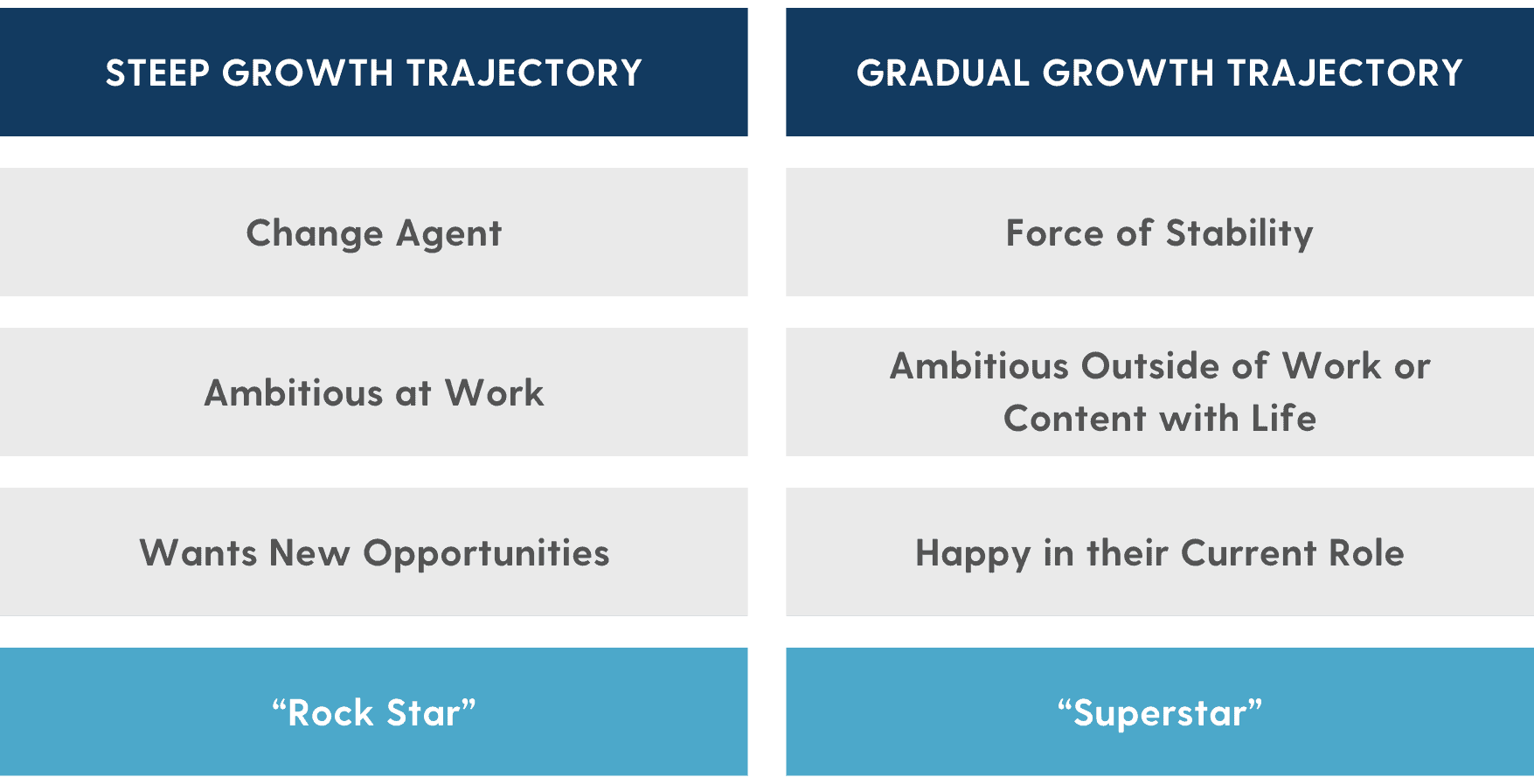
Taken from Radical Candor p. 45
- At times, managers don’t understand that certain people aren’t aspiring for career advancement. Unintentionally, we attach labels like “unambitious” and overlook their contributions. However, these individuals are the foundation of a strong team.
- As a manager, you need to understand the growth aspirations of each team member and provide opportunities aligned with their goals. Recognizing that will also prevent burning out the Rock Stars and boring the Superstars.
- Note that these are not permanent labels. For your team to become successful, you need to understand what growth trajectory each person wants to be on at a given time.
- g., some people might shift from a steep into a gradual growth trajectory because they might have just had a child or have to take care of aging parents.
- Be wary of becoming an absentee manager while trying to avoid micromanaging. Ignoring someone, even when it appears they don’t need you, can harm relationships.
- The best way to manage Rock Stars is to recognize them and keep them happy. For many, recognition means promotion. In this case, a bonus or raise may work better.
- You can also give them another role like becoming teachers or trainers. Just make sure that they actually enjoy teaching. You want this role to be an honor and not a requirement.
- To manage Superstars, keep them challenged. And figure out who will replace them when they move on.
- When people become managers solely for personal advancement rather than a genuine interest in managerial responsibilities, they typically struggle. Think twice before promoting.
- There will be instances in which you’ll have poor performers. Deciding whether to fire someone is challenging, but the following three questions might help.
- Have you given radically candid guidance?
- How is this person’s poor performance affecting the rest of the team?
- Have you sought out a second opinion or spoken to someone whom you trust?
- Trying to avoid having to fire someone, you might tell yourself one of the following lies:
- “It will get better.” But it won’t get better all by itself. Ask yourself how exactly it will get better, because if you don’t have an answer, it won’t.
- “Somebody is better than nobody.” Poor performers often create more work for others. Sometimes, nobody is better than someone who negatively impacts others.
- “A transfer is the answer.” You might feel better if you transfer someone instead of firing. But that’s not so nice to the colleague receiving the transfer.
- “It’s bad for morale.” The truth is that keeping someone who can’t do the job right can be far worse for morale.
- When firing someone, be radically candid. To be in the right frame of mind:
- Recall a job you were terrible at and think how glad you were when you no longer had it.
- Remember that retaining people who are doing bad work penalizes the people that are doing excellent work.
- While it is perplexing and uncommon to find low performers in growth trajectories, four main reasons explain why this may happen. Consider them before firing someone.
- They might be in the wrong role.
- The person is in a new role and too much is going on too quickly.
- The person may be having personal problems.
- There might be a misalignment between the culture of the group and the individual’s personality.
Chapter 4: Drive Results Collaboratively
- Your job as manager is to provide and manage the resources that will help your team reach their goals. To attain results, Scott provides a seven-step process.
- She warns that it is important to avoid the impulse to dive right in without having laid the groundwork for collaboration first.
-
- Listen: First, create a culture in which everyone listens to each other. Then, define your listening style.
-
-
- Quiet listening is purposely prolonging silences to let people talk. The goal is to abstain from even reacting to avoid people telling you what they think you want to hear.
- Some drawbacks to quiet listening include:
- Exceedingly prolonged silences will lead to people trying to guess what you’re thinking. And that can lead to a lot of wasted time.
- A lot of people get uncomfortable in silence.
- Excessive silence is not having a radically candid conversation.
- Some people feel like when you’re not talking, you’re not listening.
- Loud listening is saying what will get a reaction out of your team members. It is stating a point of view very strongly.
- This approach works only when people are confident they can rise to the challenge. The main drawback is that people might get offended or intimidated if the culture is not properly set.
- To create a culture of listening, establish a system for employees to generate ideas and voice complaints. Make sure that the issues raised get addressed promptly, and offer explanations when issues are not addressed.
- A culture of listening also concerns managing meetings. Make sure that everyone is participating.
-
-
- Clarify: Ensure everyone in the team understands and can convey ideas clearly. Part of this entails understanding the people to whom you will have to explain the ideas.
-
-
- Help your team think through their ideas before they submit them for debate, and help them develop new ideas by providing space and time to clarify their thinking (e.g., weekly one-on-ones)
- Don’t judge the ideas. But help them clarify their thinking by pointing out problems and figuring out a solution.
-
-
- Debate: Foster a healthy debating culture so that ideas can move forward.
-
-
- Debating requires a lot of energy. Overdoing it is not a good idea. To manage the debates, Scott recommends:
- Keeping the conversation focused on ideas, letting go of ego. Whenever you feel like someone’s ego is meddling, redirect them to the facts.
- Avoid allowing people attribute ownership to ideas. Your goal is to get the best answer as a team
- Create an obligation to dissent.
- Whenever people are getting tired, burned out, or emotionally charged, take a pause.
- Use humor and have fun.
- Be clear when the debate will end.
- Don’t get married to a decision because the debate is getting painful or too long.
- Debating requires a lot of energy. Overdoing it is not a good idea. To manage the debates, Scott recommends:
-
-
- Decide: Even though you’re the manager, you are not necessarily the decider. Create a clear decision-making process that empowers people. This helps make better decisions and increases morale.
-
-
- In instances when you have to be the decider, focus on the facts. This is especially true when you’re a manager of managers.
-
-
- Persuade: Now that you’ve made a decision, get more people on board. It’s likely that not everyone working on the project was part of the debate or the decision-making process.
-
-
- You cannot expect people to execute to the best of their ability without being persuaded.
- Aristotle said that the elements of rhetoric are pathos, logos, and ethos. Scott loosely translates to emotion, logic, and credibility.
-
- Focus on the listeners’ emotions rather than the speaker’s.
- To build credibility, demonstrate your expertise and show humility.
- To show logic, show your work
-
-
-
- Execute: As the boss, you have to spend some time doing the work that would otherwise distract your team or steal from the time they should be spending on execution.
-
-
- Don’t waste your team’s time, but don’t become oblivious to the product either. Stay connected to the work that’s been done and even execute yourself.
-
-
- Learn from both mistakes and successes to improve.
-
-
- There are two main pressures that may influence a manager’s temptation not to learn:
- Pressure to be consistent (feeling like you cannot change your mind), and
- Feeling burned out.
- There are two main pressures that may influence a manager’s temptation not to learn:
-
Part II – Tools & Techniques
Chapter 5: Relationships
- Business school probably taught you that your job as a manager is to maximize shareholder value. Scott explains that, through real-life experiences, she learned that that’s the result but not the core.
- Only when she was able to center herself, did she build strong relationships. And it was through those strong relationships that she fulfilled her responsibilities.
- This chapter is about staying centered. It is by creating a stable foundation that you can build teams where people thrive.
- Caring Personally is integral to building healthy relationships with your reports. But if you’re going through a tough time yourself, you won’t be able to care about others.
- Only you can know what works for you to keep yourself centered. It might be sleeping, eating healthy, watching movies, or exercising. If it’s exercising, give yourself time in your schedule to exercise daily, but especially when things get tough.
- Don’t just think in terms of your daily tasks but also monthly and yearly. Do you need to take a two week vacation every year? Do you need to go out on a date with your partner once a month?
- Once you’re centered, help your team become centered so that they bring the best of themselves to work.
- A key process worth employing is letting go of unilateral authority and control. These get in the way of building the types of relationship that will make your reports feel free at work, allowing them to produce their best work.
- As a manager, you’re still going to have to guide your team to achieve results and make tough decisions.
- It’s not about anarchy, but about letting go of excessive bureaucracy and authority.
- To build trusting relationships,
-
- Learn to socialize at work. Sometimes, companies organize social events at work or outside of work (e.g., holiday party). Be careful that
- Non-mandatory events don’t feel mandatory
- Alcohol doesn’t harm relationships.
- Respect boundaries. Where that boundary lies will differ depending on the person.
- Learn to socialize at work. Sometimes, companies organize social events at work or outside of work (e.g., holiday party). Be careful that
-
-
- Building trust takes time. Don’t pry too deeply into personal matters too quickly. However, know that you will need to ask questions eventually to Care Personally.
-
-
- Be wary of sharing your personal values.
-
-
- Some people feel like their values are private and don’t want to discuss them.
- Other people might feel like sharing their values may drive a wedge rather than help build relationships.
-
-
- Be open to connecting with people who are different from you.
- To Care Personally, you might need to be a bit more open when it comes to physical space. There are instances when a hug means more than a professional handshake.
-
-
- Be careful that hugs are never sexual or belittling.
- Before hugging anyone, make sure that the other person is comfortable
-
-
- Recognize your own emotions.
-
-
- Own up to how you feel and what’s going on in your life so that others don’t feel like your mood is their fault.
- If you’re going through something difficult, consider staying at home.
-
-
- Master your reactions to others’ emotions.
- Don’t try to prevent, control, or manage other people’s emotions (this leads to Manipulative Insincerity).
- To build Radically Candid relationships, acknowledge people’s emotions and react compassionately.
- Don’t pretend not to notice emotions.
- Ask questions and listen attentively.
- Try not to feel guilty if someone is upset and you did nothing wrong, as this may lead you to react defensively.
- Focus on them and not on yourself.
- Don’t tell people how to feel (e.g., don’t tell people not to cry).
- Keep tissues a short walk away from your office or meeting room. Handing a tissue to someone who’s about to cry might make them cry even more, but if they know where the tissues are, they can walk away for a moment and may calm down on the way.
- Have closed bottles of water in your desk. If you see that someone’s getting upset, offering a bottle of water can help the person calm down.
- If you’re going to have a difficult conversation, go out for a walk instead (instead of sitting down). Emotions will be less on display and the conversation will feel more collaborative.
- Master your reactions to others’ emotions.
Chapter 6: Guidance
- “In order to build a culture of Radically Candid guidance you need to get, give, and encourage both praise and criticism” (p. 129).
- Your goal is to create an environment where people feel comfortable criticizing you. Stereotypes, assumptions, and simply being in a position of authority make it difficult, but to combat these, work on establishing trust and don’t overfocus on gaining respect.
- Reacting properly to criticism builds trust and respect.
- Techniques to provide guidance include:
- Be the only one who is not criticized in private. This sends the message that you want criticism and serves as an example for others to embrace it. It will also save you time as many reports may have critique to offer.
- Have a question that will help ask people for feedback (e.g., “What could I do to make it easier for you to work with me?”). If you don’t get any answers, stay silent for six seconds.
- Respectfully point it out if someone’s comment doesn’t match their body language.
- Listen, clarify the criticism, but never debate it. Do not act defensively.
- Reward criticism and candor.
- If you agree with the criticism, make the change as soon as possible.
- Make sure you don’t receive more praise than criticism.
- Establish systems that can help reports feel more comfortable, such as a box in which to put questions or feedback anonymously.
- When it comes to giving praise or criticism, be humble. Other techniques include:
- Follow the Situation, Behavior, Impact framework. Simply describe the situation, behavior, and impact that you observed to remain objective.
- Question your thinking.
- Be mindful of objective reality versus your subjective truth.
- State your intentions to lower defenses.
- Be specific about what you’re criticizing or praising. Instead of saying, “You’re really smart,” explicitly describe what they did that was clever.
- Finding help is sometimes better than offering it yourself (e.g., find a coach). Sometimes, you won’t be able to offer a solution but don’t let that keep you from offering guidance.
- Give feedback immediately and try to be in as informal as possible.
- Praise and criticize often to make it a norm. Make it quick. Try not to go over 3 minutes. There’s no need to schedule meetings. However, do make sure that you program slack time in your calendar, or be willing to be late to other meetings, given most guidance instances will be impromptu.
- Don’t use your one-on-one or performance reviews to criticize or praise.
- Always try to give guidance in person. If you’re struggling between being prompt or giving it in person (e.g., the person is travelling), prioritize immediacy unless it’s a big deal. A video call is your second best option.
- When it comes to praise, use multiple modes such as praising in public, then following up with an e-mail and even mentioning it again in your one-on-one.
- Don’t personalize, even when it is personal.
- Explain the Radical Candor framework to your reports and ask them to criticize your guidance weekly. You can come up with your own system.
- You will also need to be Radically Candid with your boss. But proceed with caution as you are not in a position of authority. Not every boss will let you be Radically Candid.
- Once you’re established with your own team, you can explain the Radical Candor framework to your boss and ask him to challenge you.
- If you want to provide guidance, ask for your boss’s permission first.
- Providing guidance through the Radical Candor approach can be difficult when there are gender differences between managers and reports. Be mindful not to stereotype, be aware of your biases, and be respectful.
- If your organization has performance reviews, you can use the following techniques:
- Have no surprises during the review. You should have been giving regular impromptu feedback.
- Don’t rely solely on your own judgment.
- Start by asking for feedback.
- Make time to write your review in advance to make sure that you spend some time reflecting and clarifying the main points of your meeting.
- Spend half the time diagnosing (looking back) and the rest planning ahead.
- Never tolerate people talking about each other behind their backs.
- If you’re a manager of managers, consider having skip-level meetings. Meet with your reports’ direct reports at least once a year. Your goal is to help their managers become better bosses and to make sure the team feels comfortable giving feedback.
Chapter 7: Team
- You shouldn’t expect everyone in your team to be a superstar or a rock star.
- Your goal is to manage growth and stability.
- To show that you Care Personally, have three types of conversations to understand people’s motivations, so that you can help and guide them.
- Life story: Learn what motivates each person by asking them about their lives. Usually, when they talk about changes or choices, they reveal values. For instance, if someone says they quit running to join a soccer team, you can deduce that being part of a team is part of their motivation.
- The reason to ask for stories is that when you ask people for their motivations, they usually give abstract answers that are easy to misunderstand. Financial independence, for example, may mean different things to different people.
- Dreams: Learn about people’s long term career aspirations. It’s better to use words like “dream” than “career goals” because you don’t want people to give you professional answers or for them to say what they think you want to hear.
- Your goal is to find opportunities to help reports move closer to their aspirations by having them do a more satisfying and meaningful job. This will also help with retention rates.
- 18-month plan: Define what skills your reports need to learn over the next six to 18 months to help them move closer to their dreams. Create a plan so they understand why you assign them a given project or put them in a certain role.
- Life story: Learn what motivates each person by asking them about their lives. Usually, when they talk about changes or choices, they reveal values. For instance, if someone says they quit running to join a soccer team, you can deduce that being part of a team is part of their motivation.
- To Challenge Directly, you need a growth management plan for each team member.
- First, define who’s a Rock Star and who’s a Superstar. Then, identify the people who are doing good work (but not exceptional), those who are doing poor work, and those who are not doing good work and are not getting any better. Verify your classification with an outside perspective.
- Then, develop a short bullet point growth plan for each team member including projects and opportunities for them.
- When hiring someone, be specific about what you need: Rock Stars or Superstars.
- While all hiring is subjective, tips to make sure you’re hiring the right people include:
- Write a job description that considers role, skills, and team fit criteria. Try to define your culture in three or four words.
- Consider having prescreens such as a skills assessment. This helps make sure that you don’t get too many false positives or negatives.
- Establish an interview committee and use the same one for each candidate.
- Consider having casual interviews such as taking candidates to lunch.
- Ask other people in the office, such as the receptionist, if they had any reactions to the candidate.
- Write down your thoughts and feedback right after the interview. Sometimes, it is by writing that you finish understanding certain impressions.
- “If you’re not dying to hire somebody, don’t make an offer” (p. 189).
- While firing can be difficult, it is something all managers need to learn to do. The following three tips can help you make the experience a little more stress-free:
- Don’t wait too long. Remember, you’re trying to be fair to the person who’s failing, your company, yourself, and the rest of your team, especially those who are performing well.
- Don’t make the decision unilaterally. Take time to get advice from your boss, peers, if appropriate, and HR.
- Be humble, care about the person, and, if appropriate, follow up (after a month, more or less).
- When it comes to rewarding Superstars, think about promotions. Be fair.
- When rewarding your Rock Stars, avoid promotions and the status obsession.
- To avoid becoming an absentee manager or a micromanager, refer to the table below (p. 197).
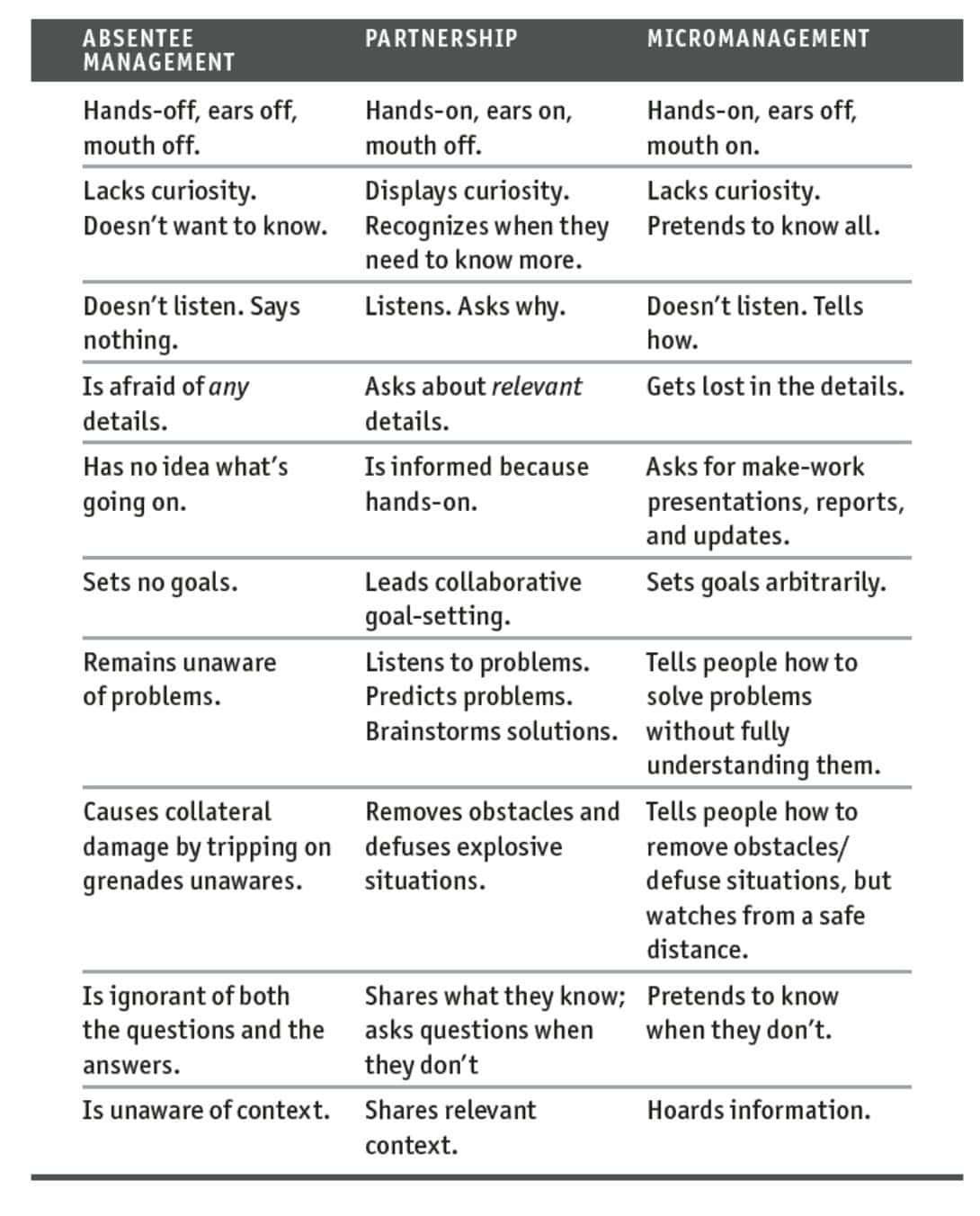

Image Source: https://www.radicalcandor.com/blog/micromanager-absentee-manager/
Chapter 8: Results
- “The ultimate goal of Radical Candor is to achieve results collaboratively that you could never achieve individually” (p. 199).
- To foster an environment conducive to achieving results, promote the process outlined in Chapter 4, allowing it to organically take root within your team.
- Also, define communication channels and frequencies to ensure effective collaboration.
- One-on-one meetings are a must. Remember that this is not where you criticize but where you listen and clarify.
- Some signs that you’re not getting the most out of your one-on-one meetings include:
- Too many cancellations,
- People giving you updates that could have been an e-mail,
- You’re hearing only good news and nobody talks about their problems,
- You receive no criticism,
- People come in with nothing to discuss.
- The goal in a staff meeting should be threefold: review the previous week (learning), share important updates (listening), define decisions and debates for upcoming weeks (clarify). This is not where you should have debates or make decisions.
- Block time in your calendar to think and clarify. Otherwise, you’ll have to do it at home, when you should probably be doing something else.
- Hold big debate meetings. These are not deciding meetings. (Refer to chapter 4 for tips on how to hold these meetings.)
- After your debate meeting, schedule a decision meeting. While the logistics and norms of these two meetings are the same, the idea of having separate meetings is to help figure out when a decision must be made.
- If you have outside people who are joining a project, schedule an all-hands meeting to persuade. You can include Q&A’s in these meanings.
- Be careful not to host so many meetings that you disrupt your and your team’s ability to execute. If you must, you can block time in your calendar to be alone and execute. You can exhort your team members to do the same.
- At Google, for instance, some teams had “no meeting Wednesdays.”
- Making progress visible gives autonomy to the team. Establish a system to figure out where resources are going, and where intervention might be needed that doesn’t necessarily have to come from management. For example, use Kanban boards.
- These boards or a similar system should also help you understand what is driving success. You want to learn and grow.
- If you’re a manager of managers, listening can be harder. You can’t have one-on-one’s with everyone, but maybe you can hold office hours. You can also schedule time to walk around. Your goal is to learn about small problems to prevent bigger ones.
- Be conscious of the culture.
- As a manager, your own personality is going to have a big impact on your team’s culture. But if you’re regularly and genuinely asking for feedback, you can keep your culture from mirroring your flaws.
- By moving consciously through the steps defined in chapter 4, you can influence other aspects of your culture:
- People are listening, probably more than you’d expect. You’re under a microscope. Be careful what you say; something you wouldn’t expect to be taken seriously might be taken way too seriously.
- Clarify what you are communicating.
- It might be tempting to delegate certain decisions to HR or other staff. But never delegate things that could pervert your culture in any way. You should decide.
- Part of persuading requires that you pay attention to the small things.
- Your actions, no matter how small, and execution should reflect your culture.
- As a manager, it’s your responsibility to learn from mistakes and make a change. This will foster a culture that learns from mistakes
- Once you set a strong culture, it will self-replicate.
Afterword to the Revised Edition
- Self-awareness is the ability to recognize your own strengths and weaknesses. To be Radically Candid, you also have to be relationally aware. This means you need to know how others perceive you, and how your actions will have an impact both short and long term.
- Storytelling can help you develop self and relational awareness. Start by sharing a Radical Candor story. Remember a time when someone helped you. Showing vulnerability in this way also demonstrates humility.
- Then share three stories: one showcasing Obnoxious Aggression, another one Manipulative Insincerity, and finally Ruinous Empathy.
- The feedback triangle is an exercise that helps people see the impact of their words on others and choose different words that are kinder but clearer.
- In a group of three, role play a situation where you gave feedback. Have the third member be an observer that tracks how the conversation is going, using the Radical Candor framework and identifying patterns.
- The goal is for the observer to help the speaker understand how their feedback landed on the other person.
- There is an important order that you should follow in the Radical Candor framework: first solicit criticism, then give praise, next give criticism, then gauge the criticism and adjust, and finally, encourage praise and criticism between others.
