


Secrets to Winning at Office Politics: How to Achieve Your Goals and Increase Your Influence at Work

About the Author
Marie G. McIntyre, Ph.D. operates a career coaching business in Atlanta, GA, and the website YourOfficeCoach.com. She is the author of Secrets to Winning at Office Politics and The Management Team Handbook. She also writes a newspaper column, Your Office Coach, for the McClatchy-Tribune News Service.
McIntyre conducts national webinars for Business Management Daily, Business 21, and other business resource companies. She has consulted a wide variety of organizations, including Cisco, The Home Depot, Tyson Foods, the Federal Reserve, AT&T, Walgreens, Macy’s, and Habitat for Humanity. In her business, she focuses on career coaching, leadership development, conflict resolution, and team building. She has also taught classes and leadership workshops at Georgia State University, Emory University, and the University of Georgia.
Marie previously held management positions in business and government, including Director of Human Resources in a Fortune 500 company. She has more than twenty years of experience in management, leadership development, and career coaching.
Sources: https://www.yourofficecoach.com/about-us and the “About the Author” section of the book
Our one-sentence summary
Practicing smart office politics requires pragmatic strategies for understanding workplace dynamics, building influence, and advancing your career by managing power struggles, handling difficult colleagues, and positioning yourself for success—all while maintaining professionalism and integrity.
Publisher’s Summary
Get Ahead, Gain Influence, Get What You Want
Office politics are an unavoidable fact of life in every workplace. To accomplish your personal and business goals, you must learn to successfully play the political game in your organization. Whether you are a new player or a seasoned veteran, Secrets to Winning at Office Politics can help you increase your personal power without compromising your integrity or taking advantage of others. This smart, practical guide shows you how to stop wasting energy on things you can’t change and start taking steps to get what you want.
Written by an organizational psychologist and corporate consultant, Marie G. McIntyre’s Secrets to Winning at Office Politics uses real-life examples of political winners and losers to illustrate the behaviors that contribute to success or failure at work. You will be shown techniques for managing your boss more effectively, improving your influence skills, changing the way you are perceived, and dealing with difficult people. Using these proven strategies for political success, you will then be able to create a Political Game Plan that outlines the steps necessary to accomplish your own individual goals.
Source: Book Jacket
Detailed Summary
Preface
- People often experience challenges at work because they struggle to read their environment or anticipate the consequences of their actions. However, most situations can be corrected when you truly understand the problem.
- When people fail to master organizational politics, jobs become unrewarding and unhealthy.
- In her consulting business, McIntyre usually encounters the following people, all of whom are facing political dilemmas:
- A confused and anxious employee who doesn’t understand what management expects of them
- A tired and angry person who’s clearly in the wrong job
- A frustrated manager who doesn’t know how to deal with a poorly performing employee
- People at all levels who feel like their boss is incompetent or unreasonable
- Colleagues who consistently have disagreements
- Departments at war with each other because of conflicting roles
- People who feel they’re being treated unfairly
- Office politics are a normal aspect of work that needs to be managed.
- The first section of this book describes the basic realities of organizational life. The second discusses destructive games and political blunders. The last part provides specific strategies to improve your political position and influence.
Part I – Mastering the Fundamentals
Chapter 1: Politics Is Not a Dirty Word
- Despite its negative reputation, organizational politics will naturally occur when people with different interests, goals, and personalities work together.
- Managing organizational politics is as important as managing tasks and responsibilities. The key is to understand your goals and acquire the political power to achieve them, that is, be able to influence others.
- You’ll have a better chance of achieving your goals if you connect with the people who will be able to support you. Making yourself known in appropriate ways is necessary, even if some tactics may cause discomfort.
- Some people appear like they possess innate political power. They have an instinctive ability to gain an advantage at work. Yet, this is a skill anyone can learn.
- The problem is that most people frown upon organizational politics and avoid discussing related strategies. Yet, these people often end up suffering in silence.
- To succeed in office politics, you must first clearly define your goals, as they dictate all subsequent actions. To do so, you must clearly differentiate between goals and
- When facing a challenge, people often think in terms of wishes (e.g., “I wish I could make more money”), but this is passive. Often, it results in complaining.
- Wishes put the focus on others rather than yourself.
- When converted to a goal (e.g., “I am going to develop the skills I need for a higher-paying job”), it implies action.
- Goals typically fall into two categories: business and personal.
- Business goals are about the responsibilities of your position and the tasks that make the organization successful.
- Personal goals focus on what you desire for yourself, such as being promoted, being assigned to a project, or developing your skills.
- The table below describes four political archetypes based on behaviors that affect goals.
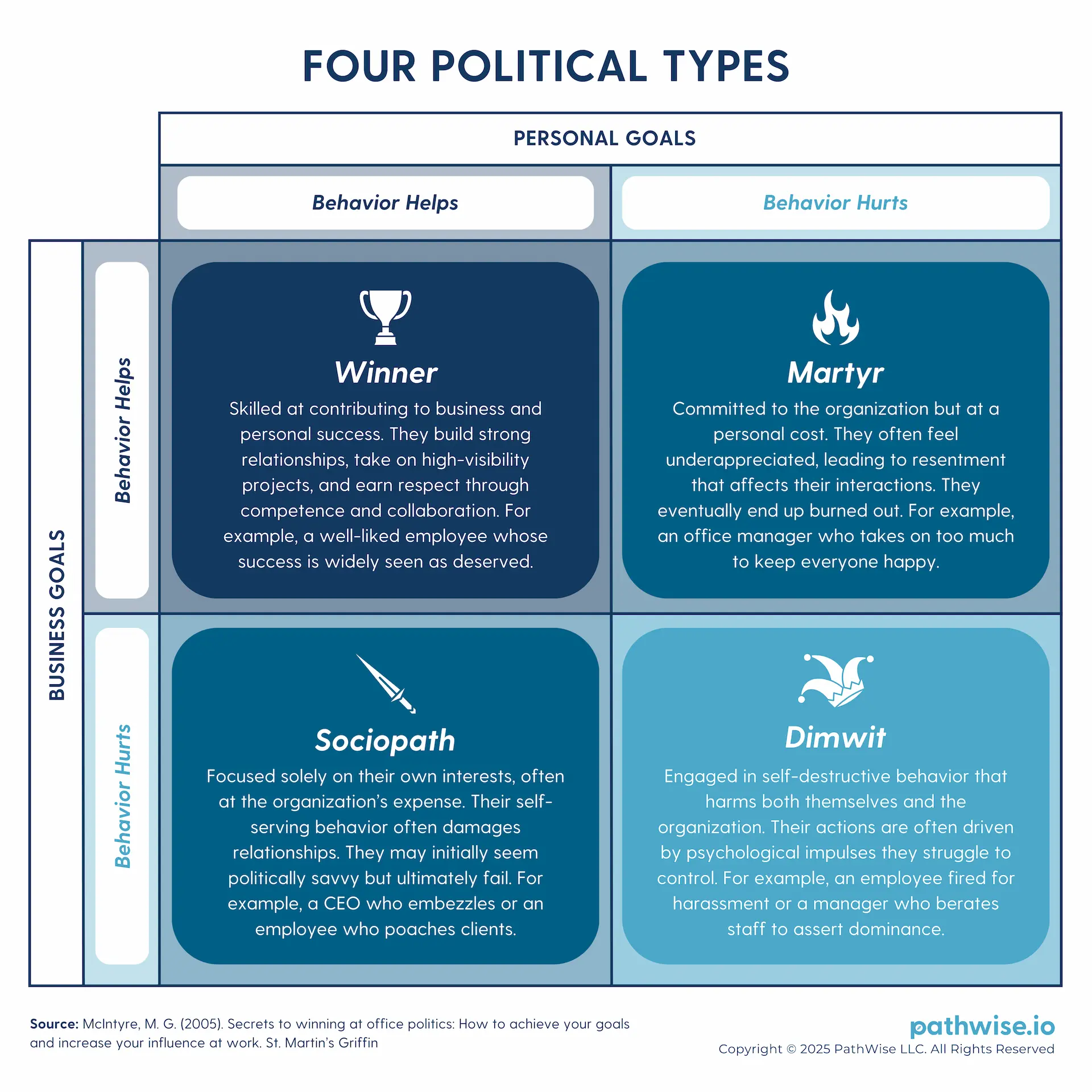
- Determining your political weaknesses or tendencies (even if not as extreme as the examples in the table) will help you improve.
- Smart office politics require that you consider the ethical implications of your decisions. Your moral code is only communicated through actions. Everyone will face ethical moments when they’ll be forced to decide whether to live up to their ethical standards.
- The Political Golden Rule is, “Never advance your own interests by harming the business or hurting other people” (p. 17).
Chapter 2: Political Intelligence and the Facts of Life
- Everyone, no matter their job, needs Political Intelligence (IQ), which will make work more productive and pleasant. High Political IQ will help you:
- Define the steps you need to take to achieve your goals
- Recognize the power relationships in any group
- Leverage opportunities to increase power and influence
- Identify others’ true motives or agendas
- Remain focused on your objectives and disregard distractions
- Build positive relationships
- Respond appropriately to other people’s attacks
- Turn conflicts into productive discussions
- Avoid wasting energy on irrelevant issues or unattainable goals
- Know when to leave a toxic environment and find a healthier place to work
- To become a Winner and develop your Political IQ, you must accept facts about how organizations operate. The following are Organizational Facts of Life (OFOL):
- Organizations are not democracies
- Some people are more powerful than others
- Virtually all decisions are subjective
- Your boss has control over much of your life
- Fairness is an impossible goal
- Organizations function as power hierarchies because consensus on every decision would lead to stagnation. Yet, many people struggle to accept that workplaces are not democracies.
- People also complain that management makes subjective decisions. While that’s true, it is also true that the only objective decisions are those that involve counting (e.g., Which machine produces more in less time?) – which we don’t consider decisions.
- The Ultimate Organizational Fact is “The person with the most power wins” (p. 29). Once you accept this fact, the need to effectively manage your boss follows. Managing upward is essential to Political IQ.
- Overfocusing on fairness is a guaranteed way to sabotage your career. People with high Political IQ know that fairness is impossible and They center around how to take steps to achieve their goals. That is, they focus on leverage rather than fairness.
Chapter 3: Forget Fairness, Look for Leverage
- Political IQ requires understanding leverage dynamics – your ability to get others to do what you want. Note that control through abusive power will fail in the long run.
- Many of our daily transactions involve leverage. For example, if you plan to ask for a raise, you’ll more likely receive it if you show you have another job offer than if you remind your boss that you’ve been a loyal employee for years.
- Political IQ also entails assessing your leverage relative to others’ leverage. Leverage miscalculations often create unanticipated and negative consequences. For example, if you defy authority, you shouldn’t be surprised if you’re eventually fired.
- Being the boss doesn’t guarantee the most leverage. Unions or other connections can at times overpower a manager’s authority.
- Loyalty is key in your leverage equation. Even if you get along with someone, you should think twice before sharing any negative remarks about someone else, as you don’t know where their loyalties lie.
- Departments or work groups can also miscalculate their leverage. For instance, after pilots received a significant raise through a strike, flight attendants followed their example. However, they misjudged their leverage and ended up being replaced since flight attendants are easier to hire and train than pilots.
- Leverage miscalculations can result in many consequences, from embarrassing mistakes to political catastrophes. To avoid them, use the table below.
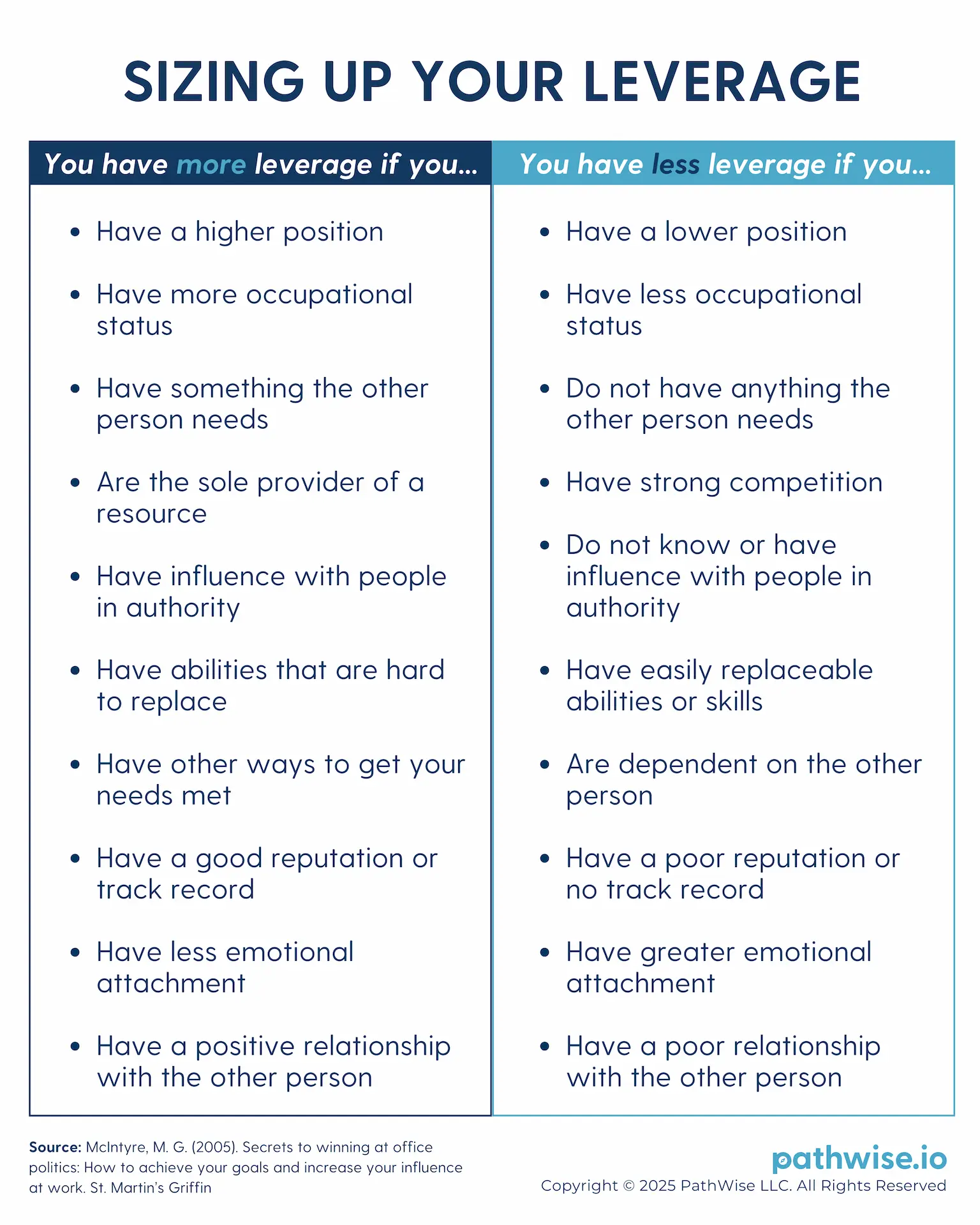
- If you let your ego overtake you, you might overestimate your leverage, which will result in a mistake. However, underestimating it due to self-doubt or modesty can lead to missed opportunities.
- Be on the lookout for leverage shifts. Power fluctuations – promotions, demotions, or reorganizations – occur frequently. Because these can happen unexpectedly, always follow this principle: “Never intentionally offend anyone at work” (p. 43).
- Other leverage shifts include changing market conditions, increased competition, new laws or regulations, or the election of a different political party. The key is to stay alert, anticipate shifts, and react appropriately.
- People with little leverage often waste energy on complaining, blaming, worrying, or gossiping. Instead, focus on results, build relationships, and concentrate on your goals and what you can control.
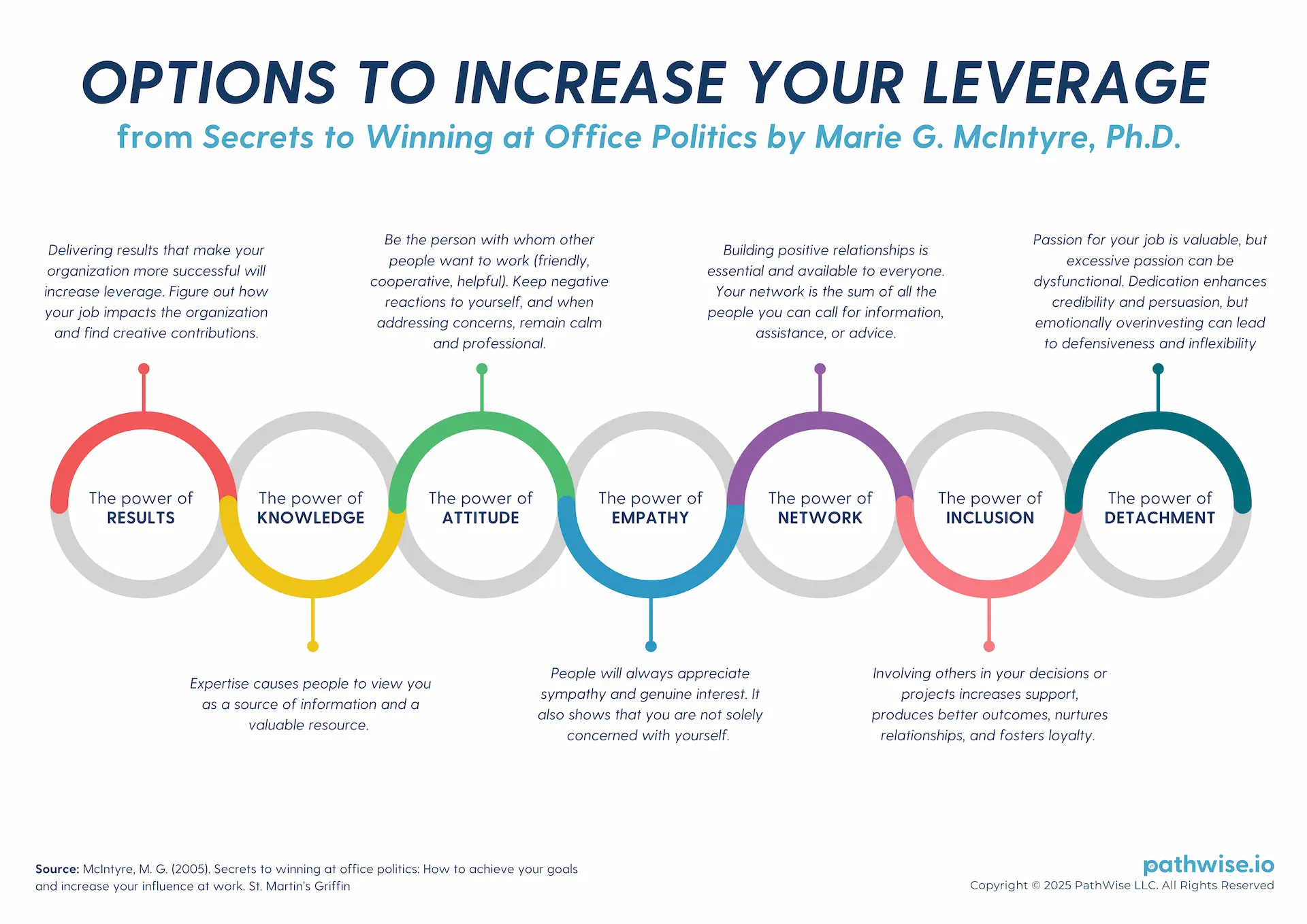
- Options to increase your leverage include:
- The power of results: Delivering results that make your organization more successful will increase leverage. Figure out how your job impacts the organization and find creative contributions.
- The power of knowledge: Expertise causes people to view you as a source of information and a valuable resource.
- The power of attitude: Be the person with whom other people want to work (friendly, cooperative, helpful). Keep negative reactions to yourself, and when addressing concerns, remain calm and professional.
- The power of empathy: People will always appreciate sympathy and genuine interest. It also shows that you are not solely concerned with yourself.
- The power of networks: Building positive relationships is essential and available to everyone. Your network is the sum of all the people you can call for information, assistance, or advice.
- The power of inclusion: Involving others in your decisions or projects increases support, produces better outcomes, nurtures relationships, and fosters loyalty.
- The power of detachment: Passion for your job is valuable, but excessive passion can be dysfunctional. Dedication enhances credibility and persuasion, but emotionally overinvesting can lead to defensiveness and inflexibility.
Chapter 4: Political Psych 101 – Allies and Adversaries
- The notion that who you know matters more than what you do is half true. Your success depends both on what you do and who knows you. Doing a poor job will damage your reputation, but great work won’t get you far unless the right people hear about it.
- A key political truth is that “positive relationships build political capital” (p. 53).
- High Political IQ requires that you recognize not only your allies but also your adversaries.
- Allies provide information, advice, assistance, and support, making them your most valuable political asset. A strong network can safeguard your career—during layoffs, for example, allies may help protect your position.
- There are three types of allies:
-
- Friends are colleagues with whom you get along, share interests, or have similar temperaments. You like each other for reasons other than your work tasks.
- Note that friends tend to judge your personality and competence separately. They can love you but still think you’re performing poorly. When they think you do great work, they’re among your strongest allies.
- Partners are colleagues you rely on—and who rely on you—to complete tasks and projects. Your goals are interconnected, and your actions impact each other. You don’t need to seek out partners; they come with the job.
- Partners become your allies when they think you are both competent and supportive. Otherwise, they can quickly become adversaries.
- It’s a big mistake to view your partner as your rival. They can be powerful allies, so cultivate these relationships and never alienate them.
- Connections are people you turn to for assistance or information—they help you get things done. The more connections you have, the more problems you can solve.
- These relationships are not as strong as those with friends or partners, so don’t ask for too many favors to avoid wearing them out.
- Friends are colleagues with whom you get along, share interests, or have similar temperaments. You like each other for reasons other than your work tasks.
- A key political strategy is to build a strong network. You must be willing to invest time in getting to know your colleagues. More importantly, avoid creating barriers. There are three ways to create walls around you (which you should avoid):
-
- Clustering happens when people group according to a given demographic or characteristic such as age, gender, nationality, etc.
- Layering is similar to clustering, but it happens based on organizational level.
- Occupational tunnel vision occurs when people ignore those outside of their department or function, limiting the view of the business.
- To build successful alliances:
- Identify those who can help you achieve your goals
- Seek opportunities for interaction
- Try to attract people with a positive and collaborative attitude
- Be predictable. People avoid those whose moods shift widely as they don’t know what to expect
- Get outside of your comfort zone
- Look for shared interests, experiences, or opinions to personalize the relationship
- Be helpful and offer assistance. Build bridges
- To identify adversaries, first ask yourself whether the person is an actual opponent or just someone with a disagreeable personality.
- Avoid labeling people as adversaries too quickly, as it can create a self-fulfilling prophecy.
- A true adversary is a person who stands between you and your goals.
- If you find that someone is indeed an adversary, think about what they want. Based on their motives, there are three types of adversaries:
-
- Focused adversaries are extremely determined people who want to get their own way and see you as an obstacle, but their opposition is not personal.
- Emotional adversaries are driven by intense emotional needs, usually deep-seated anger or anxiety. This person usually creates problems for everyone, not just you.
- Vengeful adversaries are unmistakably against you. Some are open and direct and will let you know they don’t like you. Others are more stealthy, and it is not immediately apparent that they’re adversaries.
- When dealing with difficult people, stay focused on your goals and manage the situation to your advantage—it takes self-control and discipline. Handling adversaries, however, requires strategy: avoid traps, convert them into allies when possible, or contain their destructive potential. Specifically,
-
- Managing focused adversaries: Often, focused adversaries’ actions can lure you into a power struggle, but you need to resist. Your focus should be on trying to convert them into allies. For this to happen, they must believe your goals do not conflict and that cooperating with you will contribute to their success.
-
-
- When you’re struggling to convert them, the most effective containment strategy is to increase your leverage and enlist the support of those with more power or influence. You might also need to enforce boundaries.
-
-
- Managing emotional adversaries: The first step in managing emotional adversaries is recognizing that their behavior stems from their own needs, not your actions. While they can sometimes become allies, containment is usually the best approach.
-
-
- You can’t change their personalities, but you can minimize their disruptive behavior. Control your reactions and avoid emotional responses. However, in extreme cases, the best option may be to avoid them.
- If your boss is the emotional adversary, accept the reality, focus on excelling in your role, strengthen your network of allies, stay calm, and be available when needed, but otherwise, keep your distance.
- If the situation becomes untenable, consider seeking other employment.
-
-
- Managing vengeful adversaries: Do everything possible to avoid creating this type of adversary. If you do, reflect on your actions to identify any potential triggers for their resentment.
-
-
- If they are rational, consider a direct, non-defensive conversation to address the issue. If they are irrational, focus on containment and self-protection.
- For example, if an irrational, vengeful colleague targets you, make your boss aware of the issue, document your efforts to resolve it, strengthen your network of allies, and directly ask the person to stop their aggression. The relationship may not improve, but their hostility may become less overt.
-
Part II – Avoiding Political Pitfalls
Chapter 5: Political Games – Moves and Countermoves
- While some degree of office politics is natural in any organization, people sometimes engage in political games with a specific purpose. Signs to spot these games include:
- The players’ actions have an identifiable pattern
- The behavior has an emotional payoff
- True motives are never stated, and players have a socially acceptable explanation for what they do
- A player always comes out ahead, and sometimes, another is defeated or humiliated
- There’s resistance to changing the game
- The three most common games are Power Games, Ego Games, and Escape Games.
- A Power Game is usually about gaining more leverage. Players can be either malicious or self-absorbed.
- Power games can be classified into:
-
- The Suck-Up Game: In this case, the players focus all their energy upward, as their emotional payoff stems from being liked by people in power. They will compliment managers excessively and rarely disagree with them.
-
- Pitfalls of this game include:
- Losing allies among peers
- Upsetting the manager when they discover concealed bad news
- Being disapproved by managers who appreciate unfiltered opinions and honest feedback
- To disrupt the game, describe the pattern you observe and share your thoughts about the player’s motives. In private, you can be direct. In a public setting, ask questions to avoid appearing confrontational.
- This game is usually more annoying than harmful. When problems arise, though, a key countermove to get back to a productive track is having candid discussions.
- These games usually end with the player becoming more assertive and confident or acquiring a new boss who hates obsequious behavior.
- Pitfalls of this game include:
-
- The Control Game: In this game, players resist direction and advice. They are dominators or resistors who resent outside influence.
-
- The emotional payoff is doing whatever they want to do.
- Pitfalls of this game include:
- Falling into a power struggle spiral that results in unproductivity
- Losing the game
- To expose the game, remain professional. Have an open, honest conversation with a businesslike attitude.
- As countermoves, avoid the power game and don’t fall for a power grab trap. However, do stand your ground and establish boundaries. Also, fortify relationships with high-leverage allies.
- Another key strategy is going with the resistance – don’t push back when they push you, but don’t give in either.
- The game ends when the relationship stops feeling adversarial or a player gives up.
-
- The Shunning Game: This group game punishes a person for deviating from a given standard, where the target gradually realizes they’re being excluded.
-
- The emotional payoff is feeling powerful by punishing others.
- Pitfalls include:
- Appearing immature and small-minded
- Angering the target who might retaliate (and might first acquire leverage)
- Exposing the game can be complicated, making the target seem needy. So, countermoves include finding other sources of support, befriending the kinder group members to short-circuit the game, figuring out what behavior caused the shunning, and, if reasonable, changing it.
- This game usually ends with the group offering acceptance or the target leaving. This game is a particularly stressful and psychologically difficult situation to tolerate. Sometimes, it’s best to leave.
- Ego Games are about making the players feel smarter, better, or special. However, they’re often hiding feelings of insecurity. These games can be classified into:
-
- The Superiority Game: In this game, players send messages implying they are important, unique, indispensable, or better than the rest. This game usually has only one player in search of an audience. But, sometimes, two players compete childishly.
-
- The emotional payoff is about making others believe they’re special.
- Pitfalls include:
- Being tuned out by colleagues
- Appearing insecure
- To expose this game, verbalize the player’s underlying message in a calm and sincere tone (e.g., “You certainly seem to have a lot of impressive contacts”).
- These games are rarely destructive, but if they interfere with work, your countermoves consist of avoiding getting hooked, not rewarding the behavior, addressing the problem, and remembering their motive (having sympathy).
- The game ends when the player stops the behavior, usually because the people they’re trying to impress are gone.
-
- The Put-Down Game: This game consists of a bully making their target feel inept, usually by criticizing and making hurtful remarks.
-
- The emotional payoff is to demonstrate superiority to feel less inferior.
- Pitfalls include:
- Creating resentful and angry adversaries
- Appearing insecure
- To expose this game, calmly describe the reaction the player is trying to produce (e.g., “You’re obviously smarter than I am”).
- The best countermove is to avoid the player altogether. If you can’t, always respond calmly.
- This game ends when either the player or the target leaves.
-
- The In-Group Game: This game requires two groups, one of which is more desirable than the other. Unlike the shunning game, this one is not hostile, but people know a barrier exists.
-
- The emotional payoff is exclusivity.
- Pitfalls include:
- Nurturing resentment among colleagues
- Fostering group divisions that impact the organization’s success
- To expose the game, out-group members must collectively expose the “in-group” by describing the situation. The goal is to make the whole group more inclusive.
- The countermoves in this game include bringing the issue into the open, building one-on-one relationships, and suggesting activities to include others.
- The game is over when all members interact freely.
- Escape Games are about avoiding unpleasant consequences or blame and neglecting responsibilities. These can be classified into:
-
- The Scapegoat Game: This game can be played at the individual and group levels. It consists of a target being blamed for a problem or issue.
-
- The emotional payoff is avoiding feelings of guilt or shame.
- Pitfalls include:
- Facing retaliation
- Failing to address the real issue and continuing the problem
- To expose the game, the scapegoat can comment on what is happening (e.g., “We seem to be focusing on advertising as the only cause for the problem, but there might be other causes”). At the individual level, a question might work better to avoid sounding defensive.
- Countermoves include avoiding getting into an argument, acknowledging the possibility of partial responsibility, defending yourself subtly, broadening the scope of the discussion, and relying on facts to support your case.
- The game ends when members decide to adopt a problem-solving strategy.
-
- The Avoidance Game: This one-person game impacts those who depend on the player, who continually delays difficult tasks until forced to perform them.
-
- The emotional payoff relates to reducing anxiety by avoiding responsibilities.
- Pitfalls include:
- Alienating colleagues and potential allies
- Creating adversaries
- Facing serious consequences with upper management
- To expose the game, discuss the underlying motives with the player.
- Countermoves should focus on getting the required results. To do so, don’t leave a deadline open-ended, offer to help with the difficult part of the task, increase your leverage, and escalate the issue without threatening (e.g., “I know you’re busy, but I’m going to have to let the CEO know we’re delayed”).
- This game ends when the avoider leaves.
- If malicious political games are too common in your organization, you might need to find a healthier workplace. Spending too much time in a toxic company can have detrimental effects on your psychological, emotional, and physical well-being.
- The following are indicators that you might need to look for a new job:
- Power struggles and plays are too common
- Leadership egos need regular affirmation
- Executives are focused on growing their power
- People talk to managers only if they have to
- Departments are at war with each other
- Management pays more attention to mistakes than successes
- Problems trigger a search for a scapegoat
- Gossip, put-downs, blaming, and backbiting are common
- Disagreements get personal
- Unreasonably long work hours are normalized
- No consideration is given to personal or family issues
Chapter 6: How to Commit Political Suicide
- To commit political suicide, engage in any behavior that consumes a disproportionate amount of your manager’s time and attention. Managers fire or demote when they reach a tipping point, which seldom happens suddenly.
- Managers begin considering the options of demotion or firing when they become convinced the person in question is the problem.
- Once people arrive at a given conclusion, they unconsciously gather evidence that supports their opinion, so if someone falls into the problem category, managers will be primed to notice the behaviors that confirm the conclusion.
- While no one becomes the problem on purpose, many people become victims of their own chronic self-destructive habits. Others simply make bad choices when handling difficult situations.
- There are four common causes of career destruction:
-
- Poorly Controlled Emotions
-
-
- The two emotions that most negatively impact professional lives are anger and anxiety. While everyone feels these emotions, issues arise when these become persistent and create a pattern of destructive behavior.
- Poorly controlled patterns of anger lead to complaining, rebellion, and confrontation.
- Poorly controlled patterns of anxiety result in timidity, neediness (frequent reassurance), and hiding (working alone and avoiding others).
- Another emotion to consider is lust. It’s best to seek romantic relationships outside of your organization.
- Regardless of the emotion, those who lack self-control will inevitably become Dimwits and be labeled the problem.
-
-
- Victim Mentality
-
-
- Everyone has an inner dialogue. You have to be careful about what you tell yourself because we all believe our own messages. Habitually thinking negatively forms beliefs and attitudes that impact communication and behavior patterns.
- It is through self-talk that people create victim identities. While actual triggers may vary, once people engage in this form of self-talk, all their interactions will be screened for signs of unfair treatment.
- Victim identities always find adversaries and, in turn, create them themselves.
- If you are facing true discrimination, you will have to make a tough decision. Unfortunately, filing an official grievance may cause others to treat you differently (even if only behind your back).
- This is not to suggest that you should tolerate illegal treatment, but if you go public with a charge, you need to be aware that there will be political ramifications.
- Before doing anything, consult a trusted friend or colleague and discuss possible strategies. In some cases, it may be best to find another job.
-
-
- Self-Centered Goals
-
-
- All Sociopaths are selfish and contribute to their own political downfall. This happens throughout all levels of an unorganized nation. Even a CEO can become the problem.
- Some self-centered individuals are Martyrs acting in the interest of what they think is a higher cause. However, their narrow focus leads to a lack of balance necessary for political success.
- Self-centered people struggle to shift their thinking to different perspectives. Selfishness and misguided advocacy lead to political self-destruction because organizations cannot succeed if members act out of self-interest.
-
-
- Foolish Reactions to Change
-
-
- Stressful change—whether self-chosen, like changing jobs, or imposed by resignations, mergers, or reorganizations—can lead to political decline if not managed effectively.
- Those with low Political IQ often perceive the new situation as wrong, reinforcing this belief with negative self-talk. This mindset frequently leads to the start of adversarial relationships.
-
- In order of severity, the following are warning signs of political trouble:
-
- Level One: Something is Not Quite Right
-
-
- You feel a growing uneasiness with frequent angry thoughts about unfairness
- You find yourself alone a lot
- Your boss ignores you, fails to notify you of meetings, neglects to give you information, or similar
- Your boss has a serious talk with you about your performance or personality
- A personal coach is hired to help you
-
-
- Level Two: The Future Looks Questionable
-
-
- An important assignment that should have been yours is given to someone else
- You are turned down for promotions more than once
- After acquiring a new boss, your leverage seems to slip away
- Someone from Human Resources initiates a serious talk
-
-
- Level Three: A Sudden Career Change May Lie Ahead
-
-
- Following a reorganization, you find that you have a reduction in staff, title, responsibilities, or reporting level
- Your manager’s boss gets involved in a serious talk you already had with someone else
- There are rumors of layoffs, and people are avoiding you or looking at you sadly
-
- To address what’s causing you to be the problem, determine if the issue originates with you or the environment. Attribution error is a cognitive bias that makes people credit themselves for positive experiences and blame outside factors for negative events.
- Strive for objectivity and look for patterns. Have you been in a similar situation before? How are other people feeling and performing? Is the workplace toxic, or does it appear healthy to others?
- Review your work history, relationships, and reactions to authority, and look for common trends. Honest self-scrutiny is not easy, but if you identify patterns, you can start taking corrective action.
- The acronym AMISH describes a five-step process to change behaviors:
- Awareness: Find out what others perceive. Solicit feedback. If you don’t know what the problem is, you can’t address it.
- Motivation: If someone tells you that something about your behavior is a problem, don’t dismiss it. Understand how your actions affect others so that you become motivated to try new approaches.
- Identification: Identify what exactly needs to change. If someone says, “poor communication,” determine specifically what needs to happen differently in your communication (is it verbal, written, or non-verbal communication?).
- Substitution: If you’re stopping a behavior, it follows that you’ll need to replace it with another one. Determine what helpful behavior will be the substitute.
- Habit Replacement: It takes time for old habits to disappear. Expect relapses, but persist. New habits will eventually become automatic.
- Note that as you try to change your behavior, it will take even more time for others to notice. Once they notice, they may remain skeptical. So, be patient.
Chapter 7: Power, Power, Who Has the Power?
- When it comes to office politics, you have to understand who has the power, how to get it, and how to use it.
- To understand how much power you hold, think about your position and personal characteristics. Position power comes with the job. Hierarchical authority and organizational level contribute to your power.
- Other forms of position power include higher- and lower-status jobs (e.g., design engineers will have more status in an electronics company), and those with access to important people or platforms for leverage-building activities (e.g., receptionists).
- Another source of power is specialized knowledge – those in “expert” positions.
- Many people fail to recognize their position power and others are afraid to use it, both jeopardizing their jobs (e.g., a manager who’s reluctant to address performance issues with her staff will cause her superior to question her management abilities).
- Personal power stems from your characteristics and abilities. This includes your skills, strengths, friendliness, and anything that provides you with leverage. Note that increasing personal power is about using your strengths and reducing your weaknesses.
- Some questions to consider to determine another person’s power level include:
- Do top managers know who they are?
- Could the CEO find their office without a map?
- Do people listen when they speak?
- What meetings do they attend?
- With whom do they have lunch?
- Whom can they go to see without an appointment?
- To further assess someone’s power, you can rely on the clues in the table below.
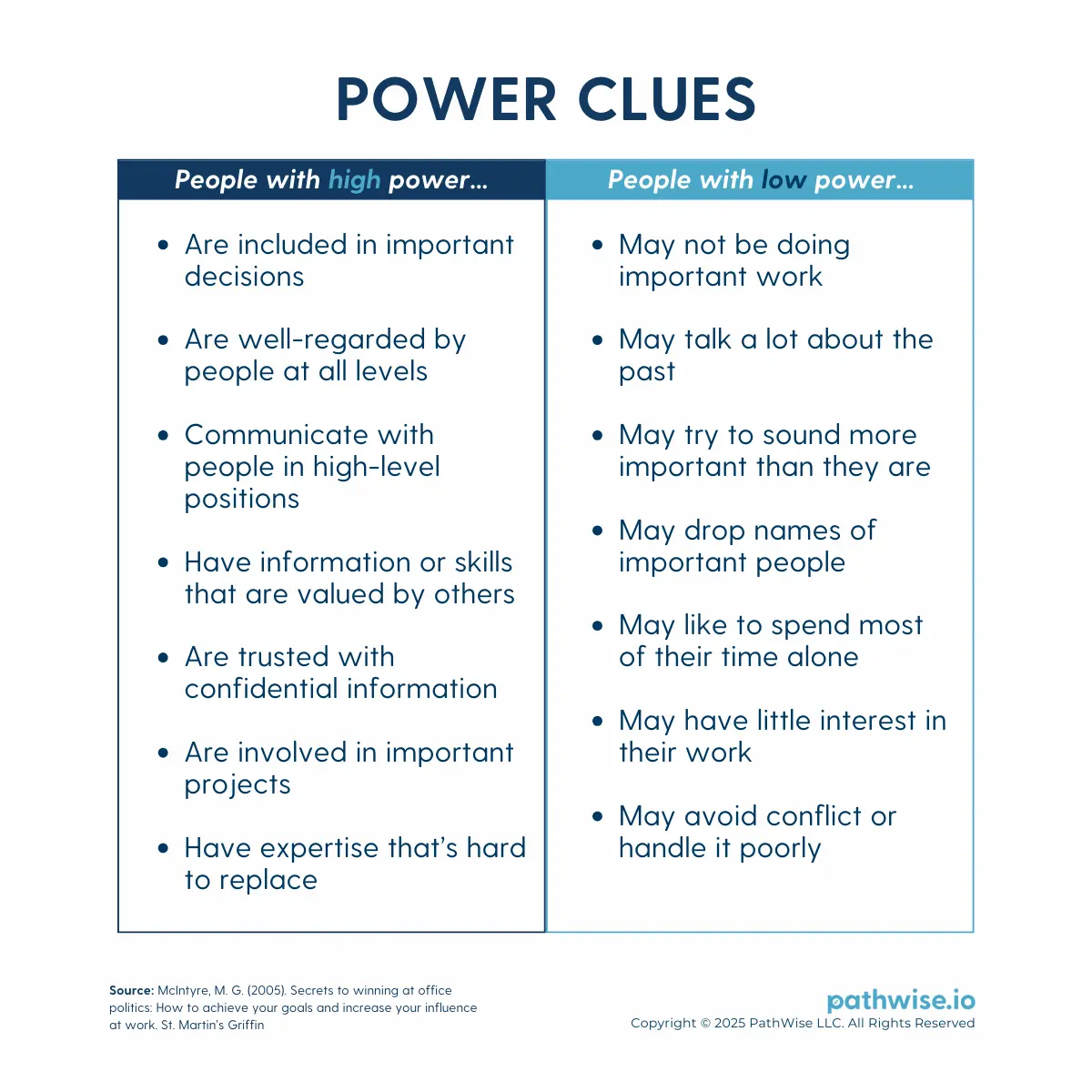
- When using power, it is common for people to make mistakes. On one extreme, shy people, fearing they’ll seem pushy or insensitive, give their power away.
- At the other extreme, some people act as if they have more power than they actually do. There are also aggressive types seeking dominance who often end up in power struggles.
- Another power mistake is when people dismiss leverage-building opportunities. For instance, fearing appearing presumptuous, someone might decide not to attend a meeting with the executive team. Yet this is an opportunity to increase exposure.
- There are also cases of people who try to use power they don’t actually possess. For instance, McIntyre tells of a nurse group forming a union. In a meeting with the company’s labor attorney, he said “We can’t agree to your terms.” They replied, “Then we won’t sign a contract.” To which he said, “Ok,” and left.
- It was after several weeks that the nurses noticed they had no power to make demands. Political IQ requires understanding the extent of your power.
- Ego and arrogance often lead to political mistakes. For example, in a consulting firm, three consultants were particularly successful and had good relationships with key clients. When they asked to be considered for partnership, the owners said no.
- The consultants left the company, made their own new consulting firm, and took their knowledge, experience, and clients with them.
- Power mistakes are triggered by our personality and experiences, but they’re also learned. Many of these behaviors are learned at home.
- Culture also plays a role. In the West, people value individuality and assertiveness. In the East, they emphasize harmony, collaboration, and respect for authority.
- Gender differences also impact power mistakes. For reasons of biology and socialization, men focus on dominance and hierarchy while women focus on relationships. Women exercise power through inclusion and exclusion.
- To achieve your goals, know who can help and hurt you, keeping in mind that power shifts frequently and you must remain alert. A key way to keep track of these changes and assess power levels is creating a power grid, based on the diagram below.
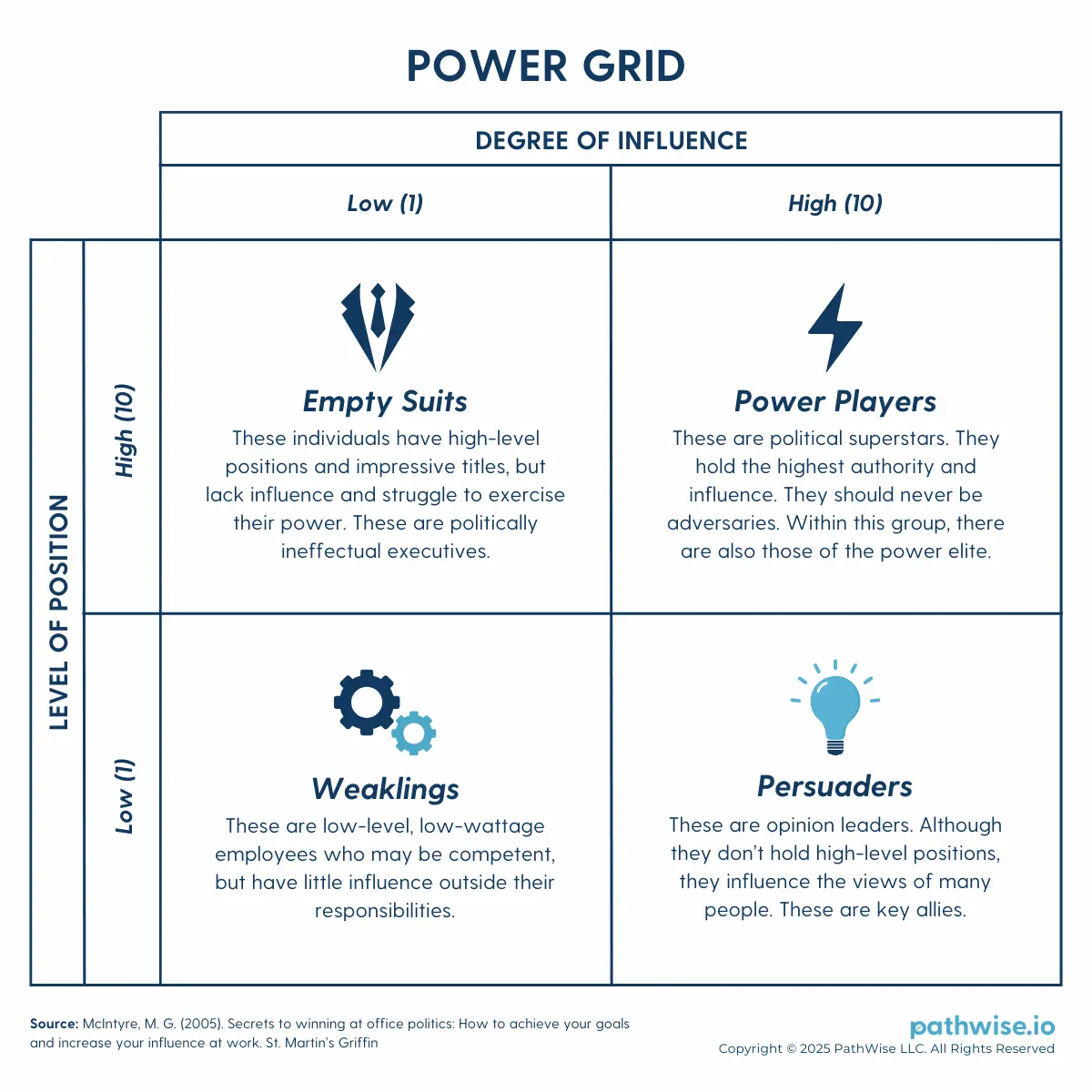
- To determine someone’s power, assign the person a rating on the level of position and the degree of influence. Then, add the rating to get a Political Power Score. Finally, find the point where the ratings intersect to place the person in a power category.
- Within the Power Players, there is a Power Elite category – executives with extensive authority and widespread influence.
- An organization’s culture greatly depends on the values and beliefs of the Power Elite. If their values strictly conflict with yours, you’ll likely need to find another job. To determine what these values and beliefs are,
- Don’t just listen to what they say, watch what they do
- Take note of what they like to talk about and how they work (a personal working style often reflects what someone expects of others)
- Observe who gets recognized, praised, or promoted
- Ask your boss or connected colleagues. Cultural coaching from your mentor can really help advance your career
- When someone new joins the power elite, observe what they change
Part III – How to Become a Winner
Chapter 8: Increasing Your Political Power
- An important fact to remember is that “To achieve any goal, you must have sufficient power” (p. 159). To increase your power, first recognize that it is not a merely self-serving desire, as you will always be working for the success of a company.
- A Political Game Plan can help you obtain more power. To design it, consider the Four P’s of Politics and think through the questions below.
- Power Assessment: How can you improve your leverage position?
- Performance: How can your work make the business more successful?
- Perception: How can you enhance your reputation, especially with those who can help you achieve your goals?
- Partnership: How can you increase your network of allies and supporters?
- To evaluate your leverage, use the power grid exercise covered in the previous chapter.
- The performance principle suggests that true political power is based on the value of your contributions. That is, you must produce results that make the business successful.
- There are a few people who have leverage while producing few contributions: those placed in a given position through nepotism or because of romantic relationships. Yet their political power is completely dependent on one person.
- To produce quality results, engage in an ROI Mindset. There are expectations associated with your job. There’s a reason why the company hired you over other candidates. Even if not explicitly explained, there’s a return on investment you should provide.
- To increase your political power, deliver more than the minimum expected ROI.
- Another strategy is being clear about what management finds important. Start by understanding your boss and work upwards.
- “Once you’re doing the right things, then you must be sure to do them right” (p. 167).
- The perception principle suggests that invisible contributions have no political value. That is, great performance has political value only if the right people know about it.
- A positive perception is almost as important as your accomplishments.
- One way to make sure your results are visible is to categorize your work by visibility and importance levels, as shown below.
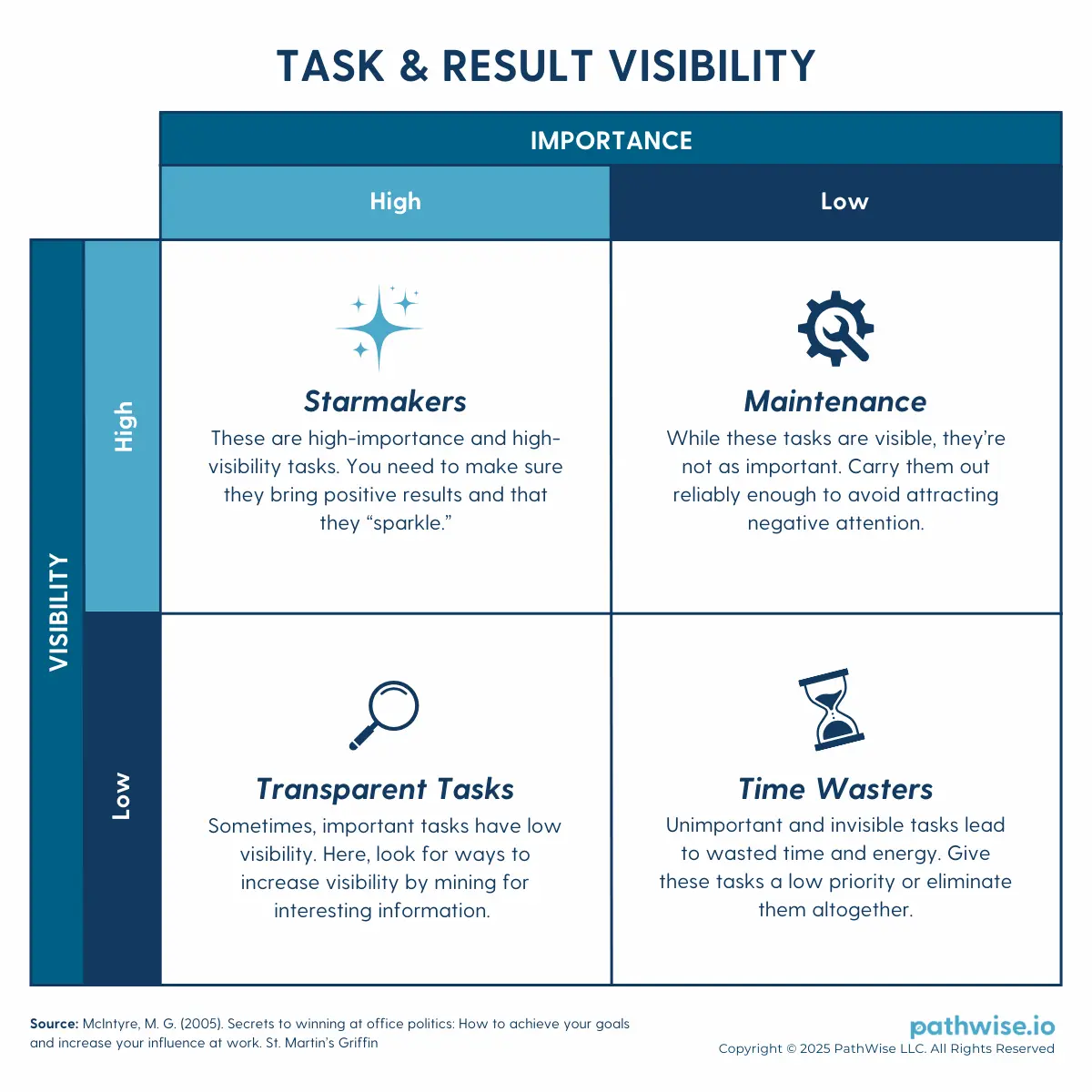
- Focus on doing quality work that creates positive perceptions. A key way to make transparent tasks more visible is to develop measures.
- For example, during her time working in HR, McIntyre noticed management didn’t pay attention to employee complaints. By keeping a count and classifying them in a report, she found that they paid more attention to them.
- If you’re a manager, your performance will be judged based on the performance of your whole team.
- Because people don’t know what you think or feel, their perceptions of you depend on your behavior. If you feel confident but don’t look it, they won’t perceive it. Acting as if is a good strategy to get you to where you need to go.
- For example, if you don’t like your boss, act as if you do. Eventually, it may no longer be an act.
- The partnership principle suggests that every positive working relationship increases your political power. Develop a partnership approach to work. When people fail to collaborate, the business suffers.
- To implement this principle, think in terms of involvement and inclusion. Constantly ask yourself who can contribute to your projects. Ultimately, partners improve results and expand your network.
- Unless you’re dealing with a Dimwit, you should be able to collaborate with anyone. If you’re struggling to get along with someone, there might be work style incompatibilities. The list below shows the most common ones.
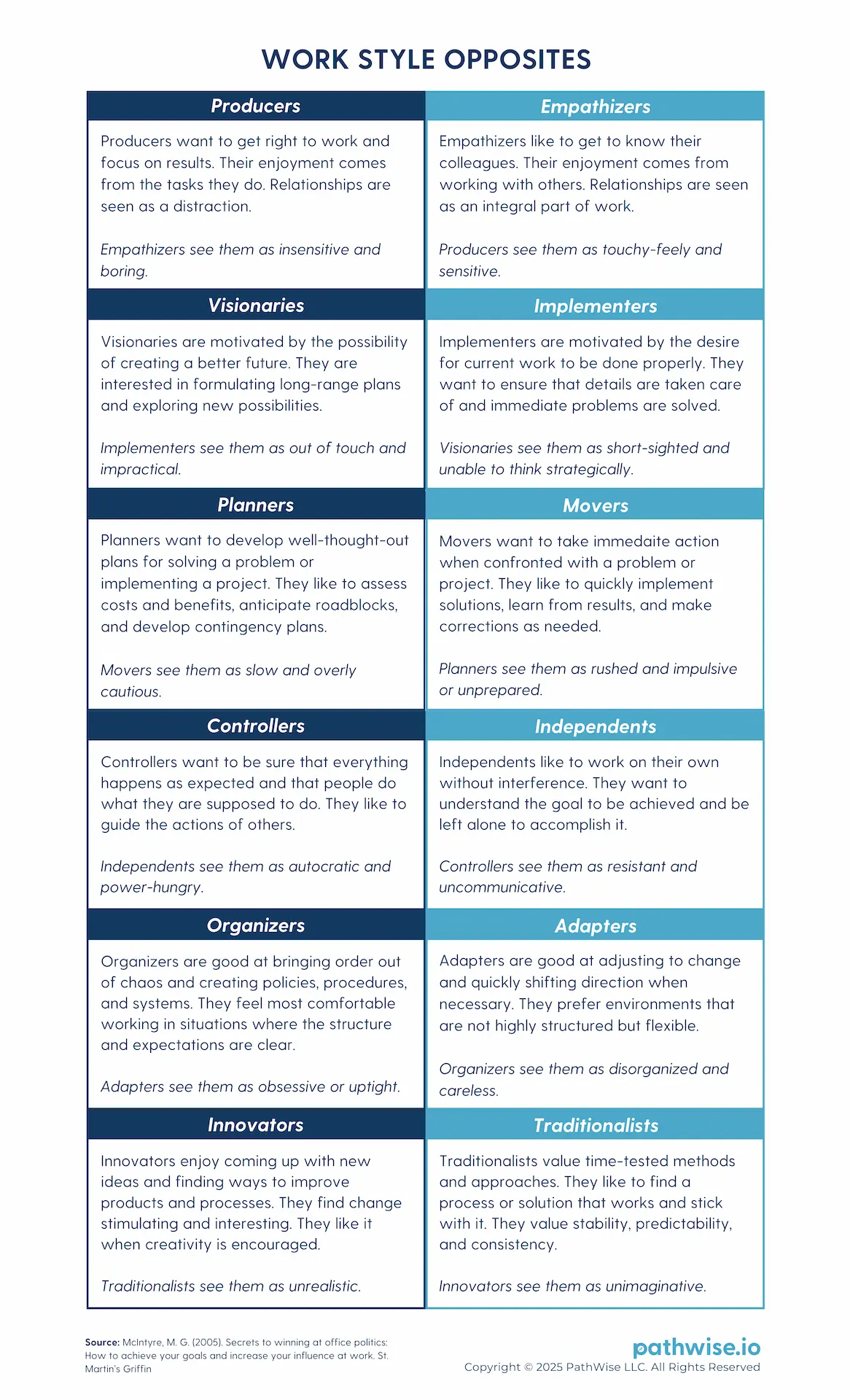
- Becoming more tolerant to accommodate working styles pays dividends. The people who appear incompatible with us are often the ones to complement us the best.
Chapter 9: Sharpening Your Influence Skills
- Most people operate on autopilot, doing what comes naturally, unaware of their own behavior and the effect it has on others. Routine, low-impact tasks don’t deserve a lot of energy or thought, but few interactions at work can be described as such.
- To influence others, you have to think about what you’re doing, making conscious, intelligent decisions about your behavior.
- The Paradox of Influence is that to get other people to change their behavior, you have to change your own. To develop influence skills, you need to first foster self-management skills, as you can only control your own actions. To do so, develop:
-
- Self-Observation Skills: You need to be aware of what you’re doing.
- Self-Control: Foster the ability to control your impulses and restrain yourself.
- Selective Behavior Skills: If you can observe your actions and control yourself, you can increase your influence by making better behavioral choices.
- The influence process consists of the following steps:
- You have a goal that’s important to you
- Someone else can help or hinder your accomplishment of such a goal
- You need the other person to engage in certain behaviors
- To produce these behaviors, you must use the appropriate influence strategy
- To avoid becoming overly manipulative, remember the Political Golden Rule which prohibits you from using any strategy that would harm others. Also, remember that acting without thinking can cause more harm to others than strategic behavior.
- There’s a difference between influence and control. Trying to control a situation or other people will cause harm. Influencing, done right, usually leads to cooperation.
- People often fail to achieve goals because they waste energy on tasks or situations that are clearly out of their control.
- Political IQ enables individuals to identify strategies that help them achieve their goals but that are also tailored to the person whose support they need.
- When someone rejects a strategy, people’s impulse is to escalate their current behavior (like shouting at someone who doesn’t speak your language, raising the volume will not help). When a strategy is not working, you need to shift your approach.
- To help you expand your influence toolbox, watch what other people do.
- To choose the best influence approach, consider the other person’s view. Then, frame your requests in terms of shared goals. It’s a good idea to anticipate objections and concerns. Assess your leverage, and when in doubt, solicit their point of view.
- In emotionally charged interactions, people tend to lose sight of their objectives and fall into counterproductive behaviors. Other times, when people feel criticized, they use tactics to distract you from your goal (anger, tears, excuses, or shifting the focus).
- Political IQ requires that you keep your goal in mind at all times.
- Your influence tools can be categorized on a spectrum from indirect to direct influence. Direct influence is telling people exactly what to do. Indirect influence is about watching people, asking questions, and learning from their responses.
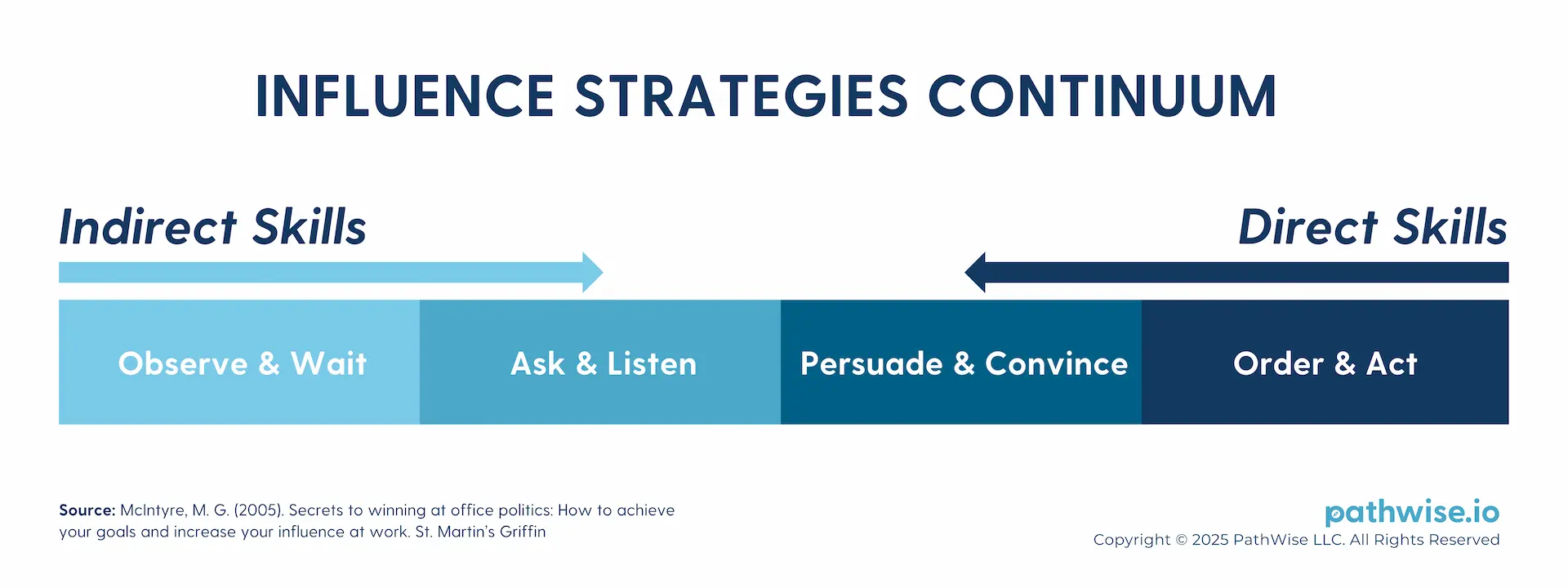
- Observe and Wait: To become a political Winner, learn to process the constant stream of observations. Watch the political games in your organization to detect conflicts, alliances, and leverage shifts.
- In individual encounters, nonverbal signs can alert you to feelings and reactions.
- In a meeting, you can monitor topic changes and interpersonal hints to reveal a perfect moment to make your point.
- Timely observations are essential to influence processes since they enable you to select the most effective strategy for each given situation.
- Note that any strength taken to the extreme becomes a weakness. Too much observing and waiting will lead to others thinking you have nothing to say.
- Ask and Listen: The more you know about another person, the more influential and helpful you can be. When someone speaks to you, make sure you actually listen (rather than rehearsing what you’re going to reply). Questions can help influence others, but they must be actual inquiries and not leading.
-
- Explanatory questions help you understand the other person’s point of view, helping you convey interest in their opinions and ideas.
- Involvement questions increase buy-in by inviting others to participate in a project or help plan a change.
- Softening questions reduce defensiveness and help bring up topics or get points across in a less confrontational manner.
-
- Persuade and Convince: To become more persuasive:
- Do your homework; you’ll feel more comfortable if you’re informed about your subject and can answer questions intelligently
- Speak up
- Demonstrate confidence
- Don’t try to fake it. If you don’t know something, say so. Bluffing is usually obvious and makes you look bad
- Believe in your product, idea, suggestion, policy, program, etc. You can only convince others if you believe in it yourself
- Look for shared goals and common interests
- Generate excitement
- Get people involved and engage them in discussions
- Don’t forget your indirect skills
- Order and Act: Sometimes, the best way to get results is by asking directly. This is a good strategy whenever the situation calls for strong leadership, or a group lacks clear direction, has difficulty making decisions, or includes many inexperienced members.
- Relying too heavily on direct skills can provoke resistance and defensiveness, so make sure to be balanced.
Chapter 10: Managing Power Relationships
- A political Winner knows how to manage relationships in all directions. If you’re unsure whether colleagues at all levels would speak positively about you in a 360-degree feedback report, you need to assess your power relationships.
- Because power relationships often mirror those in families, power difficulties often come from people taking on a Parent or Child role.
- Upward influence is challenging for those who view management as a Parent and act like a Child. They either become rebellious and hard to manage or submissive and overly compliant.
- Lateral influence problems occur when people take a Child role with their colleagues, reflecting sibling dynamics (such as a competitive kid who always wants to win or the self-sufficient child who prefers being alone).
- Downward influence, which is essential for good management, leads to trouble when the manager acts as a Parent or a Child.
- Parental managers can be dominating or smothering. Dominating managers overuse their direct authority and issue orders and reprimands. Smothering managers get too involved in employees’ work, thinking they’re being helpful, but employees will perceive it as micromanagement.
- Managers who adopt a childlike role are uncomfortable with authority. While employees dislike dominating managers, they don’t respect passive, weak-willed ones either.
- To effectively and politically intelligently manage upwardly,
- Accept the fact that your boss has been given the power to direct your activities
- Don’t expect them to be perfect. Recognize their sensitive points and avoid triggering them
- Study your boss’s management style and figure out what makes them happy
- Make your boss look good by producing quality results, meeting deadlines, staying within budget, responding quickly, etc.
- Never complain to others about your boss
- Give your boss a sincere compliment from time to time, and add an appropriate moment
- Don’t forget it’s not your boss who protects your job but your boss’s boss. Look for opportunities to interact with higher-level managers
- Managing your boss differs from working with executives. High-level leaders—such as CEOs, presidents, elected officials, and top political appointees—are accustomed to saying and doing as they please, requiring a different approach. Consider the following guidelines:
- Never tell an executive that they cannot do something
- Talk fast as these individuals are busy and have tight schedules
- Don’t expect specific instructions—high-level executives often shift quickly between major issues, resulting in directions that may be vague or incomplete
- Once they give a vague directive, take action and make it happen—they don’t expect to revisit the issue
- Take care of every detail
- Don’t take anything personally
- Keep your ego in check
- Foster your self-confidence and self-assurance, and display them
- Hang on to your sense of humor because you’ll need it
- Colleagues are valuable allies, and keeping them happy is simple—be agreeable, helpful, and responsive. Investing in these relationships pays off quickly in access to information, contacts, or support. Also, you never know when a colleague might become your boss.
- To effectively and politically intelligently manage laterally,
- Watch for opportunities to help your coworkers
- Return phone calls, answer emails, meet deadlines, and keep your commitments
- Don’t treat your colleagues as therapists
- Avoid blatant self-promotion, especially at your colleagues’ expense
- Be polite and pleasant even if they are not
- Whenever you have concerns, avoid gossiping and talk to the person directly
- When facing disagreements, discuss them in a professional manner
- If someone is rude, offensive, or insulting, resist the temptation of retaliation
- To effectively and politically intelligently manage downwardly, first remember that your company can make you a manager, but your staff decides if you’re a leader. “A leader is someone people choose to follow. Follow, not obey” (p. 225).
- Part of your influence involves inspiring people to go the extra mile and contribute their best effort.
- Other strategies for downward influencing include,
- Understand what being a manager is (you’re not a monarch)
- Worry about being respected, but not so much about being liked
- Learn to manage other people’s performance (motivate and inspire, set clear goals, give helpful feedback, address performance issues, etc.)
- Appreciate the power of inclusion and learn when to involve employees
- Help your team members become the best they can be (insecure managers fear being overshadowed)
Chapter 11: Developing Your Political Game Plan
- For most people, work occupies a large portion of their waking hours, so it’s important to avoid feeling unhappy. To do so, regularly update your Political Game Plan.
- The chart below helps assess your current political situation. Your answers to each question will either lead to a strategy that is discussed in more detail below, or will have you move to the next question until you become a political Winner.
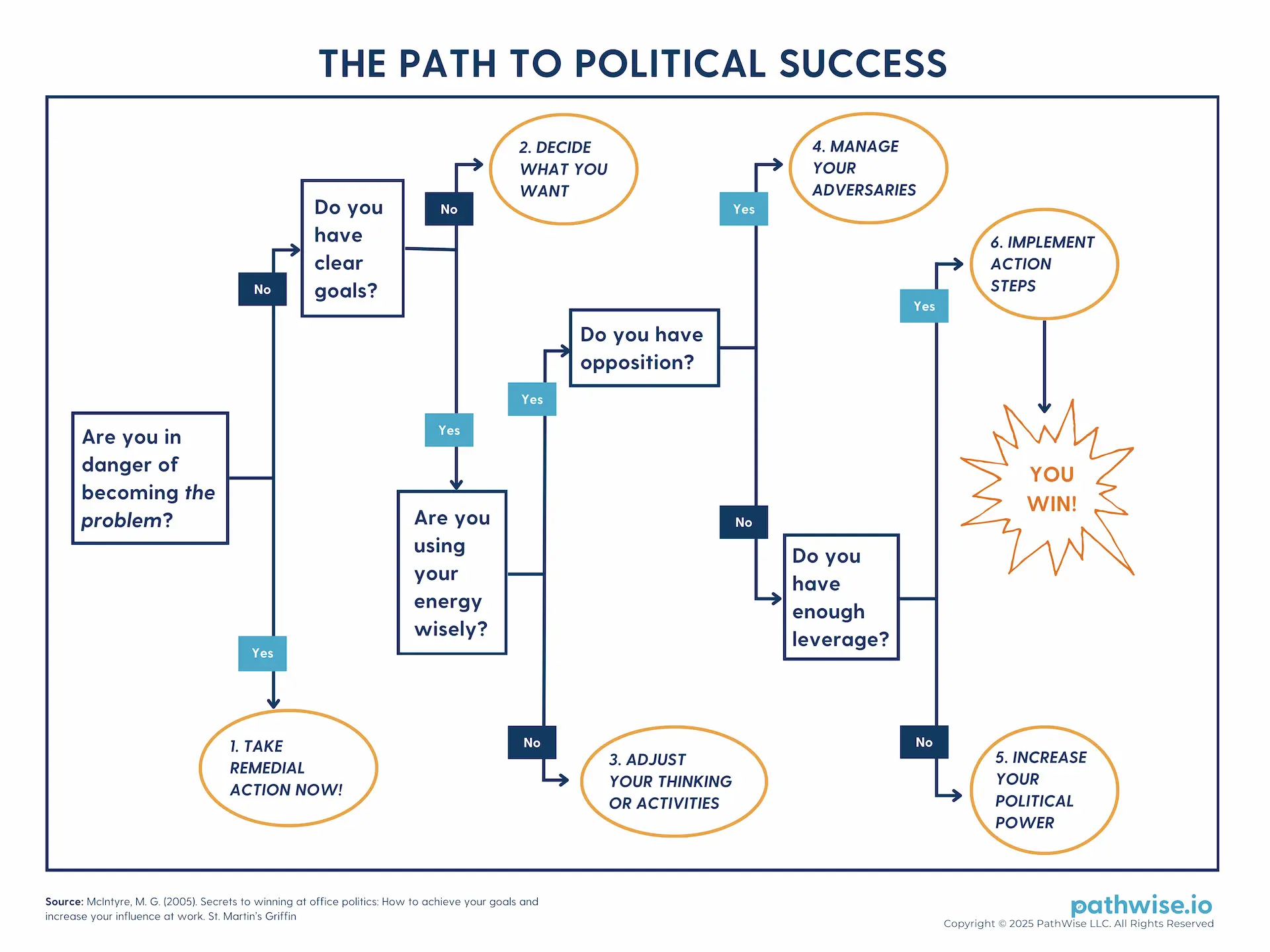
- Strategy 1: If you’re in danger of becoming the problem, take remedial action asap.
- Three reasons explain why someone can be seen as the problem:
- The person is a Dimwit and makes working difficult for everyone. If you firmly believe that most of your colleagues and managers are uncooperative or difficult, you might fall in this category.
- The person has become the victim of a toxic work environment. If this is your case, relocate to a healthier setting as quickly as possible.
- The person is acting inappropriately as a reaction to change or a difficult situation. If this is you, you need to adapt or leave.
- The first step to overcoming being the problem is changing your feelings and actions. You must get over the “it’s not fair” barrier. If the unfairness is intolerable, consider finding another job. Otherwise, shift your focus from the past and towards the future.
- With your emotions under control, formulate a restoration plan. Work on changing people’s perceptions. This might include having difficult conversations or acting differently, and waiting for people to notice.
- Strategy 2: If you are not clear about your goals, decide what you want.
- What political strategies you use depends on your goals. If you can’t define them, consider the following questions:
- Do you want to continue your current type of work? If not, what sort of change are you seeking?
- Do you want to stay with your current organization? Is the culture a good fit for you? Do you respect leadership? Is there a meaningful path for you?
- Do you want to remain in this particular job? Do you like what you’re doing? Is it challenging enough? Do you enjoy working with your colleagues and manager?
- Strategy 3: If you are not using your energy wisely, adjust your thinking or activities.
- If you have clear goals, your energy should mostly be fixed toward achieving them. Your goals are your screening question for your thoughts and actions. Ask yourself, “Is this use of energy helping me create my desired future?”
- Sometimes, internal or external distractions throw us off track. With the above screening question in mind, consider the following distractors,
- Difficulty focusing: If focusing is challenging for you, you need to prioritize self-management. Multitasking might be an issue.
- Negative emotions: If you’re ruminating or engaging in too much negative self-talk, you need to work on your internal dialogue.
- Seductive tasks: We all have task and responsibility preferences. Prioritizing only what you like can lead to serious problems. If this is you, you need to devote time to the unpleasant but necessary tasks required to reach your goals.
- Toxic people: If you have to work with a difficult coworker, try not to spend lunch, breaks, or extra time with them. If you’re struggling to set boundaries, you’re probably being too polite.
- Strategy 4: If you face opposition in reaching your goals, manage your adversaries.
- You can spend much time and energy dealing with contrarian or incompetent adversaries. Politically intelligent people manage their antagonists. If you’re having difficulty doing so, consider the following questions:
- Have you allowed feelings about your adversary distract you from your goals?
- How have you framed the situation? How you frame your circumstances determines how you act.
- Are you sure that the person has bad intentions?
- Have you considered their point of view?
- Can you convert this person into an ally?
- Do you need to increase your leverage?
- Are there other steps you need to take to manage this person? If collaboration and leverage strategies are not working, you might need more assertive methods.
- Sometimes a direct request to stop certain behaviors will work. Setting boundaries, insisting on clear agreements about responsibilities, and as a last resort, involving your manager might help.
- Strategy 5: If you don’t have leverage to get what you want, increase your political power.
- If you can’t achieve your goal on your own, you depend on other people. You need political power to sway these individuals’ opinions in a desired direction. Take time to define who these people are and what can help you increase your leverage with them.
- To enhance political power, rely on the four Political P’s (also covered in chapter 8).
- Power assessment: Evaluate your current leverage position with critical decision makers. What factors can influence them and what can reduce your leverage?
- Performance: Do you have the knowledge and expertise that decision makers view as necessary? Would more responsibilities increase your leverage?
- Perception: How are you viewed by the people who control your outcomes? Do they know you? What is your opinion of you and your performance?
- Partnerships: Who’s help do you need? Are these people your allies? What can you do to enlist your support?
- Strategy 6: If you have none of the above political issues, move ahead!
- If you’re in good political standing, you know what you want, you’re not wasting energy on distractions, you have no obvious adversaries, and you have the leverage you need, nothing should stop you.
- Design your Political Game Plan by defining the steps you need to take to achieve your goal. Shift from strategy to behavior. To do so, you can rely on a technique called “Stop, Start, and Continue.”
- What are you currently doing that may keep you from reaching your goals? These are the behaviors you need to stop.
- What new behaviors or activities could help you reach your goals? These are the things you should start.
- What are you already doing that’s important to achieve your goals? Continue these activities.
- The answers to these three questions also provide the action steps that formulate your political game plan.
Chapter 12: A Personal Political Note
- Based on her own experiences and values, McIntyre shares the following beliefs which she believes summarize political fundamentals:
- Be honest and ethical in all your dealings with people.
- Believe in yourself. If you don’t, why should anyone else?
- Believe in your work. Find the sense of purpose in your activities and you’ll be happier and more effective.
- Always do the best job you can.
- Keep your commitments.
- Be a pleasant person.
- Feel true respect for everyone.
