


Thinking, Fast and Slow
About the Author
“Daniel Kahneman was Eugene Higgins Professor of Psychology Emeritus at Princeton University and professor of Psychology and Public Affairs Emeritus at Princeton’s Woodrow Wilson School of Public and International Affairs. He received the 2002 Nobel Prize in Economic Sciences for his pioneering work with Amos Tversky on decision making.”
Sources: “About the Author” section of the book
Our one-sentence summary
As humans, we have dual systems of thought—the fast, instinctive, and emotional System 1 and the slower, more deliberate, and logical System 2— that shape our judgments and decisions.
Publisher’s Summary
“In the international bestseller Thinking, Fast and Slow, Daniel Kahneman, the renowned psychologist and winner of the Nobel Prize in economics, takes us on a groundbreaking tour of the mind and explains the two systems that drive the way we think. System 1 is fast, intuitive, and emotional; System 2 is slower, more deliberate, and more logical. The impact of overconfidence on corporate strategies, the difficulties of predicting what will make us happy in the future, the profound effect of cognitive biases on everything from playing the stock market to planning our next location –each of these can be understood only by knowing how the two systems shape our judgments and decisions.
Engaging the reader in a lively conversation about how we think, Kahneman reveals where we can and cannot trust our intuitions and how we can tap into the benefits of slow thinking. He offers practical and enlightening insights into how choices are made in both our business and our personal lives – and how we can use different techniques to guard against the mental glitches that often get us into trouble. Winner of the National Academy of Sciences Best Book Award and the Los Angeles Times Book Prize and selected by The New York Times Book Review as one of the ten best books of 2011, Thinking, Fast and Slow is destined to be a classic. ”
Source: Book Jacket
Detailed Summary
Introduction
- Kahneman’s goal for this book is to provide people with the language to help them understand judgment, hopefully leading to improved decision-making.
- Just like learning the language of medicine is part of learning medicine, a deeper understanding of judgment and choices also requires a richer vocabulary to understand patterns in people’s errors—systematic errors known as biases.
- As humans, we assume we understand what goes on in our minds. The truth is that most of our thoughts occur without us knowing how. The goal of this book is for the reader to improve his ability to identify and understand errors in judgment and choice.
- Through experiments, Kahneman and Amos Tversky discovered that people use resemblance as a simplifying heuristic to make difficult judgments, which leads to biases in their predictions. Later, they also discovered the availability heuristic – the ease with which instances come to mind when we make judgments.
- The authors published an article titled Judgment Under Uncertainty: Heuristics and Biases, where they explained about 20 biases as manifestations of heuristics.
- With this article, they redefined the current understanding of cognition. Unlike previously thought, they proved that humans are not rational thinkers.
- Later they also published Prospect Theory: An Analysis of Decision Under Risk.
- Heuristics are helpful, but sometimes, they lead to errors.
- Expert intuition (e.g., a firefighter knowing when to leave a burning house before the floor collapses) is better explained by prolonged practice than by heuristics.
- That’s not to say that all professionals’ intuitions arise from true expertise. Emotion plays a role in understanding intuitive judgments and choices.
- E.g., an expert might decide to invest in a particular stock based on feelings of liking and disliking rather than reasoning and not even be aware of it.
- This phenomenon is called intuitive heuristic, which means that when faced with a difficult question, we answer another, easier one instead, without noticing.
- The title of this book includes the words fast and slow.
- When we don’t have spontaneous solutions, we slow down and spend time in deliberate and effortful thinking: slow thinking.
- Fast thinking is intuitive thought and automatic mental activities.
- In the remainder of the book, Kahneman refers to these two forms of thinking as System 1 (fast) and System 2 (slow).
- This book is made up of five parts.
- Part 1 presents the basic elements of the two systems and their approach to judgment and choice.
- Part 2 explains why it is difficult for us to think statistically.
- Part 3 describes how humans tend to have excessive confidence in what they believe they know and an incapability of accepting the extent of their ignorance.
- Part 4 is about the discipline of economics on the nature of decision-making, based on the assumption that economic agents are rational.
- Part 5 describes the research that introduced two selves, the experiencing and the remembering selves, which do not have the same interests.
PART I – TWO SYSTEMS
Chapter 1: The Characters of the Story
- Throughout the book, Kahneman refers to the “two main characters of this story” as System 1 and System 2.
- System 1 consists of automatic and quick operations that occur with little to no effort or voluntary control. It includes innate skills such as recognizing objects, avoiding loss, or fearing threats (e.g., spiders).
- Some mental activities become fast and automatic through prolonged practice, and others are learned through association between ideas.
- We store knowledge in our memories, and System 1 accesses it without our intention or effort.
- System 1 cannot be turned off.
- System 2 is in charge of the allocation of attention to effortful mental activities and operations that are associated with agency, choice, and concentration.
- These systems sometimes interact. E.g., there are activities (e.g., chewing) that are susceptible to control but that we perform automatically.
- Both systems share the task of controlling attention.
- System 1 generates suggestions for System 2 through impressions, intuitions, and feelings. System 2 endorses them, and they turn into beliefs and voluntary actions.
- System 2 can change the way System 1 works. It can monitor behavior (e.g., the control that keeps us polite when we’re angry).
- System 1 calls on System 2 whenever it needs help processing.
- System 2 is activated when an event violates our understanding of the world as defined by System 1.
- Most of our thinking and doing originates in System 1, but System 2 takes over when things get difficult and has the last word.
- System 2 is tasked with overcoming the impulses of System 1 (i.e., self-control).
- Relying on System 1 allows us to minimize effort and optimize performance.
- System 1 causes systematic errors as it has little understanding of logic and statistics.
- Like optical illusions (e.g., the Müller-Lyer Illusion), our minds face cognitive illusions – errors of intuitive thought that are difficult to prevent. This happens when and because System 2 doesn’t notice a given error.
- Although Kahneman writes of Systems 1 and 2 as characters, he clarifies that they are not entities or specific, localizable parts of the brain. The naming of these systems is intended to help the reader understand the content of the book more easily.
Chapter 2: Attention and Effort
- System 2 is in charge of effortful operations. But it is also reluctant to invest more effort than what’s strictly necessary; it’s lazy.
- Often, the choices System 2 thinks it made are highly influenced by System 1.
- Our pupils are indicators of mental effort: the more effort we employ, the more they dilate. They contract immediately when we find a solution or give up.
- Most mundane activities (e.g., casual conversations) demand little to no effort, and pupils remain small.
- Humans decide what to do but have little control over how much effort to put into it.
- System 2 has limited capacity. During mental overload, it will protect the most important activity, giving it more attention. What we spare is assigned to other tasks.
- System 1 takes over in emergencies, assigning priority to self-protection.
- As we become more skilled with tasks, the demand for attention and energy decreases.
- Both cognitive and physical exertion are subject to the law of least effort. If there are many ways to achieve a goal, we will naturally gravitate to the easiest.
- “In the economy of action, effort is a cost, and the acquisition of skill is driven by the balance of benefits and costs. Laziness is built deep into our nature” (p. 35).
- System 2 is the only one that can follow rules, compare and contrast, and make deliberate choices. System 1 detects simple relations and integrates information but cannot deal with more than one topic at once.
- System 1 cannot interpret statistics. System 2 can, but only if taught how. This leads to biases and systematic errors.
- System 2 can program memory and override habitual responses.
- Switching attention is effortful. The ability to control attention can predict better outcomes than intelligence per se.
- Time plays a role in effort exertion. “The most effortful forms of slow thinking are those that require you to think fast” (p. 37).
Chapter 3: The Lazy Controller
- Unless you’re in a dangerous or self-conscious situation, monitoring your environment or what’s inside your head demands little effort. E.g., walking and thinking at the same time is easy. But if we take one of these to the extreme, System 2 begins to struggle.
- Self-control and deliberate thought draw from the same limited budget of effort.
- Effortful thinking requires self-control, but not always. Flow is a state of effortless concentration in which people can lose their sense of time.
- System 1 has more influence on behavior when System 2 is busy. In a study, people who were challenged with a demanding cognitive task and offered a temptation (e.g., cake) were more likely to give in than those who were not challenged.
- Cognitive load can weaken self-control in the same way that alcohol and sleep deprivation do.
- People who are cognitively busy are more likely to make selfish choices, use sexist language, or make superficial judgments in social situations.
- Ego depletion refers to putting too much effort into self-control, leading us to become tired. With a depleted ego, we’re less likely to have self-control.
- In an experiment, participants who were told to bottle up their emotional reaction to an emotional film later performed poorly on a physical stamina test.
- Whenever we’re in a conflict or in need to suppress a natural tendency, we deplete our self-control.
- Unlike cognitive load, ego depletion relates to a lack of motivation. After exerting too much self-control in one task, we won’t want to do it again on another, but we could if we wanted to. Increasing cognitive effort, on the other hand, is not an option.
- System 2 monitors and controls the thoughts and actions suggested by System 1. Many people are overconfident and prone to placing too much faith in their intuitions, and others find cognitive effort unpleasant.
- In an experiment, researchers found that when people believe a conclusion is true, they believe the arguments that support it, even if these are unsound.
- Intelligence is not only the ability to reason but also to find material in our memories and to deploy the attention needed to solve a problem.
- System 1 is in charge of memory, but we all have the option to slow down and actively search our memories for relevant facts. System 2 is in charge of the extent of that deliberate checking and searching.
- Often, the problem is more a matter of insufficient motivation or laziness than a lack of intelligence.
- “Those who avoid the sin of intellectual sloth could be called engaged. They are more alert, more intellectually active, less willing to be satisfied with superficially attractive answers, more skeptical about their intuition” (p. 46). That is, they’re more rational.
- In an experiment, children were offered the option to have one cookie or marshmallow at that moment or two if they waited 15 minutes. Ten to 15 years later, researchers found that those who waited the 15 minutes grew up to be more self-controlled and scored hired in tests of intelligence.
- In another experiment, testers found that training attention improves executive control, resulting in improved scores on intelligence tests.
- People who follow their intuition uncritically are more likely to accept other suggestions from System 1; they are also more impulsive, impatient, and prone to instant gratification.
- Keith Stanovich, an expert in biases in judgment, argues that rationality should be distinguished from intelligence. To him, lazy thinking is a flaw in the reflective mind and a failure of rationality and not necessarily intelligence.
Chapter 4: The Associative Machine
- Associative action refers to the process where ideas that were evoked trigger other ideas coherently.
- E.g., a word can trigger a memory, which can evoke emotions, which can evoke facial expressions and other reactions. All of this happens quickly and at once.
- Cognition is embodied, meaning it does not happen only in your brain. System 1 treats associations of words and ideas as a reality, and your body reacts in a tempered way to how you’d react in reality.
- The priming effect refers to being exposed to a stimulus that causes immediate and measurable changes in your thinking and acting. E.g., after reading the word “eat,” we’re more likely to complete the word fragment SO_P as “soup” rather than “soap.”
- In an experiment, participants were exposed to words that primed thoughts of old age without mentioning the word “old.” This triggered thoughts about old age and the behavior of walking slowly.
- When questioned, researchers found that participants were not conscious about the idea of old age or that it had impacted their actions. This is known as the ideomotor effect.
- Researchers have also found reciprocal priming effects. E.g., being amused can make you smile, but smiling can also make you feel amused.
- Gestures can also unconsciously influence thoughts and feelings.
- In an experiment, participants were instructed to move their heads to test the quality of new headphones. Those who were asked to nod in a “yes” gesture tended to accept the message they were hearing, while those who shook their heads “no” tended to reject it.
- Research has found that voting can be influenced by seemingly irrelevant details surrounding the voting areas.
- Reminders of money also trigger behaviors associated with individualism and selfishness.
- Other experiments have found priming effects in symbols and metaphors in unconscious associations. E.g., feelings of guilt can lead to a desire for cleansing.
- In an experiment, participants were asked to lie to an imaginary person either over the phone or via e-mail. When offered the option, those who lied on the phone preferred mouthwash, and those who lied over e-mail preferred soap.
- It’s common for most people to react in disbelief when reading about these research findings. This is because System 2 believes it is autonomous and aware of its choices.
- Kahneman argues that “You have no choice but to accept that the major conclusions of these studies are true. More importantly, you must accept that they are true about you” (p. 57).
- Priming occurs in System 1, and we have no conscience access to it.
Chapter 5: Cognitive Ease
- System 1 automatically assesses our surroundings and evaluates tasks. Then, it determines if the extra effort from System 2 is needed.
- Throughout this assessment, System 1 measures cognitive ease.
- The spectrum ranges from easy to strained, where easy signals that everything is safe (there are no threats and no need for further attention or effort), and strained indicates that problems exist (which will require System 2).
- Cognitive ease makes us feel good, trust our intuitions, and think superficially, while cognitive strain makes us more vigilant, suspicious, and careful. It reduces intuition and creativity but leads to fewer errors (see image below for further details).

- Repetition, conscious or not, gives us a sense of familiarity. But it can be an illusion. We experience greater cognitive ease when we’ve seen something before, which leads to an impression of familiarity and trust.
- Familiarity comes from System 1. System 2 relies on that impression to decide if a judgment is true or false. This is how biased beliefs can be produced.
- Repetition is a reliable way to make people believe untrue statements, as our systems can confuse familiarity with truth.
- The ease with which we can read certain words can also impact our perception of truth. This refers to font, style, rhymes, rhythm, etc.
- Complicated names or last names, because they trigger effort, lead to strain, making us more likely to avoid or reject them.
- We experience cognitive strain when System 2 is engaged. But once it is activated, we shift from intuitive to analytic processing. In an experiment, those exposed to unclear fonts performed better. Here, cognitive strain triggered System 2, which rejected the intuitive answer suggested by System 1.
- The mere exposure effect refers to the link between repetition and the mild affection that we eventually develop for it. In an experiment, the words that were presented more frequently were rated more favorably.
- This finding has been confirmed in other experiments where they used Chinese ideographs, faces, and polygons.
- This effect does not depend on consciousness, as the finding was also observed when words and pictures were shown so quickly that the observers were not aware of seeing them.
- There is a link between positive emotion and cognitive ease. Scientists explain this phenomenon by linking it to evolution: survival was less likely if people were not suspicious of novelty.
- Mood also influences the operations of System 1. There is an association between the functions of System 1 and good mood, intuition, creativity, and gullibility. There’s also an association between System 2 and sadness, vigilance, suspicion, analytic approach, and increased effort.
- Good mood loosens control of System 2. We become more intuitive and creative but also less vigilant and, therefore, more prone to logical errors.
- This is explained by evolution. A good mood signals that the environment is safe.
Chapter 6: Norms, Surprises, and Causes
- System 1 creates an understanding of the world and what it finds normal. Surprise is the effect of our expectations not being met.
- System 1 normalizes events to the point where, if an improbability were to happen twice, we’d feel less surprised the second time (even if System 2 knows that, rationally, there’s nothing normal or expected of the event).
- Repeated events appear normal because they trigger a memory of the original event, and our minds interpret both events in conjunction.
- When events are processed together, our minds fit them into a pattern. This is Norm Theory – an unconscious detection of associative coherence.
- We detect any violations of normality quickly and subtly. E.g., in an experiment, a distinctive pattern wave appeared in participants’ brains when they heard a voice of an upper-class English man say, “I have a large tattoo on my back.”
- Our minds can detect incongruency while processing a vast amount of information. Here, it recognized the voice as that of an upper-class English man and considered the idea that large tattoos were uncommon among that group.
- Our minds create norms among categories. New information rests on these categories to be interpreted and understood, providing a basis for detecting abnormalities.
- These norms specify ranges of possibilities that we use to interpret information. E.g., in the sentence, “The large mouse climbed over the trunk of a very small elephant,” our minds understand that the mouse was big compared to other mice and the elephant was small compared to other elephants. It understands that the mouse was not bigger than the elephant.
- System 1 finds causality and creates stories that link fragments of knowledge. Evidence suggests this comes from birth and supports the notion that these impressions of causality do not depend on reason.
- System 1 also attributes personality traits and intentions to specific agents, even inanimate. We are born prepared to make intentional attributions.
- Because of this, “people are prone to apply causal thinking inappropriately to situations that require statistical reasoning” (p. 77).
Chapter 7: A Machine for Jumping to Conclusions
- We jump to conclusions based on context, lacking awareness of ambiguity.
- When there is no explicit context, System 1 generates one of its own.
- When uncertain, it guesses based on experience (recent events and context).
- System 1 does not keep track of the alternatives it rejects or the fact that there were alternatives to begin with.
- When System 2 is busy, we are more likely to believe any statement to be true. System 1 is gullible and biased to believe.
- E.g., evidence suggests that people are more likely to be influenced by empty persuasive messages when they are tired.
- Associative memory contributes to confirmation bias. Often, System 2 tests hypotheses by deliberately searching for confirming evidence.
- The halo effect refers to interpreting a person’s character based on the emotions triggered by first impressions.
- E.g., if someone is described as intelligent, industrious, impulsive, critical, stubborn, and envious, we perceive them as better than if we had described them as envious, stubborn, critical, impulsive, industrious, and intelligent.
- The first traits in the list change the meanings of those that appear later.
- The halo effect is an example of suppressed ambiguity. The adjective stubborn is ambiguous and will be interpreted in a way that makes sense given the context.
- To avoid this bias, it’s important to find multiple sources of evidence and ensure that they are independent of each other. E.g., a good police practice is to separate witnesses before they give their testimony to prevent them from influencing each other.
- This principle is called independent judgment (or decorrelated errors). It can help conduct meetings. Have people write a summary of their position to avoid giving greater weight to the opinions of the ones who speak early and assertively.
- System 1 operates on the assumption that what you see is all there is (WYSIATI). While System 2 can carefully review evidence, System 1 will influence it to some degree.
- System 1 is insensitive to the quality and quantity of information. Rather, it’s the consistency of the information that matters (not its completeness).
- WYSIATI facilitates achieving coherence and cognitive ease, leading us to accept statements as true. However, this also helps explain biases in judgment and choice, such as overconfidence or framing effects.
Chapter 8: How Judgment Happens
- Evolution has shaped System 1 to provide continuous assessment of our surroundings, seeking problems that we must solve to survive.
- An example of a quick basic assessment is our ability to determine, at a glance, if a person approaching us is threatening.
- Research shows that we evaluate a stranger’s face based on two crucial factors: dominance (or strength) and trustworthiness. These inform us about their intentions to be friendly or hostile.
- Research has found that people judge competence by combining these two dimensions. Such judgment influences voting behaviors, particularly among the uninformed and TV-prone voters.
- System 1 can match dimensions of intensity or amount across diverse dimensions. E.g., if crimes were measured in colors, murder would be a deeper shade of red than theft.
- System 1 can carry several computations at once without needing intention to trigger them. The same is true for the monitoring of violated expectations.
- System 2 is in charge of the computations that take place when we need them (requiring attention and effort).
- Although these are voluntary, our control over them is not precise. We often compute in excess, leading to what Kahneman calls a mental shotgun (it’s impossible to aim at a point with a shotgun as it shoots pellets that scatter).
- System 1 cannot be stopped, even if System 2 is engaged.
- E.g., the following two pairs of words rhyme: vote – note, and vote – goat. While we’re comparing sounds, we can’t help but notice the mismatch in the spelling of goat, and we slow down to recognize the rhyme.
Chapter 9: Answering an Easier Question
- We often have intuitive feelings and opinions about whatever comes our way. We have answers to questions that we don’t completely understand, and we rely on evidence that we can’t explain or defend.
- If we can’t find an answer quickly, System 1 will find a related question that’s easier to answer. This is what Kahneman calls substitution.
- Heuristic is defined as a simple procedure that helps find adequate, albeit imperfect, answers to questions.
- When judging probability, we often judge something else and believe we’re judging probability.
- Substituting one question for another is a good strategy for solving difficult problems, but the heuristic that Kahneman discusses is not chosen but rather a consequence of a mental shotgun, the imprecise control we have over targeting our responses.
- E.g., when asked, “How much would you like to contribute to save an endangered species?” We are more likely to answer the heuristic question, “How much emotion do I feel when I think of dying dolphins?”
- We come up with quick answers to difficult questions to avoid putting hard work on System 2. Because System 1 is very good at matching intensity among dimensions, we are able to fit our answer to the original question. That is, our contribution matches our feelings.
- System 2 has the ability and opportunity to reject and modify intuitive answers. However, because it’s lazy, it often endorses them without much scrutiny. We may not even notice that we did not answer the question we were asked.
- In an experiment, students were asked, “How happy are you these days?” and “How many dates did you have last month?” Scientists found 0 correlation between their answers. However, when they switched the order of the questions, they found high correlations between their answers.
- The phrase “happiness these days” is not an easy or natural assessment. So, we let the emotional state of the first question influence our answer to the second.
- This was true in other experiments where instead of dating, researchers asked about relationships with parents or finances.
- The affect heuristic is when people let their likes and dislikes determine their beliefs.
- Your emotional attitude toward a given topic (e.g., nuclear power, tattoos, or motorcycles) will drive your beliefs about its benefits or risks. (Note that your beliefs may change if you learn about the risk of a given activity.)
- In the context of attitudes, System 2 tends to endorse the emotions of System 1. It will then search for information that is consistent with existing beliefs and will not have an intention to examine them.
- System 1 remains active, so it will suggest solutions to lazy System 2.
PART II – HEURISTICS AND BIASES
Chapter 10: The Law of Small Numbers
- System 1 automatically and effortlessly identifies causal connections, even when they don’t exist. Thus, it struggles to understand mere statistical facts.
- The truth of how the world works is that extreme outcomes, whether high or low, are more likely to be found in small samples. This is not a causal explanation.
- E.g., if a study finds that the population of a US rural county has a much higher (or lower) incidence of cancer than the population in a city, there is nothing to explain other than that the sample size is smaller in a rural county than in a city.
- Even sophisticated researchers have poor intuitions and weak understandings of sampling effects.
- The law of small numbers refers to drawing conclusions based on small datasets. It is a form of general bias that favors certainty over doubt.
- System 1 cannot distinguish degrees of belief because of the WYSIATI principle.
- System 1 is not prone to doubt, as it likes to suppress ambiguity and jump to conclusions. Unless the message is immediately refuted, it will make associations that support the idea that a given message is true.
- While System 2 is capable of doubt, sustaining it requires hard work.
- System 1 is likely to exaggerate consistency and coherency when seeking causation.
- We are prone to making mistakes when evaluating whether events are random.
- We seek patterns and attribute causes where there are none. This probably stems from evolutionary advantages: hypervigilance informed us about threats.
- The illusion of pattern affects us daily. We are prone to errors of misclassification of random events as systematic.
- Our trust in small numbers is an example of a more general illusion: we pay more attention to a message’s content than to the information about its reliability.
Chapter 11: Anchors
- The anchoring effect occurs when we consider a value for an unknown quantity before we estimate it. Our estimates stay close to the anchored value.
- E.g., if we are asked whether Gandhi was more than 114 years old when he died, our estimate of his death age is going to be a lot higher than if we were anchored with the number 35.
- The anchor effect is true even in cases of random or unrelated numbers.
- There are two main mechanisms that explain the anchoring effect:
- Anchoring as an Adjustment (system 2):
- When estimating values, we start from the anchored number and adjust our by moving away from it. We usually end prematurely because we stop when we don’t know if we should go any further.
- Adjustment is a deliberate attempt to find a reason to move away from the anchor; it is an effortful operation. So, if we are mentally tired, we’re less likely to adjust (we stick closer to the anchor).
- Anchoring as a Priming Effect (system 1):
- The anchoring effect can also stem from suggestion (a priming effect).
- System 1 tries to make its understanding a truth through a selective activation of compatible memories. This leads to systematic errors that make us gullible and prone to believing too strongly in our conclusions.
- System 1 makes sense of the world by treating the anchor as a true number.
- In an experiment, real estate agents were asked the lowest price at which they would sell a house and given an anchor price. The anchoring effect was 41% (100% would mean they stayed at the anchor, and zero would mean they completely ignored it). The anchoring index for students was 48%.
- Researchers concluded that professionals are just as susceptible as any other person to the anchoring effect, with the only difference being that experts deny the effect (students conceded).
- Being aware of the anchoring effect in negotiation can help resist it. Research suggests that the best strategy is to search for memories and arguments against the anchor, activating System 2.
- Always assume that any number on the table will have an anchoring effect.
- System 2 works on data retrieved from memories, but retrieving them is a System 1 task. Thus, System 2 is susceptible to being influenced by anchors that make information easier to retrieve.
Chapter 12: The Science of Availability
- The availability heuristic is the process of judging the frequency of a given event by the ease with which instances come to mind.
- This heuristic substitutes one question for another. In your attempt to estimate the size of a category or the frequency of an event, you end up reporting the ease with which impressions came to mind. This process leads to systematic errors and biases.
- Whatever attracts your attention will be more easily retrieved from memory.
- Dramatic events increase the availability of their category in your mind (e.g., a plane crash attracts media coverage, and it will alter your feelings about flying).
- Personal experiences are more available than incidents that happen to others or mere words and statistics.
- Awareness of your own biases can help solve misunderstandings more easily, especially in conflicts related to credit allocation.
- In an experiment, one group of subjects was asked to list six instances in which they behaved assertively. Next, they were asked to evaluate how assertive they were. Another group was asked for 12 The second group evaluated themselves as less assertive than the first.
- Listing instances impacts judgment by two routes: 1) the number of instances retrieved and 2) the ease with which the number of instances came to mind.
- Findings suggest that self-ratings were dominated by the ease with which examples were retrieved.
- The mind assumes that if we’re being asked for 12 instances, then listing around that number shouldn’t be that difficult (even though thinking of six is already challenging). Therefore, it concludes that if we can’t think of 12 times, then we’re likely not assertive.
- Research found that when subjects are given an explanation of their fluency (retrieval) experience, even if random, they are no longer influenced by the ease of retrieval.
- E.g., instead of explaining that thinking of twelve instances is challenging, participants were told that the music being played would impact their ability to think. They reported themselves as more assertive.
- System 1 can set expectations and becomes surprised if these are violated. This system also retrieves the causes of the surprise. System 2 can reset those expectations.
- In an experiment, people who were instructed to frown (compared to smile) experienced greater degrees of cognitive strain and rated themselves as less assertive.
- The ease with which instances come to mind is a System 1 heuristic that can be replaced by a focus on content when System 2 is more engaged.
- Those who let themselves be guided by System 1 are more strongly susceptible to biases.
Chapter 13: Availability, Emotion, and Risk
- The availability heuristic explains our behaviors in the context of insurance purchase and protective action. Immediately after a threatening event, people are more concerned and diligent. However, this lowers over time as memories of the threats fade.
- People (and governments) often design protective actions thinking about the worst disaster experienced yet. Ideas of something worse don’t come to mind.
- Research suggests that we are very bad at estimating causes of death, usually due to the influence of media coverage (which is in itself biased towards novelty and poignancy).
- Unusual events attract disproportionate attention, so they’re perceived as more common (e.g., in a study, people estimated that tornadoes killed more than asthma when the latter caused 20 times more deaths).
- The availability heuristic and emotional reactions to risks are linked. The affect heuristic poses that people make judgments by consulting their emotions.
- Studies that compared differences between experts and the public’s perceptions of risk found that experts focus on the number of lives lost and the public on other distinctions (such as good versus bad deaths or accidental vs. voluntary activity).
- Some researchers claim that risk is not objective and that humans invented the concept to help understand and cope with danger. So, they believe experts shouldn’t decide for the public what measures to take to manage risk.
- Other researchers disagree and argue that risk regulation and government intervention should be regulated by experts based on a rational weighing of costs and benefits. They argue that poor regulation (based on biases) can lead to wasted lives and money, both of which can be measured objectively.
- The availability cascade is a mechanism through which biases flow into policy. It refers to the chain of events, usually started from media reports, that lead to public panic and eventually large-scale government action (e.g., the Love Canal or the Alar incident).
- Our minds have limitations when assessing risk:
- We either completely ignore it or give it far too much weight. The amount of concern we give an issue does not adequately represent the probability of harm.
- Probability neglect refers to a pattern where people focus on the numerator and ignore the denominator (i.e., we do not measure risk by comparing the tragic story on the news to the many safe cases that exist relative to that event).
- The combination of probability neglect with the availability cascade often leads to an exaggeration of minor threats.
Chapter 14: Tom W’s Specialty
- In a study, Kahneman and Tversky made up the character Tom W. They asked participants to rank, from a list of nine options, the order of the likelihood that Tom W was a grad student in each of those majors.
- Without any other information, we’d naturally assess proportion based on our knowledge of the number of students per field. This is called the base rate.
- In the study, Tom W was given a stereotypical description based on a psychological test that the researchers described as having uncertain validity. The description led participants to neglect the base-rate information and guess the field of study completely based on the stereotypes in Tom W’s description. This is representativeness.
- In layman’s terms, probability is understood as a synonym of likelihood, uncertainty, propensity, or surprise.
- We’re usually not confused when asked to assess probability because we don’t assess it in the way that statisticians do.
- A question about probability activates a mental shotgun and leads us to answer easier questions. In the case of Tom W, the easier question was related to the assessment of representativeness.
- Judging probability by representativeness can result in accurate guesses, as in some cases, stereotypes that govern a given judgment are true.
- In other cases, the stereotypes are false and the representative heuristic will mislead, especially when it causes people to neglect base-rate information.
- A common representativeness mistake occurs when predicting the occurrence of unlikely events. E.g., if you see a person reading the New York Times on the New York subway, is it more likely that she has a PhD or that she does not have a college degree?
- Representativeness would suggest she has a PhD. But base-rate information would suggest that more non-graduates than PhDs ride New York subways.
- Activating System 2 can improve the predictive accuracy in the Tom W problem.
- When an incorrect judgment is made, System 1 suggests the incorrect intuition, but System 2 endorses it. While ignorance can sometimes explain this effect, studies suggest that laziness is usually the main cause.
- In the Tom W. case, participants were explicitly told not to trust the character’s description. But WYSIATI won’t let us apply that principle.
- To protect against this bias, know that base rates always matter, even in the presence of other evidence. Also, intuitive impressions are often exaggerated. We easily believe the stories that System 1 tells us. Therefore, we always need to question the diagnosticity of our evidence.
Chapter 15: Linda – Less Is More
- In a study, Kahneman and Tversky developed The Linda Problem, and they discovered that when putting logic and representativeness to the test, representativeness wins.
- Even when given a fair opportunity to detect a logical rule, we still default to generalizing based on stereotypes and assumptions.
- A fallacy results from failing to apply a logical rule that is clearly relevant. The conjunction fallacy is when we judge two events as more probable than one of the two in a single comparison.
- Linda was given a description that allowed for the conclusion that she was a feminist activist. The probability that Linda is a bank teller is higher than the probability that she is both a bank teller and an active member of a given feminist movement. Yet, because of the description, people believe the latter to be more likely than the first.
- “The most representative outcomes combined with the personality description to produce the most coherent stories. [These] are not necessarily the most probable, but they are plausible, and the notion of coherence, plausibility, and probability are easily confused…” (p. 159).
- When we inadvertently substitute plausibility for probability, we become more biased.
- Often, adding detail to scenarios makes them more persuasive, although less likely to be true, especially if it makes the story better or more coherent.
- In a study, three groups were asked to evaluate the price of dinnerware sets. One group was exposed to sets A and B, another to set A only, and the last to set B only.
- Set A had 40 pieces, but nine were broken.
- Set B had 24 pieces, and they were all in good condition.
- The group who saw both sets valued set A at $32 and set be at $30, under the logic that they were getting more plates. The other groups valued set A at $23 (nobody wants broken plates) and set B at $33, respectively.
- This is the less is more effect.
- This study shows that the economic value of (in this case) dinnerware is a sum-like variable. Probability is a sum-like variable as well.
- The incidence of the conjunction fallacy is reduced when questions are phrased in terms of numbers (how many…?) rather than probability (What percentage of…?).
- When a conjunction appears plausible, system 2 will endorse it.
Chapter 16: Causes Trump Statistics
- Bayesian inference is a statistical method that updates conditional probabilities as more evidence or information becomes available.
- In a study, subjects were told that 85% of cabs in a city were green and 15% blue. A witness identified a cab involved in a hit-and-run as blue. The reliability of the witness was deemed accurate 80% of the time.
- Even though the likelihood of the cab being blue was 41%, most participants ignored the base-rate information and answered that the probability was 80%.
- In another study, the subjects were told that the percentage of green and blue cabs in the city was the same, but 85% of the accidents were caused by green cabs. Here, even with the information of the witness, people more accurately deduced that the likelihood of the cab being blue was around 41%.
- Statistical base rates are facts about the population.
- Causal base rates are beliefs that we are less likely to ignore.
- Stereotyping has a negative connotation, but in the context of this book, it is neutral.
- System 1 represents categories as norms and makes them prototypical examples of the world. Our memory is made up of representations of norms for each of these categories.
- While some stereotypes are wrong, the psychological fact is stereotypes, whether true or false, are how we think of categories for everything in the world.
- System 1 understands stories in which elements are causally linked but is weak in statistical reasoning.
- We cannot draw an inference from base-rate information that contradicts other beliefs or stereotypes.
- In an experiment, participants were told about another experiment in which researchers found that people felt relieved of responsibility to help others when they knew there were more people around who could help.
- They were told that only four of 15 participants rushed to help a person in need (the probability of someone helping was 27%). Then, they watched uninformative videos of two people talking about themselves, in which they appeared normal and kind. Participants predicted that both individuals would have run to the victims aid despite it being highly unlikely.
- We tend to exempt ourselves and the people we like from the conclusions of experiments that surprise us.
- In another experiment, subjects were told about the study that found that people tend not to help when there are others around. Then, they were shown the two videos of the kind, normal individuals and were told that neither of them had rushed to help the stranger.
- When they were asked to guess the global results, their calculations were accurate.
- We are not prone to deducing the particular from the general but are prone to infer the general from the particular.
- There’s a gap between understanding statistics and analyzing individual cases; causal statistics impact our thinking more than noncausal ones, but they rarely change long-held or experience-based beliefs.
Chapter 17: Regression to the Mean
- Kahneman tells about a time when he was explaining to the Israeli Air Force that rewards for improved performance work better than punishments for mistakes. One instructor disagreed and explained that when he praised cadets for good executions, they’d do worse next time. And when he yelled at cadets for bad execution, they would improve the next time.
- This is known as regression to the mean. We interpret the inevitable fluctuation of random processes as causal.
- The reality is that poor performance is typically followed by improvement, and good performance by deterioration without the need for praise or punishment. Extremes are bound to return to the mean.
- Regression to the mean is a pattern where the more extreme the original value, the more regression we should expect.
- While regression effects are common, so are misguided causal stories.
- E.g., the Sports Illustrated jinx claims that athletes whose pictures appear on the magazine’s cover will perform poorly next season. Many explain this as overconfidence or pressure. The truth is that the athlete selected for the cover performed exceptionally well, so now they’re bound to regress to the mean.
- We detect regression to the mean rather easily but just as easily invent a causal story for which there is no evidence.
- Regression will inevitably occur whenever there is a relationship between two factors in which the correlation is less than perfect.
- In the following two statements, “Highly intelligent women tend to marry men who are less intelligent than they are” and “The correlation between the intelligence scores of spouses is less than perfect,” one appears more trivial than the other. Yet, algebraically, they’re the same.
- System 2 finds it difficult to understand and interpret the relationship between correlation and regression because System 1 insists on causal interpretations.
Chapter 18: Taming Intuitive Predictions
- Some predictions require precise calculations and analyses (e.g., those that experts and professionals rely on). All other predictions involve intuition and rely on System 1.
- Some draw on skill and expertise (repeated experience), such as a chess player’s choices or a firefighter’s decisions.
- Others arise from heuristics that substitute questions. These feel subjectively indistinguishable from the ones that stem from expertise.
- We can reject information that’s irrelevant or false, but we struggle to adjust for System 1’s weaknesses.
- Intuitive predictions tend to neglect the quality of the evidence. When System 1 finds a link between information, WYSIATA is triggered. (i.e., our associative memory quickly and automatically makes up a story).
- After this, evidence is usually evaluated in relation to a norm. We rely on substitution and intensity matching.
- This process generates systematically biased predictions and completely ignores the regression to the mean.
- Just like we are biased when judging probabilities of outcome, we are biased in predicting judgments of scale (e.g., GPA or revenue).
- In both cases, there’s a baseline prediction (in the numerical case, it’s the average) and an intuitive prediction.
- The problem with intuitive predictions is that they are not just biased towards the extreme, but we tend to be overconfident.
- A corrective procedure requires that we consider how much we know. System 1 will want to make extreme predictions of rare events based on weak evidence. We naturally match our extreme predictions to the perceived extremeness of the evidence.
- System 1 will be overconfident because its judgments are determined by the coherence of the story that we tell ourselves.
- Understanding regression is a problem for both Systems 1 and 2. It is hard to understand it, as it is not learned from experience but requires training.
- Even when regressions are identified, we will attribute a causal interpretation (which is often wrong).
PART III – OVERCONFIDENCE
Chapter 19: The Illusion of Understanding
- A narrative fallacy is a flawed story of the past that shapes our views of the future.
- We naturally assign a bigger role to talent, folly, or intentions than luck.
- We interpret behavior as propensities rather than coincidences.
- When we hear about a success story, such as Google, our sense of learning is an illusion.
- The human mind cannot understand nonevents. Many events did not occur for Google to become as successful. Yet, we exaggerate the role of skill.
- Here, WYSIATI is at play: we have limited information and deal with it as if it’s all there is to know.
- Note that it’s easier to construct coherent stories with fewer pieces of information.
- “Our comforting conviction that the world makes sense rests on a secure foundation: our almost unlimited ability to ignore our ignorance” (p. 201).
- If we think something will happen, and it does, we’re likely to say that we knew it. But we never knew. This is the illusion of knowing.
- We believe we understand the past and assume that the future is knowable. The fact is we understand the past a lot less than we think we do.
- When an unpredicted event happens, we adjust our views to accommodate it.
- Our human mind is limited by its ability to reconstruct past knowledge or beliefs. Scientists found that when people change their minds, they cannot retrieve their original beliefs.
- The I-knew-it-all-along effect, or hindsight bias, refers to our inability to reconstruct past beliefs, causing us to underestimate the extent to which we’re surprised by past events.
- This bias leads us to assess the quality of a decision based on the outcome rather than whether or not the process was sound.
- We are prone to blaming decision-makers for good decisions that didn’t work out. We also give decision-makers too little credit for successful decisions, as they appear obvious to us after they happen. This is the outcome bias.
- The hindsight and outcome biases foster risk aversion. But they also lead to rewarding undeserving or irresponsible risk-seekers.
- System 1 makes us see the world as tidy, simple, predictable, and coherent. The impression that we understand the past leads to an illusion that we can predict and control the future.
- Research shows that the correlation between CEOs’ characteristics and success might be 30% at most.
- The halo effect also plays a role in this process. We attribute causal relationships backward: we believe that a firm fails because the CEO is rigid when the truth is that the CEO appears rigid because the firm is failing.
Chapter 20: The Illusion of Validity
- The illusion of validity is our tendency to overestimate our ability to make accurate predictions and interpret data in a way that reinforces our confidence in those predictions.
- System 1 jumps to conclusions from little evidence.
- Our confidence in our opinions reflects the coherence of the stories that we tell ourselves. The amount and quality of evidence do not play the big role it should.
- Knowing that we cannot predict has no effect on confidence because confidence is a feeling that reflects coherence and cognitive ease.
- Kahneman argues that investment management is built around an illusion of skill:
- Research found that for the majority of individual investors, doing nothing is better than acting on their ideas.
- On average, most active traders have poor results, and the investors who trade the least earn the highest returns.
- “Few stock pickers have the skills to beat the market consistently […] Professional investors and fund managers fail a basic test of skill: persistent achievement” (p. 214).
- To determine whether advisors persistently differed in skill and consistently achieved better returns for their clients, Kahneman ran a series of correlations and found them to be 0%, meaning that differences in skill were not found.
- Cognitive illusions are stubborn due to an illusion of skill. Investors believe they can do better than the market, contrary to economic theory and to what they learn from dispassionate evaluations of their experiences.
- In stock trading, the key question is whether the information about the firm is incorporated into the price of the stock. Traders lack the skill to answer this question and don’t know it.
- Everything makes sense in hindsight. That’s how financial experts make sense of the events of the day.
- Humans cannot suppress the intuition that “what makes sense in hindsight today was predictable yesterday. The illusion that we understand the past fosters overconfidence in our ability to predict the future” (p. 218).
- A researcher interviewed professionals who provided advice on political and economic trends. He collected over 80,000 predictions and found that their forecasts were less accurate than if they had randomly assigned equal probabilities to each possible outcome.
- Prediction errors are inevitable because the world is unpredictable. High subjective confidence is not an indicator of accuracy.
Chapter 21: Intuition vs Formulas
- Studies comparing clinical and statistical predictions in psychology have continually proven that algorithms are more accurate. This is true for medical variables, economic measures, government decision-making, and even football games.
- One reason this happens is that humans like to think cleverly, considering complex combinations of features that ultimately reduce validity.
- Another reason is we are inconsistent when making summaries of judgments of complex information. If we’re asked to analyze the same information twice, we’re likely to give different answers.
- System 1 depends on context. Unnoticed stimuli influence our thoughts and actions.
- Following a checklist or a set of simple rules can help decrease the chances of error due to mistaken subjective judgments (e.g., Apgar score for newborn babies).
- People reject the idea that statistical measures can accurately predict long-term results because we tend to prefer the natural. Yet, experts argue that relying on intuition can be unethical, as research shows that relying on statistics leads to fewer mistakes.
- Based on his experience trying to standardize the process of interviewing candidates for the army, Kahneman discovered that intuition can add value but only after a systematic collection of objective data and scoring.
- Implementing procedures requires little effort but substantial discipline. Developing scales and dimensions to assess traits can help prevent the halo effect.
Chapter 22: Expert Intuition: When Can We Trust It?
- Naturalistic decision-making (NDM) is a line of academic research that disagrees with the science that focuses on biases and heuristics.
- Kahneman and Gary Klein, an NDM scholar, collaborated on research that tried to determine when one can trust an expert’s intuition.
- Klein developed a theory of decision-making called the Recognition-Primed Decision (RPD) model, which proposes that people make quick, effective decisions without comparing options. E.g., firemen usually know when to leave a burning house before it collapses.
- Kahneman and Klein’s disagreement stemmed from the type of experts they studied: Klein studied firefighters and nurses, and Kahneman studied stock brokers and political scientists who were trying to make long-term forecasts.
- Both agreed that people’s confidence in their intuition is not reliable.
- Intuitions are skilled when they result from a predictable environment and when there have been opportunities to learn regularities through prolonged practice.
- Fear can be learned through experiences and words. E.g., firemen may learn to recognize danger by discussing the types of fires and their consequences.
- Emotional learning is quick, but expertise takes time. E.g., chess players understand complex positions at a glance, but this ability takes years to develop.
- Accurate intuitions, as per Klein’s research, are due to System 1 learning to use valid cues even if System 2 has not named them. Inaccurate intuitions come from situations that operate in low validity and do not allow accuracy. That is, they’re too complex.
- “Intuition cannot be trusted in the absence of stable regularities in the environment” (p. 241).
- Intuitive expertise depends on the quality and speed of feedback (and having opportunities to practice).
- One problem is that experts do not usually know the limits of their expertise. They also have difficulty identifying the situations and tasks where intuition can betray them.
- Kahneman and Klein’s conclusion was that it is possible to distinguish valid and invalid intuitions.
Chapter 23: The Outside View
- Kahneman tells of a time when he wanted to develop a curriculum about judgment and decision-making in Israeli high schools. He explains that his team started working only to find out, based on previous cases, that the project would take over seven years to complete and there was a 40% chance of failure.
- He explains they made three mistakes in their forecast:
- They focused too much on the inside view and neglected the outside view
- They fell victim to a planning fallacy
- And they irrationally persevered despite learning that the odds were against them (they finished eight years later).
- The inside view is the focus on our specific circumstances and experiences to gather data or evidence.
- It refers to forecasting based on WYSIATI and neglecting unknown unknowns.
- The outside view is the reference point that should lead to the objective truth (often showing that the inside view is causing a false forecast).
- We often discard statistical information when it is incompatible with our view of the circumstances.
- The planning fallacy describes plans that are best-case scenarios. These are usually predictions that could improve if we consulted statistics of similar cases.
- To mitigate it, we need to purposefully put effort into using the outside view.
- Reference class forecasting refers to the treatment for the planning fallacy that consists of identifying an appropriate reference class, obtaining its statistics to generate a baseline prediction, and using specific information about the case to adjust the baseline.
- The optimistic bias is a big source of risk-taking. Executives often make decisions based on delusional optimism rather than weighing losses, gains, and costs.
Chapter 24: The Engine of Capitalism
- The planning fallacy is one of many manifestations of the optimistic bias.
- Most of us view the world as better than it really is, our own attributes as more favorable than they are, and our goals as more achievable than what they likely are.
- Some people are genetically predisposed to an optimistic bias.
- Optimists are happier, more resilient, less likely to have depression, have a stronger immune system, take better care of themselves, and live longer.
- Those who are more optimistic also tend to be overconfident and are more willing to take risks.
- Psychologists found that we generally believe to be superior to most others in desirable traits or activities that we do well (e.g., driving). This is the above-average effect.
- The opposite is also true; when asked about tasks that we find difficult, we rate ourselves as below average.
- Entrepreneurial optimism is due to the cognitive biases inherent to System 1’s WYSIATI:
- We focus on goals, anchor on our plans, and neglect base rates, leading to the planning fallacy.
- We are prone to an illusion of control.
- Competition neglect refers to making decisions without considering what others will do. This leads to more competitors entering a market that cannot profitably sustain it, and the average outcome here is loss.
- System 1’s WYSIATI and substitution processes lead to competition neglect and the above-average effect.
- Overconfidence is in itself a manifestation of WYSIATI: when we estimate a quantity, we rely on information that comes easily to our minds and construct coherent stories.
- Overconfidence among CEOs and CFOs has been found to lead them to take risks they should avoid. The same is true for medical experts.
- Emotional, cognitive, and social factors support overconfidence and exaggerated optimism tendencies. People take risks they should avoid because a lack of confidence can lead to negative consequences (e.g., getting fired).
- Overconfidence can be controlled, but because it comes from System 1, it cannot disappear.
- Premortem (proposed by Klein) refers to a procedure that should occur when an organization is about to make an important decision. It consists of having a group of knowledgeable people imagine a year into the future after implementing the plan, it turns out a disaster. Then, they have to write a brief history of that disaster.
- This process overcomes groupthink and has experts think about a plan under a frame that they wouldn’t otherwise naturally consider.
PART IV – CHOICES
Chapter 25: Bernoulli’s Errors
- Expected utility theory proposes that rational agents maximize utility – the subjective desirability of their money.
- Economists rely on this theory as their basis for the logic that describes how people make decisions.
- Prospect theory, developed by Tversky and Kahneman, explains systematic violations in the axioms of rationality present in the expected utility theory (see next chapter).
- Swiss scientist Daniel Bernoulli’s work is the basis of the utility theory. He describes the function that relates psychological intensity to the magnitude of a stimulus.
- Bernoulli argued that utility (defined as the psychological value or desirability of money) is a logarithmic function of wealth.
- Bernoulli also observed that most people are risk-averse.
- Given the choice between a gamble (where one could earn or lose) and a certain gain of less value, a risk-averse person will choose a certain gain of less value.
- People will often pay a premium to avoid the uncertainty (insurance).
- Bernoulli argued that the diminishing marginal value of wealth explains risk aversion (e.g., in a gamble where people have two options, the first is equal chances to have 1,000,000 or 7 million, and the second is to have 4 million with certainty, people will prefer the 4 million).
- The expected utility theory is still used in economic analysis 300 years after being proposed. Yet Kahneman argues that it is flawed, not in what it asserts explicitly but in what it tacitly assumes.
- To protect subjective experience, it’s not enough to know absolute utility. You also need to consider a reference point. E.g., current wealth matters. Depending on the context, some might think in terms of gains and others in terms of losses.
- Because Bernoulli’s model lacks the idea for a reference point, it doesn’t consider a scenario where the gamble has equal chances of ending up owing 1 million or 4 million versus owing 2 million for sure. If the person currently owns 4 million, losing half is terrible so they’d probably prefer the gamble.
- Kahneman argues that theory-induced blindness explains why this theory (and others) has lasted so long despite its obvious flaws.
- This effect supposes that once you have accepted a theory and used it in your thinking, you have difficulty noticing its flaws.
- Disbelieving requires effort, and System 2 gets tired easily.
- In this chapter, Kahneman describes two “species:”
- Econs: economic agents who are assumed to be rational in economic theories,
- Humans: agents prone to biases, as described in prospect and other psychological theories.
Chapter 26: Prospect Theory
- Utility theory does not explain how losing $500 could be greater than the utility of winning the same amount of money.
- Risk–seeking behaviors often occur when the certainty of losing is very aversive.
- In mixed gambles (where both gain and loss are possible), loss aversion causes extreme risk-averse choices.
- Humans dislike losing more than they like winning.
- If we are offered a gamble on the toss of a coin, where tails means we lose $100 and heads means we win $150, we’re likely to reject the gamble. For most people, the fear of losing $100 is more intense than the hope of gaining $150.
- The loss aversion ratio has been estimated to be between 1.5 and 2.5 (it varies per person).
- The loss aversion coefficient tends to increase when steaks rise (even if not dramatically).
- In utility theory, you need to know the state of wealth to determine its utility. In prospect theory, you also need to know a reference state.
- Diminishing sensitivity plays a role in sensory dimensions and the evaluation of changes in wealth (the subjective difference between $900 and $1000 is smaller than the subjective difference between $100 and $200).
- In prospect theory, humans are guided by the immediate emotional impact of gains and losses and not long-term prospects of wealth or global utility.
- Failing to win is intensely disappointing when the likelihood of earning a large amount of money is high. In this case, winning nothing can be experienced as a large loss.
- One flaw in prospect theory is it doesn’t consider the role of disappointment when the reference point is 0.
- Prospect theory also fails to account for regret or that people can anticipate regret.
- There are theories that consider the role of regret and disappointment in decision-making. The problem with these theories is they become too complex.
Chapter 27: The Endowment Effect
- In the graph below, the relationship between vacation time and income is displayed by the convex lines, which indicate a diminishing marginal utility (with the assumption that both goods are equally desirable). This is an indifference map.

- On an indifference curve, all allocations are equally attractive: we don’t care where we fall (A and B are the same). But this model has a deficiency. It does not account for a person’s current income and leisure (a reference point).
- Indifference curves assume that our utility is determined by the present situation and don’t account for the past and our evaluation of the variables.
- Indifference curves neglect two main aspects of choice: 1) tastes are not fixed – they vary as per the reference point—, and 2) disadvantages appear larger than advantages, inducing a bias that favors the status quo.
- Behavioral economics stems from Richard Thaler’s observations of what he called the endowment effect: ascribing more value to things simply because we own them.
- Prospect theory suggests that willingness to buy depends on a reference point. This helps explain the role of ownership. If we own something, we consider the pain of giving it up.
- The endowment effect is not universal. We do not experience loss aversion in routine trading from any side of the commercial exchange (e.g., shopping for shoes).
- Vernon Smith designed an experiment in which participants were given tokens that could be redeemed for cash. Redemption values differed for different individuals.
- Those who owned tokens that were of little value to them sold them for a profit to someone who valued them more.
- This experiment showed the expectations of standard theories of economics.
- Kahneman, Thaler, and Jack Knetsch replicated this experiment and added a twist: they used an object that people would value for use (a coffee mug), and had buyers use their own money.
- Results showed that the average selling price doubled the average buying price, and the number of trades was less than half of the number predicted by the standard theory.
- In another version of this experiment, the team added a third group: buyers, sellers, and These subjects could receive either the mug or the money amount at which they valued it.
- The results showed that, on average, sellers valued the mug at $7.12, choosers at $3.12, and buyers at $2.87. The gap between the first two groups shows the importance of emotion. They both faced the same choice, but sellers set a price that reflected their reluctance to give up something they own.
- Loss aversion is inherent to System 1’s automatic evaluations.
- The endowment effect disappears by changing reference points.
- Knetsch discovered that when people were offered to trade a good before they physically possessed it, the effect was not observed.
- Expert traders (e.g., baseball card collectors) have learned to think rationally. They ask themselves, “How much do I want to have this mug compared to other things that I could have?”
- Poor individuals are also likely to not be influenced by the endowment effect. Their choices are between losses (what they spend on one good is the loss of another good that they could have purchased).
- There may also be cultural differences in attitudes toward money.
Chapter 28: Bad Events
- Our brains are designed to prioritize bad news. They respond quickly, even to symbolic threats. E.g., emotionally charged words (war, crime) attract our attention faster than happy words (peace, love).
- Simply reminding someone of a bad event appears threatening to System 1.
- Loss aversion is one of the many manifestations of human negativity dominance.
- Negative information is not just processed more quickly but more thoroughly.
- A reference point is often the status quo, but it can also be a goal for the future (not achieving a goal is a loss; exceeding it is a gain). We are more averse to failure of not reaching a goal than a desire to exceed it.
- People tend to reduce effort once they reach an immediate goal.
- Research in the context of golf found that players were more successful when putting for par than for a birdie. The difference in the rate of success when avoiding a bogie or going for a birdie was 3.6%.
- Intense aversion to a bogie appeared to contribute to extra concentration.
- Kahneman and colleagues found that the moral rules by which people evaluate fairness draw from a perception of losses and gains.
- E.g., 82% of people find it unfair if a hardware store sells snow shovels for $15 but raises the price to $20 the morning after a snowstorm.
- In another study, two groups learned about a photocopy shop employee who earned $9 an hour. Because of an economic crisis, other shops were firing employees or paying them $7 an hour.
- One group was told that the shop’s owner reduced the employee’s wage to $7. They claimed this to be unfair.
- The second group was told that the current employee left, and the owner decided to pay the replacement $7 an hour. They found this acceptable.
- These results suggest that entitlement is personal. People find it unfair if the shop owner imposes a wage cut even though the market conditions would allow it, and it would be okay to cut it for a replacement.
- This is called reference-dependent fairness.
- People’s reactions to seemingly unfair actions reduce productivity. Sellers who follow unfair pricing policies can expect to lose sales.
- Research has found that strangers who observe unfair behavior join the punishment. This has been termed altruistic punishment and has been found to trigger the pleasure centers of the brain.
- Humans reward generosity less reliably than they punish injustice.
Chapter 29: The Fourfold Pattern
- When we evaluate something, we unconsciously assign weights to its characteristics.
- Gambles used to be assessed by their expected value. In utility theory, the utility of a gamble is the average of the utility of its gambles, each weighed by its probabilities.
- The possibility effect causes us to weigh unlikely outcomes disproportionately.
- The certainty effect is when almost certain outcomes are given less weight.
- These effects remain in the domains of losses. E.g., a 5% risk of amputation is very bad, much more than half as bad as a 10% risk.
- Because of the possibility effect, we’re willing to pay to eliminate the risk.
- Overweighting of probabilities is what attracts people to gamble and insurance.
- The ways in which people assign weight to outcomes are not the same as the probability of the outcomes (contrary to the expectation principle proposed in utility theory).

- In a study, Tversky and Kahneman estimated decision weights that explained preferences for gambles (see table above).
- At the extremes, weights and probabilities are the same. At the low end, there’s the possibility effect, and at the other end, the certainty effect.
- Decision weights reflect how much you worry about something. The possibility effect makes it so that the worry is not proportional to the probability of a threat.
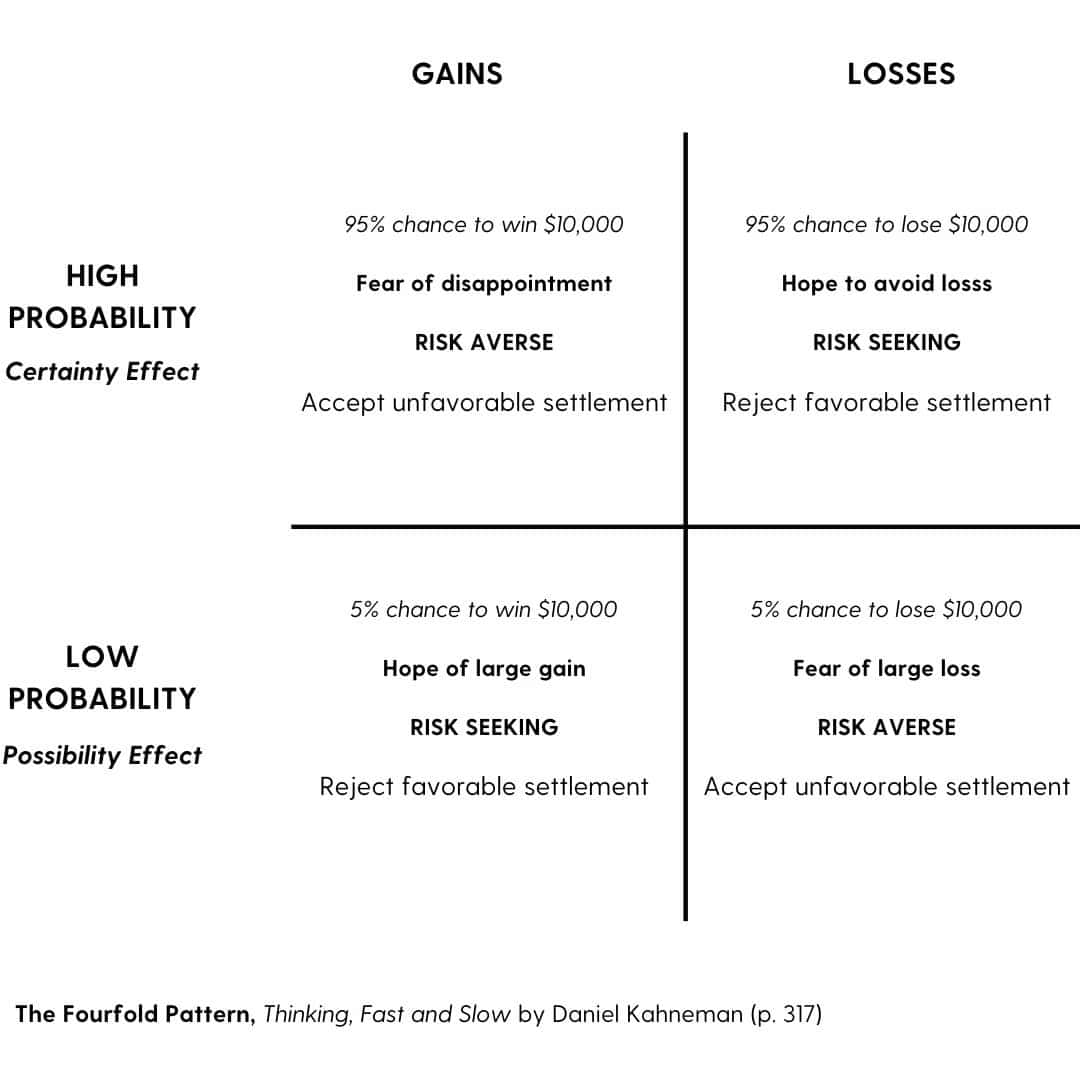
- When Tversky and Kahneman developed prospect theory, they described the fourfold pattern represented in the table above. The top right cell was a new discovery.
- The top left was what Bernoulli described in his work.
- The possibility effect (bottom left cell) explains why are drawn to lotteries.
- The bottom right cell explains insurance.
- The top right cell explains risk-seeking with negative prospects.
- Prospect theory explains two reasons for the effect described in the top right cell: diminishing sensitivity and the certainty effect.
- The decision weight that corresponds to the probability of 90% is about 71. Diminishing sensitivity makes the loss more aversive, and the certainty effect reduces the aversiveness of the gamble.
- This cell also explains why manageable failures can become disasters. The hope of relief is too enticing to make the sensible decision that it is time to give up.
- E.g., businesses that are losing ground to new technology often keep using their resources to try to catch up.


Chapter 30: Rare Events
- According to prospect theory, highly unlikely events are ignored or overweighted.
- While the theory does not provide an explanation, Kahneman argues that emotions and vividness in decision-making play a key role.
- These two factors influence fluency, availability, and judgments of probability, responses of System 1.
- We tend to overestimate the probability of unlikely events and overweigh them in our decisions. This is explained by focused attention, confirmation bias, and cognitive ease.
- Sometimes, we do not focus on the event that we are asked to estimate. We focus on whatever is odd, different, or unusual.
- The probability of a rare event is more likely to be overestimated if the alternative is not specified.
- Both utility and prospect theory assume that decision weights remain the same in distinct contexts. This is wrong. More recent research found that gamble valuation is less sensitive to probability when outcomes are emotional (e.g., roses vs cash).
- Research has questioned the role of emotion intensity in sensitivity to probability. E.g., research found that when given the probability of a chance to win roses valued at $59, people who thought of it as a chance to get roses did not use the price as an anchor to evaluate the gamble.
- Kahneman concludes that vivid representations of outcomes, emotional or not, reduce the role of probability in evaluating an uncertain prospect.
- Research has pointed to the possibility that fluency, vividness, and ease of imagining contribute to decision weights.
- This can be explained by the probability or denominator neglect (see Ch.13).
- We react differently to the following two statements:
- “A vaccine that protects children from fatal disease carries a 0.001% risk of permanent disability.”
- “One of 100,000 vaccinated children will be permanently disabled.”
- In a between-subjects study (people only saw one of two messages), participants found the statement, “A disease that kills 1,286 people out of every 10,000,” as more dangerous than “A disease that kills 24.4 out of 100.” They mean the same.
- Experts such as psychiatrists are prone to these effects, too.
- Focal attention and salience contribute to the overestimation of unlikely events and the overweighting of their unlikely outcomes.
- Choice from experience refers to making decisions relying on past experiences rather than statistical probabilities. It tends to yield a possibility effect.
- Underweighting occurs when people have experienced a rare event.
- We tend to overestimate the probability of a rare event because of confirmatory bias and overweight it if it attracts attention (outcomes are described explicitly).
- In summary, when there is no overweighting, there will be neglect.
Chapter 31: Risk Policies
- Simple choices about gains and losses can be deconstructed into a combination of choices that can lead to inconsistent preferences.
- Narrow framing is when we assess simple decisions separately.
- Broad framing is assessing a comprehensive decision with several options.
- Because of WYSIATI and System 2’s tendency to be lazy, we make decisions as problems arise, not compounding them.
- It can be costly to be risk-averse for gains and risk-seeking for losses (this makes us willing to pay to avoid a definite loss or obtain a sure gain).
- When offered a bet where people have a 50% chance of winning $200 and a 50% chance of losing $100, many reject it, perceiving the potential loss as outweighing the potential gain.
- When offered the opportunity to take this same bet 100 times, people are more likely to accept.
- Over many iterations, the law of large numbers suggests that the overall outcome is likely to be positive due to the positive expected value.
- People tend to weigh potential losses more heavily than equivalent gains, which can explain their reluctance to accept a single bet. But, when considering multiple bets, they recognize the benefits of aggregation, where the probability of a positive outcome increases with the number of bets.
- Kahneman advises those who are prone to narrow framing to have a risk policy that they apply whenever a problem arises. E.g., “I should never buy extended warranties.”
- A risk policy that aggregates decisions is analogous to the outside view of planning problems. It is a broad frame that embeds a particular risky choice in a set of similar choices.
- The outside view and the risk policies remedy the exaggerated optimism of the planning fallacy and the exaggerated caution induced by loss aversion.
Chapter 32: Keeping Score
- For most of us, the main motivator of money-seeking is not economics but self-regard and achievement. It serves as an incentive.
- We have mental accounts – a form of narrow framing that helps us keep score.
- E.g., if you purchase a ticket to a game, missing it leaves you with a negative balance in your mental account, which wouldn’t happen if the ticket was free.
- System 1 performs these tacit calculations of emotional balance without deliberation. Standard economic theory does not acknowledge these emotions.
- A similar bias can be observed when selling stocks. This is the disposition effect, which posits that investors are more likely to sell assets that have increased in value and hold on to those that have decreased, often driven by emotional biases.
- This is a form of narrow framing: the investor wants to close every account as a gain. An Econ would view his portfolio more broadly and sell the stock that is least likely to do well, regardless of whether it is a sinning or a losing account.
- Experienced investors use System 2 and are less susceptible to this effect.
- A sunk-cost fallacy is a decision to invest more resources in a losing account when better options are available. This happens outside the investment industry, too: driving to a game during a storm and risking your life because you already paid for the ticket.
- Regret plays a key role in people’s decision-making, as it is triggered by the availability of alternative realities. This emotion can also be anticipated.
- We experience stronger emotional reactions to outcomes produced by action than inaction, even when the outcomes are the same.
- The risk of regret biases us to favor conventional and risk-averse choices.
- A taboo tradeoff refers to the sensation that making a decision that involves exchanging sacred values, such as human life, with secular values like money is unacceptable. Yet Kahneman argues it is not an efficient way to use safety budgets, as we tend to overestimate risk. Often, we’re driven by anticipated regret rather than rationality.
- In law, we see this as precautionary principles – a trend that’s strong in Europe. This principle and this effect can be costly because they can become paralyzing.
- Experts argue that these precautionary principles would have kept past innovations, such as airplanes and air conditioning, from ever being invented.
- This is a form of enhanced loss aversion.
Chapter 33: Reversals
- Poignancy is a counterfactual emotion that is evoked by the thought “if only…”
- In an experiment, participants were asked to set compensations for victims of violent crimes. There were three groups.
- One group was asked if the compensation would change between the following two scenarios. In the first, a man was shot at his regular store. In the second, his regular store was closed, so he had to shop elsewhere and got shot.
- The two other groups were only told about one of these two scenarios.
- The group who saw both scenarios reported that the compensation should not differ. However, comparisons of the other two groups revealed that the compensation was greater in the second scenario group.
- Poignancy played a key role as a reaction of System 1. When we’re asked to compare, we activate System 2.
- In real life, we can’t contrast alternatives, and we’re influenced by WYSIATI. Our moral intuition is often not internally consistent.
- Preference reversal refers to choices between two options changing when the method of evaluation changes, such as preferring one option when asked to choose directly but assigning a higher monetary value to the other when asked to price them both.
- The table below compares dictionaries. In a single evaluation, dictionary A appears more valuable. In a joint evaluation, the preference changes as we can now evaluate the number of entries and value them appropriately despite dictionary B’s torn cover.
- The evaluability hypothesis posits that the ease with which an attribute’s value can be assessed affects its weight in decision-making. People rely more on attributes that are easier to evaluate when making judgments and choices.
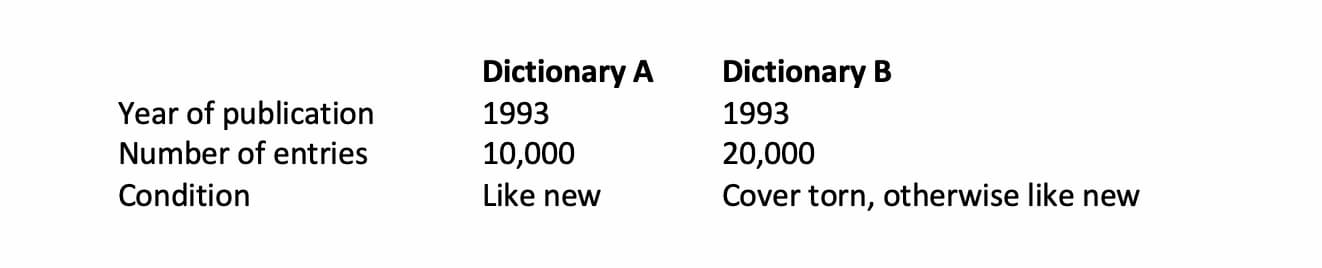

- Except for cases of deliberate manipulation (sales promotions), comparative judgment triggers the use of System 2. These evaluations should be more stable than single evaluations, as these often reflect the emotional response of System 1.
Chapter 34: Frames and Reality
- In 2006, the World Cup final was between Italy and France. Do the statements ‘Italy won’ and ‘France lost’ have the same meaning? “The answer depends entirely on what you mean by meaning” (p. 363).
- The meanings of each of these statements differ depending on how System 1 reacts to them. To System 2, they are the same.
- In an experiment, Tversky and Kahneman discovered that, when offered two options that would both end in either a gain of $95 or a loss of $5, people were more attracted to the version that was framed as a cost of a lottery ticket compared to a losing gamble.
- Losses evoke stronger feelings than costs. System 1 is not reality-bound.
- People will let go of a discount more readily than pay a surcharge.
- In an experiment on framing effects, researchers recorded brain activity and found that:
- The amygdala (associated with emotional arousal) was most likely to be active when participants fell for a frame.
- The anterior cingulate (associated with conflict and self-control) was more active when subjects didn’t fall for the frame and resisted System 1’s inclinations.
- The most rational subjects, those who were the least susceptible to framing effects, showed enhanced activity in the frontal area of the brain (associated with emotion and reasoning).
- Reframing requires effort, and System 2 is lazy. We rarely notice the extent to which our decisions are frame-bound or reality-bound.
- Risk-averse and risk-seeking preferences are not reality-bound, as decisions change with different formulations of the same outcomes.
- Experts, as much as non-experts, are prone to making important decisions influenced by System 1 thinking, which is particularly vulnerable to framing effects.
- In a study, participants were exposed to one of two scenarios. In the first, a woman bought two $80 tickets, arrived at the theater, and found that they were missing. In the second, she intends to buy the tickets at the theater. When she gets there, she discovers that her $160 cash is missing, but she can use a credit card.
- Subjects in both groups were asked if the woman would buy the tickets [again].
- This is another example of a sunk-cost fallacy. The frames evoke different mental accounts, and the significance of the loss depends on the account.
- In the first scenario, the cost of the tickets appears to double, making it less likely for subjects to think that she’ll want to purchase them again. In the second, we think about a general revenue account and are more likely to assume that she will buy the tickets.
- Most instances in which we fall victim to framing effects are due to features of System 1, but sometimes, it is because of System 2’s laziness.
- E.g., most people don’t give much thought to deciding whether they should be organ donors. High-donation countries have an opt-out option in their driver’s license forms, while low-donation countries have an opt-in option.
- When unprepared for the question, people are less likely to tick a box.
- Human rationality has a large effect on the real world.
PART V – TWO SELVES
Chapter 35: Cognitive Ease
- According to Jeremy Bentham, utility is a measure of the happiness or pleasure derived from an action, as opposed to the pain or suffering it may cause. Kahneman calls it experienced utility.
- Economists use the same term to define desirability. Kahneman refers to it as decision utility.
- In economic theory, Econs are rational. They’ll want what they’ll enjoy and enjoy what they’ll choose. But psychology shows discrepancies between experienced and decision
- In a study, patients undergoing a colonoscopy without anesthesia were asked to indicate their level of pain on a scale from zero to ten every 60 seconds. When the procedure was over, they were asked to rate the total amount of pain they experienced.
- The expectation would be that those patients who underwent longer procedures would report a higher total pain. But it was how high the worst moment of the experience was and how it ended that marked their self-reported total pain (peak-end rule).
- Retrospective assessments don’t take into account time (duration neglect). Rather, we focus on the peak and end
- There is a conflict of interest between the two selves: the experiencing self (which assesses whether something hurts in the moment) and the remembering self (which determines how the experience was as a whole).
- Confusing these experiences is a cognitive illusion that can make us think that a past experience was ruined by a negative event that occurred at the very end.
- When given an option, we intuitively pick the one that we like the most or dislike the least. But memory determines what we dislike. This is similar to the less-is-more effect.
- The operating features of System 1 are at play in both instances.
- Decision utility doesn’t always correspond to experience utility, leading to wrong decisions. This is due to diminishing sensitivity, duration neglect, and the peak-end rule.
Chapter 36: Life as a Story
- Duration neglect is present in the memories of any event, experience, or narrative. Our remembering self composes stories and keeps them as future references.
- Often, caring for people can take the form of concern based on the quality of the story and not their feelings.
- E.g., we can feel pity for a husband who died believing his wife loved him when we know she had a lover. But in his ignorance, he had a happy life.
- Research suggests that duration neglect and the peak-end rule govern the evaluations of entire lives.
- The pains of labor and vacation time seem to be objections to duration neglect. Yet, in these two cases, we’re intuitively assessing the progressive deterioration or improvement of the ongoing experiences, as well as how the person feels at the end.
- Research shows that the remembering self chooses vacation spots.
- Picture-taking among most tourists on vacation suggests that they are valuing more future memory than savoring the moment. Other times, we evaluate vacations by the stories we can tell.
Chapter 37: Experienced Well-Being
- Arguing that most measures of well-being and happiness focused on the remembering self, Kahneman and colleagues developed the Day Reconstruction Method (DRM) to measure the experienced self’s well-being.
- Participants would describe the previous day in detail, breaking it up into episodes. Then, they would answer questions about each episode, determining which activities they found engaging and reporting the intensity of their feelings.
- In the questionnaire, the researchers also included questions about life satisfaction to measure the remembering self.
- In this study, they interviewed French, Danish, and American women. Their findings suggest that societal and cultural differences impact people’s well-being.
- The use of time was found to impact well-being experiences. E.g., American and French women spent about the same time eating, but Americans combined it with other activities, diluting their pleasure.
- More recently, the Gallup World Poll extended these measurements and gathered millions of responses in the United States and 150 other countries.
- Their data allow for a comparison of two aspects of well-being: people’s experiences as they live them and their judgments when they evaluate their lives.
- Findings suggest that some aspects of life have a greater effect on our evaluations than our experienced well-being.
- For instance, educational attainment is associated with higher evaluations of our own lives, but it is not associated with experienced well-being. In the US, the more educated reported higher levels of stress.
- Data suggests that money enhances life satisfaction but does not improve experienced well-being.
- Satisfaction levels of the experienced well-being cease to increase after a household income of about $75,000 in high-cost areas.
- Overall, people’s evaluations of their lives and their actual experiences may be related, but they’re not interchangeable.
Chapter 38: Thinking About Life
- Affective forecasting refers to when individuals predict their future emotional states, anticipating how they will feel in response to specific events or experiences.
- The graph below shows individuals’ level of satisfaction around the years they got married.
- A possible explanation for this graph is that humans are prone to making an affective forecasting error in marriage. But another explanation is also possible: heuristics of judgment.
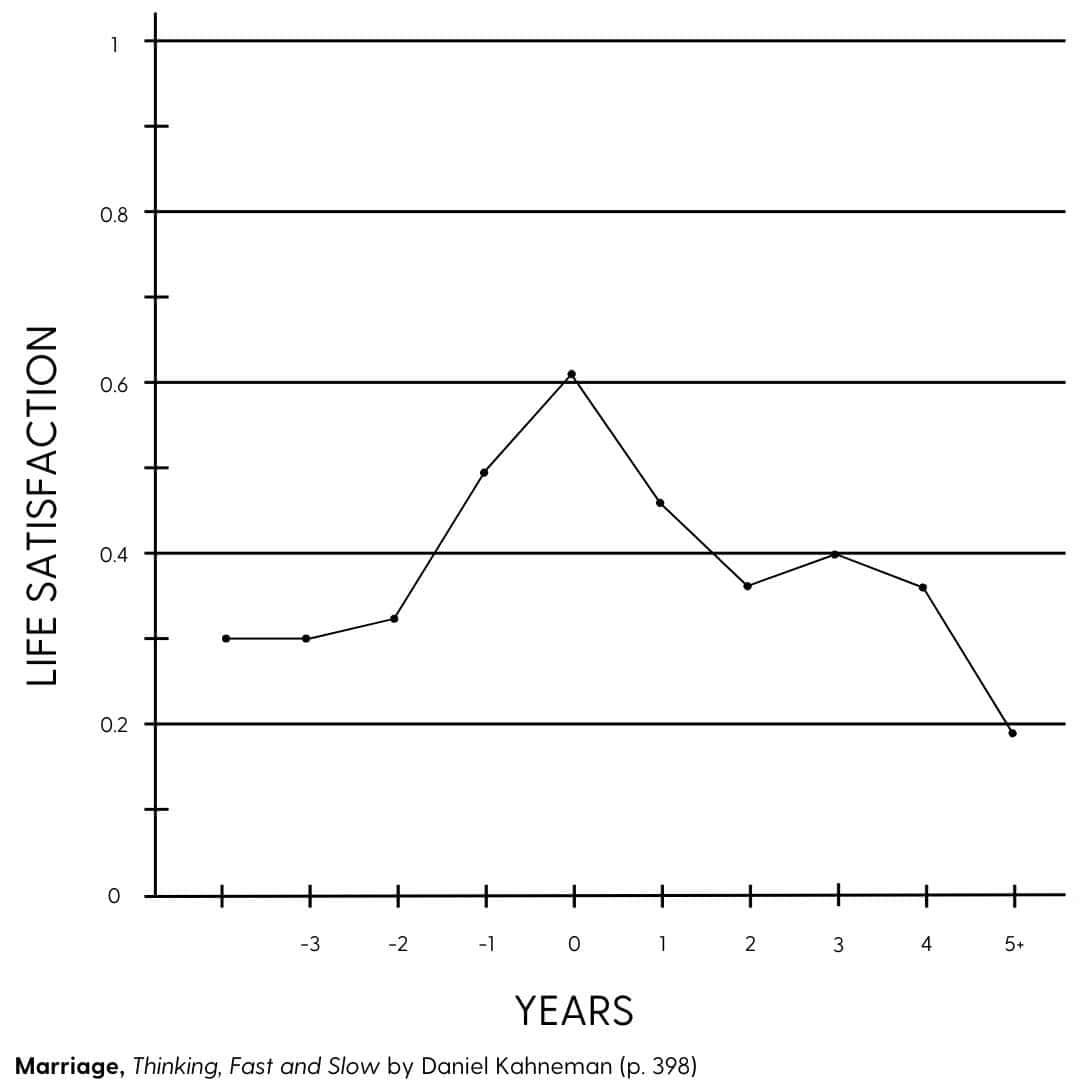
- A possible explanation for this graph is that humans are prone to making an affective forecasting error in marriage. But another explanation is also possible: heuristics of judgment.

- In an experiment, participants were asked to photocopy a sheet of paper before going to the lab to answer a questionnaire about life satisfaction. Half of the participants found a dime in the copying machine (placed by the experimenter). Those who found the coin reported more satisfaction with their life as a whole.
- Mood heuristics impact the way we answer life satisfaction questions.
- When asked these questions, people who are about to get married or recently married are likely to retrieve that fact about their lives and be happy with the idea. The salience and novelty of marriage impact their answer.
- In the DRM studies, experienced well-being was, on average, unaffected by marriage.
- Research also shows low correlations between people’s circumstances and their satisfaction with life. Both experienced happiness and life satisfaction are largely determined by genetics of temperament.
- Like height, a predisposition for well-being is hereditary.
- As per WYSIATI, people do not engage in careful examination when they evaluate their lives and instead resort to heuristics. System 1 substitutes certain areas of attention to measure life satisfaction as a whole.
- This is called the focusing illusion, which can be described as “nothing in life is as important as you think it is when you’re thinking about it” (p. 402).
- E.g., many people think that living in warmer weather leads to greater well-being. However, research suggests that climate makes no difference.
- Someone who recently moved from Ohio to California because they disliked cold weather will pay attention to the climate aspect, which might distort the weight of his experience, at least for the first few years.
- Miswanting refers to the bad choices we make due to errors in affective forecasting, often because of the focusing illusion. It makes us prone to exaggerate the effect of changing circumstances on our future well-being.
- The focusing illusion creates a bias in favor of goods and experiences that are initially exciting, even if they eventually lose their appeal.
- We neglect time when making these assessments.
Conclusions
- Kahneman talked about two fictitious characters (Systems 1 and 2 ), two species (Econs and Humans), and two selves (remembering and experienced self).
- The remembering self is a construction of System 2. Duration neglect and the peak-end rule originate in System 1 and do not always correspond with the values of System 2.
- These two effects cause a bias that favors short periods of intense joy over long periods of moderate happiness and fears short periods of intense but tolerable suffering more than longer periods of moderate pain.
- Our susceptibility to seeing life in hindsight also influences our decision-making as we assess an experience based on how it ended.
- A theory of well-being cannot ignore what people want or people’s view of their own lives. Both the remembering and the experiencing selves must be considered, given their interests don’t always coincide.
- In economic and decision theories, a rational agent is seen as an internally consistent individual. Regardless of their circumstances, their preferences are always consistent. However, evidence suggests that humans are not rational.
- An Econ wouldn’t be vulnerable to priming, framing, or any of the other biases and effects covered in this book.
- Humans are not irrational, but they do need help making accurate judgments and decisions, especially when it comes to setting policies and institutions.
- The two systems do not exist in any specific location of the brain; they symbolize our automatic and effortful responses. System 2 makes judgments and choices, but it often endorses or rationalizes ideas and feelings generated by System 1.
- System 2 can prevent foolish or inappropriate impulses.
- System 2 is not a paragon of rationality. Its abilities are limited to the knowledge we can access. We all make errors due to intrusive or incorrect intuitions.
- While system 1 can be the origin of many of the things we do wrong, it is also the origin of most of what we do right.
- We need considerable effort to reduce biases and improve judgment and decision-making. System 1 is not easily educated.
- To make better choices, recognize signs, slow down, and consciously involve System 2.
