


You didn’t get here by accident—but you might still feel like you’re wandering.
At some point in every career, there comes a moment of pause. You look up from the to-do list, the promotions, or the pivot you never quite planned, and wonder: Am I actually heading where I want to go? That moment is the beginning of choosing your path. It’s the shift from reacting to what’s in front of you to intentionally shaping what comes next.

What Does Choosing Your Path Mean?
Choosing your path means taking intentional ownership of your professional journey rather than passively going wherever circumstances lead you. It’s about defining what success means to you and aligning your choices, skills, and experiences accordingly.
A few dimensions of what choosing your path can involve include:
- Clarifying Your Values and Goals: What matters most to you? (e.g., impact, creativity, stability, recognition, etc.) What kind of work do you find fulfilling or energizing?
- Understanding Your Options: Are you seeking leadership, expertise, entrepreneurship, or a portfolio career? Do you want to stay in one industry or explore different sectors? Are you more drawn to startups, large corporations, or mission-driven organizations?
- Making Strategic Decisions: What skills or roles will move you closer to your goals? Which opportunities (or risks) are worth taking now, even if they’re unconventional?
- Being Proactive, Not Reactive: Instead of waiting for promotions or offers, you seek out mentors, projects, or learning opportunities that support your vision. You reflect and pivot when necessary instead of sticking to a path that no longer fits.
- Navigating Trade-offs: Choosing your path also means accepting that you can’t do everything at once. It’s okay to prioritize growth in one area now and shift focus later.
So, choosing your path is less about figuring everything out early on and more about committing to a direction with curiosity, self-awareness, and adaptability. It’s about walking purposefully, even if the road ahead isn’t perfectly mapped.

Image used under license from Shutterstock.com
Thought Leaders
Several influential thought leaders speak to the idea of choosing your career path and taking ownership of your professional journey. Some of the most notable ones include:
- Herminia Ibarra: A professor of organizational behavior at London Business School and formerly at INSEAD, her work focuses on identity, leadership transitions, and career reinvention. In her book Working Identity: Unconventional Strategies for Reinventing Your Career, she argues that we don’t change by thinking—we change by doing, experimenting with new roles and selves before settling on a new direction.
- Cal Newport:A computer science professor at Georgetown University and a bestselling author, he’s known for his books So Good They Can’t Ignore You. In it, Newport challenges the idea of following your passion and advocates for building rare and valuable skills, which then lead to meaningful career choices and control over your path.
- Adam Grant:An organizational psychologist at Wharton and author of several bestselling books, including Think Again, Originals, and Give and Take, he explores how people find purpose, rethink assumptions, and shape unconventional careers. In Think Again, he emphasizes the importance of flexibility and curiosity—traits essential for navigating a career path that evolves over time.
- Dorie Clark:A consultant, keynote speaker, and professor at Duke University’s Fuqua School of Business and Columbia Business School, her books Reinventing You, Entrepreneurial You, and The Long Game provide actionable guidance for professionals who want to take control of their career development. She also provides insights on how to build a personal brand and play the long game of growth and success.
- Jenny Blake:A career strategist and former Google employee who authored Pivot: The Only Move That Matters Is Your Next One, her work focuses on helping professionals navigate change and make career moves without needing all the answers upfront. She emphasizes the value of small experiments and iterative steps.
- Marshall Goldsmith:A renowned executive coach and leadership thinker, his book What Got You Here Won’t Get You There is relevant for professionals at an inflection point—ready to grow, but needing to shift their behaviors and mindset to reach the next level. His coaching work centers around clarity, intentionality, and legacy.
- Tony Martignetti: A leadership coach, author, and host of The Virtual Campfire podcast, he helps professionals find clarity, connection, and purpose in their work. His book Climbing the Right Mountain: Navigating the Journey to an Inspired Life encourages people to pause and ask whether the success they’re pursuing is truly aligned with who they are. His work resonates with anyone who’s followed a conventional path only to realize they’re climbing someone else’s version of success. He focuses on aligning inner purpose with external action and helps clients uncover what truly fulfills them.
- Bill Burnett and Dave Evans: Co-authors of Designing Your Life: How to Build a Well-Lived, Joyful Life, they bring design thinking into the world of career development. Burnett is the executive director of the Design Program at Stanford, and Evans is a lecturer and former tech executive. Their book and workshops encourage people to prototype different versions of their future, test ideas through real-world experiences, and iterate as they learn. Instead of trying to find a single “correct” career path, they teach people to design a life with multiple possibilities.
Key Frameworks
Several models and frameworks advocate owning your career, navigating growth, and intentionally designing your path. These approaches draw on academic theory and practical career development tools and echo the themes of self-direction, adaptability, and long-term thinking. Some of the most notable include:
- The Protean Career Model: Introduced by Douglas T. Hall, this model describes a career path that is driven by the individual rather than the organization. In a protean career, success is defined internally—by personal values and fulfillment—rather than by traditional markers like promotions or job titles. It emphasizes adaptability, continuous learning, and a sense of purpose as central to career development.
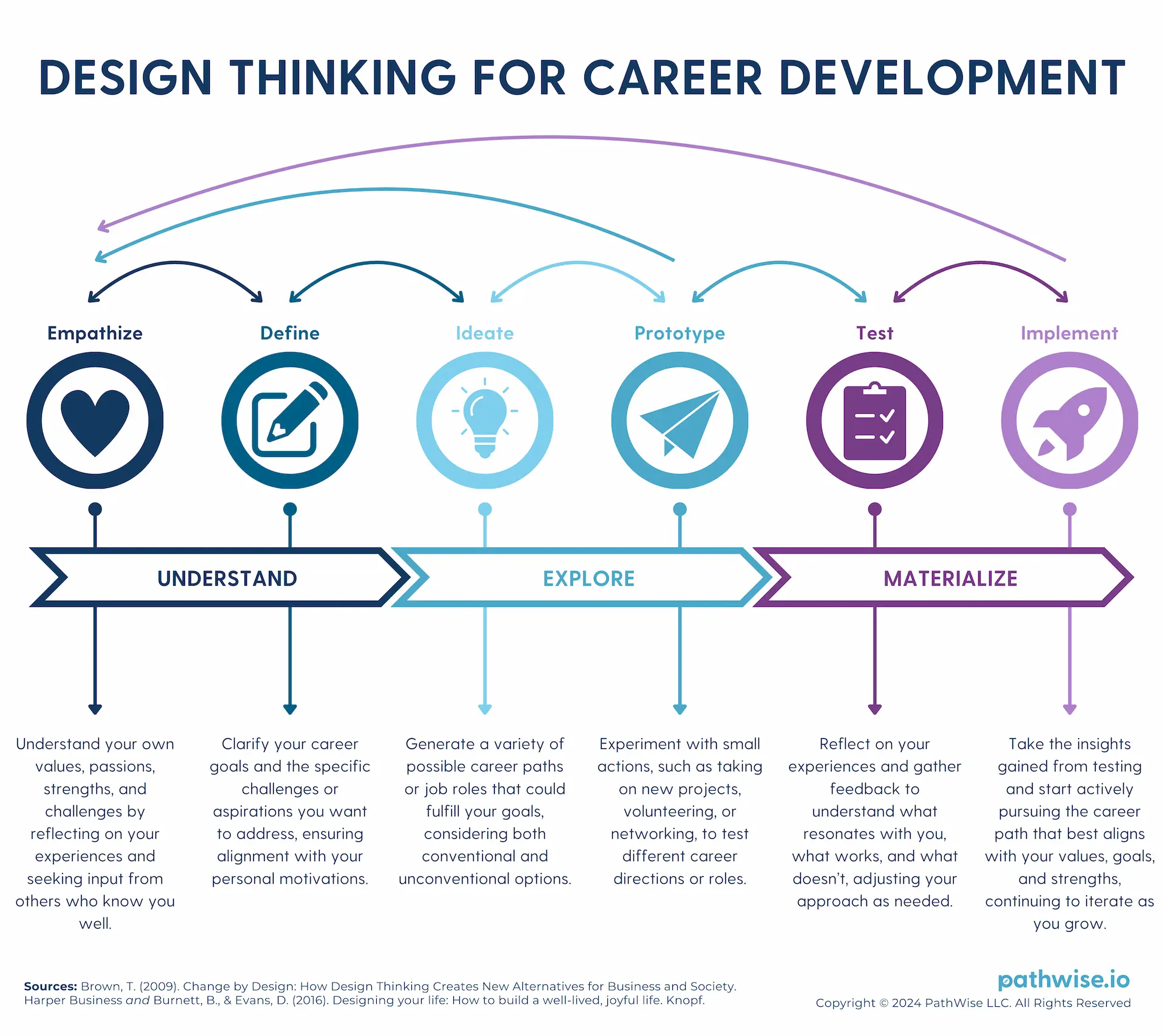
- Design Thinking for Career Development: Popularized by Bill Burnett and Dave Evans, this model applies principles from product and experience design to careers. Rather than setting a fixed destination, individuals are encouraged to explore multiple possible futures through prototyping, experimentation, and reflection. This approach embraces ambiguity, sees failure as data, and helps people move forward when they feel stuck.
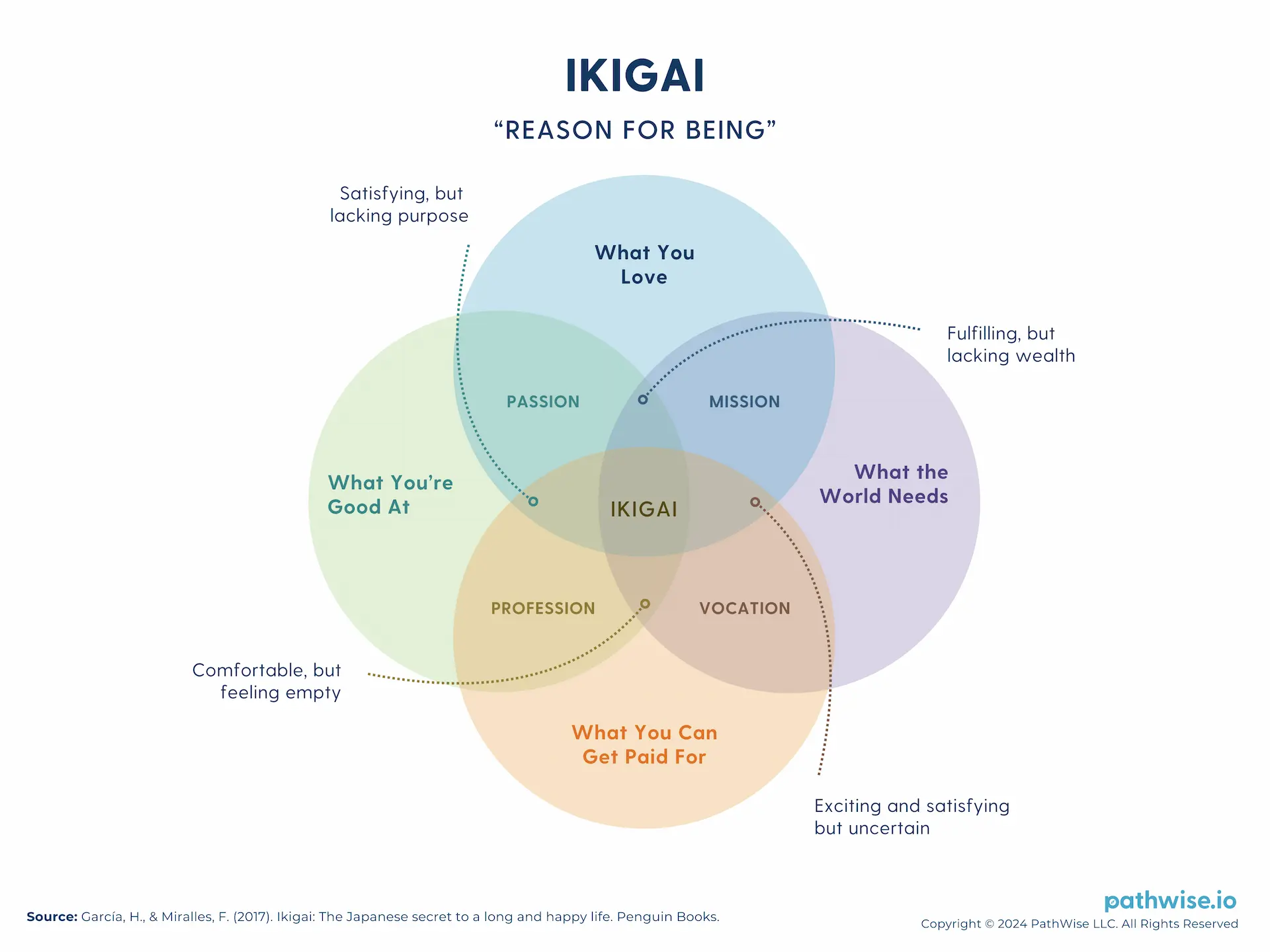
- Ikigai: A Japanese concept that roughly translates to “a reason for being.” It is visualized as the intersection of what you love, what you’re good at, what the world needs, and what you can be paid for. While not originally designed as a Western career framework, it has become a popular tool for aligning purpose with profession. It invites people to
reflect on motivations and create a career that is both meaningful and sustainable.
- The Boundaryless Career Framework: Developed by Michael B. Arthur and colleagues, this framework challenges the traditional idea of a linear, hierarchical career within a single organization. Instead, it reflects modern realities, where careers cross organizational, functional, and national boundaries. It encourages a focus on transferable skills, social capital, and identity rather than loyalty to one employer.
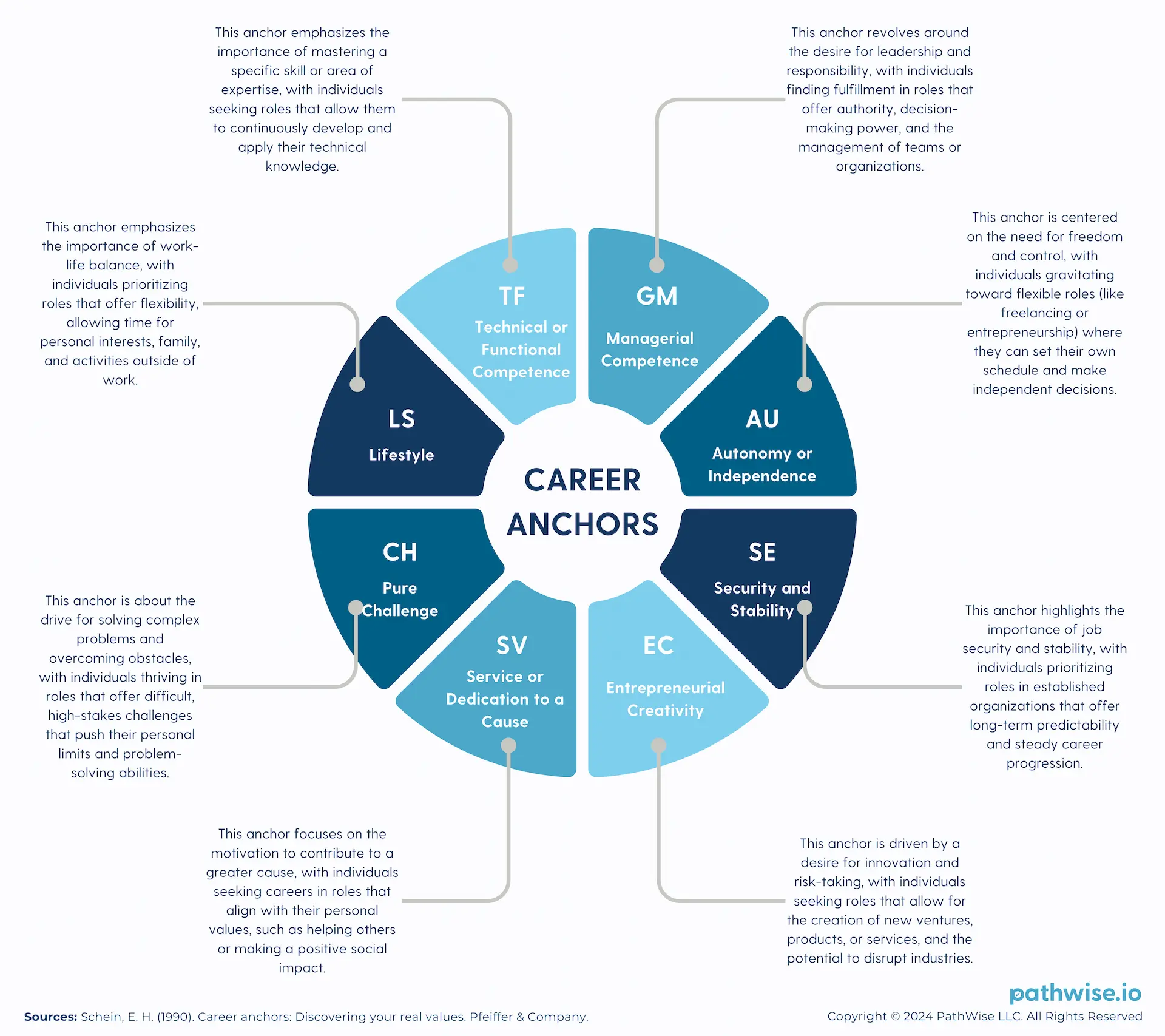
- Career Anchors: Developed by Edgar Schein, this self-assessment framework identifies the dominant values and needs that guide a person’s career decisions. The eight anchors—such as autonomy, security, technical competence, or lifestyle—help people recognize what they’re truly unwilling to sacrifice in their work. Understanding your anchor can clarify why specific roles fit (or don’t) and guide better career choices.
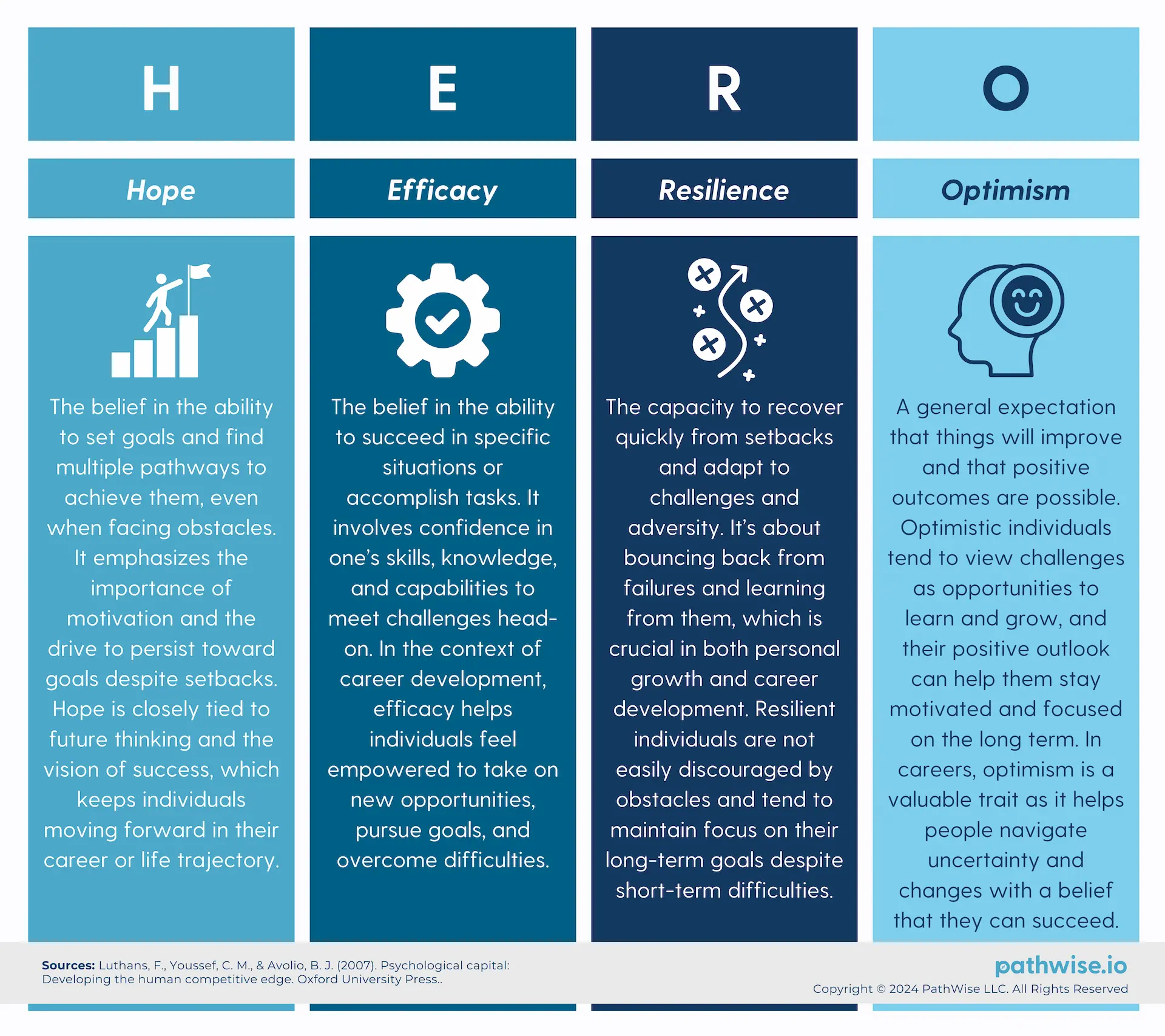
- The HERO Model (Hope, Efficacy, Resilience, and Optimism): This model comes from positive organizational psychology and is often applied to career sustainability and growth. It emphasizes the psychological capital needed to thrive in a complex, evolving workplace. People who develop these traits are more likely to own their development, bounce back from setbacks, and see opportunities in uncertainty.
- Person-Environment Fit Theory: This foundational concept in vocational psychology explores the alignment between an individual and their work environment. The core idea is that people experience higher job satisfaction, performance, and well-being when there is a strong fit between their personal characteristics—such as values, interests, personality, and abilities—and the demands or culture of the workplace. The theory has evolved into different sub-models, like a person-job fit, person-organization fit, and person–supervisor fit. It highlights that career success isn’t just about skill-building or ambition but about finding environments where you naturally thrive.
Choosing Your Path and Leadership
The relationship between choosing your path and being a better leader is both direct and reinforcing: when professionals make intentional choices about their career path, they cultivate the clarity, confidence, and self-awareness that strong leadership demands. More specifically, the factors of choosing your path that impact leadership include:
- Self-awareness as a foundation: Choosing your path requires deep self-reflection—understanding your values, strengths, motivations, and long-term vision. This same self-awareness is at the core of effective leadership. Leaders who know who they are and what they stand for are better equipped to lead with authenticity, make aligned decisions, and earn the trust of others.
- Vision and direction: Choosing your path means setting a clear direction for your development. Leaders who have defined their personal and professional goals are more capable of creating and communicating a compelling vision for their teams. They model purpose-driven action, which can inspire and align others.
- Resilience and ownership: Intentional career navigation fosters resilience and a growth mindset—qualities essential in leadership. When you take ownership of your career, you become more adaptable in the face of change and setbacks. Leaders with this mindset are more effective at guiding teams through uncertainty and modeling perseverance.
- Empathy and guidance for others: By actively choosing and navigating your own path, you build insight into the challenges others face in doing the same. This increases empathy, making you a better mentor, coach, and people leader. It also positions you to support others in their development, a key part of leadership.
- Credibility and inspiration: Leaders who have chosen their path—and who continue to walk it with integrity—often serve as role models. Their story inspires others to take ownership of their own journeys, creating a ripple effect of motivation and self-leadership within an organization.

Image used under license from Shutterstock.com
Choosing Your Path and Personal Development
Choosing your path is a proactive stance. It means taking responsibility for your growth, making intentional decisions, and aligning your work with your values, strengths, and long-term aspirations. This fosters clarity and purpose, helping you set meaningful goals and identify opportunities that support your development. Rather than drifting from role to role, or reacting to external pressures, you become the architect of your journey. This mindset encourages reflection, learning, and strategic risk-taking, all of which contribute to building the skills, experience, and resilience needed to advance professionally.
In contrast, waiting for opportunities, promotions, or clarity to arrive on their own can lead to stagnation or misalignment. While you may gain experience, it’s often fragmented or driven by others’ agendas rather than your own. Without an intentional path, it’s easy to fall into roles that don’t challenge you, match your potential, or contribute to long-term fulfillment. Choosing your path is about being engaged in your process of discovery and growth. Over time, this leads to a more integrated, confident, and capable version of yourself—someone who not only grows professionally but leads with purpose.

Image used under license from Shutterstock.com
Conclusion
Choosing your path doesn’t mean having everything figured out. It means being willing to ask better questions, make intentional decisions, and stay curious about who you’re becoming. Careers aren’t linear, and there’s no single “right” direction. But there is power in owning your next step. Proactively and purposely choosing your path is what transforms your job into a journey worth taking.
Other Resources
- PathWise Book Summary: Working Identity
- PathWise Book Summary: Designing Your Life
- HBR: The Key to Choosing the Right Career
- HBR: How to Make Better Decisions About Your Career
- Forbes: How To Choose A Career: Five Steps To Take When You’re Stuck
- Forbes: How To Choose A New Successful Career Path In 5 Easy Steps
- Forbes: One Question to Ask Yourself When Deciding Which Path to Take
- Forbes: Six Tips On How To Find Your Career Path
- TED Talk: The best career path isn’t always a straight line
