


What is Collaboration?
No matter what your field of work, collaboration is a part of your job. Work by its very nature involves individuals or groups joining together to achieve a common goal or complete a task. In this context, collaboration involves sharing ideas, expertise, resources, and responsibilities to accomplish objectives collectively. It is crucial in any career.
Note that collaboration isn’t just about teamwork; it’s about leveraging collective strengths to achieve greater outcomes. Specifically, collaboration leads to:
- Enhanced Problem-Solving: Collaborating brings diverse perspectives to the table, allowing for a broader understanding of issues and enabling more comprehensive problem-solving.
- Innovation and Creativity: Combining different viewpoints and skill sets often leads to innovative ideas and creative solutions that might not arise in isolation.
- Efficiency and Productivity: Collaboration allows tasks to be divided based on expertise and time availability, speeding up processes and ensuring efficient use of time and resources.
- Professional Development: Working with others provides opportunities for learning and skill development. It encourages continuous improvement through exposure to different approaches and knowledge areas.
- Networking and Relationship Building: Collaboration fosters strong relationships and networks. Building trust and rapport with collaborators can lead to future opportunities and professional growth.
- Adaptability and Flexibility: Collaborating often requires adaptability, flexibility, and the ability to work with diverse personalities and working styles, which are essential skills in today’s dynamic work environments.
Collaboration in Your Career Management
Collaborative teams help businesses thrive. However, mastering collaboration skills can also help you throughout your personal career journey. That is, while collaborating will lead to successful projects, creative ideas, problem resolution, and productivity, all of which benefit you and the organization you work for, learning to collaborate can have a positive impact on your career management.
Collaboration cultivates a diverse skill set essential for success in today’s interconnected world. Collaborating with others hones your communication, negotiation, and conflict-resolution skills. It teaches adaptability and flexibility, which are highly sought-after attributes in the workplace.
Collaboration also cultivates strong relationships and networking opportunities. Working well with others builds trust, communication skills, and a sense of camaraderie, which can open doors to new opportunities and collaborations in the future. It also helps in developing a supportive professional network that can provide guidance, advice, and support throughout your career.
In many industries, employers highly value teamwork and collaboration skills. Being able to demonstrate your ability to work effectively in a team can greatly enhance your employability and career advancement prospects. In fact, successful collaboration positions you as a team player and a leader. Employers highly value individuals who can work effectively in teams, leading to increased opportunities for advancement and leadership roles.
Collaboration in Leadership
Collaboration is integral to effective leadership on multiple fronts. Firstly, it plays a significant role in building collaborative teams. Leaders who prioritize and foster a collaborative environment empower team members to share ideas, work collectively, and leverage diverse skills. This approach helps in creating cohesive, high-performing teams that are adaptable and innovative. By encouraging open communication and mutual respect, leaders can build trust among team members, fostering an environment where everyone feels valued and motivated to contribute their best.
Moreover, collaboration enhances a manager’s leadership skills. When leaders actively engage in collaborative efforts, they model the behavior they wish to see in their teams. They demonstrate the value of listening to diverse viewpoints, making informed decisions, and leveraging collective intelligence. This not only strengthens the manager’s relationships with their team but also enhances their own learning and growth.
Collaboration also amplifies a leader’s problem-solving abilities. By drawing upon the strengths of the team, leaders can address complex challenges more effectively. They learn to navigate conflicts, align different perspectives, and guide the team towards shared goals. This approach nurtures a culture of continuous improvement and innovation, driving the team and the organization toward success.
In essence, for leaders, fostering collaboration within their teams not only creates a more engaged and efficient workforce but also enhances their own leadership skills by promoting openness, adaptability, and a collective approach to achieving objectives.
Thought Leaders
Several thought leaders have made significant contributions to our understanding of collaboration and its impact on teams and organizations. Their work often shapes the discourse and practices surrounding collaborative efforts in various professional settings.
- Simon Sinek: While known for his work on leadership and motivation, Sinek emphasizes the importance of collaboration in creating strong teams and organizations. His insights, such as in his book Leaders Eat Last, often delve into the dynamics of teamwork and the role it plays in achieving success.
- Amy Edmondson: Renowned for her expertise in organizational learning and leadership, Edmondson focuses on the concept of psychological safety in teams. Her work explores how creating a culture of psychological safety encourages collaboration and innovation.
- Adam Grant: A professor and author, Grant delves into the power of collaboration and the benefits of giving and receiving help. He explores how collaborative efforts can drive success, highlighting the significance of generosity and reciprocity in teamwork.
- Francesca Gino: Gino is known for her research on organizational behavior and decision-making. Her work delves into collaboration, exploring how it affects individual and organizational performance, creativity, and innovation.
- Keith Ferrazzi: As a thought leader in relationship building and networking, Ferrazzi emphasizes the importance of collaboration in achieving professional success. He focuses on building strong, authentic relationships as a cornerstone of effective collaboration.
- Heidi K. Gardner – A scholar and expert in the field of professional services and collaboration, Gardner is a Distinguished Fellow at Harvard Law School’s Center on the Legal Profession and a faculty member at Harvard Business School. Gardner’s work focuses on how professionals can collaborate more effectively to deliver better outcomes for their clients. She has written extensively on the subject of collaboration in professional settings, and her research often explores the intersection of law, business, and leadership.
Key Frameworks
Several frameworks exist to guide and enhance collaboration within teams and organizations. They offer structures and methodologies to guide teams in working together effectively, addressing challenges, leveraging strengths, and fostering an environment conducive to successful collaboration.
- Tuckman’s Stages of Group Development: This classic model outlines the stages teams typically go through. These are forming, storming, norming, performing, and adjourning. This framework helps teams understand the dynamics and challenges they might face while collaborating and provides insights on how to navigate these stages effectively.

Content Source: https://ns4business.com.br/tuckmans-stages-of-group-development/
- Belbin Team Roles: Belbin identified nine team roles that individuals naturally take on within a team, such as the Plant, the Coordinator, or the Completer Finisher. Understanding these roles helps in composing well-rounded teams and leveraging diverse strengths for effective collaboration.

Source: https://www.prepearl.net/belbin-team-roles/
- Six Thinking Hats by Edward de Bono: This framework is based on a book by the same name, and encourages parallel thinking by assigning different hats to team members, each representing a different perspective (e.g., creativity, critical thinking, emotions). It helps teams explore ideas thoroughly and make well-rounded decisions collaboratively.

Source: https://mutomorro.com/six-thinking-hats/
- Design Thinking: Often used in innovation and problem-solving, design thinking is a human-centered approach that encourages collaboration among multidisciplinary teams. It involves empathizing with users, defining problems, ideating solutions, prototyping, and testing—all done collaboratively to arrive at innovative solutions.

Source: https://www.nngroup.com/articles/design-thinking/
- Scrum Methodology: Commonly used in agile project management, Scrum emphasizes iterative and collaborative approaches to project delivery. It involves short, focused work periods called sprints, frequent collaboration among team members, and continuous improvement.
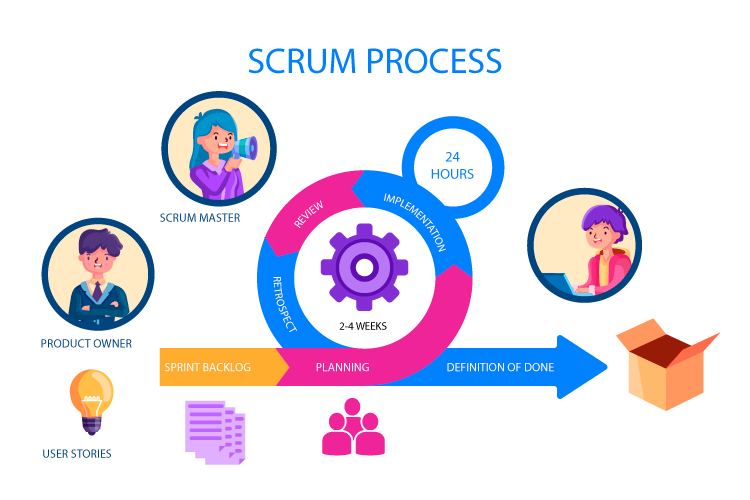
Source: https://www.nimblework.com/agile/scrum-methodology/
- Lencioni’s Five Dysfunctions of a Team: Though focused on team dysfunctions, this model highlights crucial elements for effective team collaboration—trust, conflict, commitment, accountability, and a focus on results. Addressing these aspects fosters a cohesive and high-performing team.

Source: https://www.bitesizelearning.co.uk/resources/five-dysfunctions-of-a-team-summary-pyramid
Other Resources
- TED Talk: A Guide to Collaborative Leadership by Lorna Davis
https://www.youtube.com/watch?v=9zC2Bc22QfA - Tips for Building a “Culture of Collaboration” Within Your Business
https://www.forbes.com/sites/katevitasek/2023/01/16/4-tips-for-building-a-culture-of-collaboration-within-your-business/?sh=33401d3a46bc - HBR: 8 Ways to Build Collaborative Teams
https://hbr.org/2007/11/eight-ways-to-build-collaborative-teams - HBR: Are you a Collaborative Leader?
https://hbr.org/2011/07/are-you-a-collaborative-leader - HBR: 6 Ways to Become a More Collaborative Leader
https://hbr.org/2023/07/6-ways-to-become-a-more-collaborative-leader - Indeed: 10 Reasons Why Collaboration Is Important in the Workplace
https://www.indeed.com/career-advice/career-development/why-is-collaboration-important - Slack: 5 tips for effective collaboration at work
https://slack.com/blog/collaboration/5-tips-for-effective-collaboration-at-work - PathWise’s “Career Sessions, Career Lessons” podcast episode 41, with Ivan Matviak, co-author of Smarter Collaboration: A New Approach to Breaking Down Barriers and Transforming Work
