


Have you ever wondered how top innovators and successful professionals consistently stay ahead in their careers? What if there was a proven method that could empower you to not only navigate career changes with confidence but also drive innovation within your current role? Let’s discuss experimentation.

Image used under license of Shutterstock.com
What is experimentation?
Experimentation is the process of conducting controlled tests or trials to explore hypotheses, validate ideas, or discover new insights. It’s systematically changing variables to observe their effects and gather data, allowing us to learn and make informed decisions based on empirical evidence.
In a work context, experimentation is – at least for most of us – not about working in a science lab but about trying new things and learning from the results. It’s a way to move beyond the status quo and find innovative solutions to problems. In your current role, it can help you by allowing you to test ideas and prototype concepts. This, in turn, allows you to become a better or more effective contributor regardless of your current position.
For instance, you could experiment with:
- Marketing strategies: Trying “A/B testing”, i.e., different ad copy or website layouts to see what resonates best with your audience in terms of impressions, clicks, likes, etc.
- Product features: Running small pilot programs, i.e., “beta testing”, with a limited group of users to gather feedback on new features before a full launch.
- Workflow efficiency: Experimenting with different task management tools or processes to see what boosts your productivity the most.
Experimentation is also a valuable strategy to adopt and practice if you’re seeking to advance or grow in your career, whether that’s aiming for a promotion, changing jobs, or switching careers altogether.
Let’s discuss these two forms of experimentation further, starting with refining products or ideas.
Experimenting to Refine Products and Ideas
Through experimentation, you can test products, company processes, or ideas to identify what works and what doesn’t, make data-driven decisions, and enhance your ultimate product or service. However, doing so requires that you foster a growth mindset and that your company embraces a culture of learning and adaptability so that efficiency, creativity, and value within the organization increase.
For example, depending on your field, you might face a situation where there are too many ideas floating around, and it can be hard to know which ones are worth pursuing. Experimentation would allow you to test different approaches in a controlled way, helping you identify the most effective options.
Other ways in which experimentation helps refine existing products or services include:
- Prototyping, Testing, and Proofs of Concept: Prototyping often uncovers unexpected insights about customer needs, preferences, or behaviors, leading to more informed decision-making.
- Risk Mitigation: Experimentation allows for testing in a controlled environment, minimizing the possibility of failure in a real-world scenario.
- Cost Optimization: Small-scale experiments are typically less costly than full-scale rollouts, allowing companies to identify and correct flaws early on. This is particularly important for small companies that won’t have the resources to pursue every idea they conceive. It’s at the heart of the idea of “The Lean Startup”, a popularized by Eric Ries’ book of that name.
- New Ideas and Innovation: Experimentation encourages creative thinking and exploration of new ideas, leading to innovative solutions.
- Breaking the Status Quo: Experimenting also challenges the status quo and pushes teams to explore alternative approaches that might be more effective.
- User Involvement: Engaging customers in the experimentation process ensures that their needs and preferences are directly addressed, leading to higher satisfaction. It can also help assess a product or service’s market fit, ensuring it meets the target audience’s expectations and demands.
- Process Optimization: Experimentation helps in pinpointing inefficiencies and bottlenecks in existing processes, enabling targeted improvements. For instance, experimenting with different approaches helps organizations find the most efficient ways to complete tasks, leading to increased productivity.
- Tool Evaluation: Experimentation helps in evaluating the effectiveness of new tools and technologies before full-scale implementation.
Amy Edmondson, an organizational theorist and professor at Harvard Business School, recently published a book titled Right Kind of Wrong. In it, she explains three forms of failure: basic, complex, and intelligent failures. The last one results from experimentation and innovation. You and your company should strive to commit this type of failure, as it will, in the worst case, provide a learning opportunity and, in the best case, find the best approach to your new endeavors. To learn more, you can access our summary of this book here.

Image used under license of Shutterstock.com
Experimentation in Career Development
Experimentation in career growth and development entails actively exploring new opportunities, skills and approaches to advance professional goals. This approach proves especially effective when pursuing change, whether you’re looking for a promotion, seeking to transition into a new role, or contemplating a career shift altogether. By engaging in experimentation—prototyping, testing, and experiential learning—you gain invaluable insights that surpass what traditional research alone or solely focusing on inward self-assessments can offer. This method allows you to gather firsthand knowledge without the risks associated with radical changes.
Experimentation is about learning, discovering our strengths, and uncovering our genuine passions. For instance, it allows you to explore and acquire new skills that can enhance your expertise and versatility. Experimenting with different roles or departments within an organization can also provide you with insights into various career paths and help you identify areas of interest and strength. Freelance work or side projects also allow you to test different industries or types of work to find what aligns best with your career aspirations.
Organizational behavior scholar and professor at London Business School, Herminia Ibarra, published a book titled Working Identity: Unconventional Strategies for Reinventing Your Career. In it, she argues that instead of over-planning, we should experiment with different roles and projects to gain insights into our interests and strengths. On the one hand, trying out various experiences can lead to small wins, which build confidence and provide valuable feedback. On the other hand, experimentation allows for provisional identities that help us see what aligns with our evolving sense of self and career aspirations. To learn more, click here and access our book summary.

Image used under license of Shutterstock.com
Leadership: Building a Culture of Experimentation
As a leader or manager, your team can benefit from embracing a culture of experimentation, as it will lead to innovation, progress, efficiency, resilience, and long-term success. This is consistent with the idea of being a “learning organization.”
To foster this culture among your team,
- Lead by Example: Demonstrate your willingness to experiment and take calculated risks. Share stories of your own successes and failures from experimentation.
- Encourage Open Communication: Create an environment where team members feel safe sharing ideas and proposing experiments without fear of criticism.
- Provide Resources and Support: Allocate time, budget, and resources for experimentation. Support teams with necessary tools and training.
- Organize Events: Hackathons and Innovation Days are great examples of ways that you can make experimentation fun and even introduce some healthy competition.
- Celebrate Learning and Progress: Emphasize that failures are opportunities for learning and growth. Celebrate both successful outcomes and valuable insights gained from experiments.
- Set Clear Goals and Expectations: Define clear objectives for experiments and align them with overall business goals. Ensure everyone understands the purpose and potential impact of their experiments.
- Iterate and Iterate Again: Encourage iterative experimentation—testing, learning, and refining ideas continuously. Foster a mindset of continuous improvement.
- Emphasize Collaboration: Encourage cross-functional teams to collaborate on experiments. Foster a culture where diverse perspectives contribute to creative problem-solving.
- Learn from Failures: Encourage teams to document and share insights from failed experiments. Use these as opportunities to adjust strategies and improve future experiments.

Image used under license of Shutterstock.com
Thought Leaders
Many experts and thought leaders have contributed to our understanding of how experimentation can drive personal and organizational growth. Some of these influential figures, each from their respective fields, include:
- Amy C. Edmondson: The Novartis Professor of Leadership and Management at the Harvard Business School, she is known for her research on psychological safety in teams and organizations. More recently, she has been working on the concept of intelligent failures in fostering innovation within organizations.
- Herminia Ibarra: A professor of organizational behavior and the Cora Chaired Professor of Leadership and Learning at INSEAD, she is known for her research on career transitions, professional identity, and leadership development. Her book, Working Identity, explores how individuals can navigate career changes through experimentation and exploration to discover and develop one’s career path.
- Bill Burnett and Dave Evans: They are co-authors of Designing Your Life: How to Build a Well-Lived, Joyful Life, based on their work at the Stanford Life Design Lab. Burnett is the Executive Director of the Design Program at Stanford University, and Evans is a lecturer and co-founder of the Life Design Lab. They apply design thinking principles to career and life planning, advocating for experimentation, prototyping, and iteration to create meaningful and fulfilling lives.
- Clayton M. Christensen: A professor at Harvard Business School and a leading authority on innovation and growth, he was best known for his theory of disruptive innovation, which explains how smaller companies can successfully challenge established incumbents by introducing simpler, more convenient solutions. Christensen’s work profoundly influenced how businesses approach innovation and manage disruptive change.
- Peter Sims: An entrepreneur, author, and leadership advisor, his book Little Bets: How Breakthrough Ideas Emerge from Small Discoveries explores how successful innovators, from entrepreneurs to artists, use experimentation and small, manageable risks (little bets) to discover and develop ideas. Sims advocates for a mindset that embraces uncertainty and encourages iterative approaches to creativity and innovation.
- Eric Ries: An entrepreneur and author of The Lean Startup, a methodology for developing businesses and products through rapid experimentation and iterative learning, Ries advocates for validating assumptions and hypotheses through small-scale experiments, customer feedback, and iterative product releases.
- Gary Hamel: A management expert, author, and professor at London Business School, he is known for challenging conventional management practices and advocating for strategic innovation and organizational change. Hamel’s work focuses on how organizations can foster a culture of experimentation, adaptability, and continuous improvement to stay competitive in rapidly changing markets.

Image used under license of Shutterstock.com
Key Frameworks
There are several frameworks and models that provide structured approaches for individuals and organizations to innovate, experiment, and navigate career development effectively. Here are a few notable ones:
- Design Thinking: A human-centered approach to innovation that emphasizes empathy for users, generating ideas, prototyping, and testing solutions iteratively. Design thinking is often used to address complex problems and create innovative solutions, but Burnett and Evans argue it can also help you design your life and make career-related choices that will bring you joy.
- Lean Startup Methodology: Developed by Eric Ries, this methodology advocates building and testing products iteratively, using customer feedback and data to validate assumptions, and pivoting quickly based on results. It aims to reduce market risk and optimize resource allocation in startups and large organizations.
- Disruptive Innovation Theory: Coined by Clayton Christensen, this theory explains how smaller, simpler, and more affordable innovations can disrupt established markets and industries, often by addressing the needs of overlooked or underserved customers.
- Little Bets: Introduced by Peter Sims, this approach emphasizes making small, manageable experiments (little bets) to explore and test ideas, iterate based on feedback, and gradually build towards breakthrough innovations or solutions.
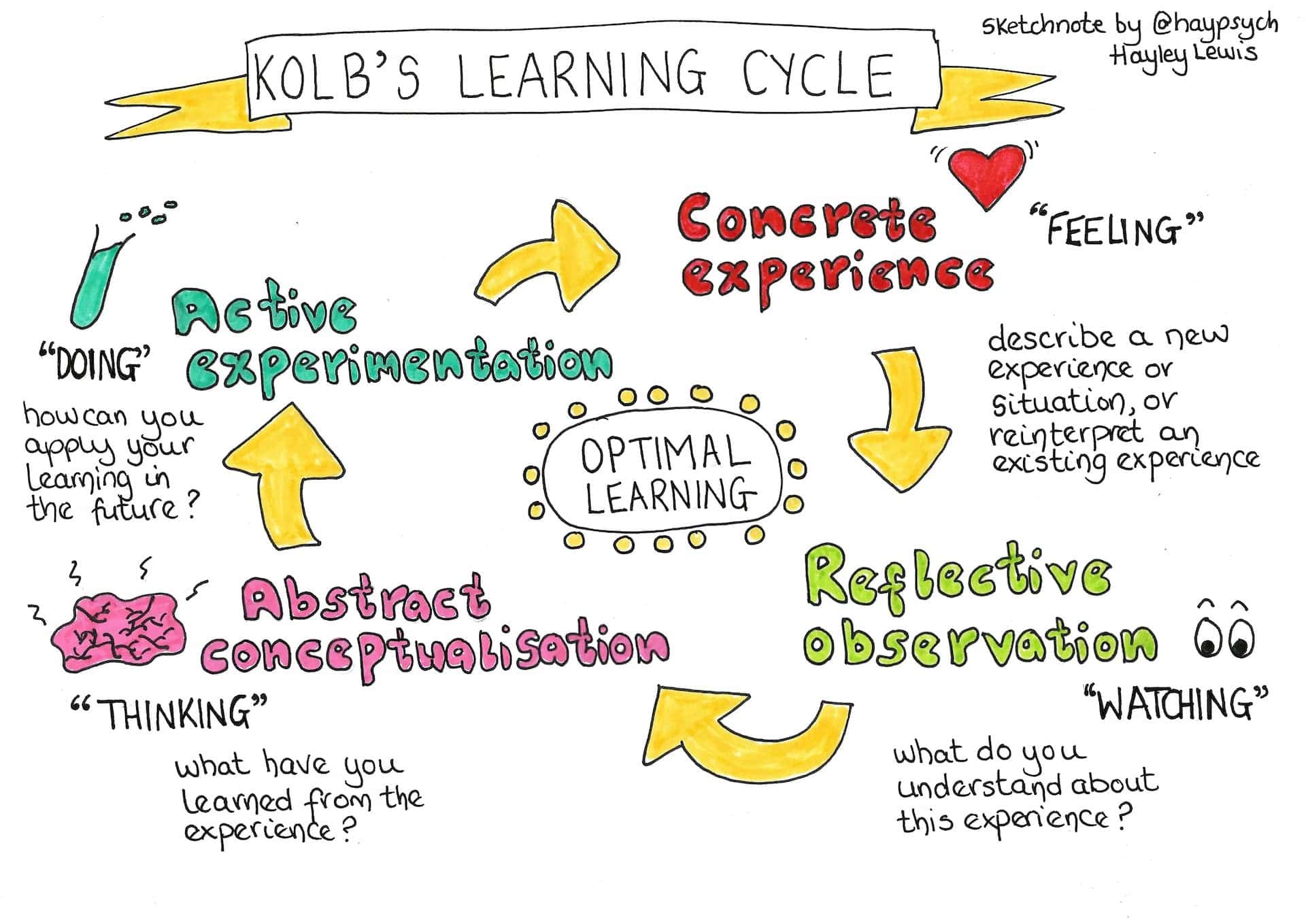
- Kolb’s Experiential Learning Cycle: A model that describes how individuals learn through experiencing, reflecting, conceptualizing, and experimenting. It emphasizes learning by doing and actively engaging in new experiences to gain insights and develop skills. See Dr. Hayley Lewis’s Sketchnote below to learn more.

Conclusion
As the world continues to change, the ability to innovate and adapt is more crucial than ever. At the heart of this capability lies experimentation—the deliberate, systematic exploration of new ideas, approaches, and strategies. Experimentation catalyzes growth, innovation, and learning in terms of personal career development and within organizational settings.
Other Resources
- PathWise’s Career Sessions, Career Lessons, Episode ft. Amy C Edmondson
- PathWise Book Summary: Right Kind of Wrong
- PathWise Book Summary: Working Identity
- PathWise Book Summary: Designing Your Life
- PathWise Book Summary: Humanocracy
- HBR: Building a Culture of Experimentation
- HBR: The Disciplines of Business Experimentation
- Forbes: Revolutionize Your Career: The Power of Rapid Experimentation
