


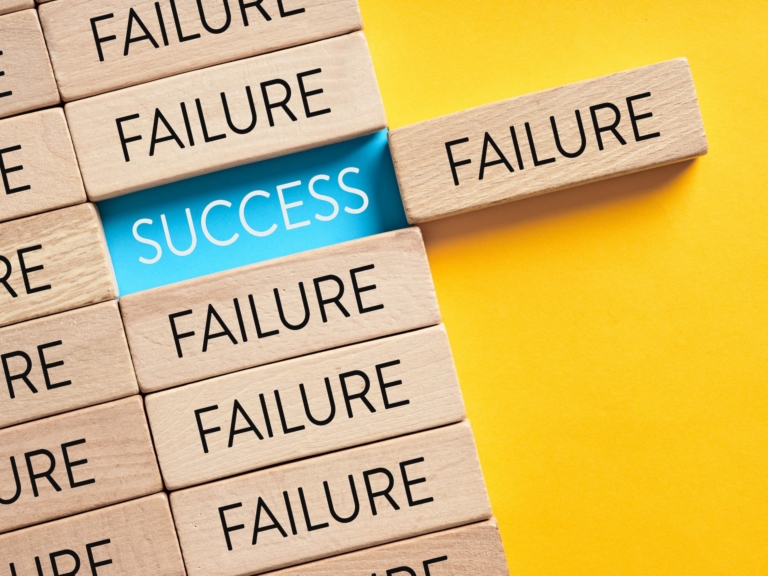
We have all felt like failures at some point in our lives. Whether it’s in sports, relationships, a competition, or our career, failure always stings. But it can be a good thing! That’s because failure creates opportunities for learning.
About Failure
We can define failure as a lack of success. It’s often attached to an inability to achieve a desired goal or outcome. It represents a situation or event in which we, both as individuals or organizations, fall short of expectations and face adverse results. Failure can take various forms, including mistakes, lapses, setbacks, underperformance, or the non-attainment of specific targets. But the good news is that failure is a natural and common part of life, and more importantly, it can provide valuable learning experiences and opportunities for growth when approached with a constructive mindset.

Image obtained from Canva
Learning from failure isn’t easy. With failure there often comes a sense of shame and embarrassment. That’s because several psychological factors make us perceive failure as blameworthy. For instance, society often places a strong emphasis on success and achievement. Failing to meet these expectations can lead to feelings of shame, as we fear judgment or rejection from others.
We also tend to compare ourselves to others, especially in cultures that highlight achievements on social media. When someone perceives themselves as falling short in comparison, it can trigger feelings of inadequacy.
Failing can sometimes carry a social stigma, particularly in highly competitive or perfectionist environments. This fear of being labeled as a failure can lead to shame. And sometimes, we cause these negative feelings ourselves. Internal dialogue and negative self-talk can exacerbate feelings of failure. We make it so that failing feels like a loss of prestige, and this loss of social standing can feel humiliating.
But it’s important to note that while feeling shame is a common reaction to failure, it’s not a productive or healthy response. Shame can be paralyzing and hinder personal growth. Instead, it’s more constructive to view failure as a natural part of life and an opportunity for learning and improvement.
Experts in career management believe that reflecting on mistakes and setbacks can provide insights into what went wrong and how to improve the next time. That means that failure can help us build resilience and adaptability. Embracing failure can help us bounce back from setbacks and use them as a catalyst for personal and professional growth. To do that, however, experts emphasize the importance of reframing failure as feedback. Instead of viewing it as a personal flaw or a dead end, we should see it as information that can guide future decisions. This mindset shift can reduce the fear of failure and promote a more positive attitude toward it.
Additionally, career experts often encourage calculated risk-taking. They argue that if we’re not failing occasionally, we may not be taking enough risks in our careers. Taking on challenges that push our boundaries can lead to significant rewards, even if it means encountering failure along the way. However, self-reflection is a critical aspect of managing failure. Experts advise us to analyze our failures objectively, identify areas for improvement, and make necessary adjustments to our career strategies. Ultimately, many career management experts see failure as a natural part of the journey to success. It’s not something to be ashamed of but rather a necessary part of growth and development. Each failure has the potential to bring us closer to our ultimate career goal if we approach it with the right mindset.
Thought Leaders
Some of the thought leaders who have made significant contributions to the understanding of failure in professional settings include:
- Amy Edmondson, who is known for her work on psychological safety in organizations and the role it plays in learning from failure. Her research has highlighted the importance of creating environments where employees feel safe to speak up about mistakes and failures. More recently, she published Right Kind of Wrong, a book about the importance of embracing failure and taking advantage of it. In it, she defines the different types of failures and talks about how assessing and learning from failure requires an analysis of the contexts and systems that lead to mistakes and setbacks.
- Carol Dweck, whose work on the growth mindset has significant implications for how we approach failure. She has written extensively about the idea that our mindset can impact our willingness to take risks and learn from setbacks rather than merely wallowing in shame. Her book Mindset, covers the importance of the growth mindset in managing failure and treating it as a learning opportunity.
- James Reason, a British psychologist and a prominent figure in the field of human error and safety management. He’s known for his Swiss Cheese Model, where he illustrates how multiple layers of defense can fail, leading to an adverse event or failure when the holes (weaknesses) in these layers align. It’s often used to understand complex systems and how various factors can contribute to failures or accidents.
- Scott Berkun, an author and speaker. In his book The Year Without Pants, he explores the culture of failure at Automattic, the company behind WordPress. He offers insights into how organizations can embrace experimentation and learn from failures.
- Malcolm Gladwell, a journalist, author, and public speaker. In books such as Outliers and David and Goliath, he shares insights into how individuals and organizations can turn disadvantages and setbacks into advantages.
- Organizational psychologist Adam Grant, who has written about the importance of embracing failure and taking calculated risks in his book Originals. He emphasizes the role of non-conformity and innovation in career and organizational success.
- Peter Senge, a systems scientist, who in his book The Fifth Discipline, discusses the concept of a learning organization. He emphasizes the importance of creating cultures where learning from failures is encouraged and valued.
Frameworks

In her new book, Edmondson discusses a spectrum of reasons for failure. Check out Dr. Hayley Lewis’s Sketchnote about it, reposted with her permission. Based on this spectrum, Edmondson explains that failures can be categorized as one of the following three types:
- Preventable Failures: These occur when known processes or procedures are not followed correctly. They are considered preventable because the knowledge and means to avoid them already exist.
- Complex Failures: These are the result of unforeseen and intricate interactions among various factors in a system. They are difficult to predict and require a deeper understanding of the system’s complexities.
- Intelligent Failures: These occur when organizations intentionally take risks, experiment, and try new approaches to solve problems. While the initial attempts may fail, they often lead to valuable insights and innovations.
Other structured approaches to help individuals and organizations understand, analyze, and learn from failures include:
- Root Cause Analysis (RCA): a problem-solving method used to identify the underlying causes of a failure. It involves asking “why” multiple times to dig deeper into the factors that contributed to the failure. For example, in the Five Whys technique, you ask “why” five times to uncover the root cause of the problem.
- After-Action Review (AAR): a retrospective analysis conducted after an event or project to evaluate what worked well, what didn’t, and why. It helps capture lessons learned for future improvements. The military often uses AARs to review missions and exercises.
- Fishbone Diagram (Ishikawa or Cause-and-Effect Diagram): a diagram that helps visualize the potential causes of a problem, categorizing them as people, process, equipment, and environment. If a project fails, a fishbone diagram can help identify factors like lack of resources, communication issues, or inadequate planning.
- Swiss Cheese Model: is a concept used in risk analysis and safety engineering. The model illustrates how a series of unfortunate events can align and cause the failure, illustrated by how the holes (weaknesses) in the cheese are layers that happen to align. In aviation, the Swiss Cheese Model explains how a combination of human error, equipment failure, and communication breakdowns can lead to accidents.

Swiss cheese model. (2023, August 18). In Wikipedia. https://en.wikipedia.org/wiki/Swiss_cheese_model
These failure frameworks can be adapted and applied to various situations, helping us and organizations gain insights from our failures and make informed decisions to prevent future mishaps.
Failure & Career Management
Failure can have a positive impact on our careers when approached with the right mindset and actions. Here’s how:
- Failure often provides valuable lessons that success may not offer. It can highlight areas where we need to improve, whether in skills, knowledge, or decision-making. This learning can lead to personal and professional growth.
- Failure encourages creative thinking and innovation. When something doesn’t work, it prompts us to explore alternative approaches and solutions, which can lead to breakthroughs and new opportunities.
- Experiencing failure can foster humility and self-awareness. It reminds us that we are not infallible and encourages us to seek help, collaborate with others, and be open to different perspectives.
- Failure can be a powerful motivator. It can create a strong desire to prove oneself, achieve goals, and overcome obstacles. Many successful people have used their failures as motivation to push harder.
- Failure can sharpen decision-making skills. When we analyze failures, we often gain insights into how to make better choices in the future.
- Success can sometimes lead to complacency, while failure can help us confront and overcome fears. It encourages us to take calculated risks and step out of our comfort zones.
- Failure can prompt us to reevaluate our career goals and direction. It may lead us to discover new passions or fields where we can excel.
- Leaders who have experienced failure often have a deeper understanding of their team members’ challenges and can offer guidance and support based on their own experiences.
While failure can be emotionally challenging, it can also be a valuable teacher and catalyst for career development. Embracing failure as a learning opportunity is a key component of a proactive and forward-looking career strategy.
Tools & Exercises
- Dealing with failure can be difficult. But everyone fails. Failing, in and of itself, doesn’t matter as much as how we pick ourselves back up. If you’d like some strategies, take a look at this article.
- Check out this site to learn more about how to overcome any setbacks.
- Here are more tools to help you manage failures effectively, taking in all its benefits.
Want to learn more? Check out these resources:
- Recovering from Setbacks: 8 Practices For Managing Failure
https://pathwise.io/recovering-from-setbacks/ - Strategies for Learning from Failure
https://hbr.org/2011/04/strategies-for-learning-from-failure - The Science of Failing Well
https://www.forbes.com/video/6330184732112/the-science-of-failing-well-according-to-author-amy-edmondson/?sh=41fad8b4b041 - How to Fail Smartly
https://www.fastcompany.com/90772563/yes-you-can-fail-smarter-heres-how-to-do-it-according-to-science - It’s Okay to Fail, but You Have To Do It Right
https://hbr.org/2023/07/its-ok-to-fail-but-you-have-to-do-it-right - Don’t Learn the Wrong Lessons From Failure
https://hbr.org/2023/03/dont-learn-the-wrong-lessons-from-failure - Failure Isn’t the Opposite of Success
https://www.linkedin.com/news/story/failure-isnt-the-opposite-of-success-5475914/ - How to Own a Failure (And Still Preserve Your Reputation)
https://www.linkedin.com/pulse/how-own-failure-still-preserve-your-reputation-lisa-earle-mcleod/
