



Have you ever found yourself mired in the murky waters of office politics, and unsure of how to navigate the dynamics at play? Politics can be tricky, but they are inherent to at least some degree in every organization with more than one person. In other words, they’re everywhere. So, how do you manage them? Let’s dive in.
What is organizational politics?
Organizational politics refers to the activities, behaviors, and strategies that employees within an organization engage in to advance their own interests or the interests of a particular group. These activities often involve maneuvering for power, influence, resources, and recognition within the organizational structure.
Office politics can take various forms, such as forming alliances, lobbying, manipulating information, undermining colleagues, or engaging in office gossip. While some level of politics is inevitable in any human organization, excessive politicking can lead to dysfunctional dynamics, decreased morale, and reduced organizational effectiveness.
Understanding organizational politics and how to maneuver them can help you navigate complex interpersonal relationships and power dynamics. If you’re a leader, it’s also crucial for you to recognize and manage political behavior to foster a healthy organizational culture and ensure that decisions are made based on the organization’s goals and values, rather than personal agendas.

What drives people to engage in political behavior within organizations?
There are various reasons why people engage in office politics, but they often stem from a desire to advance personal interests, gain power, achieve recognition, or secure resources. Some of the key drivers behind political behavior include:
- Ambition: Many people engage in political behavior as a means of climbing the corporate ladder or achieving career advancement. This might involve forming alliances, lobbying key decision-makers, or positioning themselves strategically within the organization.
- Competition: In competitive work environments, the pressure to outperform peers and secure limited resources can lead people to engage in political tactics to gain an edge. This might include undermining colleagues, spreading rumors, or seeking to discredit others.
- Resource Allocation: People may resort to political behavior to secure access to resources such as budgets, staff, or project assignments. This can involve lobbying supervisors, forming coalitions, or leveraging personal relationships to ensure they receive a favorable allocation.
- Influence: Some people engage in political behavior to exert influence over decision-making processes within the organization. By cultivating alliances, building networks, or leveraging expertise, they seek to shape outcomes in their favor.
- Perceived Inequities: When people perceive injustices within the organization, they may resort to political tactics as a means of addressing grievances or leveling the playing field. This could involve challenging authority, mobilizing support from colleagues, or advocating for change.
- Organizational Culture: The prevailing culture within an organization can also influence someone’s propensity to engage in political behavior. In environments where political maneuvering is tolerated or even encouraged, employees may feel compelled to adopt similar tactics to succeed.
Are there certain industries or structures more susceptible to these dynamics?
Industries and organizational structures that are characterized by intense competition, hierarchical power structures, and ambiguity in decision-making processes are typically more susceptible to political dynamics. For example, industries such as finance, law, and consulting often involve high stakes and intense competition for clients and resources, which can incentivize people to engage in political behavior to gain advantage. Similarly, organizations with rigid hierarchies and centralized decision-making may foster environments where employees feel the need to navigate complex power dynamics through political tactics. Additionally, organizations undergoing significant change, such as in times of mergers, acquisitions, or restructuring, may experience heightened political activity as employees vie for position and influence in the evolving landscape.

Can we escape organizational politics?
Eliminating organizational politics entirely is likely impossible due to the inherent complexity of human interactions within workplaces. However, there are strategies people and organizations can employ to mitigate negative effects of office politics and foster a healthier work environment:
- Promoting Transparency: Encouraging open communication and transparency in decision-making processes can help reduce speculation and mistrust, mitigating the need for covert political maneuvers.
- Focusing on Collaboration: Emphasizing teamwork over individual competition can shift the organizational culture away from zero-sum games and toward collective success.
- Clarifying Goals and Expectations: Clearly defining goals and performance expectations can provide a common framework for decision-making, reducing ambiguity and the potential for conflicting agendas.
- Developing Strong Leadership: Effective leadership that promotes fairness, integrity, and accountability can set a positive tone and serve to role model ethical behavior, discouraging political tactics.
- Encouraging a Culture of Accountability: Holding staff accountable for their actions and promoting merit-based rewards can help discourage political games.
- Providing Conflict Resolution Mechanisms: Establishing formal channels for resolving conflicts and grievances can help address underlying issues before they escalate into political battles.
- Investing in Training and Development: Providing training on conflict resolution, communication skills, and ethical decision-making can empower employees with the tools they need to navigate challenging situations effectively.
Thought Leaders
Several scholars and experts have made significant contributions to our understanding of power dynamics, influence, and political behavior within organizations.
- Jeffrey Pfeffer: A professor at Stanford Graduate School of Business, he has written extensively on topics such as power, influence, and organizational dynamics. His book Power: Why Some People Have It and Others Don’t explores the role of power in organizational politics.
- Barbara Kellerman: An expert on leadership, she has written extensively about followership, power, and leadership in politics and organizations.
- Robert Cialdini: While primarily known for his work on influence and persuasion in social psychology, Cialdini’s principles of persuasion have implications for understanding political behavior within organizations.
- Henry Mintzberg: Renowned for his work on organizational structures, managerial roles, and strategic management, his research often touches on the political nature of organizations and how power and influence shape decision-making processes.
- John P. Kotter: Primarily known for his work on change management and leadership, his research and writings often address the role of power, influence, and political dynamics in driving organizational change.
- Kathleen Kelley Reardon: A prominent American academic, author, and professor known for her work in communication, persuasion, negotiation, and leadership, she has written several influential books on these topics, including The Secret Handshake: Mastering the Politics of the Business Inner Circle and It’s All Politics: Winning in a World Where Hard Work and Talent Aren’t Enough.
A Key Framework: Political Skill Model
This model, developed by Gerald R. Ferris and Eliza W. King, outlines four dimensions of political skill, suggesting that those who possess higher levels the skills that make up these dimensions are better able to navigate organizational politics effectively.
- Social Astuteness: This dimension refers to an individual’s ability to accurately perceive and interpret social cues and dynamics within the organization. Socially astute people are adept at understanding the motivations, intentions, and behaviors of others.
- Interpersonal Influence: This dimension focuses on an individual’s ability to effectively persuade and influence others in order to achieve desired outcomes. Those with high in interpersonal influence are skilled communicators who can build alliances, negotiate effectively, and rally support for their ideas or initiatives.
- Networking Ability: Networking ability involves the capacity to develop and maintain a diverse network of contacts within and outside the organization. People with strong networking abilities have extensive social connections that they can leverage to gather information, gain support, and access resources.
- Apparent Sincerity: This dimension refers to the ability to convey authenticity and sincerity in interpersonal interactions, even when engaging in political behaviors. People who are perceived as genuinely trustworthy and credible are more likely to garner support and influence others effectively.
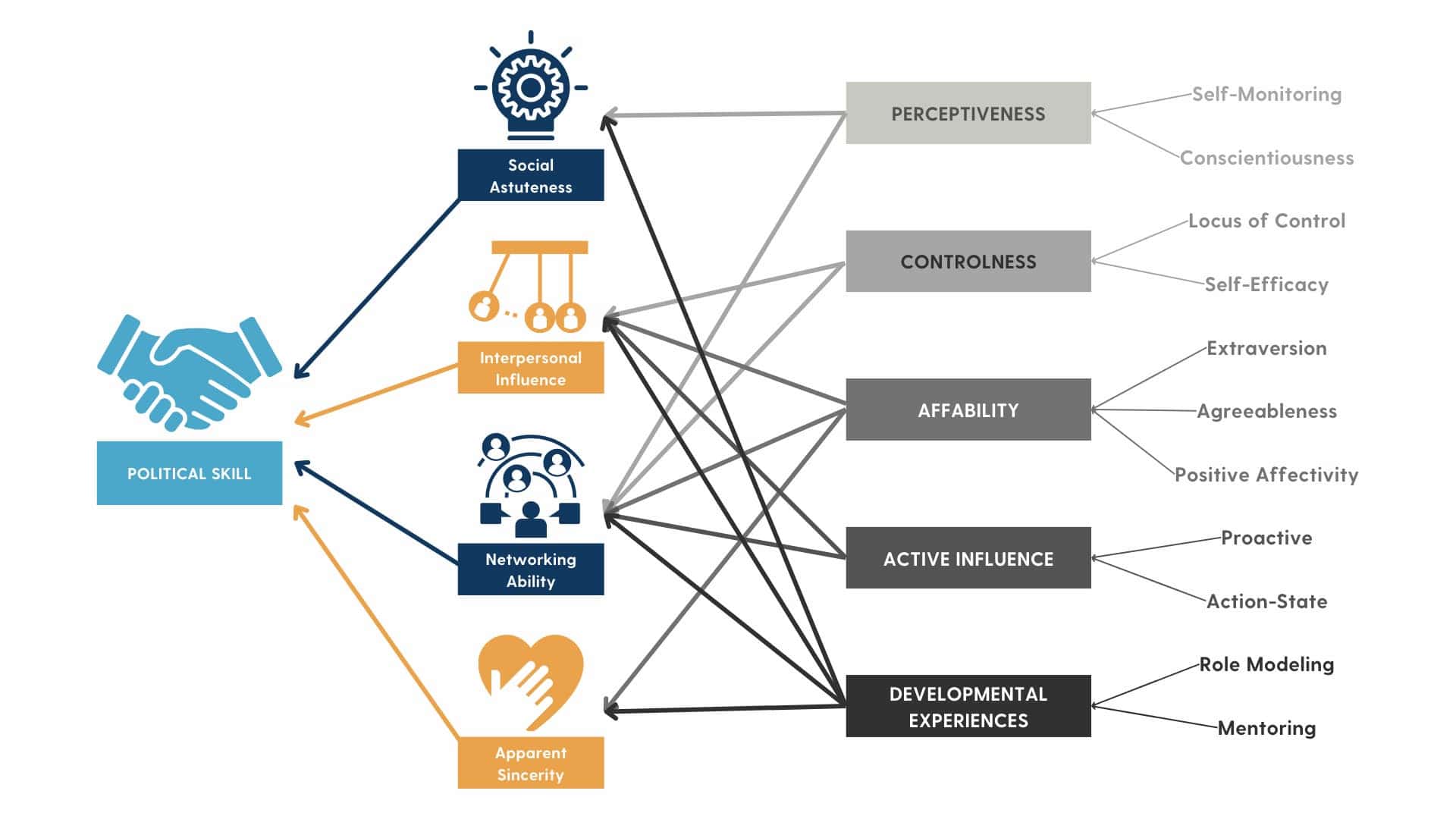

Source: Ferris, Gerald & Treadway, Darren & Perrewé, Pamela & Brouer, Robyn & Douglas, Ceasar & Lux, Sean. (2007). Political Skill in Organizations. Journal of Management. 33. 290-320. 10.1177/0149206307300813
Organizational Politics in Personal Development
Learning to ethically navigate organizational politics can significantly contribute to professional development in several ways:
- Enhanced Influence and Impact: Understanding how organizational politics operates allows us to navigate complex power dynamics more effectively. By building coalitions, gaining allies, and advocating for our ideas in a politically astute manner, we can increase influence and make a greater impact within our organizations.
- Improved Networking and Relationship Building: Ethical political behavior involves building authentic relationships and networks based on trust, reciprocity, and mutual respect.
- Better Decision-Making: Ethical navigation of organizational politics requires careful consideration of diverse perspectives and interests. By engaging in constructive dialogue, seeking input from stakeholders, and considering the broader implications of our actions, we can make more informed decisions that benefit us and the organization as a whole.
- Heightened Emotional Intelligence: Successfully navigating organizational politics often requires a high level of emotional intelligence, including self-awareness, self-regulation, empathy, and social skills. By honing these competencies, we can better understand our own motivations and those of others, navigate conflicts more effectively, and build stronger interpersonal relationships.
- Increased Resilience and Adaptability: Organizational politics can be challenging and unpredictable, requiring us to navigate ambiguity, setbacks, and competing priorities. Developing these skills can help us weather the inevitable professional storms.
- Recognition and Opportunities: Ethical political behavior can help us gain recognition for our contributions, earn the trust and respect of colleagues and leaders, and position ourselves for new opportunities within the organization.
Other Resources
- Career Sessions, Career Lessons Podcast with Niven Postma
- HBR: You Can’t Sit Office Politics Out
- HBR: 4 Types of Organizational Politics
- HBR: Power & Politics in Organizational Life
- Forbes: Office Politics – How True Leaders Win
- Forbes: The Weight of Politics and Power During Corporate Change
- Forbes: Fifteen Strategies to Minimize Office Politics
