



Defining Psychological Safety
Psychological safety refers to an environment that allows people in the workplace to experience comfort within a team or organization. Feeling psychologically safe lets people express themselves, be vulnerable, voice concerns, admit mistakes, and share bad news without fear of negative consequences such as ridicule, punishment, or humiliation.
More specifically, when employees feel psychologically safe, they are more likely to:
- Speak up: They voice concerns, ask questions, and share their opinions openly without fear of retribution.
- Collaborate: They work together effectively, sharing information to achieve common goals.
- Learn from mistakes: They are willing to admit errors, learn from them, and find ways to improve without feeling ashamed.
- Innovate: Because people are not afraid of being criticized, and they learn from failure, psychological safety encourages creativity and the exploration of new ideas.
- Take risks: They know they won’t be unfairly penalized for setbacks. A psychologically safe environment supports calculated risks that lead to growth and innovation.
In contrast, a lack of psychological safety can lead to a toxic work culture with low morale, limited creativity, poor communication, and increased stress.
Thought Leaders on Psychological Safety
Various experts in psychology, organizational behavior, leadership, and workplace culture have studied the concept of psychological safety. Some notable examples include:
- Amy Edmondson: A professor at Harvard Business School and a pioneering researcher of psychological safety. Among several books, she wrote The Fearless Organization: Creating Psychological Safety in the Workplace for Learning, Innovation, and Growth, where she explains that workers need to collaborate to drive organizational success. Without psychological safety, collaboration becomes compromised, and fear and silence overtake productivity.
- Timothy R. Clark: An author, speaker, and expert on leadership development and organizational change. He wrote The 4 Stages of Psychological Safety: Defining the Path to Inclusion and Innovation and is Founder and CEO of LeaderFactor.
- Edgar Schein: A respected organizational psychologist and management scholar, known for his work on leadership. He researched psychological safety in the context of effective teams, arguing that it helps people overcome the defensiveness and learning anxiety typical of tense work environments. He concluded that, instead of focusing on self-protection, with psychological safety, people concentrate on achieving goals through group collaboration.
- William Kahn: An organizational psychologist and one of the pioneering researchers in organizational behavior. His work focuses on employee engagement and fulfilment, arguing that companies should support employees’ psychological needs, provide meaningful roles, and work on building a sense of community.
While many experts have contributed to our understanding of psychological safety and its impact on workplace dynamics, team performance, and organizational success, it’s also worth noting Google’s Project Aristotle Team. This is a research project that explored factors contributing to effective team performance. Psychological safety was a crucial finding, and the researchers identified it as one of the five key dynamics of successful teams within Google.
Models & Frameworks
To understand and promote psychological safety in the workplace, consider two main frameworks.
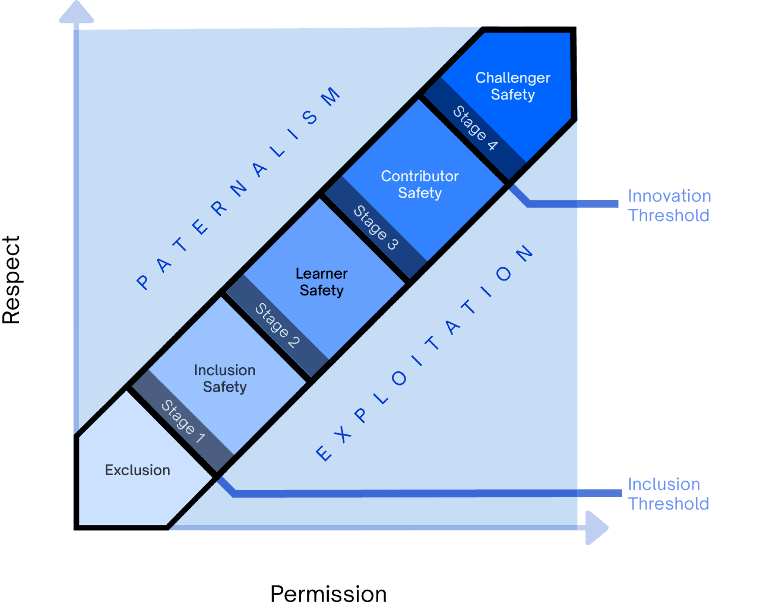
- Timothy R. Clark’s 4 Stages of Psychological Safety Model: The model describes the journey to creating psychological safety in teams. The stages are:
- Inclusion Safety: feeling valued and included,
- Learner Safety: willingness to learn and experiment,
- Contributor Safety: feeling encouraged to contribute, and
- Challenge Safety: openness to giving and receiving feedback.
- Edgar Schein’s Model of Psychological Safety: This is a three-level model of psychological safety. Level 1 focuses on basic safety needs, Level 2 relates to interpersonal and group dynamics, and Level 3 deals with organizational and system-wide aspects of psychological safety.

What Psychological Safety Is Not
As psychological safety became a more popular term, some misconceptions about it also emerged. Taking from Amy Edmondson’s The Fearless Organization, psychological safety:
- is not about being absolutely nice and supportive, no matter what. It’s about candor, willingness to engage in and manage conflict, and seizing learning opportunities.
- is not a personality trait. It’s not the same as being extroverted. It’s an environment and culture that helps all personality types thrive.
- is not another word for trust. We can only experience it at a group level, and trust is among two individuals.
- Is not about lowering standards. A company should seek high psychological safety and high standards to avoid falling into a comfort zone where people don’t grow, and instead foster a high-performance zone where people continually learn.
Amy Edmondson also developed a matrix that explains how psychological safety relates to performance standards. The Sketchnote below, developed by Tanmay Vora and published on Edmonson’s personal site, explains what psychological safety is, is not, and how it leads to better performance.

The Impact of Psychological Safety
Psychological safety can help in the areas of:
- Career development. Psychological safety refers to the comfort and security an individual feels in their job role and within the organization. When employees experience it, they are more likely to take risks, voice their opinions, and pursue growth opportunities, leading to higher job satisfaction, increased engagement, and a sense of fulfillment in their career paths.
- Management. Psychological safety is crucial for effective leadership. Managers who create a psychologically safe environment are approachable, open to feedback, and encourage open communication with their team members. Leaders who prioritize psychological safety are empathetic, promote a culture of inclusion, and provide space for diverse perspectives. They encourage risk-taking and view mistakes as opportunities for learning and growth. Such leadership fosters innovation, creativity, and a sense of purpose among their teams.
- Personal Development. Psychological safety allows individuals to take risks, explore new challenges, and step outside their comfort zones. When people feel safe to experiment and make mistakes without fear of judgment, they are more likely to learn and develop new skills. Psychological safety is also closely linked to self-confidence, as individuals are more willing to embrace their vulnerabilities and seek growth opportunities.
Psychological safety contributes to the overall well-being and success of individuals and teams. It creates an environment where people feel valued, respected, and empowered to contribute their best efforts. Organizations prioritizing psychological safety tend to experience higher levels of employee engagement, improved teamwork, and greater overall performance. Similarly, individuals who experience psychological safety are more likely to thrive, achieve their goals, and develop professionally and personally.
Self-Assessment
If you’d like to measure your personal sense pf psychological safety in your current circumstances, click here.
Other resources
- PathWise book summary of The Fearless Organization and a video presentation:
https://pathwise.io/books/the-fearless-organization/ - What is Psychological Safety? by Amy Gallo (from Getting Along). https://hbr.org/2023/02/what-is-psychological-safety
- Forbes: Fostering Psychological Safety in the Workplace https://www.forbes.com/sites/forbescoachescouncil/2021/05/28/fostering-psychological-safety-in-the-workplace/?sh=3f3f2c94773b
- What Psychological Safety is Not
https://www.forbes.com/sites/timothyclark/2021/06/21/what-psychological-safety-is-not/?sh=28469d0a6452 - Teams that Build the Future, by Amy Edmondson
https://hbr.org/webinar/2016/09/teams-that-build-the-future - Learning from Failure (video), by Amy Edmondson
https://hbr.org/video/2226539841001/learn-from-failure
