Insights From CEOs With Multi-Billion Dollar Growth Stories, With Georgie Dickins
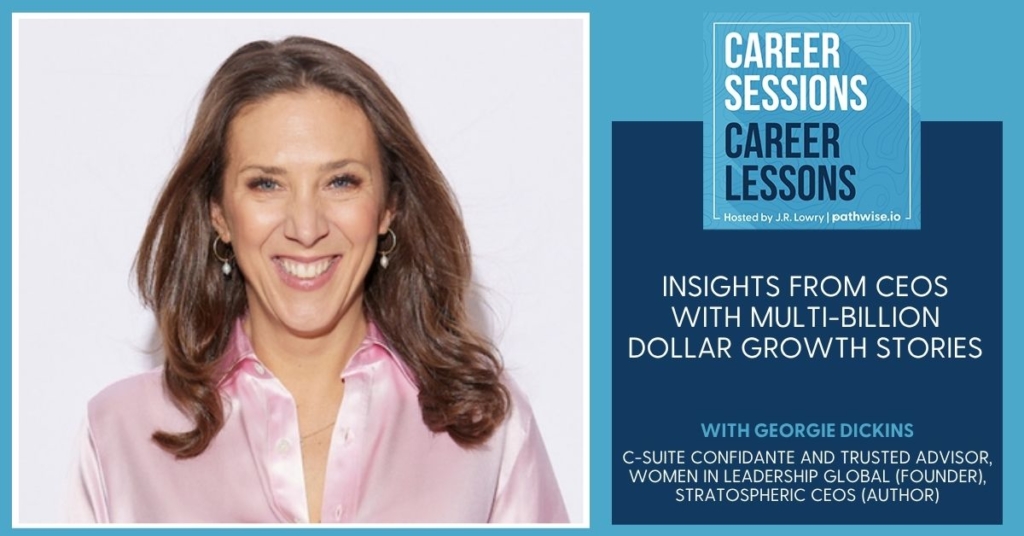
Leadership is less about ego and more about evolution. In this dynamic conversation, Georgie Dickins—executive coach, founder of Women in Leadership Global, and author of Stratospheric CEOs—dives into the lessons behind some of the most influential financial industry leaders. She shares firsthand insights from working with C-suite giants and reveals what sets stratospheric leadership apart: clarity of vision, magnetic storytelling, intentional culture-building, and relentless personal growth. Whether you’re scaling a startup or leading at enterprise level, this is a blueprint for elevating your impact.
Check out the full series of Career Sessions, Career Lessons podcasts here or visit pathwise.io/podcast/. A full written transcript of this episode is also available at https://pathwise.io/podcasts/georgie-dickins/.
—
Watch the episode here
Listen to the podcast here
Insights From CEOs With Multi-Billion Dollar Growth Stories, With Georgie Dickins
C-Suite Coach, Advisor To The Financial Services Industry, And Author Of Stratospheric CEOs
Building A Foundation: From Farm To Finance
I’m J.R. Lowry. This is Career Sessions, Career Lessons, which is brought to you by PathWise.io. If you want to take control of your career, join the PathWise community. Basic membership is free. My guest is Georgie Dickins. Georgie is a speaker, author, and sought-after C-suite coach and trusted advisor in the financial services industry. She is the founder and managing director of Cajetan, a boutique business specializing in transformational leadership.
She works with the titans of the global financial markets as a thinking catalyst. She is also the founder and CEO of Women in Leadership Global, an elite peer membership network that unites inspiring and accomplished female leaders from across the industry. In our discussion, we’ll be talking about Georgie’s book, Stratospheric CEOs, where she profiles some of the biggest names in the fintech landscape and draws a number of key lessons on their meteoric rises. Let’s get going.
—
Georgie, welcome. Thank you for joining me on the show.
It is a pleasure. Thank you for having me.
We’re going to talk mostly about your book, Stratospheric CEOs, and the people that you profiled in the book. Let’s start with your background. You got your start in the financial services industry. What were some of your early roles?
We’re talking about the early roles in financial services because my parents had me working from age fifteen. I was a waitress, a strawberry picker, and then a bean picker. My parents were farmers. Very early on, I learned the importance of hard work and earning money helping my dad on the farm. To be fair, looking back, I probably should have done it through love, but it was always ten pence for getting the cows up. It’s interesting. I look back, and many of my attributes or qualities that I see in myself now were shaped by my formative years. Farming has that work ethic that hard work is a minimum. There are so many lessons and insights that I’ve reflected on in my more seasoned years in terms of what they taught me.
I hear that from a lot of people who have parents who are farmers. It is about the value of hard work and the day-to-day discipline of running a farm, and how they learn those lessons as children. You’re certainly echoing what I’ve heard from others who’ve come up in similar backgrounds.
There’s a great quote. I don’t know who to attribute it to. That is, “Nothing in nature rushes, yet everything gets done.” That resonates quite profoundly at the moment for me. I look at the world around us. I look at the individuals I work with. There are so many advantages to the pace of technological change and advancements, and yet there has been more asked of us than ever before. It’s the Navy SEALs saying, “Slow is steady. Steady is fast.”
Nothing in nature rushes, yet everything gets done. Share on XThat doesn’t mean going at a snail’s pace. It’s coming from a place of being very conscious, rather than being on autopilot. I learned a lot from farming, but I could have had a gap year. I wanted to get straight into the working world. I wanted to start earning money. I started my early career at Reuters on the graduate program. I have to say it was the school of life. Having come from living on a farm, a small market, town, and school, I went to a university called Loughborough campus-based, and then suddenly exposed to London.
It was a time when the markets were very bullish. At Reuters, I was on the client-facing side. There was so much experience exposure, so much that we were invested in in terms of our market knowledge. It was such an incredible platform. I still connect with many people from those formative years. I never planned to go into financial services. My degree was in European Business Languages with Accountancy, Economics, and a lot of different business modules. We had a year in the industry. It was a sandwich year as part of our degree. We had the opportunity to have a sandwich year or year in business or to go to France to go to a French university.
I was like, “No. I want to get down to the center of business, start learning, and start earning money.” Reuters was one of the companies that came to Loughborough to source placement students. I remember saying to my mom, “I’ve got a job at Reuters.” She went, “Are you going to be a journalist?” I was like, “No, this is a whole other world,” which I didn’t know anything about. The dynamism, how progressive it was, the innovation, the speed, and the pace were the pieces that I gravitated to without at the time knowing what I was saying yes to.
Scaling Up: Navigating Tremendous Growth At ICAP
You spent a bunch of years at ICAP as well, working with one of the CEOs that you profiled in your book, Michael Spencer. How did you find working there? I’m sure it went through tremendous growth in the time that you were there.
I joined the electronic broking side. I joined at a time when FX had gone electronic. I joined the interest rate swap trading platform. It was an extraordinary time to be there because it was progressive. It was dynamic. We were reshaping an industry when so much of the market was like, “This isn’t going to work.” Michael was very clear on his mission. He’d seen the electronification of other markets.
There was such an investment in that part of the business. I loved being at the forefront. I look back at ICAP with such fond memories because it was an exciting time to be part of it. It was a very social organization as well. Every year, Michael hosted ICAP Charity Day, which raised millions and millions for such incredible causes. It had strong values that I subscribe to. It was a great time to be there.
Is he the only one in the group with whom you had firsthand working experience?
Yes. Also in the book that I profiled, there were Lee Olesky, who was the founder and CEO of Tradeweb, and Rick McVey, founder and CEO of MarketAxess. When I was at JP Morgan, I was on the rate side. We worked very closely with Tradeweb as partners. We were one of their liquidity providers. It was the same on the credit side at MarketAxess, but I didn’t have any touchpoints with them. I knew of them, but they were avatars to me. They didn’t have that proximity to them.
The Coaching Catalyst: Shifting From Industry To Advisory
You eventually left ICAP. You moved out of the industry directly into more of a coaching and advisory role. What prompted that shift?
I loved being part of the markets. As you get older, you evolve. Your motivations and drivers change. You get a better sense of who you are. What is the person you want to become? What are the things you love? I was inspired by human behavior, psychology, mindset, leadership, excellence, and high performance. How do you become the best of the best? How do you stay there? I love working with people. People bring me alive. I was looking for a change, but I hadn’t anticipated life outside the world I was in. I assumed I might move to an exchange or a clearinghouse or go back to a bank. I hadn’t quite anticipated setting up my own business.
I hired a coach because I wrongly assumed that if I was on this, I felt like a bit of a crossroads in my life. I thought, “If I hire a coach, they’ll tell me what I should be doing. I’ll pay them some money. They’ll give me my blueprint. Off I’ll go, and I’ll execute on it.” It was far more profound than I could ever imagine. It was holding the mirror up to understand my values, what I cared about, what mattered to me, and what I enjoyed.
When you have been in the industry for nearly two decades, there are so many things you can do. There are so many things you’re very capable of doing and many things you’re great at, but what are the things that you enjoy? I kept searching back to this human behavior. It’s leadership, excellence, and working closely with people. Through that coaching process, I was like, “What if I could do this as a profession?” I’m not a total leap of faith. I’m more calculated with risk.
For me, I wanted to speak to every CEO I’d ever worked with, new to be like, “Have you ever worked with a C-suite confidant, a trusted partner, or a coach? What have been the changes? What are you doing differently as a result of having that individual as a trusted partner?” The more I went down that pathway, it ignited and inspired me in ways that I could never have imagined. It took me eighteen months because I got my qualifications. It said not a leap of faith. I am supposed to leap of faith.
I remember at the time, my husband was like, “What’s your cash flow projection for two years and five years? I was like, “There isn’t one. I have an idea for the next 6 to 12 months. This is a business. I’m going to be growing and evolving it. You have to trust me. I have this unwavering belief that I know this is my path. It’s going to work out brilliantly.” It was interesting. I look back on that time. One of his drivers is security, and yet he did trust me because I couldn’t substantiate anything apart from him taking my word for it. That was years ago. It has been the most extraordinary journey. I feel very privileged to be able to do what I do by working closely alongside such great entrepreneurs and visionaries in our industry.
Tell us a little bit about women in leadership because you’ve got that going as well.
I’m all about evolution. When I was growing up, I always needed to be like, “There’s a pathway. I can mark everything off as I go.” As I set up the business, it was more like, “Listen to where the pain points are. Listen to where there’s opportunity. Listen to where you can add value.” In my coaching work, I work very closely with men and women. What came up for me is some of the challenges I experienced when I was in the industry. As a woman, I was a chronic people pleaser. I was a perfectionist. I had lots of pockets of self-doubt. I was continually in the energy red zone because my boundaries were pretty much always covert, not over.
I didn’t invest in my resilience strategies because I was working all the time, and then raising a small family. I didn’t always own my voice. I’d have a seat at the table, but I didn’t always exercise that voice. What came up for me in my coaching with female leaders is that women do a really good job of having that corporate mask firmly wedded on. There’s a poise of confidence of, ”We’ve got it all together.” No one sees any of those lagoons of insecurity, self-doubt, vulnerabilities, and fears.
When I was in the industry, I was part of many great networks. They were very much about the work we did. It’d be the electronification of markets. It might have been about Dodd-Frank. We met to discuss the market topics. I thought, “What if I could create the group that I never had? We get to discuss the things that are front of mind, the things that keep us awake at night, and the opportunities we’re not reaching for. What if I could create that group?” That’s how it was born to create this trusted tribe, your internal board of directors from across the industry, really underpinned by the mission to advance the face of leadership.
There are many great women in positions of influence in the markets, whether it’s Lynn Martin at NYSE, Adena at Nasdaq, or Jane Fraser. I was like, “I want to see more of that because you can’t become it if you can’t see it.” There are some systemic challenges. For me, where do we get in our way? What are some of the strategies we could equip ourselves with, in order that we can have that impact and influence that these women are completely capable of?

Stratospheric CEOs: You can’t become it if you can’t see it—representation matters in leadership.
There are some fantastic role models out there. The point you made a minute ago is what sticks and resonates with me, which is this mask point. It is trying to create this illusion of perfection and hide all of the things beneath the surface. It’s got to be exhausting for women to do that.
It’s men as well. I look at the world today. All leaders say, “Be authentic. Bring your full self to work.” As leaders, you still have to filter because the world is a very unforgiving place. We live in a world of cancel culture. It’s okay for an employee to make a mistake. You, as a leader, make a mistake. You will be judged and held accountable for that. It’s this tightrope that leaders have to walk between, “I need to be authentic. It’s important that people get a sense of who I am,” and you still have to have that veil on because it’s a judgmental world.
Unpacking “Stratospheric CEOs”: The Genesis Of The Book
Let’s talk about the book. You worked with Michael. You knew some of the others. What prompted you to distill all of the things that they had to say into a book?

Stratospheric CEOs: Inspirational real-world lessons in leadership for the modern-day leader
It’s interesting in the book because I’ve always been quite fascinated with zero-to-one individuals who have a seed of an idea. Everyone tells them it’s not possible. Everyone tells them they’re completely reckless, and yet they go on. They take the idea from zero to one, and then the one to 100. The one-to-100 story is interesting and fascinating. There are very few people who do that. With that zero-to-one, you take the seed of an idea as a founder, and then you scale it into a multi-billion-dollar business. It is this value creation growth story.
Who are these people? What’s their mindset and their behaviors? How do they make decisions? How do they create a world-class team? How do they deal with failures? As an entrepreneur, you have many near-death experiences. When I worked with a lot of leaders, I was fascinated by virtue of the fact that they’d be talking about their business strategy, how they were thinking about building their teams, or how they were thinking about creating these billion-dollar value growth stories. So much of what they shared are these gems and these golden nuggets. I’m like, “I don’t think they realize these are golden nuggets because it’s who they are. It’s how they operate.”
Lance Uggla, whom you and I both know, was one of the first individuals whom I approached. I said, “There’s so much of what you share that a single insight can shift everything for someone. There are so many emerging leaders that would benefit from your insights, your wisdom, and your lessons.” I was like, “What if I could be the raconteur of some of these extraordinary founder CEOs, Henry Fernandez from MSCI, Lee Olesky from Tradeweb, Rick McVey from MarketAxess, amongst others? What if I could be the person who goes behind the scenes, or behind the curtain, using my coaching skills to ask incisive questions to tease out the meaningful intelligence or insight that could be valuable for people?” That’s how it all started.
When I started the project, I never imagined myself as a book writer. Although I started writing the book, I felt compelled to want to be able to put it into the world. I found their lessons interesting. I’m like, “If I do, others will as well.” I’m a perfectionist, which has its strengths but also has its shadow side, like knowing what good enough looks like. It’s a far more intensive process than I ever could have imagined because I had over close to 300 hours of interviews.
If you put all those interviews in a book, you could do that quite easily, but it’s the synthesis and the structural piece. There’ll be a book to follow up on this because there’s so much content that wasn’t in the book. At some point, you have to draw the line. Listening to these individuals and hearing their soundbites, their stories, and their strategies was a real privilege. Genuinely, I’m a different human being from having spent time with those leaders.
You talked about 300 hours of interviews. What did that translate into in terms of the ask of each of them individually?
Initially, the ask was quite a light ask because I appreciate how busy everyone is. If I’d have said, “I need 30 hours of your time,” I think the immediate reaction may have been a no. It was at the beginning of COVID. There was something about me saying, “Have you got time for a conversation? I want to share with you a little bit about the book I’m writing. I would love for you to be involved.” There was a timing element to it. A lot of entrepreneurs would credit some of their success to timing, which plays a big part. They were no longer on planes and traveling all the time. Suddenly, they were in their homes. There was a bit of space that allowed for these conversations.
I felt one of my roles was to hold the mirror up for them to reflect on their journeys. You say to the leaders, “Do you celebrate success?” Very few get to that milestone and celebrate the success, or look back down the mountain to be like, “What are all the waypoints that have led to this moment?” It’s straight on, “I’ve created this product. It’s the next big, audacious goal.” There was something about reflecting that I don’t think they’d done that much. There was a joyful piece to that.
It is recognizing that so many of these lessons have such a legacy. Every conversation was then like, “Would you be happy to have another hour?” That’s how it evolved. I never went in asking for a huge amount of time upfront. I wanted it to be very reciprocal, that they were saying yes and showing up because they wanted to be there, rather than they’d committed, and then “Here we go again.” I tuned into how I felt they’d be open to another conversation and made the ask.
I can imagine with even 300 hours, there’s a lot of distillation that’s required. That must have been a lot of work in the process itself.
Yes, it was huge. It was then that I spoke to some of their family members. I spoke to some of their board members and some of their leadership team. It was important to get that holistic. They were very open to that. Lance was like, “You should speak to my board and my leadership team. They can tell you if what I’m sharing is a direct experience they have of me.” That piece is interesting because whether it’s the board or the leadership team, they’re all extraordinary leaders in their own right as well. I learned a huge amount from them, too. I said it was a side project because I was still running two businesses alongside. It was such a bright spot in my day and week when I had these calls.
Leadership Evolution: Adapting From Startup To Enterprise
Let’s dive in a little bit. These are leaders. They pretty much all took businesses from zero to one, and in some cases beyond one, if we’re counting in billions. You go through a lot of near-death experiences when you’re running these kinds of businesses. I would imagine that, as leaders, they have changed a lot over time. What did they say to you about how their leadership styles evolved from the point of zero to one and beyond?
For me, the word that is important to underscore is evolved. To evolve is a verb. It means taking action. Evolution also requires self-awareness, the ability to see ourselves, because what got you here won’t get you there. From zero to one, then one to 100, it’s different skills, and there are different asks of you. It requires you to have that self-insight to hold the mirror up to be true to yourself. What are the things that are working? What’s not working? Where do I need to adapt? Equally, the outside in is to get that feedback from others, your board, your shareholders, and your leadership team, and to get thoughts on what they need from me as a leader.
Many of the leaders that I worked with, or were part of the book, all came from banking backgrounds. Lance came from Canadian banks. Rick came from J.P. Morgan. That in itself was an evolution. What’s interesting there is that you’ve left reputational capital. You’ve left job security and very high-paid jobs to create these businesses. One piece of the evolution is that there’s a recognition that you have an idea that’s so compelling. It’s having that idea, but then how do you bring that into reality?
One of the leaders talked about one of his evolutions, which was giving thought to the people around him. He talked about hiring the Avengers because if you think of the Avengers, everyone is a rockstar superhero. Collectively, there is this united force. One of the other evolutions is being comfortable that you’re not the smartest person in the room. When you’re hiring the Avengers, it’s having comfort in that you can be an inch of an expert in every aspect of your business, but you can’t be the expert on everything. It’s being comfortable hiring people who are smarter than you, knowing that it is ultimately going to drive the outcomes that you’re seeking.
The last piece about evolution is this. Many leaders talk about emotional intelligence. One of the core components of emotional intelligence is listening. They all independently spoke about listening. As a leader, it’s the quality of the questions you ask. It’s how much you listen. That’s such an important part. Lance said, “In my 20s, I had all the answers. I didn’t listen. In my 30s, I pretended to listen. In my 40s, people have good ideas. It’s how you create that space. It is recognizing that the best ideas can come from anywhere within an organization.”
I’m a big believer in asking questions. I try very hard as a leader to listen more than I talk. I don’t always follow through on it, but you don’t learn when you’re speaking. You can get great ideas from other people. You can learn from other people. As a leader, they will let you talk. They’ll grumble about it in the background, but they’ll let you do it. You have to work extra hard to create that space so that they start to fill it with their perspectives, experiences, and opinions on things that you’re not going to hear if you fill the room.
This quote isn’t from one of the leaders in the book, but it’s from another leader I’ve worked with. I love this quote because he said, “Before everyone knows where I sit, I want to make sure I know where they all stand.” Before he states what his view or opinion is, he will make sure that everyone on his leadership team shares what their view is. As a leader, there’s recognition that you can strongly influence the direction of a decision based on what you say. I thought his quote was a valid one.
You were talking earlier about growing up as a child of farmers. What were some of the formative life experiences that your CEO subjects had that affected their approach to business and leadership?
When you look at their family background, one thing that struck me was that they all came from very loving and stable homes. All of them talk about luck in their career. “Timing meets preparation,” is the quote. There is luck for all of us, like the families we’re born into, where in the world we’re born into, and timing. When you’re born into a stable background, that can instill confidence in you. I look at my children. They’ll put themselves into discomfort, but they know they can come home. They’ve got a stable environment, the foundation.
Your formative years have the ability to influence the risks that you’re prepared to take because if you know it’s safe to fail, then you’re more prepared to take those risks. I also look back. In their formative careers, I don’t necessarily think that their parents said, “You must go out and get a job.” They were all entrepreneurs and leaders. When you look back in terms of the sports they played, the captains of teams, getting jobs early on, and the types of jobs that they had, that leadership and that entrepreneurial spirit for all of them and any entrepreneur, if it’s Elon Musk or Jeff Bezos, you’d be able to trace it back. It was very present in their formative years.
As they’re achieving success, it’s easy for the ego to take over to develop that master of the universe mentality. These guys all had tremendous success. How did they handle ego as they went through this process of growing so much?
I’m going to answer it from my own experience of speaking with them. People may have a very different experience of having worked with them on this one. We all have an ego. For me, when I had those conversations with them, what struck me was that the ego was in service of something greater than them. The ego was in service of transforming markets and reshaping industries. That’s what the driver was. It wasn’t about, “Look at me.”
The ego was in service of something greater—it was about reshaping industries. Share on XMichael’s got a high-profile position from being in politics and everything he’s done for charity. A lot of the leaders I’ve worked with are not public. They’re not seeking that public persona. They want to build businesses. They want to make money because they’re building good businesses. The money is a function of the fact that they’re doing something different. Yes, ego is there, but my experience of it was that there’s a humbleness, and there’s very much a we mentality.
It’s not about them. It’s also about who you get to bring on that journey with you. There’s a big difference between leadership and followership. Followership is where people want to be on that journey with you. They’ll take the hill for you. I haven’t spoken to everyone in their organizations, but certainly, many of the people that I’ve spoken to had followership or still have followership.
Igniting Motivation: The Power Of Vision And Storytelling
Let’s talk a little bit about the vision and the strategy as they were growing these businesses. It’s hard. You get everybody rallied around this when it’s small, taking the first hill or the first 2 or 3 hills. How did they describe keeping people going? As you know, you grow from $0 to $1 million to $ 10 million to $50 million and $100 million and beyond. How did they keep people motivated and rallied toward a steady stream of bigger objectives?
They’ve got a magnetic personality. There’s something there about the energy. When I look at leaders, including these leaders who create that followership and that motivation you speak of, they’re great storytellers. They’re very good at explaining the why. People buy into the why. There’s an emotional attachment to the why. When I see organizations in which people may be less motivated, it’s because there’s a big focus on the what and the how. For me, the why comes first, getting people excited about their mission, what you’re trying to achieve, and what will be possible when that happens.
The what and the how come after that. That storytelling element is important. It’s having those regular touchpoints because whether that’s in a town hall or face-to-face, where you can, it can’t always be translated into a summary in an email. People feel energy. They hear it in the words. They hear it in your tone. They hear it in your pace. They feel it. When you want to get people excited, you also have to keep reinforcing. I speak about being the CRO, the Chief Reinforcement Officer, or the Chief Repetition Officer, to remind people. There will be setbacks. There will be challenges.

Stratospheric CEOs: The best leaders are Chief Repetition Officers—they reinforce the why, over and over.
Success is not linear. All of these companies have had challenging experiences. When you remind people of the why as the Chief Repetition Officer, and when you have the setbacks because they will come, transparency is equity. Be as transparent as you can be to avoid unhelpful water cooler discussions, but to keep people in the loop as much as you can.
There’s a certain DNA with these leaders. When they’re hiring, there’s a certain DNA. It’s about competence and capability they hire for, but certainly with their leadership team, it’s also about cultural fit. Do you have the qualities, the behaviors, and the mindset which is highly motivated? If we think of all leaders within an organization, they role model desirable behaviors and qualities. If you’re bringing in other cultural carriers, then that permeates down.
Some of the stories in the book are about the deliberateness with which they made key hiring decisions and the processes. It’s funny. There’s a lot of whining and whinging depending on whether you want to use the American or the British word on social media now about companies that put people through lots of interview rounds. At the end of the day, it’s a big decision on both sides. You don’t want to make a mistake. It’s especially costly for the company when they make one of those mistakes. It’s not unreasonable for them to be thoughtful and deliberate and to want multiple points of view in terms of making one of those hiring decisions. I’m not overly sympathetic to the whinging.
I agree with you. To your point, it’s so costly if you’re having to reverse the decisions. You want to get it right the first time. You want to be able to ask the questions to tease out, because people can present very well. The more touchpoints you have, you’ve got the greater opportunity to experience who that person is.
You can supplement what you’re seeing and hearing in an interview with real-world examples of what they’ve done that you get from other people. You put yourself in a much better position to make good decisions and involve other people in the interviewing process. You avoid the risk of your blind spots or unconscious bias.
The thing is that we all can do it, hiring people who sound like you and look like you. It’s unconscious for a reason. You don’t want to have that echo chamber. You want that cognitive diversity. You want diversity on so many levels. Hence, it’s having a consensus view in terms of who is the right fit for the seat.
You mentioned in the course of the conversation that they all went through difficult periods. It comes with the territory of taking businesses from the starting point to something bigger than that. What did you observe about the way that they approach these big, pivotal strategic decisions and strategic moments in their company’s history?
I suppose there are two pieces here. There’s about how they think about the strategic decisions, and when there are failures, what happens in those moments. I’ve borrowed this. I think it’s from Jeff Bezos. It wasn’t in the book. They talked about decisions. It does fall into how Jeff Bezos thinks about it, which is the one-door and two-door, or the reversible and irreversible. There’s a real recognition that not all decisions are created equally. It is being thoughtful about how much time you apportion to a decision.
If it’s irreversible, then seek counsel. Make sure that you’re in the right mental headspace to be making that decision. There’s a great saying. There are lots of sayings I’ve learned over the years, and I don’t always know who to attribute them to. “When emotion runs high, intellect runs low.” If you’re depleted and you’re exhausted, you’re not always necessarily going to have that mental acuity to be in the best possible decision-making place. It’s discerning between what the decision is. The world is moving so fast around us. Leaders are having to make decisions, as the leaders in the book were, as their businesses were scaling quickly, and sometimes with incomplete data.
You don’t even necessarily know which corners you should be looking around because that’s not even obvious to you at that moment. Sometimes, it’s being comfortable with that because taking a decision is better than no decision at all. It’s then recognizing when you need to course correct. That’s where you see where time is lost and people try and hold on to a decision for too long. These leaders have a strategy, have an execution plan, and are religious at measuring themselves against the execution plan, because that’s data. Data will quickly highlight to you where there is a need to pull back and a need for course correction. It’s executing, but the execution plan is making sure you’re spending time looking at that, reviewing it, and taking action where needed.
Fueling Success: Personal Resilience And Energy Management
What did you hear from them about how they manage their resilience?
There’s a certain bubble of people who don’t need as much sleep as everyone else. I do believe that. That’s incredible. I’m not that person. I look at people’s risk tolerances. I see this all the time with leaders I work with. Some people thrive in chaos and complexity. If I think back to my university, when I was doing my dissertation, I spent months working on it. Some of my friends would do it three days before it’s due to be handed in, yet they could produce this, all singing or dancing. Under that intensity and pressure, that’s where they came alive. They were firing on all cylinders. Their neurons were firing together.
There is something about your DNA. Maybe that can be coached, but there’s something about it intrinsically, in terms of who you are. If we think about energy management as a bank account, every conversation, every meeting, and every email that there is a debit from that bank account, you need to be putting the credits in. They will all attribute exercise. Exercise for anyone who has a heartbeat is critical for endorphins, dopamine, all those good hormones, and keeping you fit, healthy, and well. People say they don’t have time, but we all have the same hours in the day. People who are busy make time.
What I learned from them is that some is better than nothing. If you only have twenty minutes to go to the gym, some is better than none. I’ve used Lance. I’ve used several examples from him. When I launched the CEO book, he was on a panel. I said to him, “How do you make all the pieces of your life fit? As leaders, there’s so much that’s asked of you. Is there an off switch?” He said, “Anyone who knows me will tell you I do not have an off switch, but I have on switches. My on switches are my family. My on switches are my friends. My on-switch is exercise.
I have to activate those. No one is going to gift-switch those switches on for me. For everyone, it’s being thoughtful about what your on switches are because it’ll look different for everyone. Some people will be reading a book. Others will be going for a walk in nature, whatever it may be. If those are the things that activate you and ignite you, prioritise those. Protect those. Bake those into your diary. That’s not a timeout. That is the time invested in you doing your best work. This is a resilient strategy. One thing is that they’re voracious readers and learners. They’re learning and reading all the time. Maybe that’s also part of resilience. I don’t know if it’s an off switch, but reading for people can also be a good decompression.
For each of us, that energy equation is a bit different, with how you think about your physical energy, mental energy, emotional energy, and spiritual energy. For some people, religion is very important. For others, communing with nature is important. Ultimately, as you say, it’s about debits and credits in the bank account and making sure that you’re putting enough in so that when you’re drawing on every interaction every day and the hard things you go through, you don’t hit a point of not having any more energy in your bank account.
You used the word earlier, intention. They’re highly intentional and deliberate. There are many people in the world who desire success. There are very few who are prepared to do what it takes to get there. Being a highly effective leader, it’s not just about the idea. It’s about being fit for purpose. If we think about Formula One, it’s about the engine of the car. It’s about the steering wheel and the pit crew. Fundamentally, it’s about the man and the woman in the seats. When you’re a CEO, to your point, you have to know your energy credits. What do they look like to you? It’s a non-negotiable to make time for those. It’s foundational. Everything else comes because you’re creating space for those things.
You’ve got to be deliberate about it, particularly when you’re a CEO or another senior executive in a big firm, a challenged firm, or a growing firm, because there will be lots of demands on your time. If you don’t protect time for the things that are the energy builders for you, then you’re going to run yourself down over time.
There’s also an opportunity. Most of them are all on LinkedIn, but they’ve probably got personal Instagram accounts. Are they spending loads of time scrolling and looking at benign stuff? We think about what we consume food-wise. If you eat a lot of trash, you’ll feel rubbish. There’ll be a black cloud over you. You’re going to be sluggish. The same is true of things like social media. When they use platforms, they’re intentional. It’s for a business perspective. It’s to see what their family is doing. They’re not bleeding time on filling their minds with things that are irrelevant.
For everyone, there’s an opportunity. Where am I bleeding time? There is an opportunity cost to every unit and every moment. It is not even every hour. Every moment is an opportunity cost to every thought. They’re so intentional. They’re so deliberate. They have boundaries. They protect those boundaries because time is one of your most precious non-renewable resources.
There’s an opportunity cost to every thought, every moment—be intentional. Share on XCultivating Culture: Intentional Growth In A Dynamic Environment
Being mindful of time, Georgie, I want to make sure that we cover a couple of other areas. One of them is culture. You have a company that’s right at the kernel, at the very beginning. You’re growing it ultimately to potentially thousands of people. Culture evolution has to constantly be on your mind. What did you learn from them in terms of how they managed that evolution as they went from single-digit employee numbers to thousands of people working in these firms?
We’re going to come back to that word, intentional. If I think about MarketAxess, they had representatives from all across the organization who were very involved in terms of how you shape culture, because you want everyone to extol the virtues of that culture. When you’re sitting in that leadership seat, you have a view and a perspective in terms of what you think that culture should look like. It’s also important to get input from others.
Have culture carriers, those people who are responsible for making sure that others are demonstrating those qualities. For a number of them with their leadership teams, their cultural values were part of their performance reviews. Are you demonstrating these values in action? Treat people with respect. Demonstrate integrity. We can all say these words, but you also see cultures that are not as impactful as others. These are words that are emblazoned on walls across websites, but they’re not lived and breathed in reality. What gets measured improves.
You start to make sure that you are measuring people against those values. We’ll go back to the word evolve. A culture evolves. When you’ve got 100 people, 1,000 people, 10,000 people, or 100,000 people, what got you here won’t get you there. It is recognizing it’s an organism. It’s living and breathing. It needs to be shaped, reshaped, and measured. That’s done by a collective of people.
Lance has moved on, but I’m sure they’re all thinking about legacy. How do they describe that process to you in terms of thinking about what they want to leave behind?
Most of them retired since I wrote the book. Legacy is important to them. Legacy is reflective of the company’s performance. If I look at Lance, how many CEOs have come out of Markit who have gone on to do extraordinary things in the industry? It’s looking at your leadership team. I love reading about sports as well. The All Blacks have a saying, “You want to leave the jersey in a better place than when you were wearing it.” You want to leave something to hand down, and then you want that next person to do an even better job.
Some of it is the feedback you get. The leadership team has now retired, but people are talking about that leadership team in such a compelling and interesting way. It’s like, “I did a good job.” Some of it comes back very informally in feedback. You can look at the market cap. You can look at the products they’re putting out into the world and the innovation. That’s certainly a measure, but it’s also some of that informal feedback that’s like, “I did a good job there.”
This is more of a question about your interpretation. Thinking on the interviews, who or what discussion changed your views of leadership the most?
There were so many.
It’s like picking your favorite child.
There are no favorites. Let’s be clear. Let’s say that at the outset. I’m going to pick two of Henry’s and one of Lance’s. Henry Fernandez said, “When you look at people who’ve achieved success, a lot of it is common sense, not common practice.” That struck a chord for me because sometimes, we look for the complexity. We’re so busy doing. What about if you slow down? What are the real inputs that can influence the trajectory and the success of a business? That piece. I liked.

Stratospheric CEOs: Success is often common sense, just not common practice.
One of his other quotes was, “If it ain’t broke, break it.” As an organization, you’ve got to constantly disrupt yourself. The same is true of us as leaders. We’ve got to constantly disrupt ourselves to push ourselves, to push the edges, and to see what’s possible. Those two are simple but profound for me. For Lance, there’s a couple, but it’s very much about his incrementalism.
Sometimes, we can look to want to achieve everything quickly, but it’s that continual evolution and that continual raising of the bar. That’s what he says, “Raising the bar.” It’s raising the bar every day. It’s these marginal gains that lead to the big wins. His thing is that what gets measured improves. He measures everything. Now, I measure so much of what I do because it tells a story, and it draws attention to what needs attention and where your energy needs to go.
Those incremental improvements slowly, deliberately, and intentionally add up. It is the math that says, “If you improve by 1% every day for a year, you’ll be 3,700% better by the end of the year.” It’s that compounding effect that comes, but you’ve got to make sure that you’re compounding every day and that you’re not just doing stuff. It’s got to be little achievements, not just lots of activity.
That goes to the “Common sense, not common practice.” People want to have the big swings. When you look at success, to me, so much of it is the iceberg. When you look at these leaders, people see the success, the accolades, and the accomplishments. They don’t see all the hard work, the setbacks, the sleepless nights, the sacrifices, and all those things that have gone into it. It’s all those little steps that seemingly might seem that they’ve happened easily, but there has been a lot of sweat and intention that have gone into those.
Last question, how do you hope the book influences the next generation of leaders?
I feel it’s evergreen. I feel the lessons are timeless. I would encourage people to read it from front to back, but you could open any page. There’ll be a quote. There’ll be an insight. It’s about creating your version of success. There are commonalities equally. They’re very individual also in their approach. It’s everyone creating their own version. It is taking a bit from Henry, a bit from Lance, a bit from Lee, Rick, Michael, or Chris, but then making it their own and recognizing that it is about evolving. Take what you need now, but then reread the book in six months and twelve months. You’ll take something else away that will inform you to do things differently.
Of course, because we all evolved. Thank you. This has been great. We scratched the surface of the lessons from your book. As you said, you’ve probably got more material that didn’t even make it into the book. This is a topic that is evergreen.
My podcast, Stratospheric Leaders, is the next project to hear from more of these leaders. Like you, there’s so much to be learned. I feel very fortunate that I get to be on this path.
Thank you again. This has been fun. It’s nice to get to know you. I wish you the best.
Thank you.
—
Thanks to Georgie for joining me to discuss a little bit about her own story, her book Stratospheric CEOs, and some of the key lessons that we can all take away from a very impressive and accomplished group of individuals. As a reminder, this show is brought to you by PathWise.io. If you’re ready to take control of your career, join the PathWise community. Basic membership is free. You can also sign up on the website for our newsletter and follow us on LinkedIn, Facebook, YouTube, Instagram, and TikTok. Thanks.
Important Links
- Georgie Dickins’ Website
- Cajetan
- Women in Leadership Global
- Stratospheric CEOs
- Lee Olesky on LinkedIn
- Rick McVey on LinkedIn
- Lynn Martin on LinkedIn
- Adena Friedman on LinkedIn
- Lance Uggla on LinkedIn
- Henry Fernandez on LinkedIn
- MarketAxess
- Stratospheric Leaders Podcast
- PathWise on LinkedIn
- PathWise on Facebook
- PathWise on YouTube
- PathWise on Instagram
- PathWise on TikTok
- PathWise on Twitter
About Georgie Dickins

Georgie is the co-founder and Managing Director of Cajetan, a boutique business specializing in transformational leadership. She works with the titans of the global financial markets as a thinking catalyst. She is also Founder and CEO of Women In Leadership Global, an elite peer membership network that unites inspiring and accomplished female leaders from across the industry. Through innovative learning programs and exclusive networking events, she creates the trusted space for members to connect, collaborate, champion and challenge each other, to achieve even greater success.
Georgie’s 20 years of experience working in the financial services industry means she truly understands the requirements of leadership and the expectations placed on leaders today. Her approach empowers C-Suite executives to become more impactful in how they lead. Georgie guides and enables them to maintain the stamina and quality of thinking that they need to excel in their roles.
Georgie splits her time between the UK and the US, practising both in-person and virtually. As a powerful thinking partner, she provides her clients with a trusted outlet to have the conversations they are unable to have elsewhere. Her experience and insights provide leaders with the tools and strategies to catalyse and maximise their impact in the world.. She probes and invigorates their experience, thoughts and dreams to expand their minds in support of them making an even bigger impact.
