



Climbing a mountain alone might seem brave, but it’s rarely wise. Seasoned climbers know that summiting is less about strength and more about trust: in their gear, guides, and fellow climbers. In professional life, the same rule applies. Our allies are the people who help us spot danger, navigate hidden crevasses, and pull us up when the terrain gets steep. Without them, even the most talented can slip.

Image used under license from Shutterstock.com
What Does Creating Allies Mean?
Creating allies means building mutually supportive relationships with colleagues, leaders, and stakeholders—people who are willing to vouch for you, collaborate with you, and advocate for your ideas or interests within the organization. It requires cultivating professional relationships rooted in trust and mutual support, so that you don’t have to navigate organizational life entirely on your own.
Unlike simple connections, creating allies typically involves:
- Trust and Reciprocity: Allies are built on trust and a sense of mutual benefit. You help them achieve their goals, and in return, they support you whenever possible (e.g., backing your proposal in a meeting or defending your reputation behind closed doors).
- Strategic Relationship Building: You’re not just being friendly or building connections. Instead, you’re being intentional. You identify people whose influence, access, or insight can help you navigate complex dynamics or grow your career, and you invest in those relationships.
- Political Savvy Without Manipulation: Creating allies is a positive form of office politics. You’re not engaging in manipulation or forming cliques. However, to succeed in your career, it is worth understanding who holds power or influence and ensuring you’re connected, respected, and included in key conversations.
- Protection and Advocacy: Allies can protect you from unfair treatment, amplify your voice, or even help you recover from mistakes. They often advocate for you in spaces where you’re not present, such as leadership meetings or hiring decisions.
- Long-Term Influence: When executed effectively, allyship fosters lasting networks of influence. Over time, these relationships become a support system for navigating promotions, conflicts, challenges, opportunities, and even external career moves.

Image used under license from Shutterstock.com
Thought Leaders
Several thought leaders are recognized for their expertise in areas such as networking, influence, power dynamics, and organizational politics. The following are a few of the most notable ones whose focus is on building allies and navigating professional relationships:
- Herminia Ibarra: A professor of organizational behavior at London Business School and an expert on career development, identity, and leadership networks. Her book, Act Like a Leader, Think Like a Leader, explores how professionals evolve by stepping into new relationships and experimenting with leadership before they feel ready.
- Adam Grant: An organizational psychologist and professor at Wharton, known for his work on giving, reciprocity, and workplace dynamics. His bestseller, Give and Take,argues that “givers”—those who build relationships by supporting others—often succeed more than takers or matchers.
- Rob Cross: A professor of leadership at the University of Virginia and a pioneer in the field of network analysis. He studies how informal networks of relationships shape innovation, performance, and decision-making within companies. His book Beyond Collaboration Overloadoffers insights into how to build efficient, high-impact professional networks.
- Tiziana Casciaro: A professor of organizational behavior at the Rotman School of Management. She researches power, trust, and personal networks, and co-authored Power, for Allwith Julie Battilana, offering a democratized, research-backed view of power as something everyone can access and use constructively. Her work helps professionals and leaders understand how to build alliances to create change.
- Julie Battilana: A professor at Harvard Business School and Harvard Kennedy School, she specializes in institutional change, power, and leadership for social impact. With Casciaro, she challenges the idea that power is only for the elite and offers a roadmap for building influence through strategic alliances.
- Keith Ferrazzi: An entrepreneur, executive coach, and author best known for Never Eat Alone, a foundational book on networking and building authentic professional relationships. He emphasizes generosity, follow-up, and vulnerability as tools to create allies in every sphere of life.
- Marie G. McIntyre: An organizational psychologist, corporate consultant, and career coach. She’s the author of Secrets to Winning at Office Politics, which offers real-world strategies for building influence and managing workplace relationships without compromising integrity.

Image used under license from Shutterstock.com
Key Frameworks
Several models and frameworks help understand the best strategies for building allies, navigating office politics, and using networks or power effectively. Some of these include:
- Reciprocity Styles (Giver–Taker–Matcher): From Adam Grant’s Give and Take, this framework categorizes people into three interaction styles: Givers (help-focused), Takers (self-focused), and Matchers (favor-focused). It reveals how Givers, when strategic and not self-sacrificing, build the strongest long-term networks and allies. The model emphasizes how generosity—done wisely—leads to both relational goodwill and professional success.
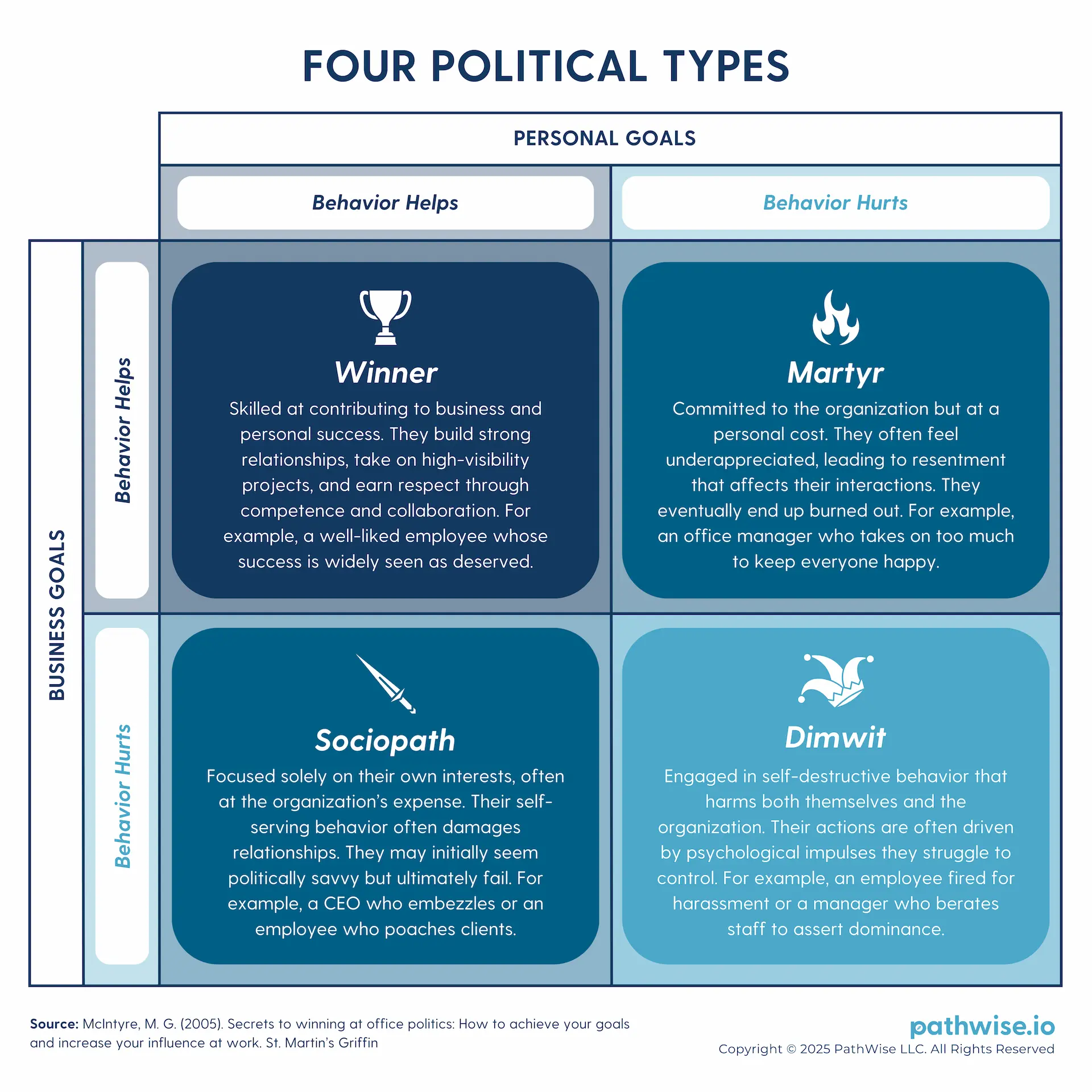
- Political Styles Matrix: In Secrets to Winning at Office Politics, McIntyre outlines different types of political players. Her matrix helps individuals recognize their approach to workplace politics and adjust to become more effective allies or influencers.
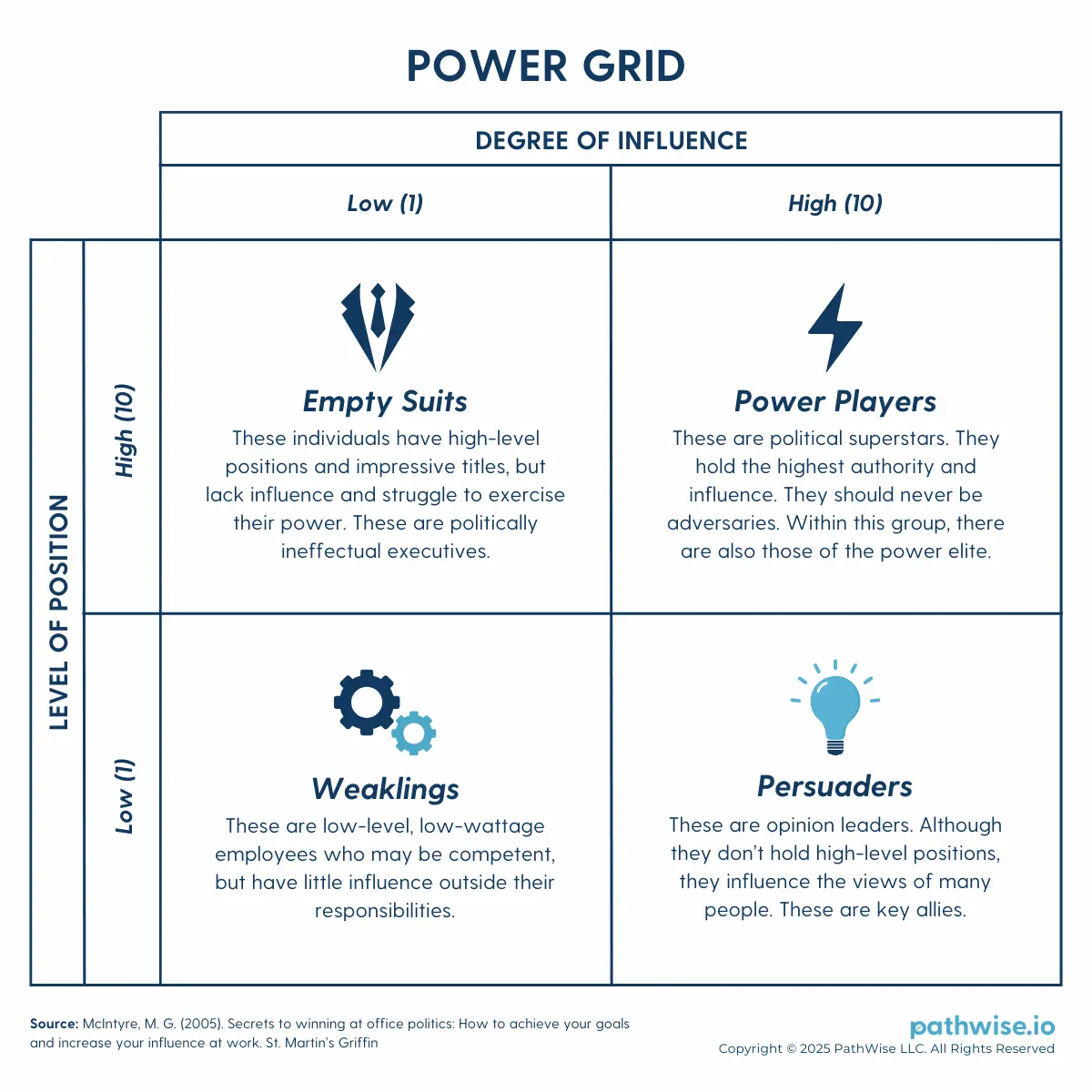
- Power Grid: McIntyre also outlines a power grid that helps assess one’s own power and influence, as well as that of others. Among the four archetypes, your focus should be both to become and to create alliances with persuaders.
- Structural Holes Theory: This theory shows that people who act as bridges between disconnected groups (i.e., span “structural holes”) gain more access to diverse information and influence. These individuals often emerge as key brokers or informal leaders. The theory has been applied to explain how alliances can help professionals gain visibility, innovation advantage, and career mobility.
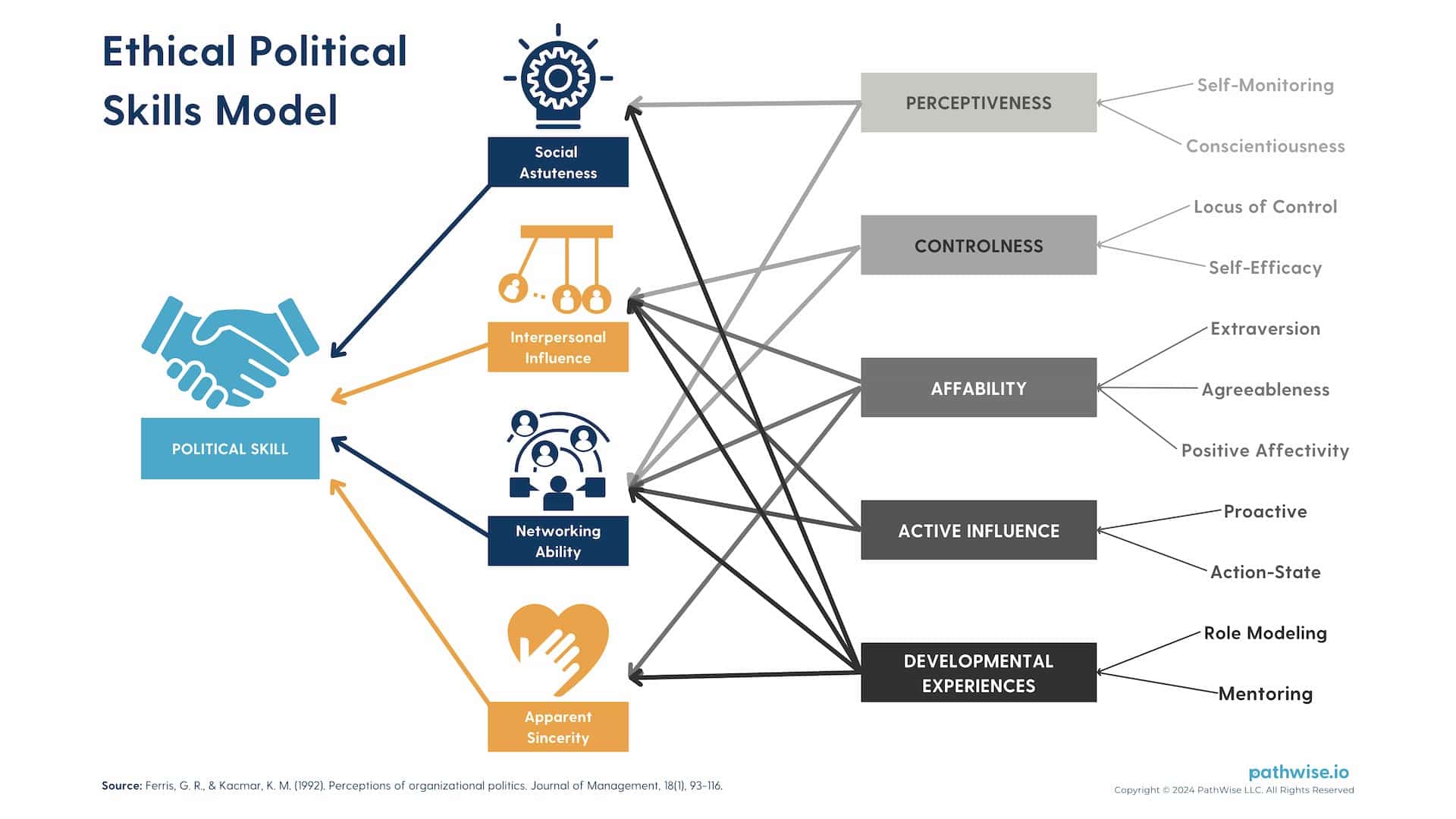
- Political Skills Model: Developed by Gerald Ferris and colleagues, this model defines political skill as a set of social competencies that help individuals understand others, influence effectively, and build beneficial networks. It has four core dimensions. The model is widely used in leadership development and is backed by significant empirical research. High political skill correlates with career success, organizational influence, and leadership effectiveness.
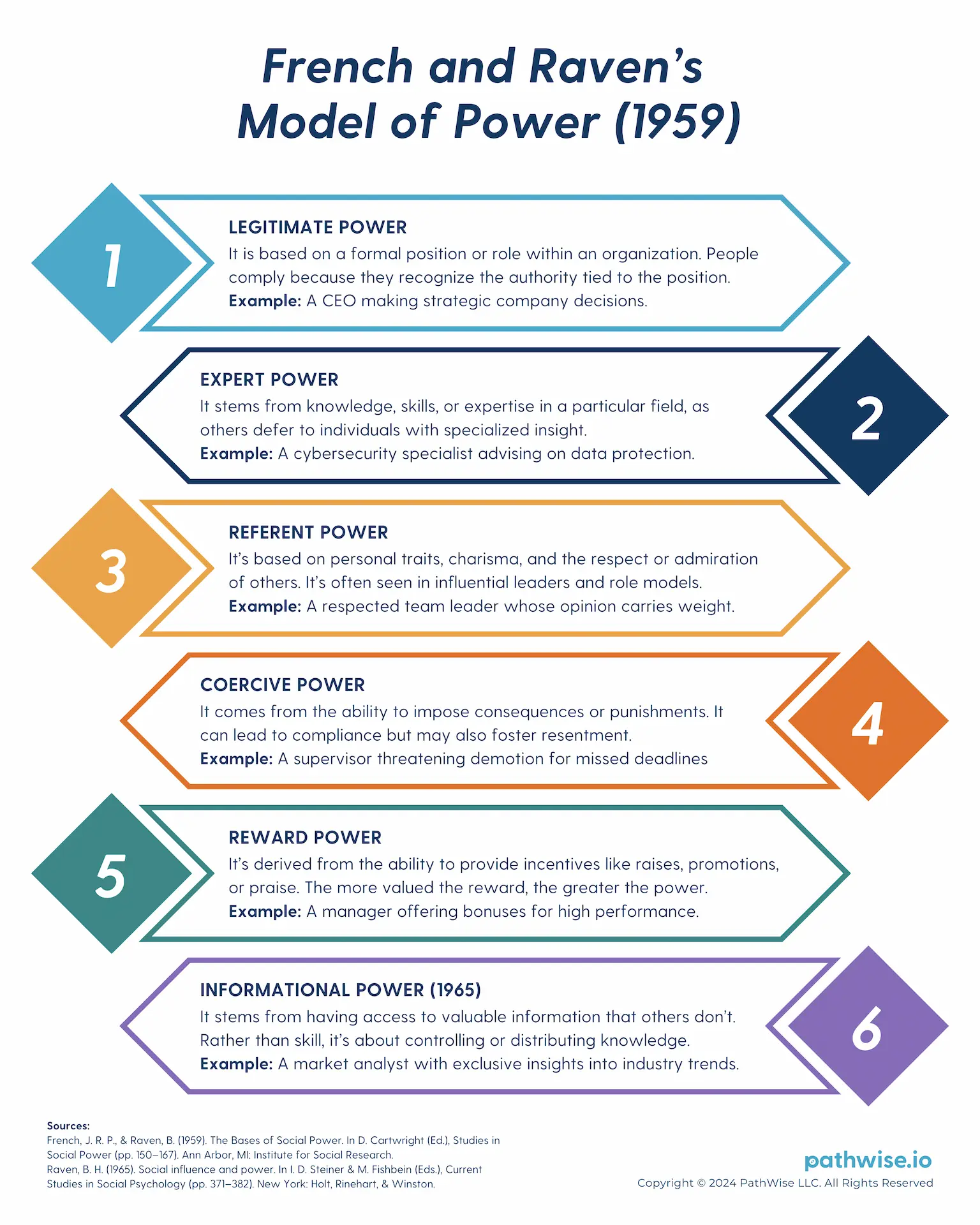
- Five Bases of Power: This early yet enduring framework identifies five sources of power in social settings: Legitimate (positional authority), Reward (ability to distribute incentives), Coercive (ability to punish), Expert (skills or knowledge), and Referent (likability and charisma). Informational (access to information) power was added in 1965. The model remains relevant in analyzing how professionals utilize different types of power to build alliances and exert ethical influence.

Creating Allies and Leadership
Creating allies helps managers expand their influence and impact beyond their formal authority, as it provides access to informal power, transforming them into leaders who build bridges and lead with both influence and integrity.
More specifically, managers who create allies:
- Extend Their Influence Beyond Mere Authority: Managers can only do so much through their title alone. Allies help leaders gain informal influence—the ability to shape decisions, drive change, and mobilize people even without direct control. This is especially critical in matrixed or cross-functional environments, where collaboration spans multiple teams and silos.
- Build Trust and Credibility: Allies are built through consistent, ethical, and mutually beneficial relationships. When managers invest in others and build trust, they earn credibility, making people more willing to follow them.
- Foster Better Decision-Making Skills: Trusted allies offer diverse perspectives, access to valuable insights, early warnings, and candid feedback. Leaders with strong networks can avoid getting trapped in an echo chamber and instead gain access to a broader, more nuanced view of the organization and its underlying dynamics.
- Protect Against Isolation and Blind Spots: Being a manager or boss can be isolating. Allies help them stay connected, informed, and emotionally resilient, especially in politically charged or high-stakes environments. They act as sounding boards and sometimes as protectors when tensions rise.
- Find Support in Change and Innovation: Managers can’t implement change alone. They need coalitions to influence others and generate buy-in. Allies act as amplifiers and translators of a manager’s vision, especially when trying to shift entrenched mindsets or behaviors.
- Model Collaborative Leadership: When managers build and rely on allies, they demonstrate a collaborative leadership style—one that values trust, collaboration, interdependence, and shared success. This sets a cultural tone for teams and reinforces psychologically safe and high-performing environments.
- Strengthen Political Savvy Without Cynicism: Ally-building is a constructive form of political behavior that’s not manipulative, but strategic and principled. It teaches managers how to read power dynamics, build coalitions, advocate for themselves, and support their team in an ethical manner.

Image used under license from Shutterstock.com
Creating Allies and Personal Development
Creating allies is one of the most powerful—and often underestimated—strategies for professional development. While skills and performance are essential, career growth rarely happens in isolation. It depends just as much on relationships, reputation, and access to opportunities. Allies help shape all three. They advocate for our work when we’re not in the room, open doors to new roles or projects, and offer candid feedback that sharpens our thinking. Without strong allies, even the most competent professionals can remain invisible or stagnant.
Allies also help accelerate learning and resilience. In any career, there are moments of uncertainty, challenges, conflict, or transition. Trusted allies can serve as sounding boards, advocates, mentors, or collaborators, offering knowledge, emotional support, and political insight. Through these relationships, we learn to navigate organizational dynamics more strategically, develop confidence in complex environments, and build the kind of social capital that enables long-term growth.
Additionally, creating allies fosters a shift from individual achievement to relational leadership. As we progress in our professional journey, the expectations placed on us expand: we must influence across departments, lead others, persuade those above and below us, and navigate ambiguity. Allies become vital sources of cross-functional insight and credibility. Ultimately, ally-building turns professional development into a collective process rather than a solitary one. It embeds us in a network of mutual growth, where success is shared and amplified.

Image used under license from Shutterstock.com
Conclusion
Much of what determines your career doesn’t happen in public. It happens in rooms you’re not in—project planning meetings, hiring discussions, executive reviews. And in those rooms, you need someone who speaks up for you – someone who remembers your work, defends your decisions, or suggests your name. That’s not luck. That’s allyship.
Other Resources
- PathWise Book Summary: Secrets to Winning at Office Politics
- PathWise Book Summary: Never Eat Alone
- Career Sessions, Career Lessons Podcast with Niven Postma
- HBR: Power & Politics in Organizational Life
- Forbes: Office Politics – How True Leaders Win
- Forbes: The Weight of Politics and Power During Corporate Change
- Forbes: Fifteen Strategies to Minimize Office Politics
- Forbes: How To Form Allies In Your Network (And Why You Should Want To)
