The Human Side Of AI-Driven Change, With Monica Marquez
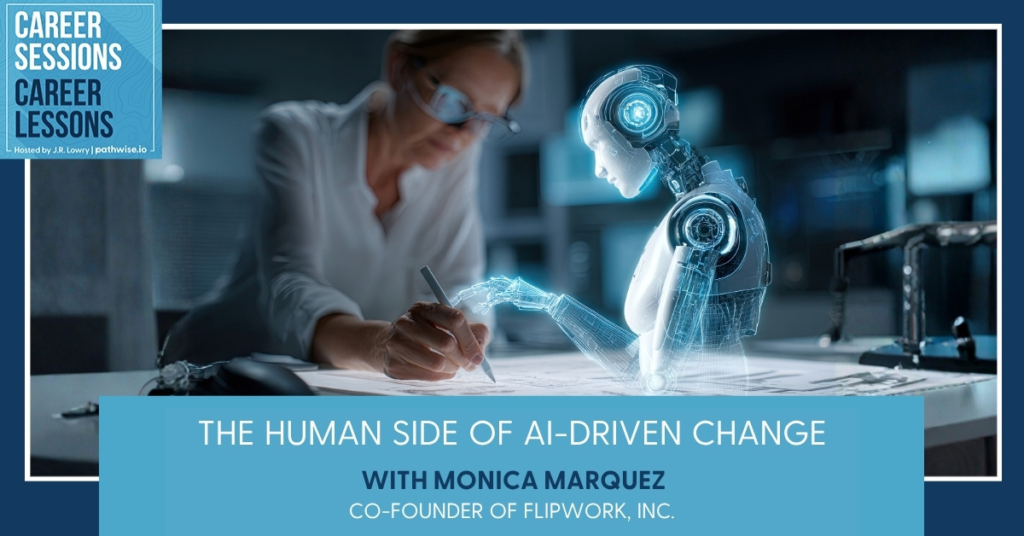
The future of work is here, and it’s being shaped by AI-driven change. Dive into a captivating discussion with Monica Marquez, Co-founder of FlipWork, Inc., the enterprise-wide AI workforce transformation system, as she illuminates the evolving landscape of an AI-centric world. Monica shares her unique insights on bridging the gap between AI tool availability and adoption, the imperative for individuals and organizations to disrupt themselves before being disrupted, and the critical role of human expertise in making artificial intelligence truly authentic.
She also discusses her impactful work in diversity and inclusion, her valuable board work, and the fascinating, “squiggly” journey of her career, offering advice for those just starting.
Preparing your workforce for the shift Monica Marquez describes? PathWise offers professional skills training for an AI-driven workplace.
—
Watch the episode here
Listen to the podcast here
The Human Side Of AI-Driven Change, With Monica Marquez
Co-Founder Of FlipWork, An Enterprise-Wide AI Workforce Transformation System
I’m J.R. Lowry. This is Career Sessions, Career Lessons, which is brought to you by PathWise.io. If you’re to take control of your career, join the thousands who have already become part of our community and become a member now. My guest is Monica Marquez. Monica Marquez is the Cofounder of FlipWork, Inc., which she describes as the only enterprise-wide AI workforce transformation system that ensures Fortune 500 companies adapt quickly to disruptive change.
FlipWork is the People Operating System that turns AI into ROI by reinventing how people work. At our discussion, we’re going to be talking about FlipWork, Monica’s view on the future of work in an AI centric world, her work in diversity and inclusion and what’s ahead there, her board work and her broader career journey. Let’s dive in.
—
Monica, welcome. Thank you for doing the show with me. It’s great to meet you and I’m looking forward to our conversation.
Likewise. Thank you so much for having me. I’m thrilled to have this conversation with you.
The Genesis Of FlipWork: Solving AI Adoption Challenges
Let’s start with what you’re doing now at FlipWork. What inspired you to find it? What gap in the market did you see that you want to sell?
In a nutshell, FlipWork is what we like to call the people operating system that turns AI into ROI by reinventing how people work. The reason we decided to focus on this area is because I saw a lot of companies were buying AI tools but they weren’t changing the way people work. Based on my former experience in corporate and the senior leader roles that I held in HR, a lot of my colleagues who were still were telling me that they were investing in all these AI tools but the adoption level was atrocious.
Even after a year of having these tools, the user rate was only around 47%. Less than half their people were using them. They were seeing them as failures and saying that these tools don’t work. I challenged them that it’s not the tools that aren’t working. It’s that there was a gap in people first, a focus on helping them redesign the workflows, upskilling the team to understand how you adopt or do work differently.
AI is not going to replace you. A human that leverages AI is going to replace you or outpace you. Share on XThey were so used to the tried and true way of doing their job or their roles that pulling in a tool that they just didn’t trust yet was what was holding them back. With that, we started working with a few key clients to figure out a way to help people start to adapt to the change. AI is changing work so fast and it’s faster than people are able to change. That was the inspiration behind FlipWork.
The Three-Pronged Approach To AI Workforce Transformation
What are some of the ways that you do that? What are the services that you provide? How do you bridge that gap between the availability of the tool and the actual use of it?
It’s a three-pronged approach. First, you have to help the individuals understand how to change. We start with the flip operating system to help them learn to focus on what it is that they do well and how you rework some of your workflows. How do you leverage AI to enhance that? How do you start doing these self-assessments and workflow assessments of what takes up a bunch of your time? One of those things are necessary in order to get those things done or what are some of those things that can be delegated to this artificial teammate to help you get some of those things done?
It goes in various different ways. First, we work with humans and what we call helping them flip the mindset of your old playbook isn’t going to suffice now in this world of AI. How do you reinvent or rework your workflows and all of those things to get it done? It’s getting the person to start to leverage the tool and start to trust it, understand it and kick the tires and start to get used to FlipWork or your AI. Flip your work around where the AI is helping you do things that may have taken you three days to do and now you can do in three hours.
There’s a level of mistrust there of like, “This used to take me this long. How can I trust the output?” The reality is, most of these people have a level of expertise that they can test and challenge the outputs and make the outputs better. What they’re starting to realize is that the outputs have a multiplier effect on the level of impact. The quality and the impact of the output is much higher than just the human way of doing it.
Getting them to start to trust and calibrate that for themselves is hard because there’s a level of trust that is still missing, where people don’t trust it because of some of the things they’ve heard. The initial models are they hallucinated a lot and all of those things, but they’ve gotten a lot better. Part of it is that you do have to train your tools or whatever tools you might be using or whatever tools your company has approved. How do you start using them in a way where you start building this trust with those tools and reworking your workflows?
AI’s Impact: Beyond Speed, Towards Authentic Intelligence
As you said, technology has been advancing very quickly. The tools are better than they were back in the early days of 2023 when Gen AI and ChatGPT became words that people are broadly familiar with. We’ve come a long way since then. The tools still can’t do everything, but they get better day-to-day. The challenge a lot of people feel is there are a lot of things that AI tools do not just faster and better than I do. They feel that threat of like, what’s going to happen to me?
That’s part of it. As I mentioned, the three-pronged approach. First, we work on humans to almost get them to understand that AI is not going to replace you. A human that leverages AI is going to replace you or outpace you. You’ve got to learn to start to use it. The second prong is, how do you start working with the teams and the leaders to start to break down the workflows or what is your current operating system that you like? How does your team operate and get things done? How might you enhance those with AI?

AI-Driven Change: It’s not the tools that aren’t working. It’s that there was a gap in people first: focusing on redesigning workflows and upskilling the team to adopt new ways of working.
Finally, how do you continuously challenge yourself every day? We’ve created this AI tool we call Flippy, that helps you flip work. Every day, being able to almost have a conversation with Flippy. If I have to solve X, how might I do it differently or what AI tools or what should I use to make this day more efficient? People realize that the expertise you have is what’s going to make the intelligence authentic to use.
I love alliteration. I love playing with words, word play. I always tell people artificial intelligence is artificial until you put your authentic diversity of thought in it and then it becomes your authentic intelligence. How do you start to work with AI in a way that you are putting your unique perspective and stamp on it because you’ve tested it in different ways of your years and years of expertise to know what is good, what is valid, and what is not.
One thing’s very clear to me. It’s sticking your head in the sand on this one and saying, “I’m just going to keep doing it the old way.” It’s not the thing to do because as you say, the people who are using these tools are going to have an inherent advantage. At the same time, a lot of CEOs out there are talking about how many jobs are going to get rid of and that’s still a challenge. You may be good at using these tools to augment what you’re doing. You’ll still bring your authentic input in and that’s the risk you have is still that the tools, AI may still eat your job.
There’s truth in that in a sense of depending on what is the ultimate goal of the organization. Some arguments are, you can keep your people, all of your people. If you upskill all of your people, then the output you’re going to have is going to be compounded because you teach them how to do more and the output is going to be a lot more. There is somewhere. I do think that there’s going to be some redundancy where there may be some of these middle management roles that aren’t going to be needed like the supervisory or the QA work. There may not need to be as many QA people anymore.
We’re going to see that fall out, but I do think that there’s always new roles that get invented. Once these new workflows come through, you realize where the new QA is going to have to happen or where you have to insert a human. I equate this a lot to where we’ve had to adapt. When they first introduced calculators and people were like, “Absolutely not. You have to show your work in the long work.” Now, I don’t think anybody does any calculation whatsoever without some form of calculator.
It’s going to be the same way where it didn’t replace people. You still have checkers and tellers. Sometimes, now there’s the self-service but then you have to have people there when there’s an issue or something’s not working. There may need to be less people but that’s also the organization and what it is that their whole outcome is. Sometimes, they want less people. You’re probably going to have a downsizing of talent but you may end up finding out that you’re going to have to report that talent somewhere else because there are other checks and balances or things that are going to need to happen.
For that Gary misnomer that it’s just going to replace everybody. I don’t see it happening but we all have to evolve. That’s the idea where I tell people we have to disrupt ourselves before we get disrupted. As you said, if we do put our head in the sand, then you will be getting disrupted and you potentially might get replaced unless you figure out how to reinvent yourself in the way you do work.
Carving A Unique Niche In AI Change Management
The way you’re describing this and the focus that you have on, I’ll call it AI specific change management, training or consulting or whatever word you want to use to describe. It feels relatively unique. Do you feel like you’ve carved out a unique niche for yourself? Who do you see as your competitors?
We have to disrupt ourselves before we get disrupted. Share on XYou nailed that. Several of the senior leaders that we’ve been working with have talked about there being that gap. There is that gap of workforce enablement. How do you enable people to work with AI and reinvent themselves? It is a bit of a place that we’ve carved out and are going to probably see lots of people starting to have that a-ha moment of like it needs to be the people first or the humanistic approach to AI to help organizations start to get their people to leverage it in that way.
The crazy thing is, at some of the conferences and places that I’ve spoken at, I’ve spoken to some of the most senior leaders at Microsoft and other organizations. They too are seeing the whole adoption of these tools at a low roll. That’s when people are talking about, “We have all these AI pilots that have failed.” It’s not the tool that is failing or the technology. It’s the adoption. How do you get people to adopt?
That’s where it falls back into my sweet spot. It’s all about learning and the behavior of how you unlearn something, which is hard to do. How do you unlearn and then relearn how to do something differently? It’s that science around how you get people to change. We all know we have that natural adversity to change, but we’re going to have to do it much faster because AI is changing so fast that we’re all going to get left behind.
It’s particularly a factor now given the speed with which the technology is used to advance. Somewhere along the way, I heard an adage that technology changes quickly and people change slowly. That’s being born out in spades. I’ve been giving a talk in different forums on the science of change. I would apply to things like transformation. I’m giving a more AI specific talk to a company about the topic of how to make sure that you get adoption. In the scheme of things, I would say 47% adoption doesn’t sound horrible to me.
These are your organizations that are pretty good with change. They’re like, “We need to get this above that.” There’s some organizations where the adoption is pretty low. A third of their people have adopted it. They’re paying for all these licenses and the license isn’t being leveraged.
I know in my most recent company, we talked a lot about how broadly we roll out Copilot, just as one example. Given the cost of it, it was unlikely that it was ever going to get rolled out organization- wide because some people were just never going to use it. To your point, why waste money on the licenses if people are using it. It is going to be a bit of a sifting mechanism.
With your calculator example. The people who are still trying to calculate things back in the 1980s using the slide rule looked like dinosaurs. There were spreadsheets that almost rendered the calculators. As you say, everything continues to advance and you have to continue to disrupt yourself. I do worry about the speed at which this is coming at us. I’m not sure we’ve ever seen anything happen this fast that has a potential to be this disruptive.
It’s definitely unprecedented. When you start layering on individuals, conditioned beliefs and other things that compound that, you start to see sometimes that digital divide even gets whiter. What I mean by that is I was having a conversation at a conference that I was speaking to that was predominantly Latino professionals. One of the things that somebody came and told me is, “I’m not leveraging AI because I worry that my manager is going to think that I’m being lazy using AI because I’m not putting in the effort.”

AI-Driven Change: There’s a level of urgency that you have to work with when you are an entrepreneur because it is a bit, you reap what you sow kind of thing.
They were like, “Usually to do this report or this analysis takes me about three days. A good twelve-hours of work, but if I do it with AI, I get it done in three hours. What does that mean that I’m not putting in the effort?” I started to realize that there’s some conditioned beliefs. We’re taught like you’ve got to work hard blood, sweat, and tears, and effort equals success. If they feel like there’s diminished effort, because AI is doing the work, then they don’t feel successful.
It’s like, how do you rewire someone to unlearn that limiting belief to say, “What if we replace effort with impact or effort with quality or quantity of output opposed to your effort? Getting them to have that a-ha moment to say like, “If you could spit out this report in three hours and now you could do twelve reports instead of the one report or analysis you did.” That is where you start to feel the compounding effect of impact and the efficiency in which you can do more work.
I was like, it’s some of those things too that start to play out from a behavioral perspective, the cognitive perspective of people feeling not only is AI going to replace me. It’s going to undervalue me or I’m going to be undervalued. That’s where we have to help people reframe and say, “No, that’s not the case. Your time is freed up so you can apply more of your expertise.”
There’s lots of examples of that where you spend three hours cobbling together the day to produce the report and now you can do that in 30 seconds. It gives you two hours and 59 and a half minutes to think about what the data means. We’re going to produce more personalized reports or a variety of reports.
FlipWork’s Stealth Mode Success And Ambitious 2026 Goals
Those are the things, as you’re saying, that you need to be thinking about just in terms of how you would adapt and bring more value to bear that sits on top of what the tools can do. That’s been true of use of tools since the beginning of the Stone Age. What’s the shape of FlipWork now? How many are you? How is the broader business going for you?
We’re in stealth mode. We started to see and hear from a lot of leaders what was going on. We rolled out a few pilots that have been extremely successful. At least that first part of how you help the humans shift the mindset and then work into the second piece of helping them reinvent work. They’ve been going extremely well and enabled you to start measuring what were benchmarks of output before you were using tools and what were benchmarks after. We’re seeing significant double digit increases of people starting to realize the benefits that they can get out of it.
The ROI is something that is raising the eyebrows of like, “Let’s enable our people to better include that.” We’re building out where we’ve had the MVP and the MVPs evolving as we’re getting more of the inputs. We’re hoping in November that we’re going to have a full-fledged launch and decided that people have this conversation with you and talk a little bit about what we’re seeing. Hopefully, in November, we’ll see and be able to at least roll it out broadly and take on many more clients as we’re building out our infrastructure here to take on that volume.
If you are wildly successful and get the ground running hard out of the gate. Do you have a plan that allows you to scale quickly enough?
It's not the tool that is failing or the technology. It’s the adoption Share on XThat’s part of why we were running in stealth mode because we knew that you would likely get an end date with requests or clients. That’s where we wanted to make sure that we set up that infrastructure to be able to handle that. My cofounder who also happens to be my wife in serial entrepreneurship is the one who built mini companies before, where she’s having to leverage external teams or former teams in India and things like that, build out and be ready. Especially at an enterprise level. Making sure that we have all of the securities and the SOF 2 security. Everything that an organization would need in order for us to be somewhat plug in place for them.
What are your goals for the first year in 2026?
The goals for 2026 is, honestly, to get our MVP situated to where we can easily be able to show someone a demo and for them to immediately get it and roll that out. Our goal is to enable thousands of companies to help enable their people. I would say our first target would be, can we get a hundred Fortune 500 companies? Their people up and running would be amazing if we could do something like that.
That sounds like an incredibly ambitious target for it to have one fifth of the Fortune 500 using your tools. How self-serving is this? Is it something that they can take as a software product or a service product off the shelf so to speak and use for themselves? Is there heavy consulting?
There’s certain tiers. That top tier would be this white gloved tier where we work with organizations or certain business units or certain teams where there would be a human facilitator involved in terms of helping them do that first human piece. We have another level tier where it is self-serve. Some of the lessons and these things that they have to rework for themselves is like self-paced or on-demand. Now, we would just be B2B but we have talked. Some people have planted the seed of, would have this could be B2C, where if there’s individuals that would want to get into the platform and do this change for themselves. Absolutely.
That third piece where we have like Flippy, our AI change agent. It would be a license that companies would have for their people. Their people could use this change on a daily basis to say, “Before I start on this task, let me collaborate with you to figure out how I might complete this task in the most efficient way. What tools or what systems should I be using?” That’s the idea of getting people to start to have that one-on-one check-in every day to say, “I’m about to take on this task. How might I do it differently?” Especially if it’s a new task or something that they have done before.
From Aspiring Doctor To AI Innovator: A Squiggly Career Path
If it’s okay, I want to go back. You’ve had a very squiggly career and I mean that in the best possible way. When I was looking at your background, you’ve done a lot of different things and worked in a lot of different Industries over the years. Going back to the beginning. What were you doing at the start of your career? Walk us through how you got to working on an AI change management offering?
If I go way back, I grew up in a small West Texas town. I was the oldest and only daughter. I have two younger brothers in a very traditional Mexican-American family. We’ve always been taught education is the way out. I was the first to go off to college. At the time, I wanted to be a doctor. I had a limited frame of reference that success in my hometown was if you were a doctor, a lawyer, or a patrolling engineer because of the big oil country, West Texas.

AI-Driven Change: Creating opportunity for people when there was an obstacle, getting that out of the way, and getting them into roles that helped them succeed—that was life-changing.
When I stepped foot on college campus and I realized all of these different disciplines and majors, the aperture started widening of what I could do. I stayed the course doing the biology and it wasn’t until my senior year, I was graduating. I was applying to med school through a mentor of mine who I happen to have been working with for the last four years in college during a work-study program. He asked me, “Monica, why do you want to be a doctor?”
I was like, “My mom wants me to be a doctor. It’s what I want to do.” He’s like, “No. Why do you want to be a doctor? I see all of the things that you did on campus with extracurricular activities, very involved in student government and all of these things that you were doing, but I never saw you light up about your biology or your medical school.”
I had this crossroads of like what do I want to do? What I found was that most of the things that I was doing were all about transfer of knowledge like, how do you learn and how do you help transfer that knowledge to people? I pursued a different course. After my Master’s, I packed up my bags and I moved to New York City. I started off in academia and it was this idea of, how do you help people open their aperture?
I started at NYU, where I was working and building out study abroad programs and getting people to immerse themselves in other cultures and learn. Ironically, I met someone who was a friend of mine and she was a lead recruiter at Goldman Sachs. She was like, “There might be a role for you at Goldman Sachs. They have this brand new office of global leadership and diversity. It’s about how you teach people cultural competencies so they can work in other countries like emerging markets and all this stuff.”
At first, I was like, “Why would I want to go corporate?” She was like, “Have these conversations.” I did and I was interested in how I could take what I was doing and help other people and enable them to do more work, better work. That’s where I shifted into this more of applying professional development, people development learning in a corporate space to help people up level their skills and things like that. That’s where I started.
Where the technology comes in is, I’ve always just had a knack for it. I’ve always been someone who’s super curious like, “New tools? Let me test it out.” I’ve never had that fear of what if. I’ve been surrounded by people who always welcomed the pioneering, like, “Let’s see what could come of it.” I’ve always just had that mat for it. I’m the big research nerd who will be like, “Let me take some class or those types of things.”
What I find is a lot of my STEM background, whether it was in physics or any of the computer science or technology classes I took in college. The foundation helps me make sense of it, but I’ve just been one who hasn’t been fearful to try those different things. I’ve been fortunate where I have colleagues that I built strong relationships with. When they go somewhere and they see a need that they’re like, “I know someone who could help us do this,” I get taped on the shoulder.
I’ve been one to always never say no to an opportunity. Suss it out and see what keeps my interest then, why not? I’ve been fortunate in that way where I’ve had lots of opportunities at some amazing organizations. After that, I picked my interest of if I could confine myself to the four walls of an organization and do good work but what if I could help more and transfer more knowledge to more organizations? That’s when I decided to go off on my own a few years ago.
You've got to stop thinking like a corporate executive. You've got to think like an entrepreneur. Share on XHow have you found that experience over the years?
There were moments where I questioned things like, “What did I do?” There were some, I would say even personal self-doubt creeping up, like, “Who am I without this label behind my name?” I found that staying the course and knowing what I had and believing in the mission of what we were trying to do, the course and proximity to my old colleagues and former people who knew me in the type of work that I did, I think the credibility I built. I was able to bring that credibility. It never left me.
In my mind I thought, “I left it all behind,” but I had to have also flipped the script myself and realized that I brought all of that with me. Now, how do I capitalize on that? There were some scary moments. There were some moments where it’s like, “What did I do?” What I have learned is that there’s a level of urgency that you have to work with when you are an entrepreneur because it is a bit, you reap what you sow kind of thing. That was the scariest part.
That security blanket was gone but thankful for me. My cofounder is someone who is brilliant in that space. It’s like, I have subject matter expertise and I can lean on somebody and build a team around me that can help us. We can’t do it alone that can help us make sure that we are providing the best service to all of our clients.
I was having this conversation with somebody earlier about the life of the entrepreneur versus the life of the corporate at whatever level. Where you’ve got all of this infrastructure behind you that helps get stuff done. As an entrepreneur, you’re always selling. No matter what you’re doing because if you’re not selling, you’re not going to generate revenue. You don’t have a viable life if you’re not generating revenue. You spend a lot of time doing minutiae and your ability to figure out how to systematize as much of that stuff. You spend as little time on it is super important. This is where AI tools are great.
Also, these workflow tools that are out there that just allow you to automate all of the routine parts of what you do so that you can focus on the things that are less routine and noble, more higher, order more, and customer facing. Apart from all of the other things that make being an entrepreneur difficult, the imperative that you learn how to use these new tools.
If you’re like everything else, you’re going to lose out to the person who’s better at using that. They figure out how to work smarter. Your effort versus impact point that you were making earlier. You got to get that equation working right for yourself. Otherwise, you don’t get the level of impact because everything flows through you. If you don’t get that going right then you end up being the bottleneck and you can’t scale.
There was an untapped talent pool that wasn't given an on-ramp back into the organization Share on XThat was the hardest thing for me. I can tell you that we’re budding heads with my cofounder because she had been an entrepreneur for several years before I came on board for at least a decade. She kept telling me, “You’ve got to stop thinking like a corporate executive. You’ve got to think like an entrepreneur.”
She was like, “Stop working on the $10 problem. I need you to work on the million-dollar problem and outsource that $10 problem. Let’s calculate your hourly rate. Anything less than this amount, you shouldn’t be focusing on. You spending an hour on this, how was it impacting revenue? If it’s not impacting revenue don’t do it.” That was hard for me to shift because again, I wanted to add value. I was like, “I want to roll up my sleeves and do work.” She was like, “I want you to roll up your sleeves and do work, but focus on the million-dollar problem and let the other things get delegated.” That was very hard to do.
Sometimes, it’s hard to find a $7 solution to a $10 opportunity. For some entrepreneurs, they can’t afford to outsource as much as they would want to outsource. They can’t figure out how to do it economically, so they end up doing a lot more things themselves. That’s a tough equation. Either you don’t have the money or you don’t have the ability to figure out how to make it economic. It’s challenging.
To your point, AI now is allowing that. We’re seeing so many more tasty studies now where you have these multimillion-dollar companies. They have less than five people on their team because they’re using AI for everything. It’s one of those things where you’ve got to figure out. It can be possible but you’ve got to reinvent the way that you do work.
Pioneering Returnship Programs: Tapping Untapped Talent
You have to remember the way that you do work. I know diversity has been a big theme in your career. You’re involved with some of the Latin-American Trade groups or employee groups in companies that you’ve worked with. You did some things at Goldman and Google that I thought would be interesting. At Goldman, you pioneered what you called returnship programs to get women who would love the workforce or back into the workforce. What did you learn from doing that? That’s still an issue. It’s probably as much of an issue now as it has been because the daycare challenges are more pronounced than they have been pre-COVID. What did you learn from that experience?
What I learned from that experience is, we were having this problem. I was brought in, working with the diversity recruiting team and trying to bring in diverse talent. The irony is, there was diverse talent but they were leaving for various reasons that pushed and pulled. Personal pools of family and domestic responsibilities and things like that. These individuals has spent years at the organization learning and the organization investing in them and their learning. It’s because of this misnomer of the career gap on your resume, recruiters and others would immediately dismiss somebody when they wanted to come back.
What I learned was that there was an untapped talent pool that wasn’t given an on-ramp back into the organization because of these biased opinions of once you had the career gap. It was one of those things where I challenged myself. It was like, how do we get brand new talent? We go to campuses. We hire these kids but we don’t hire them just out of the blue. We give them internships and assess them then we extend an offer and we bring them on. I was like, how could we remove this fear that hiring managers had of people with career gaps because they’ve been out for 2 years, 5 years plus, or whatever?
These people weren’t dormant. They were child care. They were raising their children, but many of them are the type A high performing individuals, where running PTAs or running the books for their students school or whatever it was. They were staying active. Some of them were even doing Civic work running for Mayor or Deputy whatever of their township. They’re not dormant. How do we bring them back in? That’s when we were introduced just like kids that we bring in from college campuses for internships. Why don’t we have a returnship where they can get back into the groove of working in a full-time place?

AI-Driven Change: Get rid of this persona or this misnomer that employee resource groups were just like social groups for people to get together and do things.
There’s a start date and an end date where the manager can assess. It removed the risk for them or at least the perceived risk. Interestingly enough, what we found is that more than 80%, if not 90% of the individuals coming in. We’re getting full-time offers at the end of their twelve weeks because they proved themselves that they could do the work and that they were extremely seasoned professionals. It became an easy on-ramp and it became the gold standard of a lot of other companies in creating these returns to bring talent back into these opportunities.
What I loved is, we were able to then use that template for even veterans and military. We started the VIP program. Which is the veterans internship program to help individuals come in from a military background into civilian roles and we did the same thing. That was amazing. It was fun. When people say, what is one of your favorite things that you’ve ever worked on? It was that, of creating opportunity for those people who there was an obstacle and we were able to get that out of the way and get them into roles that helped them succeed and life-changing.
Business Resource Groups: Driving Product Inclusion And ROI
You did some interesting things at Google, too. I know you focused on evolving employee resource groups which most people in big companies will be familiar with into more what you call business resource groups that had a more direct alignment with the business objectives. How did that play out in practice? What were some of the things that you did?
There always needs to be a sense of belonging, community, and organizations. Sometimes a lot of these employee resource groups are affinity driven. They’re not just ethnicity and gender. There’s lots of one, especially at Google. You have lots of different employee resource groups. What we were trying to also get them to do is get rid of this persona or this misnomer that employee resource groups were just like social groups for people to get together and do things.
What they could tap into is to bring this unique perspective or this diversity of thought of, how do you help your company if you are building products, like tangible products or offering services? How can you make sure that you are creating these products and these tools for the broader society? Partnering with various different product managers to make their product better. One great example that started, where they would do these hackathons of, how do you make a product better?
The Google hardware team partnered with the various different business resource groups to say, “We want to make the voice recognition better. How about if all of you all take a Google home with you and have your tiyas and tiyos and people who have English as a second language work with it so that we can start learning and understanding and picking up people with accents and making it a better product?”
It was things like that, how you improve the product by bringing in the perspective of different people. Those were things where they started winning awards because voice recognition was so much better because they were working with people that had a different background, different cultures and things like that.
Also, little things were also helping the diverse individual realize how their differences could impact the bottom line. One other interesting case studies story that I’ve read before is there was a point where gift cards saw a dip and consumers purchased them. They partnered with some of the diverse resource groups to find out what were ways that we could tap into other markets.
At the end of the day, it's not about lowering the bar. Share on XOne, the Asian Professional Network partnered with them to say, “Chinese New Year’s coming up and it’s tradition that we give people money in red envelopes. What if you were to create a gift card that came in a red envelope or that had some graphics that were appropriate for Chinese New Year?” They saw a huge uptick that year in purchases of gift cards. That’s where you see the diversity of thought and where employee resource groups that from a certain affinity can impact the bottom dollar if they’re giving an opportunity to partner and provide their diversity of thought.
Navigating The Evolving Landscape Of Diversity And Inclusion
We’re going through a bit of a sea change moment with diversity. What’s your take on that? Where do you feel like things are going to go in the next few years?
There’s always a pendulum swing. I remember in college. One of my thesis papers was on affirmative action, where the affirmative action went out the window scholarships. I remember even my scholarship was taken away and I had to reapply for it because not only was it for diverse students. It was open for everybody. I had to reapply and I was awarded it again. The whole thing was that those things went away.
There’s a shift where people start to realize the value of diversity and the diversity of thought. I think that it always comes down to fear and assumptions and misrepresentations. The irony is, DEI many times is like the examples that I’ve talked about with product inclusion. When they started this, it was because they were focused on the bottom dollar. They were going into emerging markets where they didn’t know the culture. You can’t go do work in another country if you don’t understand them.
Rather than trying to train somebody who’s a non-native. Why wouldn’t you hire more people from that culture so that you could do more work and make more money? At the end of the day, when people stop or when they forget that many DEI initiatives started because they wanted to increase ROI then they’ll remember and say, “If we use it correctly, it benefits everybody.” We’re probably seeing that swing where people are pushing back. At some point, it’s going to make its way back over it depending on those who are in charge at the time and how they are perceiving or positioning the DEI efforts and initiatives.
It’s a difficult time. At the end of the day, I try to tell people that you have to keep doing the work that you’re doing and a lot of the times one-on-one. If you talk to each person and you’re open and you are authentically yourself. Those things tend to work themselves out. We’re probably going to see another few years where there’s some pushback but eventually, it’s going to calibrate and bring itself back and people are going to see the benefits. When they start to miss the benefits is when they’re going to start little by little infusing those back in.
You talked a little bit about this with respect to your program that you ran at Goldman. As a hiring manager, what you want is to have as broad a candidate poll as possible. The broader the candidate poll is, the more likely it is that you’re going to find a great candidate. If you have an aero candidate, you won’t. You can play that argument both ways, the affirmative action maybe could be fun as narrowing the candidate poll. It could be fun as broadening the candidate poll, depending on how you use it. Sometimes, we get caught up in the words and the realities, but we’re living in a world of perception, so on a lot of topics.
I agree with you. When I was heading up diversity recruiting, the one thing that I would tell people is, you don’t lower the bar. At the end of the day, it’s not about lowering the bar. As you said, people can spin affirmative action saying that they gave this less capable person this role. That’s when it’s wrong. I would even agree. You can’t give somebody who is less qualified for this role just because of trying to meet some quota.

AI-Driven Change: You have to keep doing the work, often one-on-one. If you talk to each person, are open, and authentically yourself, those things tend to work themselves out.
At the end of the day, if all things being equal, these people are par to par, then you can’t argue that this person isn’t qualified. That’s where it is at. You can’t lower the bar but, unfortunately, it does happen but it happens both ways. Sometimes, it’s like who you know, you get the job when the less qualified person gets the job. As you said, it’s perceptions. It’s these things that play out that we have to figure out how we navigate through those situations and do the right thing.
A couple last questions, if it’s okay. You do some board work. How does the board work that you do complement what you’re doing with FlipWork and with some of the things that you’ve done up until now?
A lot of the missions usually speak to me and resonate with me. For me, the work that I do with the Association of Latino Professionals For America which is ALPFA. It’s again that transfer of knowledge of trying to help the younger generations. How do you transfer knowledge of what success looks like? How do they help them navigate the corporate ladder much faster than me? It might have taken me the better part of two decades to get to senior executive roles. How might I transfer that knowledge to somebody to say, “Here’s how you can navigate and maybe get there five years earlier than I did or those types of things?”
With Latinas in Tech, the same thing. I’ve worked in the tech industry. You’ve seen how low those numbers can be but I also see the benefits of when you do have that diversity of thought and you’re building products with everybody in mind. How beneficial that can be? Helping Latinas become leaders in those organizations and helping create the pipeline of qualified candidates is something that plays to what I’m doing.
The way that it ties into a lot of the work that I’ve done with my former company Beyond Barriers, as well as with FlipWork now is, how do you help them adapt to change quickly? How do you make sure that you are infusing those strategies and helping them shift those mindsets early on so that you will enable them to change it at a much faster pace and ride the wave as opposed to getting crushed by it?
Adaptability As The North Star: Advice For New Careers
What advice would you give someone who’s just starting their career now?
What I love to tell individuals who are starting their career is to know your North Star. The North Star of what it is that you want to do is what success looks like to you, but don’t be afraid if that changes more than a dozen times over the span of your career. The research is now showing that most people over the course of their career change jobs fourteen times on average.
Don’t get so narrow-minded on, “This is what I have to do.” Embrace this idea of innovation and evolution. Not just of technologies and companies but yourself. How do you upgrade your personal operating system constantly? How are you constantly putting in the updates in the patches so that you can be successful? The only static thing that’s going to happen in your career is change, so get comfortable with it.
Know your North Star. The North Star of what it is that you want to do is what success looks like to you, but don't be afraid if that changes more than a dozen times over the span of your career. Share on XAdaptability is probably one of the core things that everybody just needs to build into their DNA. In the old era of everybody working for one company for their entire career, it’s like you hoped you picked a good one because you might be stuck with it for your whole life. It’s a lot easier to change jobs, change careers and dial up and down the intensity of how much you’re working. That’s a good thing in the scheme of things. For most people, they want you to do different things in their life and the ability to do that is probably greater than ever.
I totally agree.
You can’t fall into a status quo run.
It’s a curiosity. The status quo is dangerous. When I start feeling idle, I’m like, “Something going on.”
Monica, thanks for doing this with me. I appreciate your time and getting to know you a bit. We bounced around a little bit in terms of topics, but interesting conversations. Thank you.
It has been a pleasure. Take care.
You, too. Bye-bye.
—
I want to thank Monica for joining me to discuss her firm FlipWork, her view of the future of work particularly in an AI centric world, some of her work in diversity, inclusion and what we can expect in that space going forward or forward work and her broader career journey. As a reminder, this show is brought to you by PathWise.io. If you’re ready to take control of your career, join the PathWise community. You can also sign up on the website for our newsletter and follow us on LinkedIn, Facebook, YouTube, Instagram, and TikTok. Thanks.
Important Links
- Monica Marquez
- Monica Marquez on LinkedIn
- Monica Marquez on Instagram
- FlipWork
- Asian Professional Network
- Association of Latino Professionals For America
- Latinas in Tech
- Beyond Barriers
- PathWise on LinkedIn
- PathWise on Facebook
- PathWise on YouTube
- PathWise on Instagram
- PathWise on TikTok
- PathWise on Twitter
About Monica Marquez

With over 20 years of corporate leadership experience, Monica has led teams through transformation in workforce, talent, culture, and systems. She has worked at Google, Goldman Sachs, Bank of America, and EY, building programs that expanded opportunity and created more inclusive environments for high-potential talent.
At Goldman Sachs, Monica pioneered Returnship® and New Directions®, helping thousands of women re-enter the workforce and influencing talent practices across the industry. At Google, she led the evolution of employee resource groups into business resource groups, aligning them with business goals and delivering measurable impact. Throughout her career, she has designed innovative learning and development programs that help leaders grow and advance their careers with clarity and confidence.
After a successful corporate career, Monica became a serial entrepreneur to scale her impact. She has built mission-driven businesses focused on accelerating professional growth, expanding access to leadership development, and equipping people with the mindset and tools to succeed in fast-changing environments. These ventures have helped thousands of professionals embrace change, lead with intention, and deliver measurable results.
Monica serves on boards committed to leadership and representation, including the National Board of ALPFA, Latinas in Tech, and the Corporate Advisory Board for Texas Tech University’s Career Services Center.
