How AI Is Powering Customer Analytics, With Sameer Narkar
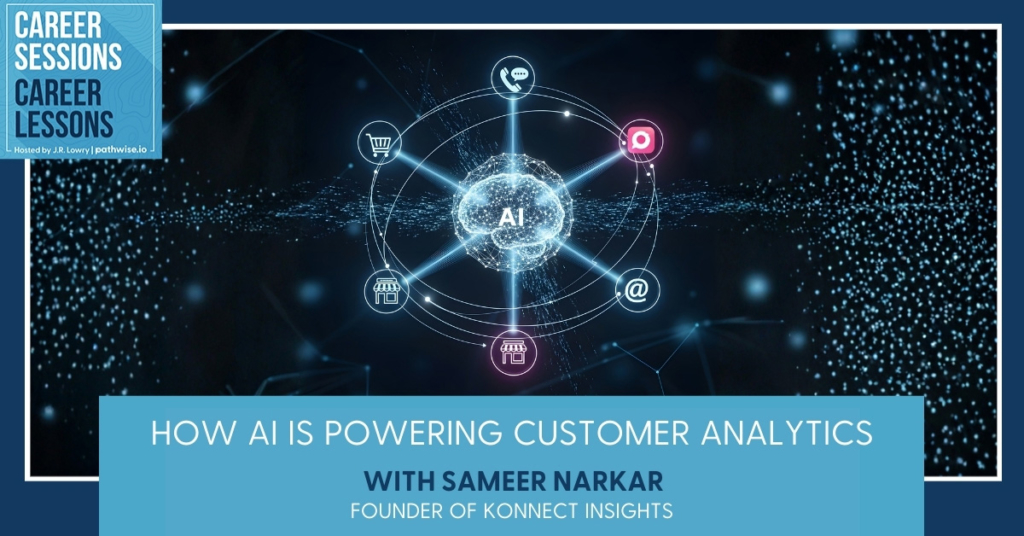
The future of business hinges on mastering the complexities of AI customer analytics, a topic J.R. Lowry explores with Sameer Narkar, Founder of Konnect Insights, a pioneering SaaS platform that delivers an AI-powered, omnichannel view of customer interactions.
Sameer details how his bootstrapped company built an in-house, secure AI solution using models like Llama and Gamma to unify customer data from all channels, solving the pain point of siloed systems to dramatically improve customer care and provide deep marketing insights.
The conversation also delves into the three layers of Konnect’s AI offering, the journey of pivoting a business, and the critical need for focus and a strong culture for leaders navigating the rapidly evolving landscape of decision analytics and AI.
Check out the full series of “Career Sessions, Career Lessons” podcasts here or visit pathwise.io/podcast/. A full written transcript of this episode is also available at https://pathwise.io/podcasts/sameer-narkar
—
Watch the episode here
Listen to the podcast here
How AI Is Powering Customer Analytics, With Sameer Narkar
I am J.R. Lowry. This is Career Sessions Career Lessons. Thanks so much for being here. This show is brought to you by Pathwise.io. We are here to help you take control of your career so it is not controlling you. If you are ready to do that, like thousands of others already have, join the Pathwise community. Our topic is AI-enabled customer experience.
We are going to be talking about that, the broader role that AI is playing in decision analytics. It’s impact on our career journeys. I am joined by our guest, Sameer Narkar, who is the founder of Konnect Insights, a SaaS platform that gives you that AI-powered, omnichannel view of your customer experience, and how all of the data across all of your customer channels comes together. That is what we will be talking about. Let us get going.
—
Sameer, welcome. Thank you for joining me on the show.
J.R., thank you for having me here.
From Engineer To Founder: Sameer Narkar’s 10-Year Journey
Really curious to hear what you are doing. It is a hot topic, how we are applying AI in the analytics space. Obviously, you guys are right in the middle of that, as we are going to get to. Before we do that, why don’t you just give us the brief background on you?
I am an electronics and telecom engineer, as you can guess. Most of the guys in India are engineers. I started my career as a software developer after completing my engineering. I worked in the finance domain. I worked in derivatives, equities, mutual funds, and insurance. As a software developer, but in the finance domain. I started this company about ten years back with the idea of how we could have some analytics for local vendors.
That is now devoted to an omnichannel customer experience for large and mid-size enterprises. What we started was way different than what we are. Talking about my background, an engineer who was a software developer, now wearing multiple hats of being a marketer, salesperson, and leading partnerships. It happens as you start. Of course, you learn the tricks of the trade once you start your own company. Before that, I was just a software developer, nothing more than that.
How big is Konnect Insights these days? How many employees do you have? Are you all based in Mumbai, or are you elsewhere as well?
We are a total of about 140 plus employees based out of Mumbai as our headquarters. Our employees are there in other parts of the world. We are in Southeast Asia. We have an office in Singapore and a couple of employees there. We have guys in Saudi Arabia, in the UAE, in Egypt, in Brazil, in Lebanon. That is where our people are. In India, we are in Mumbai, Chennai, and Delhi. We started here in this office with three folks. Now we are around 140 plus with customers in 30 plus countries, majorly in the Middle East, Southeast Asia, Latin America, and a few customers in the UK as well.
You mentioned a minute ago that you guys pivoted and evolved into this space. How did you find yourself there? Why did companies struggle so much with turning their customer data into actionable insights?
Any journey of any company that you see, the finished product is actually way different than the idea that you started with, because you learn from your customers. You have some idea about what the product should be, but as you talk to the customers, the users, you learn from them. The product starts to pivot. Even today, we have a greater understanding of what the product should be. As we talk more to the customers in different parts of the world, we understand what features should be modified. Accordingly, build the product.
It turns out to be way different than what it was. That is a constant development that you have to work on with the product and market. I have seen what happened in the last 2, 3 years. AI is just not a feature. It is now an integral part of your offering. New things keep coming. That is the fun part. As long as you are enjoying what you are doing, like what you enjoyed when you started your company, as long as that fun part is there, you will always evolve as a product. You will have different ways of marketing your product and building communication. Also doing sales in global markets.
AI is just not a feature. It is now an integral part of your offering. Share on XEliminating Data Silos: The Power Of Omnichannel Customer Experience
What problem are you now solving for your customers? What is the challenge that they are wrestling with?
What happens in today’s world is in terms of customer experience. Our product is an omnichannel customer experience. What that means is if I am a brand, customers are talking to me. They can come to me on any given channel of their choice. The ideal world would be. I demand that my customer come only on one channel. That channel is, let us say, email. That would be an ideal world. A brand would know everything about that customer. I will have the history.
I will have the complete records of how the agents served that customer. What was the CSAT? What were the SLAs? Did we meet our SLAs or not? CSAT means customer satisfaction score. SLA means service level agreement, which says that my first-level response should go in fifteen minutes. Resolution should happen in a day. It will be very easy for me to keep track if there were just one channel. The problem is that customers can reach out to you on any given channel.
They can come on social media, email, calls, and chats. Even social media has Twitter, Facebook, Instagram, YouTube, and LinkedIn. You can have Google business reviews. You can have sites like Trustpilot, Quora, and Reddit. Customers go on all these platforms, express their opinions, and also raise questions. All you have to do is find that it was one person across these channels. Give me an ideal product that unifies all those channels into one channel experience.
That is what we really do well. We ensure that every single customer touch point out there is unified in one single platform. Your agent is only on one view, not only resolving those queries, but it also has other platforms connected really well, because you will have your own CRMs. You will have your own order management systems. You might have a contact center, CCaaS solution. Everything has to be integrated into one platform. That is what we really do well at Konnect Insights.
We connect all those platforms. We ensure that every single customer touch point is covered within the channel, every single non-voice channel, every single voice channel integrated. We solve that. The advantage that the brands get out of this is that if they are using siloed solutions, one for ticketing, one for contact center, one for social queries, another for emails, obviously, the agents will have 5 to 6 iterations to solve a query.
It would take about 20, 25 minutes to solve a query. We bring that down to, let us say, 7 minutes or 5 minutes. If a query was to be resolved in 5 to 6 iterations by asking a lot of questions to the customer, it gets resolved in two iterations. That is the whole ROI side of things, our brands benefit. You get all sorts of insights just because you have that entire customer data within Konnect Insights.
You can make sense out of data by understanding what a sentiment is, what different product categories people talk about, how you fare against the competition, what your campaign insights are, your share of voice, and influencers talking. All that is within one platform. That is where the world is heading. No more siloed solutions, no more point solutions. You need a unified omnichannel platform that connects well with all the touch points, other platforms that you have. That is what we really do well at Konnect Insights.
Clearly, that is a huge need that everybody has had. As you said a minute ago, you will have your CRM system. You may have a contact center system. You will have all of your operating systems that create records of customer interactions. You talked about the efficiency aspect from a customer perspective.
When they call in, they are like, “I sent you an email. I got to your website. I tried calling your call center.” If you do not have a sense of that, you do not feel like you are necessarily really well connected with what they are doing. That is the problem that you guys are solving. What you are doing ultimately, the point you made a minute ago, Sameer, about integrating across all of those different platforms, we go through these cycles.
It started with ERM systems decades ago, the be-all end-all, “We are going to do everything for you.” Generally, those systems do not work, which is why we end up with these point solutions. You need an, I will call it, an integrating system. That plays a glue role in pulling all of that together in one way or another. That is how I take in what you are sharing in terms of what you guys are doing.
Talking about the customer, the way customers look at a brand is, I am talking to one brand. I am not thinking, “I am talking to agents.” As a customer, I do not think, “I am talking to systems.” For me, it is a brand. Whoever that customer agent who is talking to me is representing the brand. When I think of that brand next time, it is how I was served by that agent.
It is all the more important for the brands to empower their agent with a unified solution. Use the power of AI to give them AI summaries, next best actions, and everything connected with the knowledge bits. They know what kind of answers are there for the questions that are posed, a lot more addition. You are really empowering the agents with the power of AI and integrated solutions.
It is all the more important for the brands to empower their agents with a unified solution. Share on XBeyond CX: How AI Insights Power Marketing And Care Teams
When you get to the point where you have a customer up and running on your system, they are getting their omnichannel data, and they have the AI tool that helps them analyze that. How do they then take that back into their organization across marketing people, salespeople, and customer service people to make sure that they are getting them out of their functional silos?
It is an ideal platform for customer care and marketing insights. Not so much for sales unless you have some leads that are flowing into your CRM because of the social listening data. There is a use case for that, but that is not how we really position it. We focus more on the care and the marketing inside of things.
For the care team, it is understanding how they are getting better with the overall experience, how many queries they are solving more, what kind of rise in customer satisfaction scores there, what is the NPS, and what is the agent performance, not only in terms of quantitatively, but also qualitatively. Have they done the right things? Were there any opportunities for sales during the call or during the query resolution?
The AI gives you those metrics that there was an opportunity for sales, but you missed it. It gives you those kinds of signals. Again, you need not go through every single conversation to understand what was the quality of the response. The AI really does that. That is from the customer care side of things. You will measure your turnaround time. You will measure whether your SLAs are met. In addition to that, you just ensure that every single channel is within one platform, let us say that is Konnect Insights. It is giving you a complete view of your customer care, not just separate teams.
I do not want to measure emails separately, calls separately, and social data separately. I want to do that unified. I can set SLAs depending on the channel because an email resolution can take two days, but my social media resolution, at least the first-level response, has to be within ten minutes. The final resolution can take some time. You measure all that. You ensure in QA, quality assessment, that no private data is shared when you are having a public conversation.
There are means to take that public conversation to private channels within the channel. If it is Twitter, it is a DM. For Facebook, it is an inbox. You can actually move that conversation to WhatsApp from Twitter. You need to measure all that, whether the PIA information was saved. Nothing was shared on the public platform. On the customer care side of things, you measure that. In marketing, you also have to look at marketing insights.
Also, what kind of content analysis can you do? Marketing insights could be people talking, the insights on that. The analytics for the content team would be what we are posting, what our competition is posting, what kind of metrics they are getting versus us, which is engagement, let us say predictive reach or predictive impressions, and the influencers talking. What kind of content really worked? AI today can suggest to you what kind of content you can really post.
If you are a media channel, it can go to the level of characters who are really working well. Suggest that post around these characters or whatever category. Depending on the industry, it does an auto categorization. It suggests to you that these are the kind of posts that you should do as far as the content team is concerned. Whereas the market research team, even within that, you can look at marketing insights purely from what people are talking about.
Also, from the PR side of things. It needs to predict if there could be a PR crisis. AI suggests to you if a crisis has happened, what your communication. It creates a report on the fly. On the inside side of things, you understand what your sentiment score is, how you are fighting against the competition, what the campaign insights are, and everything about the brand in terms of perception is what the marketing team really looks into.
Care, marketing, and a bit of sales is what is possible when you listen to every single customer conversation, not just customers, but just publicly, people who are talking about you. The way we look at it now is, let’s say if I am a brand, there is one system that has every possible data that matters to me. Private, because I have authenticated in the channels, and public, because it just ensures the public data is out there.
It becomes a platform that can answer any question for me. Whatever questions I have, like how do I fare against the competition? If a query like, “What is the ideal campaign that we can run? What are competitors doing? Is there any scope for a campaign launch?” I need those answers. Just like we asked ChatGPT about the complexity of the world, this is now the email for your world is how the social listening tools or the customer experience platforms will be seen from here on.
Competition Analysis: The Importance Of Publicly And Legally Available Data
The competitive aspect is interesting. The social listening component that you were describing a minute ago, Sameer. If I am on LinkedIn, I gave you a list of people that I see as my competitors. You have the ability essentially to scrape LinkedIn data, to be able to look at what they are doing on LinkedIn, what I am doing on LinkedIn, what is working, what is not working. You can get all of that data.
Not on LinkedIn. Whatever data we get is publicly and legally available data. If the platform, like LinkedIn, says, “I am within those guardrails. You cannot scrape the data.” We cannot do anything. We do not go beyond those boundaries to scrape data that is not permissible. It is all publicly and legally available. LinkedIn is not the only source.
You have the complete open worldwide web, where, based on the query, you can get the data. There are blogs, forums, news, consumer forums, and review sites. There are Reddit, Quora. These are publicly available data. Twitter is totally public. As long as you are not going beyond what is legally not right, you are doing the right thing.
Based on that data, you do a competition analysis. Do things like whatever social media posts they are doing on social media channels as a brand page, not as an individual, you get those insights. All that comparison is about the company, the public data of the company, and not about the individuals. That is how competition analysis is done.
What industries do your customers tend to be in?
We specifically look into about 26 plus industries, 26 industries that we work with. They are majorly customer-facing brands. I go in alphabetical order. It will be airlines, airports, automobiles, banks, financial services, retail, FMCZ, and quick commerce. Telecom is quite big. Those are our customers. Those are large enterprises. It is a product that is ideal for a B2C brand. Whereas for B2B brands, it is more about market research.
Whereas for B2C brands, it is market research plus customer experience. Those 26 industries that I spoke about are all B2C brands. We do not focus so much on B2B, although if it is an inbound query, they take our product for market research. It is more like a weekly report for the B2B brands. Whereas for B2C brands, we cannot be unavailable even for a minute. For 24 hours, they are on our product.
Who do you guys see as your competition in that space?
If you have to look at platforms that offer point solutions, there could be many competitors. If you look at a unified customer experience, an ideal competitor is Sprinkler. Sprinkler is a big company. We compete with them. There are quite a few customers who actually migrated from Sprinkler to us. Both companies do really well. One thing that we do really well is that we do not push everything that we have.
If there are ten offerings from us, if you just want to choose 3 or 4, we will say, “Fine.” The other six we can connect. That is why our company’s name is Konnect Insights. We can connect with other platforms. We have very good connectors built in. We will not push all ten things that we have. Whereas a few competitors would like to push everything that they have. Do not connect with others. That is where we really differentiate from others.
Konnect Insights AI: Unpacking The 3 Layers Of AI-Powered Customer Experience
Can you share a success story or two about how your customers have mined the data you make available to them with your integration of all those disparate systems, then the AI layer on top of it, to be able to deliver better performance in their own business?
We have this very large airline brand. I will also take an example of an automobile brand. Both these companies are doing all those ten things that we have to offer. First, they will start using our social listening solution, social listening social care. Connect all their non-voice channels into our platform, like Twitter, Facebook, Instagram, YouTube, and LinkedIn. Create queries so that we can get public data. They will start with a bit of competition analysis, which is publicly available.
Later on, they will go ahead and connect their email channels. The account really grows in a way where we start with social, then we go to emails. For these two clients, we also have their contact centers connected within our platform, of which one client manages the call right from our platform. Whereas in the other case, they do not take calls from our platform, but our ticketing system opens in their contact center.
They had gone ahead. Also connected their CRM system with us. When a query comes in, if a mapping of that user happens, with the permission of the user, of course, we do not directly do the mapping. What we do is we ask them for contact details. That is where the mapping happens. It is all GDPR compliant. For that agent, it is one window through which they see everything. A few things that are still pending to be done are connecting with marketing automation tweets.
What happens from there on is you listen, you evaluate, and then you act on that data. If there is any marketing push that needs to be done, it is very targeted because I have that customer data, which has correct signals as far as individuals are concerned. I might be a very big brand. I have ten things to offer, but I will not push everything to every customer of mine. I do a very targeted push. The signals come from our platform.

AI Customer Analytics: You listen, you evaluate, and then you act on that data.
There are times when, before you start a campaign, a check happens within our system to see if there are any open tickets for that user or not. That is how the accounts evolve. It starts with social, but there are 8 or 9 things that they go ahead, add more to our platform. The AI layer comes into the picture. The AI offering that we have has three layers. One we call AI Essentials. That means AI does the heavy lifting of doing auto classification, workflows, assigning sentiment, and understanding the persona.
This all comes under AI Essentials. Second is Agent Empower, where the AI assists the agent with next best actions. What is the right response? It has a complete history of the conversation. It understands the ticket. It gives you an AI summary. It is also connected to the knowledge base. The way to look at it is if I were a large bank, and I have 500 agents.
Next to an agent, there is an experienced employee who knows everything about the bank, and then guides the agent on what needs to be responded to. That is the agent empowered. Of course, you cannot have experts sitting next to the agent. AI does that. The third part is what we call a Konnect Research Cloud, which is more like an experience where you can ask questions, get answers, because we have the entire data. That is still in progress. We are releasing that very slowly to a few customers.
What Konnect Research Cloud, or KRC, does is it has the data that Konnect Insights has. The idea is to connect the data links of the customers to other data sources. Use that AI interface to actually get any answers. The way we position is it perplexity or chargeability is the AI for the world. Connect AI Plus is the AI for your world. You will get all the answers. The journey starts with social, goes to Omni-Channel to the AI layer. The customers keep using more and more features of our product.
Clearly, if somebody is tuning in or watching who is in this space of trying to drive a better customer experience, this is exactly the thing that people dream of. What types of AI technologies are you guys using? I would imagine you are using large language models for some of it. What other types of AI tools are you embedding in those three layers of AI capabilities that you mentioned a minute ago, Sameer?
This is a very important question. Why? It’s because when you offer the AI features, there are two ways of looking at it. One is the best of the AI features that will empower my agents, give me everything that I want, and do all that magic. Second is how secure that AI is. If you start using any open AI and start giving data to third-party systems where there is no contract, get the AI features, you are actually compromising the PIA data.
First and foremost, you have to ensure that it is built on the most secure layer. We actually created a video to explain this concept with an analogy of how we consume food. There are three ways you can do it. One, you can order food by using any app. That is the food that is coming from a hotel outside the place. Second is you can cook at home, bring the ingredients from the market, and cook. Third is you can be a farmer yourself.
Do everything on your own. The third thing is that being a farmer is what the OpenAI Meta Google does. They build LLMs. We can use those to produce those LLMs. Cook food at home. That is a secure way of building AI. Third is just passing data to third-party systems. This is like ordering food. It may be unhealthy. You are not in control of the ingredients that go into your food. We have that second layer. We are taking the best produce.
Cooking our own food. Giving you the AI features that are most secure. This requires some bit of investment because you need those NVIDIA GPUs. It is tech that is evolving. It is expensive as well, but everything has to be in-house. None of your data can go just outside your system because it is a contract between a customer and Konnect Insights. We will not use any third-party system just to give you AI features.
We use some of these NVIDIA GPUs. The Pro 6000 GPU is something that we use for AI Essentials and Agent Empower. KRC is built on a couple of A100 GPUs. Maybe I am not an expert nowadays with all the tech stuff. REIT is really doing a great job on how we are offering this feature. It is a tough job. The last year that we spent building our AI features was not an easy road. You need to check the performance.
Obviously, you do not have money like you would if you were a Facebook or a Google. As a company that is bootstrapping, working on customer funding, you really do not have the leverage of just putting money and solving the problems. You actually have to do the right things, and don’t do things right. That is how it has been built, the AI features.
Bootstrapped Tech Strategy: The Trade-Off Between Performance And Cost In AI
Using your produce analogy. If the produce represents different AI tools from different providers, I will say the different underlying technologies that they are using. Most people obviously do not really understand. I am not going to profess to be able to fully rattle off all of the different AI technologies that are out there that you could potentially choose from. Back to your produce analogy, it is like you can only afford to buy so much produce at the supermarket or grocery store because it costs money.
You cannot necessarily figure out which ingredients you want to put into your product. How do you guys choose? I have to believe it is really hard to be on the cutting edge of this right now and not be a Meta or a Google, or an OpenAI that has seemingly endless resources. You guys with 140 people are, and you have bootstrapped this business right from the get-go. You have got to pick and choose what you incorporate into your product. How do you guys evaluate tools and make those choices?
That is a tough job. As a bootstrap company, if you are doing ten things, you at least have to be right with eight. Whereas if you are a funded company, not like Google, even if you are a VC-funded company, maybe you can fail with four things that you are doing, whereas as a bootstrap company, you do not have that choice. It is a good thing in a way because a lot of problems should not be solved just by pushing money.
You have to be very careful as to what you are doing. That has been our DNA because we have been running this company for the last ten years, totally as a bootstrap. It comes very naturally to us to make the right choices, experiment with a small set of data, and then experiment with large sets of data. If it fails, go back, change the tech, and do it. While we are doing this, of course, we tried with 3 or 4 models.
We are using Lama and Gamma, but the teams have had so many before that. We tried with NVIDIA L40 GPUs. We tried with A100s. Now we have chosen a Pro 6000, of course. There are the best of the GPUs, models that are available. The advantage of sometimes not having money is that you do not go for the best by just pushing the money.
You can try to be a trade-off between performance and cost. You optimize your code in a way where it work better. When you realize that for scaling, you need a better processor, you go for that better processor. It is a journey as far as choosing the right tech is concerned. As long as you are convinced that it is now production-ready, you need to push it for production. By that time, you should be 100% sure with all your tests on performance, load tests.
Everything that matters when you actually do a production launch. What I am saying applies to AI, but that essentially applies to every tech development, every tech release that you do on your product. It is not just about AI features, but it applies to every other architecture that is used to build your product.
Where do you see AI being used in decision-making beyond just customer experience?
AI has generally been in our lives. We have seen in the past two years that change the way we use our research in our day-to-day. How many of us now really go to Google, click those blue links, and try to understand? I know what it is. I will just quickly go to ChatGPT, Perplexity, or my choice, ask questions, and get my answers in as many details as I can. It has totally become conversational.
It is my buddy to whom I can ask questions as far as research is concerned, or anything to do with it. I keep checking what people are thinking about Konnect Insights. I write questions about how it is connected to sites versus Sprinkler or any other platform? I get answers. I understand how the world is viewing us as well as a company. If we have to do any research about it, that is where it is. Robotics will come. Robots will become much stronger with AI. It is exciting.
At the same time, it is a little scary. We never know what will happen in the future. I look at it more through the lens of a techie. Not so much a philosophical view. The moment you get there, it becomes scary. Over a period of time, we have witnessed change. Be a witness more than a judge of what is happening in the world. If you are talking non-tech in a non-tech sense, just be a witness, enjoy, adapt, learn, and evolve rather than be a judge, be scared of the future.
Be a witness more than a judge of what is happening in the world. Share on XYou have been doing this for ten years. What do you think will become the most critical skills for leaders in an organization as it becomes more AI-first?
You really need to have the right culture as you build your company, or not AI. It is important that as you build the company, you send the right culture and have the right values. Always adapt to the changes that are coming. Try to excel in what is coming your way, beyond everything like core values, and all. Excellence is something that you should always change. Enjoy the process because if you just talk to your finance and accounts team, work seems like a lot of pressure.
If you talk with your tech team, with your design team, what is the future, what you are building, if you are excited about that, I think that journey is great compared to just the balance sheets. You will never be happy with looking at finance, where the world is heading, and how you are doing against the competition. That is all the pressure. As long as it is fun, you enjoy the creation part of it. Have those core values.
The management speaks those words that you talk about as far as your values are concerned. You live the way your values are. It is a tough journey. Ask any founder. They are heavily funded, or they are bootstrapped. It is not an easy journey to just to the early days from there to get to a certain stage where people recognize you, and then scaling. Having pressure from VCs. Getting to an IPO. Getting there. Having the pressure of again, quarterly performances again. Given a choice, everybody would say a simple life was much better than this process. If you think of it purely from the revenue standpoint, it is. If you enjoy the creation process, then that is where the fun lies.
The Scrappy Startup: Funding A Product With Software Services
As they say, no rational person would ever become an entrepreneur. Talk about the early days of your journey. What were some of the key challenges that you guys went through in the early days as you sort of meandered, found your way toward what you are doing right now?
Early days, when we had this idea, we were doing something else. We were actually providing insights for the local providers, local companies. It was a very different product from what we were doing. The idea was to make it a B2C app, and then we would menuize the B2B analytics. That did not work, but it actually gave us an idea of what Konnect Insights is today. While we were doing this, obviously, it was just me, a couple of interns.
We were going around the digital marketing agencies to sell our product. I must have done at least 40, 50 meetings with the idea that it will sell. It only gave feedback, not money. Generating money was difficult. When I started, I did not even have enough money to start a private limited company. You need a certain amount in your bank balance. I did not have that, but we still started. To support ourselves, what we did was we started doing software services business, like doing software services for people who put some software projects on sites like Elance, stuff like that.
We made some money by doing software services projects and put that money into the product. I had a few customers. We did a campaign with one of the blogs here, which had dashboards. Free dashboards we gave them for different industries. There was an option to tweet and tag the brands. That is where the brands started to know us. In our initial days, we were reaching out to digital marketing agencies.
Those agencies would then take us to the brands. That is how we started in India. When we started a global outreach, it was because of our partnerships with the contact centers, CRMs. Their partners really started to sell our product. That is how we did business outside India. We are now doing it well in 30-plus countries. It is a very partner-led, partner-driven model of sales, either via ISVs, their salespeople, or the partners of the ISVs. That is how we do it.
It also sounds like some of what you were doing along the way, because you were bootstrapped, right? You were very scrappy about finding ways to generate revenue for yourself. Even if it was not necessarily the core part of the business, it brought some revenue in the door, allowing you to keep working on what you saw as the core part of the business.
That is a common theme for a lot of entrepreneurs. I guess the challenge in that, I would love to hear your perspective, Sameer, is when you do that, you are making this choice of, “This is not really on our core path, but it is going to generate revenue.” How do you make a decision on which ones of those are worth the side if you want to think about it that way, versus which are not worth the sidetrack?
On the product side, we really do not make that compromise. We have a very clear product roadmap. We will not build features just because there is one customer willing to pay more for it if it is not part of our product roadmap. You need to train your customer success folks on how to say no to certain features that are not part of the product roadmap. We never sidetrack on our product roadmap. If you have to say that there are some strategies or sales tactics that you need to pivot region to region, then we will do it.

AI Customer Analytics: You need to train your customer success folks on how to say no to certain features that are not part of the product roadmap.
For example, we will strictly say no to exclusive distributorship in a region. We might be really good in 5 to 6 regions, but if there is a market that we are exploring, over there, if there is an opportunity to sell via a distributor, that is not the core way that we do business, but there is. There could be an exception in one or two countries where we might work with a distributor.
That could be a sidetrack compared to how we do sales in major parts of the world. Those things you have to understand, depending on region to region, because if we were to get a potentially not more than 50 customers in a small country, if there is a distributor who is making that possible, you change your own plans. Things can change within your sales strategy, somewhat in your marketing. We never sidetracked on the product roadmap.
These are the features that we are going to build. We have understood what is right, depending on our own wisdom. Also, based on the customer feedback that we have received, where the industry is heading. For 1 or 2 customers, we will not build custom features. It always has to be a configurable thing, not a customization that we are working on in the main product.
What have you learned as a leader over the last decade of building this from scratch, running it today?
Where do I start? It is all about building the right team, getting the right people, and building the right culture. Operationally, you need to have folks who will really manage things well so that the top leadership is not getting involved in operations, because that can be tough. You really have to trust the leaders that you have in different departments. Give them power. Keep it easy.
Ensure that folks enjoy coming to the office on Monday as much as they love to go back home on Friday. Building that culture is important. With customers, you really have to over-deliver on what you promised. Always stay ahead. Importantly, enjoy the process. Otherwise, this can be very overwhelming. Take it easy because a lot of things you will be in control of. A lot of things, you are not going to be in control of. Accept the fact.
Ensure that folks enjoy coming to the office on Monday as much as they love to go back home on Friday. Building that culture is important. Share on XJust ensure that every single day that you come to the office, or when you work from home, that day is fulfilling. You do your 100%. There will be days off, but as long as 80% of the days that you work, if you give it 100%, things move on. Tough times will come. That is something that you cannot control, of course, how you react to those tough times, because people forget the event. They remember your reaction. You really have to stay calm always, despite the turbulence that is happening around you.
Global Expansion: The Strategy For Entering The US And Other New Markets
What is ahead for you guys? What are you looking at over the next year or two that you are particularly excited about?
Some of the regions that we are now reaching out to. We recently won a few deals in Mexico, Argentina, in Colombia. These are the markets that we really have not invested a lot in, but we have a few partners who are doing well. Africa is looking good. Even though we have won some deals in Nigeria, Kenya, where we have very little investment, it is all driven by partners. The Middle East looks good. Southeast Asia looks good. We have invested in those regions. The UK is fine.
US, we have not done a lot. We have a few customers, but not many. We are really putting a lot of effort into the US. It is a very big market, but very early days for us. Hopefully, if in a year’s time we get there where we are, at least in the UK. A year later, in the way we are in the Middle East. If we do well in the US, things will look great. The fact is that if people try our product compared to what they are using against the competition, they do switch to us.
It is a simple product. It does everything that is required in the market, but our user experience is really good. It is all about the world knowing us. It is more of a top-of-funnel problem, not a bottom-of-funnel problem. It is the awareness of net insights that matters more. Gradually, as we do that, people try our product, and obviously, the sales will come. On the development of the product side, it will continue.
That is part of our DNA. We will keep evolving as the market changes. Stay very humble, down to earth, listen to the customers, and build everything that is needed in the market. Hire the best of the AI developers. The exciting part is that all these AI developers come to our company. They are very young, 21, 22, 23, something, you know. It is fun to work with the Gen Zs, as they are called. Take that we are working these days.
One thing I learned super early in my career is that I always wanted to be working with new grads because they teach you a lot about what is going on in the world at that moment that you might not otherwise have exposure to.
Just the energy that they bring in. Makes you young.
Any last advice that you want to give to people who are thinking about their careers, the impact of AI?
I have already given a lot of advice, but yes, just live your day, enjoy your day. Keep learning. Things are moving really fast. Do not get overwhelmed. You can only consume a limited amount of information in a day. Just do not get overwhelmed. Do go on TikTok and Instagram, but limit your time there. One of the things that I really do not do is I do not have Instagram on my mobile. TikTok is not allowed here. Focus is the key. Back in our days, when we were young, information was a difficult thing, so we really had to read books, go on the internet, and find that information.

AI Customer Analytics: Things are moving really fast. Do not get overwhelmed. You can only consume a limited amount of information in a day.
That has become very easy now. What we have compromised in that process is focus. There is one nice video on YouTube. It says that the best quality that you can have in life is focus. It is not an easy thing these days because it is very easy for us to get distracted. If you are stuck somewhere, it is very easy to pick up the phone, go on YouTube Shorts. That focus is difficult to do these days. If you have that quality of focus, it is a wonderful time to be in now.
That is a really interesting observation. An important one in our overly fragmented, heavily distracted world. Thank you for sharing that. Thanks for doing the discussion. I appreciate it. Especially since it is evening time for you as we are recording, I will let you get on to the rest of your evening. Thanks for doing this with me, Sameer.
Thank you, J.R. I had a great time discussing AI and everything around it.
You could talk about this in pretty much every industry and every function. It is just amazing how much it is taking over the world. Take care.
You too take care.
—
Interesting discussion with Sameer about the world of customer experience, what he is doing at Konnect to bring all of that data together across different channels for their clients so that they can really see what is going on, and improve the customer experience for their customers in a more integrated way. AI is clearly playing a huge role in that. That is going to continue.
Just a fascinating conversation, real on the ground perspective on what is going on with AI in the world of customer analytics. As a reminder of our episode is brought to you by Pathwise.io. If you are ready to take control of your career, join the Pathwise community. You can also sign up on the website for our newsletter. Follow us on social media, LinkedIn, Facebook, YouTube, Instagram, and TikTok. Thank you. Have a great day.
Important Links
- Sameer Narkar on LinkedIn
- Konnect Insights
- PathWise on LinkedIn
- PathWise on Facebook
- PathWise on YouTube
- PathWise on Instagram
- PathWise on TikTok
About Sameer Narkar

