Bad Bosses: What To Do About Them, And What To Do If You Are One With Mita Mallick
In an ideal world, every manager would be a mentor, motivator, and model of leadership. But for too many professionals, the reality is far messier. If you’ve ever had to deal with bad bosses, the micromanagers, the emotionally unavailable, or the toxic cheerleaders, you know the profound toll it takes on your mental health and career trajectory.
In this deep-dive discussion, we sit down with Mita Mallick, best-selling author of The Devil Emails at Midnight, to unpack the pervasive problem of bad management. Mita shares her personal journey through 13 different types of awful leadership, revealing why these figures are tolerated, how they are made (not born), and the concrete strategies you need to manage up or know when it’s time to craft your exit plan.
Plus, learn the surprising bad boss behavior that flies under the radar but can be the most detrimental to your team. Ready to reclaim control of your work life? Keep listening.
Explore PathWise’s coaching and training for people managers to help your people managers apply ideas like these.
Check out the full series of “Career Sessions, Career Lessons” podcasts here or visit pathwise.io/podcast/. A full written transcript of this episode is also available at https://pathwise.io/podcasts/mita-mallick
—
Listen to the podcast here
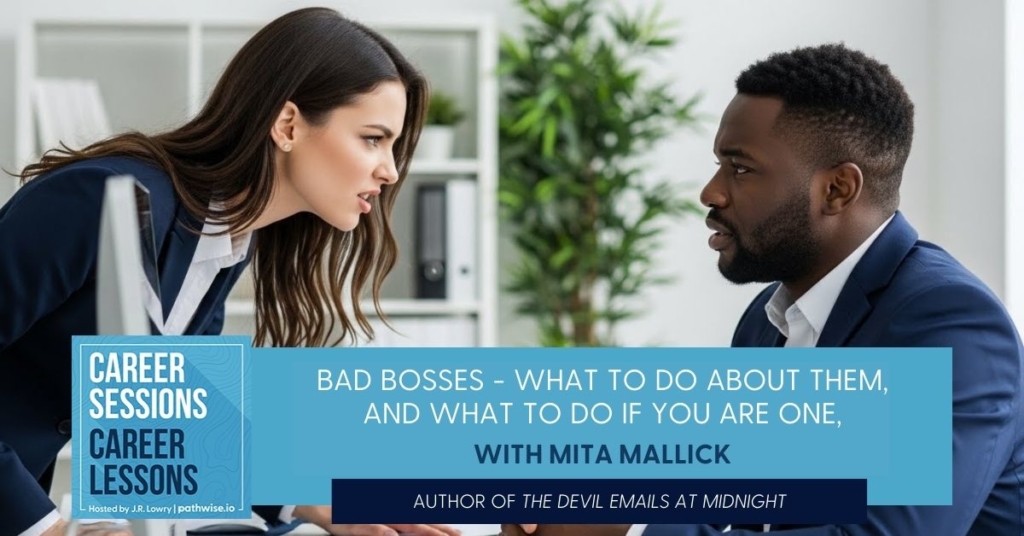
Bad Bosses – What To Do About Them, And What To Do If You Are One, With Mita Mallick
Author Of The Devil Emails At Midnight
Introduction To Mita Mallick & The Book Subject
In this episode, we are going to be talking about bad bosses, which is a topic that is probably relevant for just about everyone. To discuss this, my guest is Mita Mallick, the author of the new best-selling book, The Devil Emails at Midnight. We’re going to talk about different types of bad bosses and Mita apparently has had a lot of experience with them, why they’re tolerated, what to do if you have a bad boss, and what to do if you are a bad boss. Let’s get going.
—
Mita, welcome and thank you for doing the show with me. It’s really good to meet you.
Thanks for having me. I’m excited for our conversation.
Yeah, absolutely. I am as well. Before we dive into your new book, The Devil Emails at Midnight, and the topic of bad bosses more generally, give us the brief background on you.
My brief background is I’m on a mission to fix what’s broken in our workplaces. I’ve been both a marketing executive and an HR executive, and I love the power of storytelling to transform businesses and people’s hearts and minds. The biggest job I have right now is I’m trying to raise kind and inclusive human beings. I’m sure every generation of parents said it was tough to raise kids, but boy, is it a tough time right now. That is top of mind for me in our conversation as well.
How old are your children?
Ten going on twenty. Going on 23. All unsolicited parenting advice, you can DM me. I’m happy to hear it. Yes.
My youngest is 29, so I’m way past that point, but I remember just the constant changes, and it never gets easier. The problems are just different. Talk about the book. What inspired you to write it? I think it goes back to a very early career experience for you, even when you were doing an internship.

Yes. This is my second book. My first book, Reimagine Inclusion, came out in 2023, so I knew I wanted to write a second book, and I was thinking about what approach was I going to take. A few years ago, we got a call that my mother’s home in New England in the US was flooded and pretty badly destroyed. She’s now rebuilt and in her happy home. When I was there, I was trying to save things in my soaked childhood bedroom.
Anyone who’s been in a home that’s been ravaged by fire or water, it is traumatic. I find Barbie dolls that I thought were going to be worth something that are like washed out. I’ve got drawings, trophies, all these things we hold onto, or our parents hold onto for us. I found this notebook from my twenties. If you meet me someday and we’re having coffee, you’ll see I always carry a notebook.
That’s what I do as a writer. I like to write down thoughts on actual pen and paper. I found this notebook, and it had all these three vignettes in specific of bad bosses I had had in my twenties. Lots of details and lots of emotions and nicknames for them. I was like, “I can’t believe I had done all this and written all this and held onto it.”
You had completely forgotten about all this?
I’d forgotten about it. Some of the memories I remember, but the detail. When you write something down, you’re reading back on the details. I’m driving away with my mother from her soaked home, and I had this Mean Girls burn book moment. I thought to myself, “What if I’m in someone’s notebook?” Interesting thought. “What if someone called me ‘Micromanaging Mita’?” I’m sure they did if you worked for me several years ago, I’m sorry or, “Maleficent.” that was the genesis of the book, that the opening line of the book is, “I’ve been a bad boss, and chances are so have you.” that was what inspired the book, and then the title iterated on that, but it was also from an early internship experience I had, as you referenced, as the opening chapter.
Thinking about the title and the first vignette that you share about that person that you worked for who would only email you between the hours of like 10:00 PM and midnight. We live in a global world. I think you have to get used to the fact that people are going to email during their workday, which may not be your workday. I think what made this, I’m sure, particularly exasperating for you was that that was literally the only time you’d hear from them.
Exactly. That’s the whole point. People are like, “What?” Then people are like, “But I live in this country, and this person works in this country, and I have a signature that says you don’t have to respond when I email.” Why don’t you read the chapter, and then we’ll discuss? The biggest complaint we have in any relationship is time. You don’t have enough time for me. Time is the most precious commodity we have.
As you said, this individual who I worked for never had time for me during the day. I remember being like the Golden Retriever chasing her around the office trying to get her attention. I chased her out to the parking lot one time. I’m so embarrassed, but I really just wanted her to say hello, have time for me, see me. She never did except when she dumped her inbox out between 10:00 PM and 2:00 AM. That’s the real underlying story here.
The other underlying story here is really around what’s happening with, I think, a movement back to hustle culture, particularly with the embracing of AI and like, “I’m a human being, I’m not an AI agent.” How do you keep up? It’s like you want to be an AI agent, but you’re not, you’re human. This idea, as you say, yes, we’re working in time zones. Yes, I just had a book coming out. I am burning the midnight oil. I’m not going to say that I’m not.
However, I’m also finding times to rest and recover. Leaders really have to think about this. How are you actually having drive periods for your team and then a lull, and then a drive period again? Guess what? We’re not Uber apps. If you’re going to be on demand constantly, it’s only going to lead to one way, and that’s burnout.

Bad Bosses: If you’re going to be on demand constantly, it’s only going to lead to one outcome—and that’s burnout.
Anyone who’s a manager of people or even a more senior leader you’ve got to manage up, across, and down. You were working for somebody who had zero interest in managing down other than when she needed something from you. They’re clearly falling down on one-third of that equation. I’ve certainly had managers in my experience who were really good at 1 or 2 of those 3 things, but truly awful at the other. For the people who work around them, that’s a real issue. Usually, it’s the people who work for them that get the short shrift. You had thirteen bad bosses. Did you pick thirteen for its spooky connotations, or did it just work out that way?
No, actually, my son said the same thing to me. I’m like, “Did you forget your mom’s birthday is June 13th?” thirteen is my lucky number. I’m reclaiming it. I know there’s a lot out there about thirteen being unlucky. It’s lucky for me. Every book I have is thirteen chapters.
I noticed also that the last book also had thirteen in it, so I wondered whether there was something to that. As you wrote about those thirteen people, were they really as bad as you make them out to be in the book?
People have asked me that a few times. One of the bosses is me, so twelve left. Three of them had a really significant impact on my mental health. It’s a great question. I hope that a lot of those people are good leaders. That’s why I’ve disguised the names and changed the timing, and they’re these nicknames like a Disney villain or a Marvel character. Also, somebody who’s a bad boss for me could be a good boss for you. Context matters, situation matters. I think all of those things.
Also, one of the things that I got asked on a podcast was that I think in some ways, I was attracted to a lot of these bad bosses because of bullying I had had as a child and young adult, that I actually was a target for many reasons. There’s some accountability on my part. Also, some of these, of course, are behaviors that we’ve all seen in the workplace that I’m trying to document and bring out.
Would you consider yourself to be a pleaser?
Yes, absolutely. People pleaser. I’ll say recovering. I’m working on it.
I think I’m in the same category. I started my career, I was an Air Force officer. When I finished business school, I went to McKinsey, which I would say is one of those places that preys on people who are people pleasers because we did this simulation in one of the earlier years I was at McKinsey, and you talk about like chasing your boss out into the parking lot. One of these questions was, “Your project manager is about to get on a flight to Brazil. What do you do?” the right answer according to this McKinsey simulation that we were all doing as associates was, “You get on the plane and fly to Brazil with them.”
I was just going to say, “Buy a ticket.”
How freaking insane is that? I never got on a flight to go anywhere just to have time with a manager. For a lot of people, they let themselves go into those situations because they’re people pleasers. Your point about bosses, everybody has the potential to be a bad boss. Not everybody is going to be a good boss for every person that works for them.
I think that’s probably one of the hardest things. As a manager, and I’ve been doing this for a long time I know I’m not a perfect boss in absolute terms. I also know I’m not a perfect boss for everybody that I manage. To me, that’s one of the things I think that makes the role of manager particularly challenging. Of the thirteen types of managers that you describe in the book, which ones do you think are the most common?
The Most Common Bad Boss Type: Micromanagement
The one that’s the most common and maybe some people would say in the marketplace overplayed but yet still we’re drawn to is micromanagement. I talk about my boss who I nicknamed The Chopper in regards to being a helicopter parent, a helicopter manager. We saw the helicopter managers being born, many of them, in the pandemic. I see it, and I’m sure you’ve seen it as well. It’s this when people go from individual contributor to leading teams for the first time.
I don’t know about you, but the first time I was promoted and I got a little bit of a better office, from a cubicle to like a quasi-office, to a better title and more money, and “Congratulations, Mita, now you’re in charge of all these people,” there was like no manual, nothing. No coaching, no development. I go back to that moment, and thinking about when Micromanaging Mita was born, and no one ever taught me that it’s not my job to do my team’s job. It’s to coach them and teach them on how to do their jobs.
It’s not my job to do my team’s work; it’s my job to coach them and teach them how to do their jobs. Share on XI think as an individual contributor, there’s so much value, at least for me, derived from checklists. The output is so clear. The goal is so clear of what you’re trying to do day to day. However, when you start to coach other people, your value is different. You don’t actually have something concrete necessarily to say, “I did this.” It’s like, “No, I helped someone else do this. I taught someone else to do it.” I think that is the biggest shift I see in people’s careers and mindsets, and it can also be one of the biggest pitfalls.
One of the things that one of my other guests, a guy named Tim Welsh, who was in a very senior role at the time at US Bank, said to me, “My job is to do only the things that I uniquely can do.” I think if you get yourself in that mentality, to your point, you’re going a long way toward crossing that chasm, if you will, into management because you start to realize that it’s not about you anymore. It’s about empowering others and making them productive and happy, and that makes your life, by extension, easier. A lot of managers, they just can’t give up that control, especially when they’re new.
I think a lot of people are forced to lead and don’t want to lead. That’s a more honest conversation we need to be having. I see tech companies I work with doing this really well. On an engineering track, you can continue to be an individual contributor, continue to be valued, make money, get on great projects, and not have to be responsible for other people’s careers.
There are seasons and times in our career we may not want to do that. We may never want to do that. At least for me, I was always chasing the corporate America dream where you’re going to get the glass office, hopefully with a city view, a bathroom, a couch, a minibar you get to look out and see, “Here are all these people I manage.” not everybody wants to do that, and not everybody, if they want to do it, has the support to do it. I think that’s also when the micromanaging tendencies can come out.
To your point, this is the corporate dream. If you’re going to move up the ladder, you’ve got to manage people, and so people feel like they have to, even if they don’t really want to or aren’t very good at it. That’s not fair to the people that are on their teams, but unfortunately, it’s a huge reality. Back to what you said at the beginning about trying to fix what’s broken in the work world. Of the thirteen, which one do you think is the most under the radar but still harmful?
That’s a really good one. I’m going to talk about toxic positivity, which gets a mixed reaction. An important one. I worked for somebody who I called The Cheerleader, and he was, gosh, the corporate Pied Piper. People wanted to be in the office. So much discussion about people not trying to get people back into the office. There are some leaders you just want to be around because they teach you, they coach you, they train you, they make time for you. I’m saying all these things, and you’re like, “Mita, what’s the problem? How is he a bad boss?” he was an Instagram Reel. It was lollipops and rainbows and sunshine until it wasn’t anymore. “Whatever doesn’t kill you can make you stronger. You can do this. Keep going.”
There’s a vivid memory I have that I include in The Devil Emails at Midnight when we are launching a serial innovation. It is going gangbusters. People are eating cereal for breakfast, lunch, and dinner. I don’t recommend that, but that’s what’s happening. We hear from supply chain that this one moment of weeks after the launch that a key ingredient that’s no longer available, which is a devastating blow because you have so many customers waiting.
It’s like, what are you going to do? It’s like, we’re going to have to either offer people something else or just figure it out, but we’re not going to be able to produce this product. He walks in, and The Cheerleader’s like, “We’re going to add $1 million to the forecast. We can do it. Whatever doesn’t kill us makes us stronger. We can do it. Let’s go,” really not wanting to hear any of the facts of the situation.
I’ll never forget, fast forward to my performance review, I get no merit increase, I get a bonus that does not cover my Starbucks addiction, and you get the lowest rating. You’re like, “Why?” he’s like, “You missed the forecast.” you’re just like, “What? What is going on here?” This idea, particularly in economy, I’m sitting in the US right now, government shutdown, tariffs. It doesn’t matter where you are in the world, there’s so much it’s just change is constant. I know it’s cliché, but it’s true. You have to think of as a leader as things are changing, are you being honest and realistic on how goals have to change, or are you spewing toxic positivity, which is also again going to lead to turnover and burnout? There’s only one path that it goes to.
I think that one is probably the one that a lot of people would say, ” I never really thought about that being a bad boss,” right? But you have people who are so consistently positive that they just become caricatures.
Yes, and it’s surrounded-by-yes-people. They don’t want to be grounded in reality or the facts. If I’m working for you and we had a KPI that we needed to meet by the end of the quarter, but the 10 things I needed to achieve it, I now only have 4 of those, are we going to have a realistic conversation to say, “I can’t achieve it anymore, but here’s what I can achieve?” It’s not what anyone wants to hear, but it’s the reality. That, to me, is so fascinating, and it is one of those bad boss behaviors that, as you said, we don’t really think about, but it can be quite detrimental to team culture.
Factors That Create Bad Bosses
You say in the book, right at the beginning, that bad bosses are made, not born. What would you say are some of the factors that make bad bosses bad?
One of the factors we just talked about, which is something’s happening one in the environment. You’re sitting in lots of business change. That is creating havoc in the organization, whether that’s external factors, something happening internally, you are going to perhaps likely exhibit bad boss behaviors under pressure.
Number two, we say in my house I still try not to swear in front of my children, which is “poo poo trickles down.” you work for me, you’re a first-time leader, and I’m a terrible boss, I’m a bad boss, I have lots of behaviors I’m exhibiting, and you don’t know any better, so you start absorbing those. Something’s happening with your own boss and you start mimicking their style.
Number three, you have a personal life quake. You lose someone you love, you have a miscarriage, you move, divorce, you’re sick, someone’s sick in your family. I can go on and on, it’s horrible. There’s so much grief around the world. You have family in another part of the world experiencing something and you’re grieving for them as well.
Any type of grief, it’s so interesting is that at least my journey has been I felt like I could compartmentalize it. I could shove it in the kitchen drawer and show up at work and perform. Grief is unrelenting, it is inconvenient, and it will find you when you least expect it. When you feel any loss of control in your personal life, you will show up at work as I have, feeling like, “A good way to get control is to control my team, because I’ve got the power to do it and I can, so I will.” That third one is one we don’t talk often enough about, but it certainly does show up in the workplace.
People are human. Life is messy, and all of those things creep in. I think the hard part, like I’m thinking as you were describing that to a manager that I had way back in the day who took me out to lunch one day and was explaining the reason he was being a jerk was because he was going through a divorce. I sat across the table from him thinking like, “I feel bad for you, but at the same time, that doesn’t really excuse the fact that like you’re making my life miserable right now.”
To your point, it’s not a get out of jail free card. This isn’t Monopoly. It’s not a trauma dump session or be my therapist, which sometimes direct reports find themselves in. It’s like, “Okay, now my boss feels like they can tell me everything.” No, but it is like I wish we had more vulnerability in the workplace to say, “I am sorry that I seem off. It’s the anniversary of my father’s passing. I should have taken it off. I’m going to actually leave a little early, and I am sorry I just snapped at you.”
Taking accountability for actions, but that doesn’t mean you can repeatedly cause hurt and harm. It does help, I think, if we can tell people just a little bit about what’s happening in our lives, particularly our teams, so they’re not left to wonder, “Did I do something wrong? What’s happening? Why is this person behaving this way?” Of course, we all have responsibility and agency to say, “I need help. I need grief counseling. I need this.” one of the things I say is that some people don’t need another executive coach. Like stop weaponizing it. They need therapy. They need more than what coaching can provide in the workplace. They need some other additional help for themselves.
If we can tell people just a little about what’s happening in our lives—particularly our teams—they’re not left wondering, 'Did I do something wrong? What’s happening? Why is this person behaving this way?' Share on XCertainly, I’ve seen a lot of those situations where it’s just a situation that’s not going to right itself in the workplace and the person needs to take a step away. In some of those cases, what makes it particularly hard is they don’t want to. They feel like they’re never going to get back. I think it’s a pretty scary thing for anybody, and when you’ve got on top of that the obligations that come with being a boss to consider, it makes it an even harder situation. Sometimes you do just need to take a pause and get your life back on track and not bring all of that to work.
Absolutely. It’s going to serve you and your team so much better in the long term.
You talked about a number of situations in the book where the organizations that you were in and these bosses were in pretty much ignored or even propped up these bad bosses. Why do you think that happens so often?
Why Bad Boss Behavior Is Tolerated By Organizations
It’s because it feels easy in the short-term. That’s one. Number two, I think a lot of these things are dependent on personal relationships. Companies are made up of human beings. It’s not like the employee versus the company. I always find that interesting when people use that language as the employee. It’s like, no, the employees make up the company. The employees are all human, and we all have relationships.
Particularly I see this in startups and companies that are scaling and growing. You’re the CEO and I’m the CMO, and the head of HR comes to you and says, “All these people have left Mita’s team. We’ve done an investigation. Here are the facts, here’s how she’s behaving. This has been going on for close to a year now. I think it’s time to help Mita move on.” You say, “We went to college together, and our kids now know each other, and our family really get along.” All these personal relationships and you’re like, “I know Mita differently. That’s not the Mita I know.”
It’s so interesting that HR gets such a bad rap and I’m not saying that HR doesn’t have some accountability but at the same time, in most of these cases, and you know this, having worked in large organizations, like it’s the CEO, it’s the business owner who decides whether Mita stays or goes, regardless of what HR might present, even though they’re in a role of influence.
I keep seeing over and over again these personal relationships outweigh a lot. You can have the best processes and systems in place, and yet at the end of the day, it is how much political capital are you willing to expend to save me for whatever reason because of our personal relationship? I stay. You know what’s really interesting here? I find fascinating is I wish more companies would look at their P&L and budget in terms of turnover costs.
Right now, I think it’s like two and a half times the salary to replace somebody. You’ll let Mita stay and have 10, 20. I don’t know how many people she’s losing over the course of how many years and then you just call recruiting and say, “Fill more butts in the seats because we’ve got gaps and openings,” no one’s talking about the root cause.
I think oftentimes, particularly you have this in star cultures or with star performers, the calculus gets weighed. People say, “I’d rather have this person here than not have this person here,” some of this stuff just comes with the territory of this person being who they are and we all have to adjust. You make the point in the book at one point I forget who said this, I’ve heard it as well that the culture is ultimately defined by the worst behaviors that are tolerated.
A lot of organizations really fall down on that because they turn a blind eye and because they look at it and I think even HR people get into survival mode. They’re thinking about, “How do I keep my job because I’m not willing to stick my neck out and argue that the founder or a senior person in the company needs to either change or go, because I may lose my job in the process?” It just becomes this unwillingness to take the stand that’s needed that just in a lot of cases creates a slippery slope.
It does. I’ve been bingeing some Netflix, I don’t know about you, but I’m trying to disengage in the news and then stay off the news and I watched the downfall of American Apparel. That was a really interesting business case because, again, there was like this star founder, star culture, people are so excited about it, and then you see what’s happening inside the company and it’s completely toxic and so many excuses are being made.
I think there is this adrenaline rush and dopamine hit when people lead with fear because it does drive short-term results, but it kills culture in the long-term. You see this happen over and over again with some of these famous like movies and documentaries that are made and it’s there’s usually the impact to business will happen, and unfortunately sometimes it can happen quickly or sometimes it takes a long time and a lot of people suffer.

Bad Bosses: There is an adrenaline rush and a dopamine hit when people lead with fear because it does drive short-term results—but it kills culture in the long term.
It’s crazy how common those situations are and how long they go on that people tolerate them. It doesn’t really make widespread media until there’s like some tipping point. Everybody knows it’s going on but it doesn’t, for whatever reason, become a big story. It’s a train wreck waiting to happen.
It is. I think part of it is and this is where I believe bad bosses can be born anywhere, not born, made anywhere anytime given the circumstances but I do believe that some industries are exceptional at making bad bosses, and that would be anything anywhere there’s like a scarcity mindset or anywhere there’s like something that’s like the shiny new object.
Something like let’s say Hollywood, I’m not going to name a hot new tech brand in the marketplace, but a place where everybody wants to be. If you’re not willing to put up with this behavior and the way we work, Mita, guess what? There’s ten more people who want your job. I can remember back in the day at one point wanting to work for WeWork. I remember a lot of friends going to work there and I was like, “Oh my God.” The founder’s on the cover of X magazine and you’re like, “Wow.”
That’s like one of many examples. There is that like, “This is the place to be, and this person is a visionary and you want to be part of this movement.” Whatever it takes, whatever bad boss behavior there is, it’s all overlooked, shoved under the rug because what we’re doing, that mission is so important. I’ve worked with some nonprofits which I won’t name some pretty big nonprofits where again it’s like, “We’re so mission-driven. We’re changing the world. If somebody has to get hurt in the process internally, okay, but we’re changing the world.”
Let’s talk a little bit about what do you do if you’re in one of these situations. What are some concrete things that you would recommend that somebody who is working under a bad boss should do to help themselves through either get through it or figure out that they need to move on?
I dedicated the book to my children, and my advice to my children, to companies I’m working with as a coach, as a friend, is not that you resign every time you have a bad boss. You yourself can only make that decision. I go back to The Devil Emails at Midnight and there’s three bosses in there that really impacted my mental health. I wish I had left sooner. You have to really examine the situation. When I was working for Medusa, the boss who did throw a Chanel shoe at a colleague? It was a horrible environment. We normalized that behavior.
Interestingly, bad bosses also create community. Isn’t that interesting? We were all together trying to survive her, and she was the bully who didn’t isolate, she was the equal-opportunity bully. She went after everyone. We were like in the trenches together trying to endure this, and then we normalized a lot of things that happened.
Bad bosses also create community. Share on XI think you have to really make that decision on like I’m not telling anyone to resign without a job, but you have to think about how long am I going to tolerate this until I lose myself? If you’re working for micromanaging Mita, which sucks but I’m not throwing Chanel shoes at you, I’m just a notorious micromanager, you have to figure out what’s the expiration date. “I’m going to do this for nine months, I’m going to do this for a year, and guess what I’m going to do? I’m going actually to pull up my resume and I’m going to use that energy that I feel so aggravated working for Micromanaging Mita.”
“I’m going to actually do something future-forward. I’m going to write the bullets on my resume now. I’m going to commit to myself what I’m going to learn in this assignment, what I’m going to learn from her, and use that as a way to try to think about how do I manage this time.” My advice is always like, always have your resume ready.
People should be on LinkedIn. You should be talking internally to see is this a situation where I don’t actually have to resign from the company, but I can find my career allies and sponsors and try to figure out my next move, or am I going to make a move externally? I think always having that you say the exit plan, craft the strategy, craft the exit strategy to figure out what you’re going to do next when you find yourself working for a bad boss.
I think the key thing is just to not sit there and wallow in your own misery every day.
Yeah, I usually give myself like 24 hours with a pint of Ben & Jerry’s, and then you move on. You feel sorry for yourself and then get over it. At least that’s my advice for myself and then use that energy. You’re right because in the moments when you wallow too much, at least for me, it becomes a death spiral. You then become the person you don’t want to be around because you’re unhappy at work, you’re unhappy at home, and everyone’s just like, “Quit your job.” You’re like, “I can’t. I hate it, but I’m still here.” I’ve been that person.
There are so many people out there who will say, “I hate my boss.” “How long have you been working for them?” “Ten years.” It’s crazy but it happens. It’s heartbreaking that people are so passive about their work life, given how much time we spend at work. It’s insane, but it happens an awful lot.
I think that’s why in some cases the disruption in the marketplace is good for people. I’m not saying I wish that anyone gets laid off, that’s not what I’m saying. When people tell me, “I’ve lost my job,” I say, “Congratulations. This door is opening for a new one to open.” I’ve been there. I’ve been laid off, I’ve had family members that had been laid off, and sometimes it’s like the kick that you need to say, “Okay, I’m going to do something different.” I hope people use that opportunity to try to think about what they really want to do, because we only have one life.
There are people who like your Chanel thrower are probably not going to change. There are people who probably don’t realize some of the things they’re doing that are harming the mental health or productivity of their team. How do you approach your boss and try to influence their behavior without getting into trying to be too much of a boss fixer?
My advice is never you don’t want to go up to Micromanaging Mita and say, “You’re micromanaging me.” Like that’s not going to work and that’s not helpful and I think that can break psychological safety. It depends on the relationship that you have with your boss, but most times when I’m coaching people, that’s not the advice I would give. My advice is think about the projects you’re working on where you can give actionable feedback, particularly if something has passed.
For example, in The Devil Emails at Midnight, there’s this story of my team pulls up a deck that we had been working on and I’ll remember they go through the slides and they say, “Can you help us understand why you changed the image on slide two? Can you help us understand why on slide seven, the colors of the graph changed? Can you help us understand?” they’re going through this exercise and it’s like, yeah, because I’m a notorious micromanager because I think I can do it better because I think I can do it best.
This is not what I’m saying to them, but these are all the things I’m like, “All these open-ended questions they’re asking me, they’re actually showing me my micromanaging tendency without telling me.” if you can be a mirror and you can ask open-ended questions, and then for me to be honest and say, “I just did it because I thought I could do this better or I wanted this image instead or I wanted to do that instead.” I think if you can be a mirror and show your boss some of the actions, hopefully, they’re self-aware enough that they can start working on it.
Also, interestingly enough, I’m going to use micromanaging as one of the bad boss behaviors. If a boss is micromanaging me, they’re likely doing it to other team members. Are there systems and processes you can present to the overall team without the boss feeling threatened or like that you’re attacking them? For example, I had a boss who would routinely text me at 6:30 AM. It was like very innocuous but still annoying. It wasn’t like, “Can I call you right now?” or it wasn’t like, “I need this right now.” It would just be like, ” I was taking a run and walked by this retailer and saw this launch and we should consider it,” or “I was making breakfast and thought about this idea,” you’re like, “Why are you just like free-form texting me?”
“I was in the shower.”
Yeah, something and you’re like, “Okay.” I remember being at a team meeting and I started a very simple Google Doc and I said, “This is for like all the ideas we come up with that we’re going to review as a team every month at our team monthly. If you’ve got any exciting ideas, just drop them in here.” there are ways to retrain people and then also think about systems and processes for your boss because if you’re being affected by this behavior, you’re likely not the only one.
Your subtitle is What Good Leaders Can Learn from Bad Bosses. For the people who aren’t in the bad boss category, what do you want them to take away from your book to avoid becoming a bad boss?
One, I want people to know that this is not a static state. You go from good boss to bad boss to great leader to terrible boss. I talk about in 2017, I lost my dad suddenly. Before I lost my dad, I was in my great boss era. I was doing really well career-wise, I was in a groove. You have a personal earthquake, and your life changes, and I went from that from being a terrible boss. I’ve also since then, I believe, been a good leader and a bad boss. I want people to understand that this is fluid.
I also want everyone to think about one behavior that you have that under stress can get exacerbated. I can either call it micromanaging or I can call it holding people accountable. How do I present that? How do I share standards? How do I share output? How do I coach people rather than doing their work? If there’s something that you’re working on, tell other people that you’re working on it. Ask for help, whether it’s team members, your boss, peers. That’s what I hope. I think if we all could think of one behavior we want to improve and we worked on that and we showed up at work tomorrow actively trying to do that, imagine how much better our workplaces would be.
I think this idea of, there’s two parts of this. One, being clear on what you’re working on and what you need to improve on, and two is telling people. I guess there’s a third thing I would say, Mita, which is giving them permission to call you out when they feel like you are sliding into that territory and to normalize those conversations that just makes it easier for people to approach you. You have to be willing. You have to know when you’re creeping into that bad boss territory or maybe you at least have to be willing to hear somebody out when they think you are. A lot of people, I think, feel threatened by that and that’s unfortunate.
You’re right. Holding yourself accountable, allowing other people to hold you accountable, and then not being upset when they do the thing you asked them to do. Not being threatened or defensive or getting angry when they do call you out and try to help you.
What do you think are the hardest bad boss behaviors to unlearn?
I’m going to go back to the fear-driven one. I think if you’ve grown up in a fear-driven culture, it is hard to think about how you can actually lead with kindness. I really do. I think that people are still drawn to like driving people with fear. I still hear this. “They just need to be a little scared to work a little faster.” You’re like, “Huh?” I think people still do that. I still hear like, “We’re in war time. This isn’t peace time. We’re in war time. It’s war.” It’s like, it can’t be war 24/7.
I just think this idea of like scaring people, I really don’t get it. I use the analogy of I live in New Jersey in the US and sometimes I’ll get a message that says from a neighbor, “There’s a black bear in the neighborhood.” It’s like, “There’s a black bear.” Are they in the trash? Are they in the deck? Where are they? You’re just scared. You have that visceral, that adrenaline rush.
If you show up to work every day thinking there’s a black bear, it’s going to make you work really fast in the short-term, and you’re actually just going to get exhausted in the long-term because your body physically can’t keep up with that. I’ve found that for myself, I’ve seen that in others, and so that to me is that I just don’t get. I think that’s something that’s really broken and needs to be rethought about in our workplaces on this fear, on this driving with fear and leading with fear.
I had a boss at one point who rather proudly said that he came from the Bill Parcells school of management, American football coach, who definitely managed by fear. I would retort back, “Well, if you want to treat us like NFL players, then start paying us like NFL players.” He did not find that funny. That was probably not the right way to coach him about his behavior. It sure felt good saying it.
The Enduring Issue Of Loyalty In The Workplace
The last one I’ll mention is I talk about something that’s really top of mind for me is one of the bosses I talk about is Tony Soprano in The Devil Emails at Midnight, and it was like loyalty at all costs. Loyalty is dead in our workplaces and I think that’s something people aren’t saying out loud enough. That social contract between employee and employer is gone.
Loyalty is dead in our workplaces. That’s something people aren’t saying out loud enough. Share on XI remember I had an uncle who used to work at AT&T and was there for 30 years and got a gold Rolex. Gold Rolex? Pensions? All these things, they’re gone. It was that, “I worked for you and I got all these things, and in return you gave me my job security, you looked after me and my family, and in return I had unwavering loyalty.” I talk to leaders now, “I can’t believe this person has a podcast,” or “She’s selling t-shirts on Etsy,” or “He has like this cleaning business on the weekends.” I’m like, “Job security is no longer guaranteed.”
You can only in those moments, in these projects we’re working on, be loyal to each other in those moments, but nobody can guarantee that anyone’s going to be employed for another, I would even say like 3 years or 2 years, forget 10 or 5 or 15. I think that’s something that I hope more and more of us think about and talk about.
Agree with you completely that loyalty is dead. I can remember having many conversations with HR people who would complain about probably at the time Millennials, because this is probably 10-15 years ago, “They’re so unloyal.” My response would be, “You’ve fired their parents, so why would they ever be loyal?” There isn’t loyalty anymore. It just doesn’t go one way or the other at this point. Just get used to it because this is the situation that American corporations created from the days that they started doing layoffs back in the whenever it was, ’70s, that’s persisted ever since then.
The analogy, “We’re a family,” we’re not a family. Doesn’t mean that you don’t take care of your people when you work with them. I think all of that language is dangerous, it doesn’t serve us well, and it’s just not the honest truth and reflection of where we are right now in the marketplace.
I think a lot about I’m living in the UK, have been for the last several years, but obviously have spent most of my career working in the US. The one thing that’s different between the two is, you can make whatever comments you want to make about the NHS, but there is a healthcare safety net here that has not really existed in the same way in the US, and I think a lot of people stay in their jobs because they need the medical insurance.
I agree. I’ve been one of those. I certainly have been one.
No, I have been too. In the scheme of things, if that went away, that need for private company provided medical insurance that many people in the US depend on, I think you would have way higher turnover levels than exist in the US at the moment. I think it’s a form of indentured servitude that a lot of people find themselves in, and that’s never a good place to be. Certainly, if you’re the individual and I think in the long run if you’re the employer, but it takes a long time for those situations to play out.
There’s no pension anymore, no one’s staying for that. Some company, yeah, 401(k), but you’re right, it’s absolutely the healthcare. That’s the lifeline. There’s also the paycheck, of course, but the healthcare is a big piece of it.
Ultimately, what’s one thing that you really hope people will do differently after reading your book?
I think it’s exactly what we talked about. It’s thinking about that one tendency that you have that you might not realize is actually negatively impacting your teams, your peers. This is also for colleagues as well. We’re talking about it in terms of boss-employee relationship. You actually are talking about how you are actively working on this. As we said, giving people permission to hold you accountable when you are slipping and not lashing out at them or not being upset that they are doing that. I also think for us to have the grace and self-compassion to know that we’re going to go through these stages and how we show up to do better and be better matters a lot.
It absolutely does. The book’s been a huge success, at least in the early days. It’s been about a while since you had your publishing launch. You’ve made some bestseller lists. You have to be really happy with that. What’s it like to market a book that finds its way to a bestseller list? What’s it been like for you?
It’s been a wild ride. I’m living my childhood dream. I stood at a conference for two hours signing books and people like, “You don’t want to sit down?” I’m like, “No, this is what I dreamt about my whole life.” what’s been interesting is people are just reading it now. For anyone who’s launched a book, you know there’s a lot that goes behind the scenes, so it’s been really gratifying to see people reading about it and then talk about surprising marketing tactics.
People are anonymously gifting the book by Amazon to current and former bosses. I saw that and I’ve had a number of people come up to me at conferences. I’ve seen it in social media. I was at a very large company in New York. I won’t name the company, but someone came up to me and said, “I just talked to our head of people. I’m grabbing a few extra copies, I’m headed back to some city in Europe, and I am going to be highlighting some of these pages and leaving them in people’s offices anonymously.” people have said to me, “I got this book anonymously. What should I do?” Someone’s probably going to send my book back to me anonymously because I have been a bad boss, but it’s the spirit of it to say this is a tool, this is self-reflection, this is to think about how we can create better workplaces for all of us.
I think the spirit of it is great. What else is ahead for you, Mita, besides continuing to market the book? Next book in process, other things going on?
Yeah. I have an idea for third and fourth book and I’d love to be speaking more about the book and coaching and consulting in companies and that’s what I’m on a mission to do.
I really appreciate your time and wish you the very best with continued marketing of the book and the next book and the book after that and all the other things you’re doing.
Thank you for having me. Thanks, I really appreciated this conversation and thanks for reading the book as well.
Take care.
—
I want to thank Mita for joining me to discuss her new book, The Devil Emails at Midnight, and the topic of bad bosses more generally. As a reminder, this episode was brought to you by PathWise.io. If you’re ready to take control of your career, join the PathWise community. You can sign up on our website for our newsletter, follow us on social media at LinkedIn, Facebook, YouTube, Instagram, and TikTok. Thanks.
Important Links
- Mita Mallick
- The Devil Emails at Midnight
- Reimagine Inclusion
- Leadership, Purpose And Impact, With Tim Welsh
- PathWise on LinkedIn
- PathWise on Facebook
- PathWise on YouTube
- PathWise on Instagram
- PathWise on TikTok
About Mita Mallick
 Mita Mallick is a change maker with a track record of transforming culture and business. She gives innovative, culturally-resonant ideas a voice and serves customers and communities with purpose. She’s had an extensive career as a Marketing and Human Resources Executive. Her first book, Reimagine Inclusion: Debunking 13 Myths to Transform Your Workplace, is a Wall Street Journal and USA Today best seller. Her highly anticipated second book The Devil Emails at Midnight: What Good Leaders Can Learn from Bad Bosses will be published on September 30, 2025 by Wiley.
Mallick’s passion for inclusive storytelling led her to become a Chief Diversity Officer, building end-to-end ecosystems across big and small organizations and future proofing brands for today’s dynamic environment. Mallick has brought her talent and expertise to companies such as Carta, Unilever, Pfizer, AVON, Johnson & Johnson and more. She’s a sought after speaker and coach to start-up founders, executives, and public CEOs.
Mallick is a LinkedIn Top Voice with over 200,000 followers. She was named to the Thinkers50 Radar List and is a frequent contributor for Harvard Business Review, Adweek, Entrepreneur and Fast Company on a range of cultural, corporate and marketing topics. Mallick has been featured in The New York Times, The Wall Street Journal, The Washington Post, Time Magazine, Forbes, Axios, Essence, Cosmopolitan Magazine, and Business Insider. She was featured in a documentary created by Soledad O’Brien Productions titled “Women in the Workplace and the Unfinished Fight for Equality.” Mallick holds a B.A. from Barnard College, Columbia University, and an M.B.A. from Duke University’s Fuqua School of Business.
