How To Boost Your Executive Presence And Visibility, With Katy McFee
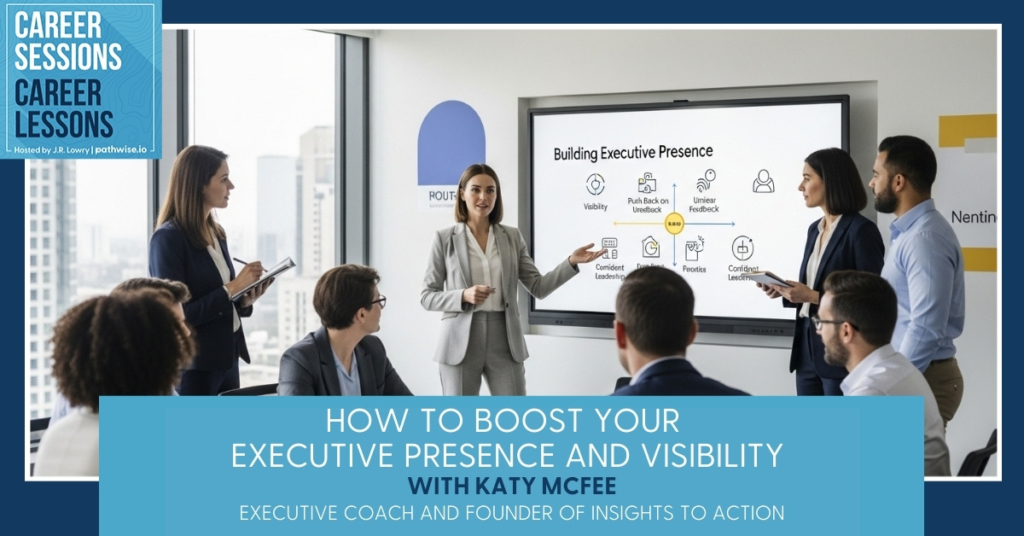
The term executive presence shows up constantly in professional feedback, but what does it actually mean? For many ambitious professionals, especially women, this vague phrase becomes a frustrating barrier that leaves them overlooked and unsure how to advance.
Today, we unpack executive presence with former tech executive and executive coach Katy McFee. She shares how she bridged the gap from director to VP and how she now helps women do it faster.
Inside, you’ll learn why “head-down hard work” stops paying off at senior levels, how to push back on vague feedback and get clarity, and Katy’s practical advice for building authentic visibility through mindset, skills, and habits. If you’re ready to stop feeling stuck and start showing up as a confident, influential leader, keep reading.
Want to help your senior leaders put Katy McFee’s insights into practice? PathWise offers executive coaching for senior leaders.
Check out the full series of “Career Sessions, Career Lessons” podcasts here or visit pathwise.io/podcast/. A full written transcript of this episode is also available at https://pathwise.io/podcasts/katy-mcfee
—
Watch the episode here
Listen to the podcast here
How To Boost Your Executive Presence And Visibility, With Katy McFee
Executive Coach And Founder Of Insights To Action
We have all heard the term executive presence, but what it means in practical terms is often hard to pin down. It is frequently thrown out as a reason why people are not ready to advance, and that leaves them feeling stuck, unclear, and frustrated. We are going to dive into the topic of executive presence with Katy McFee, a former executive turned coach who is focused on empowering women to advance. She spends a lot of time working with them on topics like executive presence, visibility, and limiting behavior. Let us dive in.
—
Katy, welcome. It is great to have you on the show.
Thank you so much for having me. I am happy to be here.
We are going to talk mostly about executive presence today, and some other topics as well. Before we do that, why don’t you give us the brief background on you?
I am a former executive. I worked in biotech and tech and had an eighteen-year corporate career. What’s important about that is it was not a rocket ship to the top for me. I struggled through transitioning from manager to director to VP, and I got stuck for a while, unsure why, no matter how hard I worked, I was not advancing to the next level.
Long story short, I did become a VP. I became an EVP, and I started to notice the women around me, the people around me, actually men and women getting stuck at these same spots. I decided when I was an EVP to leave the corporate world to start my own business, which is a whole other story. I quickly realized, as I started working with different types of clients, that I was passionate about helping people get over this gap.
Crossing that chasm from director to VP, and specifically for women, because I think with women, there is a lot of conditioning we have, there are a lot of challenges. I am passionate about closing the gender gap we see in senior leadership. That is what I do now. Now I help women to make that same transition as I did. Ideally, do it a lot faster than it was for me.
What was it that was holding you back, and what was the a-ha moment that all of a sudden, you can tell us how sudden it was, that got you over the chasm that you are describing?
Defining Executive Presence & The Shift From Doer To Strategist
I wish I could say that I just woke up one day and had an a-ha moment. It was years of banging my head against the wall. I was only able to see it in retrospect. I was making these small changes. Eventually, when I did land a VP role, and I was excelling in that role, I was doing well as an executive, I was able to look back and think, “What am I doing differently? What has changed?”
That is when it hit me. I would say one of the key things, maybe the key thing, was the element of slowing down and becoming much more intentional about the way I used my time and the way I positioned myself for the people around me. For years and years, I did not do that. I was the girl who worked hard with your head down, the right people will notice, and you will be rewarded.
Early on in my career, that worked. Hard work, hustling it out, the grind, it works well early in your career. I still think that. You do hit a point where that is not your most valuable currency anymore. Now it is your brain, and now you need to be more strategic. It took me a little bit of time to recognize that and start showing up as that type of leader.
I have had people say to me, “You need more executive presence,” earlier in my career. I would see that on a piece of paper, feedback, and be like, “What is that about?” because it is such a vague thing. You talked about needing to slow down and be more intentional with your time. It is also how you show up for other people. It is not about your own capabilities. It is more about your influence and your ability to take an organization forward. Let us talk a little bit more about executive presence. I know you talk about the idea of being seen, heard, and respected as an important thing for leaders. What does that mean in practical terms for you?
You hit the nail on the head in that oftentimes we are doing the right things. We already have the skills, the credentials, and the experience that we need, but we are not positioning ourselves in a way where the people around us are seeing it. We are not creating visibility into the work we are doing, the ideas we have, or the wins that we have already accomplished.
As a result, we are not being seen as ready for that next level. When I say seen, heard, respected, it is all about creating visibility into what you are doing, into what you are doing well, into your great ideas, into the wins and the impact you have created, so that you are getting credit for the things you are probably already doing. I hate when people get feedback like, “You need better executive presence,” because it is so vague. You mentioned yourself.
What does this even mean? You are Googling what executive presence is. That kind of feedback does not serve us, even if it’s well-intentioned. I believe that if you are working on ensuring that you are creating visibility into the stuff that you are doing, you are going to be seen as someone with more executive presence. Similarly, when I think about executive presence, it is just a series of behaviors and traits.
When you master those things, you are going to be someone who is seen, heard, and respected. There is a big overlap. It comes down to understanding what executive presence is and how I start to embody these behaviors. When you do that, you are going to totally change your perception as a leader.
What do you think the misconceptions are about what executive presence is?
The biggest myth that I love to bust is that executive presence is something you either have or you do not. It is like this special characteristic that you are either born with or not, or once you are special enough to be a leader, you are going to have it. I think that is BS. I do not think it is true. There is a series of things that come down to things like confidence, creating connections with people, and the way you communicate. Communicating in a way that is clear, concise, credible, and demonstrating command. All of these things are executive presence. Anyone can learn them. I love telling people that. This is not some special thing. It does not have to be vague. You can learn this. It is 100% learnable.
Reflecting back on my career as we are talking about this and thinking about conversations that I had about myself with somebody more senior, conversations about other people, or conversations that I had to have with somebody. What is funny about it is that people think it is like this mystique that people cannot put their fingers on. In the scheme of things, you can command a room in a lot of different ways. You can have that presence, that gravitas.
It is not necessarily one style or another. I think what it is about is that you have to find a style that is authentic to you. I think the challenge with that is that, and I think about this particularly in one company I was working with, if your style did not fit the company’s style, you could have been walking on water, and it would not matter because it was organizational rejection in the scheme of things.
That is true even outside the context of executive presence. If the way you show up authentically is not received and accepted by the organization you are in, often it is better to think, “Is there a better place for me?” When you show up authentically as an employee, as a leader, it is better for you, it is better for the people around you. Finding environments that allow you to do that is important. To your point, it’s not losing yourself in your career ambition.
Showing up authentically as both an employee and a leader is better for you and for the people around you. Finding environments that support this is essential and so is not losing yourself in your career ambition. Share on XIt’s not saying, “This is what leaders look like, I am going to do this.” If it does not feel authentic to you, it is probably not right. There are lots of ways to lead. We know this now, as there has been more research into effective leadership, and we know that quiet leaders are effective. We know that all the different styles, and we know that EQ is important. I think that there is a dated vision of what leadership looks like. We now understand that leadership can look like a lot of different things.
If you were in one of these situations and dealing with what you call the perception trap, what does that feel like in day-to-day practice?
The Perception Trap & The Need For Specific Feedback
It is the worst. It is so frustrating. I have dealt with this. Tons of my clients experience the same thing, where you are working super hard. You are doing all the things. You are doing everything you think you should be doing. You are working your butt off. You are 100% committed. You are ambitious. You are willing to do what needs to be done.
You are still being told, “You are not quite there yet,” or “You need to be more strategic,” or “You need better executive presence.” It is super frustrating because if you do not have someone to take you by the hand and show you the way, and with women, that is a challenge. Men tend to have more sponsors than women do, and the difference between sponsors and mentors is that sponsors have skin in the game. They are invested in your success.
Almost every woman I know who has reached the C-suite has said, “Yeah, I have had a more senior person tell me this is what you are doing wrong. This is where you need to pivot. This is where you need to change where you are communicating or the way you are spending your time.” The cold, hard truth is that lots of women out there do not have that. They do not have that person. You can just feel isolated and frustrated, and it can seem like maybe I am just not cut out for this.
The only thing I observe is that I can remember having a conversation with somebody who worked for me, who was a bit counter-cultural, loud. You would definitely hear her when she was in a room. There was no quiet leadership subtlety about her. Heart of gold, worked her tail off, lots of positive attributes. I remember saying to her, “The problem with this place is on the women’s side of things, it is like Mean Girls.” If you do not fit their mold, they are going to make life torturous for you. It is like you are in their burn book.
The irony of what I have observed, especially for women, is that there are fewer women role models because there are fewer women in leadership positions. A lot of them are twisting the knife as opposed to actually helping. It is like a double whammy that I think hits women on top of what you said at the beginning of our conversation, which is all of the conditions that women feel are limiting behaviors in the way that they are raised and trained to think, and all of that.
I think that culture plays into this a lot as well. If the women at the table think there is only room for one, they are not going to help lift up other women. Often, it comes down to the women who are engaging in this type of behavior. Why is that? Why is it that they are feeling this scarcity mindset, or why is it that they are feeling that they cannot lift up other women? I have found that when women are in the right supportive environment, we do want to lift one another up.
I have a community that is all women, and it is an amazing thing. Last night we were in a session, and we were doing some role-playing to help with the way we are messaging and framing things. One of the women, as we came out from breakout rooms, was like, “This is so amazing that I had these other women in this room and they are helping me and there is no competition.”
It is just collaboration, and they are sharing their advice and helping me get better. I have observed this. I think when women are in an environment that allows that, where they can feel like they can relax a little bit, it is a safe space. Generally speaking, they are going to rise to the occasion and help one another out.
I see a couple of things. One, sometimes, it can be the culture. The other thing is that a lot of women are not giving themselves permission to be loud or be authentic or take a break or go pick up their kids at school. When they see other women do it, it’s hitting a nerve. That is another thing that I see. It is so unfortunate. It is too bad because we do not have enough women in leadership who can act as these role models and sponsors. For the women who are there, ideally, they are taking on this type of role.
Getting past that scarcity mindset is important so that it becomes a supportive environment where they start to pull each other up and create more leadership roles for women in these companies. When you are dealing with this vagueness that we were talking about, how do you push your manager or their manager or whoever seems to be the root of this feedback? How do you get them to articulate in specific terms what they are looking for as opposed to just giving you that unhelpful, vague answer?
I love that question. It is something that I talk about a lot with the women I work with because oftentimes what happens is you go into a meeting with your manager and say, “I am going for this. Let us talk about my promotion track. I want to be a VP.” They say, “I do not think you are quite there yet. You need to work on your executive presence.” What do we do? We go, “Thank you,” and leave.
We are like, “What does that mean?” We are Googling what executive presence is. I always tell the women I work with, “Stop. Do not do that. If you do not know what they mean, do not leave the room.” Tap into your curiosity superpower. I always talk about my two favorite superpowers for leaders, empathy and curiosity. When you use them together, it is going to solve 98% of your problems.

Executive Presence: Tap into your curiosity superpower. For leaders, my two favorite superpowers are empathy and curiosity and when you use them together, they solve about 98% of your problems.
When I think about the use of curiosity, if you were to say that to me, what I could say is, “Thanks so much for that feedback. I would love to understand, tangibly speaking, what this looks like. If three months down the road, you are like, “Katy is killing it now in terms of her presence, how would you measure that? What would I be doing differently than what I am doing today? I would love you to work with me to carve out these behaviors, so I know specifically what you want to see from me.”
The danger of going and trying to Google it or ask your friend is that what your boss wants or their boss might be different because it is under the vague term of executive presence. This can mean all kinds of things.
In corporate culture.
At your company, this is what executive presence might mean to them. Somewhere else, it might mean something different. You do want to tap into curiosity and ask. This is one of those things that is simple and not easy. People listening are probably like, “That makes sense.” I challenge you. The next time you get this type of feedback, you are probably not going to naturally do this.
It actually takes some commitment to build that muscle and to take the pause in that moment when you hear this feedback, what is happening? You are starting to have a bit of an emotional reaction inside. You are like, “I have got to get out of this room.” You feel stupid, and maybe your mind is spinning a little bit. What we tend to do is we tend to react and say, “Thanks for the feedback. I have got to go.” In fact, what we want to do is pause. You want to take a breath and go, “How do I get curious and understand how I can use this feedback to help me get better?”
Let us flip it around. You are the boss. Is the reason that you are giving vague feedback because you are too much of a chicken to be candid, or is it because you cannot put your finger on it?
It is both. It is a combination of one of those two things. The other superpower is empathy. Let us put ourselves in our boss’s shoes. Your boss is a human, just like you. This person also probably wants you to like them. They also do not like giving constructive feedback. None of us likes giving constructive feedback. It does not feel good. We want to tell you the good things. That might be part of it. They do not want to say, “When you talk in meetings, it is too unpolished, and you speak too loudly, and you fidget a lot,” because that just feels critical.
They are like, “Yeah, you need better executive presence.” It could be that. That is why you are getting curious and saying, “I want you to just be super direct with me. Do not be afraid to hurt my feelings. Let us get direct. What does this look like? Help me know what I should work on so I can actually work on it.” The other one, though, that you mentioned, is like maybe they cannot put their finger on it.
This is what I realized for me, because when I was getting this feedback, which was not around executive presence, I was being more strategic. I was buying every book about business strategy that is out there. I am pretty sure I bought them all. It was all about building a business strategy, which was not helping me because I was like, “How do I create the perception that I am strategic for the people around me?”
There was no material in that, which is part of the reason I launched my business and my program, and I focus on that with people. I would ask him, when he would say this, I would say, “What does that mean? You tell me specifically what you want me to do, and I will do it. What is the thing?” I was not afraid to have that conversation. I had known this guy for a long time. He would be like, “Once you are there, then I will know.”
Years later, because at the time I was like, “Why will he not just tell me the secret password?” Years later, I can remember where I was in my house, where it just hit me like a ton of bricks, like, “He did not know.” He probably did not know. My boss was our CEO, but he was also the founder of the company. He never went through the same climbing up the ladder that I was trying to do. He never had to transition from manager to director to VP and go through that struggle and understand how you need to start showing up differently.
His brain was just wired differently from mine. If you have not had to think about it that hard, you might not know. I say this to a lot of people, and I remember like, “Your boss might not totally know how they got there. Maybe they knew someone, maybe they had a great mentor that just helped them along the way.” If they have never had to do this deep thought into what makes a great senior leader and understand what that looks like, they might not be able to advise you.
Navigating Stakeholder Relationships & Influence
Another thing that happens a lot of times is your boss is just saying to you what they are hearing from their boss or somebody else more senior. A lot of times, it is the person two levels up from you who is gating your progression. Your boss may think you are wonderful and do everything perfectly, but they also know that their boss does not share that view of you. That is a hard place to be. I tell people a lot, you have to have a good relationship, and you have to have a sense of how your boss’s boss thinks about you, because if they do not think you are ready, it does not matter what your boss thinks. You are not going anywhere.
I always say this, “Do not put your eggs in one basket, being your manager. Your manager might think you are the greatest thing since sliced bread. They might suck at advocating for you, or they might get fired, or they might choose to leave the company.” Many things can happen. Why are you putting all of your effort into this one place? I can remember being on a senior leadership team. If we wanted to promote someone, we did not get to make that decision in isolation.
Don’t put all your eggs in one basket, like your manager. Even a great manager can stop advocating for you, get fired, or leave. So why invest all your effort in one place? Share on XWe had to bring it to the team and say, “I’m thinking of making this person a director.” The people around the table would weigh in. They would be like, “You think she is ready?” I would say to people, “If your company works in that way, you do not necessarily know if it does or not.” What you want is the scenario where they bring that promotion to the table, and everyone goes, “Have we not done that yet? Obviously, this person needs to be blank.”
Part of that is creating the right stakeholder relationships with people within your company, including your boss’s boss, and then probably some cross-functional senior leaders who have influence. Understanding who those people are and how I demonstrate my impact and the way I think is important. If you are not doing that, it is a big mistake because we are hearing one thing from our boss. If that is the only thing we are hearing, we might be confused as to why we are not getting promoted. It is like, “This guy loves me. We have a great relationship. They keep telling me to keep doing what I am doing, and the promotion is not coming.” It is a great callout.
Certainly, you should never put your eggs in one basket. I think the situation you were just describing, one of the things I have observed time and time again in my own career, is that maybe somebody who is a peer of your boss or maybe a peer of their boss, and you have had one interaction with them, and it was only so-so.
They pull out the pocket veto and sink your chances. You have got to make sure that you understand how the decisions are getting made and who is going to influence them. It is like anything else, working in the room, managing stakeholders for all the same reasons that people hate networking, because they find it about self-promotion.
They hate networking inside their company, where they feel like they are trying to get themselves on a good list so that they can get the promotion that they feel like they deserve. I think it is great that companies do not let one or two people decide important promotions on their own. I also have seen people sitting on the periphery have way too much influence over the decision with way too little perspective. Those are terrible places to be if you are the person who is affected by that.
It is crazy because if companies are going to allow decisions to be made that way, then they need to create more opportunities for these people to get a better idea of how the next level down is doing. I used to be one of those people who was like, “That’s politics. I don’t have time for that.” It was maybe a little bit my attitude or my ego saying, “I don’t want to play politics. I’m not going to go suck up to that person.”
It was an excuse. I did not want to do it. It was uncomfortable. I may not think that particular VP or that C-suite executive liked me. I did not want to go try to create a relationship with them, but I was only hurting myself. We need to reframe that. If anyone tuning in to this is one of those people who is like, “That is politics, I don’t want to spend time on it.”
It is strategic. As you move up in leadership, being able to cultivate these relationships and being able to influence people who do not directly report to you becomes so important, especially once you are at the VP or C level. You still have to do that. You have to influence your peers. If you want to be able to implement a new strategy or change company direction, any of these big things.
A lot of us want to get there because we want to have an impact. If you want to have an impact, you still need to get people to buy in. Starting to learn how to do that now is going to serve you, and it is going to help you get those roles. You are going to have to continue doing that when you get there.
When you are talking with the people that you work with in your community or otherwise, what are some of the other structural or organizational barriers that you counsel them to be mindful of that may get in the way of what they are aiming for in their careers?
There are a few things. We talked about this a little bit earlier, but the idea that women just do not have the same access to sponsors as our male counterparts do can be a real barrier, especially within the organization. A lot of these women might have a great relationship with their manager, but they do not have somebody close to the top who is advocating for them. I actually think a lot of this stuff, by the way, we can do something about it.
You can have a sponsor who is a man. When I think about my career, I had one sponsor. It was a male. I never had any women sponsors. It just so happened because I did not have a lot of women leaders in my life. You can turn mentors into sponsors. There is stuff that you can do about it. That is one. Another one is the idea that women tend to be put in more doer-type roles. I would say this is just some bias that exists where oftentimes we are given more, “Can you order the lunch? Can you plan the event? Can you do this stuff?”
The more we allow ourselves to be caught up in execution, the harder it is going to be for us to demonstrate that we are actually senior leadership material. Those are a couple of the things. I would say another one. This is not necessarily company-specific, but the fact that a lot of us are moms. We are focused on picking up the kids at school, getting dinner on the table, and doing all of these things outside of work, which can mean that we are not participating in certain after-work activities, or we are focused on having that flexibility, but sometimes at the expense of the visibility that we need to have.
The rules are still different for men and women. It has gotten a lot better, certainly since the early days of my career, but we are not there yet. We have to continue to keep working at it.
I do think that there have been improvements. You see a lot more women who are in senior leadership today who are like, “Here are my non-negotiables.” “I need to pick up my kids, but then I’m going to be back on email at 7:00 PM,” or “I need to do drop off in the morning so I don’t do meetings before 9:30.” Women, especially in senior roles, advocating for flexibility is key.
I was intentional about doing this once I became a VP and EVP, where if my kid had a doctor’s appointment, I put it right in my calendar. Doctor’s appointment. I did not want to hide it. I wanted people to know I am taking my kid to the doctor. It needs to happen. I still work hard, and I still create a lot of impact. Part of it is that type of advocating, once you are there to let the people behind, permit them to do the same.
In your programs, what are some of the most impactful behavior tweaks that you counsel people to make in terms of how they are perceived?
There are a lot, but I would say the big things are all around, slowing down and being more intentional. The shift of reporting metrics to reporting insights. I always say, “You cannot have a strategic insight in the five minutes between Zoom calls.” You need to give yourself that time. I spend a lot of time talking about what you should be doing in that time, and why it is so important, and how we need to give ourselves permission to ideate and think and not just do all of the time.

Executive Presence: You can’t have a strategic insight in the five minutes between Zoom calls. You need to give yourself that time.
That is one of the big behavioral changes that I coach the women to make. Another one is simply in how we are showing up in the way we are communicating. Oftentimes, we have the right ideas already. These women are doing great things. They are super smart. They are super effective, but they are not necessarily communicating in a way that shows that to the people around them. When I think about my program, there are sort of three different modules.
The first one is all mindset stuff. The second one is what I call exec skills. The third is habits and boundaries. I always say, “Mindset is important because if you do not do that work, it is hard for the rest of the stuff to work.” I can teach you these skills all day long. If you are too afraid to put up your hand in the meeting and share your idea, or you are unwilling to assert yourself, it is not going to work. We need to do that.
Habits and boundaries are important because once you get to senior leadership, I do not want you to burn out and leave. I want you to thrive. I want you to be able to maintain that. In terms of the behavioral shifts that are going to allow these women to go from being seen as not quite ready to “You are our top choice for this VP role,” that is all the exec skill stuff.
It does come down to going from reactive to proactive, spending time on being intentional, coming up with strategic insights, and sharing them with the right people, building the right relationships, and refining your communication style. I get tactical because it is a pet peeve of mine to give this vague feedback.
We get right in the weeds, “How should you be framing this? How can you communicate more impactfully? How do you even come up with a strategic insight? How do you effectively build a strategy?” We go through all of that. It is powerful to see the changes that happen in these women.
Listening to those three, the first one is all internal. The second one is mostly external. The third one is probably a little bit of both. It highlights the fact that you have to address both the internal and the external components of this.
There is a mix of women that I work with. Some have done a lot of this internal work, some have done zero. Some of them, I am like, “We’re going to breathe for a minute at the beginning of the session,” and they are like, “Why am I here?” It is important. It took me years to do this internal work. It allows you to show up as a better leader, but it also just makes your whole life better.
Gaining self-awareness, like part of the mindset stuff, is like imposter syndrome, confidence, and limiting beliefs. A big part of it is self-awareness. How am I showing up today? Am I showing up as the leader I want to be? If not, what is that gap? A lot of people never even stop to ask themselves that. When you do, it can be pretty eye-opening. Also composure. When we work on these methods of managing stress and regulating your nervous system, you are going to show up as a better leader, because you are not going to fly off the handle.
You are going to be able to handle things in a way that you are composed. They are both important. I would say they are both equally important. I do not think you can have one without the other. We tend to focus so much on the external piece that we forget the internal stuff. That is why I always start with it. Truthfully, the bulk of the program is the external stuff.
That both come down to how you position yourself as a senior leader or as ready, but it also is like, “How do you develop those skills in yourself? The goal of this is not like, “Let’s trick people into thinking we’re ready.” It is how do we ensure that you’re doing the right thing, so you are such an impactful leader that people are like, “We need this person at the table.” That is my goal. The goal is not to hack the system. The goal is to show you how to be a highly effective senior leader. The people around you are going to see that.

Executive Presence: The goal isn’t to hack the system. It’s to show you how to be a highly effective senior leader and the people around you will see it.
How do you run your programs? Are they done with cohorts? Describe a little bit about what your programs are like for the audience’s benefit.
It is all cohort-based. They are live Zoom calls. My entrepreneur friends are always like, “You’re crazy. When are you going to just record this? It’s going to be so easy for you.” I love it because the women who come often tell me that this is my favorite part of the week. We do cohorts of around 25 women. When we do breakouts and exercises, we do groups of like three so that women have an opportunity to have their voice heard and get to know each of the women well.
It is live every week, and it is a twelve-week accelerator to start, but they get a whole year of coaching support. The reason I did that was that it used to just be the twelve weeks. I was like, “I’m teaching everything you need to know in twelve weeks. Have a good life.” What I noticed was that as women were transitioning to these senior director or VP roles, they wanted that continued support for, “Now how do I crush my first 30, 60, 90?” or “How do I ensure that I’m doing this right? Now that I actually landed this VP role, I’m kind of terrified.”
I made some changes, and now you get to be in that community for a full year. It is a beautiful thing. The women in this community, I am so proud that I attract just the coolest, smartest women. There is so much wisdom in the room. It is cohort-based. It is a mix of curriculum, coaching, and community. The curriculum is structured. These are the things you need to know. I did that intentionally because oftentimes we have blind spots that we are not aware of at all.
I know I did. There is a structured curriculum involved in that. There is coaching. Any specific challenges that you might have, any questions, all get addressed. There is a community of women, where people usually come for the community, but that is what they want to stay for. They start to find their tribe and see the value in having a place to be vulnerable, to share any challenges, and to get advice from women just like them.
It is great that you are doing that.
It gets me out of bed in the morning. I launch it three times a year, and it is always cohort-based, and I always do it live because I have found that just connecting with these women is the thing that drives me. It is my favorite thing. For the foreseeable future, it is going to look like that.
We talked a little bit about visibility earlier. How do you work with somebody to build a visibility strategy that is authentic to them so that they are judged on the merits of their work and not just the details of things that people often get associated with?
The Importance Of Visibility Strategy & Brag Sheets
This is a big topic that I talk about with all the women I work with in the program. Two different types of women come in. One is the woman who is like former me, working hard with their head down, thinking, “The right people are going to notice, I don’t need to create this visibility,” or “I don’t want to, I don’t feel comfortable doing it, it feels icky.” Some women think they are creating visibility, but are not doing it well.
What visibility looks like to them is that they will have a one-on-one with their manager, and they will be like, “By the way, these things happened.” That is better than not doing it at all, but I like to remind these women that their boss is thinking about 50 other things. Great that you told them. Also, they probably forgot by Friday. What I do is we create a structure whereby this is baked into a process so that you do not have to do the awkward “Knock, knock, knock, hey, can we talk about my career?”
You just do not have to do that. There is a process in place so that you are having these conversations on a regular cadence. It is a bit more formalized. It is interesting for me to say that because I am a very casual person. Sometimes process serves us. Especially when it comes to creating visibility into what we do, having a process where you create a template for a regular update, and you send that. Verbal updates are not enough.
CCing your boss on that email, great, not enough. You actually want to have some formal update that you are sending on a regular cadence. You need to get over that mindset block of “This is bragging,” or “This is bothering my manager.” The truth is, it is helpful for your manager to know what you are doing. They can report it up the chain when their boss asks them something. They are going to have a better idea of what is going on with you and your function.
Stop telling yourself that this is annoying or that your manager does not want to see it. start telling yourself, “I’m doing this to help my manager. I’m doing this to arm them with this valuable information.” One thing you can do is when you send it to your manager, you can say, “I’ve created this update. I thought it would be useful so that we are aligned on my priorities, and you know what’s going on.
If there’s anything else you’d like to see in it, please let me know. I want to make sure that this is useful for you.” That alone is going to gain you some credibility with your leader. They are going to be like, “That was a good decision. Thanks for wanting to work with me on it.” That is one element of it. The other one is to create a regular cadence around having a more strategic conversation about your career.
I always say that you should be having these more strategic conversations, either once a month or once a quarter. You want to create a process so that this is just baked in and these meetings are happening. You do not have to bring them up because what happens sometimes is we will have a conversation about our career progression.
There is no process in place, and your boss is like, “I think next year might happen,” or whatever. There is no follow-up. There is no opportunity to have a follow-up conversation around, “Are you seeing the progress you want to see? Am I still on track?” We get to the end of your review, and people are disappointed.
The key elements of this visibility strategy are that it needs to be a regular cadence and it needs to be formalized. Within that, you can start to share updates, wins, and blockers. All the important things are both demonstrating the great things you are doing and the way you are thinking. I think both of those things are important.
Do you get down to a level of advising people to track all this stuff, like with metrics or record signals that they feel like they are seeing, or behaviors that they are getting in response? What’s the tracking look like?
I am a big fan of a brag sheet. A brag sheet is a document you have that any time you get good feedback, or there is a win, or you do something good, you put it in your brag sheet. This is good for two reasons. One, because if you are feeling a little down, our brains are wired to focus on the negative. It is easy to forget all the great things we have done. If you are feeling, “Not too confident today,” go read your brag sheet.
The Role Of Reflection & Deliberate Practice
You are like, “I’m pretty awesome.” It is good for that. It is also good for these conversations with your manager. Both for your weekly updates, if you are doing the weekly or bi-weekly, as well as when it comes time for the annual review. You have all of this here. That is going to include the feedback you are receiving from other people. That is the main advice that I give in terms of what you are tracking.
The other thing, though, I recommend is a reflection practice. If you have a meeting with your boss and it goes well and you get a great result, go back and write it out. What went well? Why do I think it went well? What were the things I said that seemed to land? I think this is a great idea if you are talking with your boss or if you are in a leadership meeting. If you present something and people are like, “That’s good.” Reflect on that and be like, “How can I learn from that? How can I do more of that?”
This idea of reflection, people talk about practice versus deliberate practice, is in the same spirit as what you just described. I am a runner. I can go out running, and I can go for however many miles I run and be casual about it, or I can do drills, and I can focus on specific terrain. I can focus on cadence changes or whatever. I am much more deliberate about it, and obviously, the people who are more deliberate about it are going to get better faster than the casual people.
I am comfortable with the fact that I am mostly casual because I am just doing it for my health. I am not doing it to win the world championship of marathons, but there is a difference. When you zero in on something that you want to get better at, you have to be deliberate about it. You have got to reflect. There are so many opportunities for reflection in every single day, almost in every single moment of the day.
You cannot make yourself crazy spending all of your time second-guessing and playing Monday morning quarterback on yourself. You do need to think about, “How did that go? What would I do differently if I did it again? What went well?” If you make that a habit and it becomes almost automatic in the way that you approach things, then you are going to be a stronger performer more quickly.
I totally agree. There is a quote that I love, which is, “We do not learn from experience. We learn from reflecting on experience.” It is true. You brought up a great point, which is that the goal of this is not to beat yourself up. The goal is not to ruminate. It is to look at something with a discerning eye and say, “What went well? What would I do differently next time?”
We do not learn from experience; we learn from reflecting on experience. Share on XIt can be beneficial to even visualize, let’s say, you were in a meeting, and it did not go the way you wanted it to. Just the practice of thinking, “How would I show up next time? How would the best version of me have shown up? If this had gone well, what would I have done differently?” Actually, just take a moment and visualize that in your mind. We know that creates new neural pathways.
There is a scientific benefit to doing this. Taking a few moments, and to your point, we cannot spend all day ideating and reflecting. We do have to also do work. I am a big believer in scheduling this in. You can do 30 minutes on Monday morning or at the end of the week. If you walk out of a meeting that you notice either went well or poorly, that is often a great time to sit down and reflect.
You run these communities, you have built this big social media following. What is ahead for you? What is a big goal or next chapter that you are particularly excited about personally or professionally?
Personally, there’s always great stuff going on. Professionally, last year I did my first retreat for just the women in my community. It was a small group of women, and I also hosted my first in-person summit, which was open to the general public. Those were both amazing. I loved doing those in-person events. I am going to continue to do that. There are going to be certain in-person events that are only open to my community, and then probably will also do an annual summit that is open to everybody. I am starting to do some 2026 planning and putting those in the calendar.
The other thing I am doing is I am going to be launching a VP mastermind. I help so many women become VPs, and they can stay within my community, and they do, but I am going to be creating something specifically for women at the VP level and up. It is going to be a small curated group. My big focus is always on this group program that I run. I would say 80% of my time and effort just go into that because I am so passionate about getting more women to senior leadership.
My mission is to help close the gender gap in senior leadership. The way that I think I can help do that is by helping more women land those first senior director, VP, etc., roles. That is my big focus always. I am just continuing to run it, and I am excited to continue to do that. The community is growing, too, which is cool. I just want to keep serving these women and helping them crush it.
Which is a fantastic goal to have. Last question. What three pieces of advice would you give your younger self that our audience can take away?
I will say, “Stop winging it.” My background was in sales, and I often would wing my meetings. I did pretty well in school, but I was not a good student in terms of studying. I think I brought that with me for a lot of my career. That was one of the big things that I had to learn to do. Stop winging it and start slowing down, being more intentional. That is going to serve you.
Katy, thank you for doing this. I think our audience will find it helpful. Lots of practical advice in there. Certainly, a contagious energy that they will take away. I appreciate you making time for the conversation.
Thank you for having me. This was so much fun.
Take care.
Bye.
—
Thanks to Katy for joining me to discuss the elusive concept of executive presence, how it creates a perception trap, how it affects men and women differently, and what you can do about it. As a reminder, our show was brought to you by Pathwise.io. If you are ready to take control of your career, you can join our community. You can also sign up on the website for the Pathwise newsletter. Follow us on LinkedIn, Facebook, YouTube, Instagram, and TikTok. Thanks. Have a great day.
Important Links
- Katy McFee on LinkedIn
- Insights To Action
- Insights To Action VP Ready Quiz
- PathWise on LinkedIn
- PathWise on Facebook
- PathWise on YouTube
- PathWise on Instagram
- PathWise on TikTok
- PathWise on Twitter
About Katy McFee

Now, Katy’s on a mission to help high-performing women stop spinning their wheels, crack the leadership code, and finally step into the executive roles they’ve earned. She teaches ambitious women how to master executive presence, communicate with authority, and build environments where their leadership thrives. Her mission is simple: empower women to own their value, lead with confidence, and get the promotions they’ve earned.
