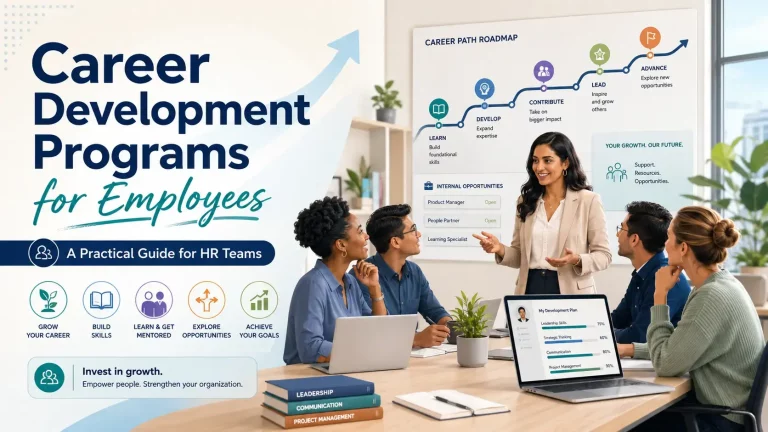
Employee career development programs are structured systems that help workers build skills, set career goals, and advance within an organization. For HR teams, these programs connect talent development directly to business outcomes: lower turnover, stronger workforce engagement, and a reliable pipeline for internal promotion.
This guide covers what effective programs look like, how to build one from scratch, and how to measure whether it is working.
What Are Employee Career Development Programs?
An employee career development program is a coordinated set of activities designed to help workers grow professionally over time. It goes beyond one-time training events. A proper program includes career pathing, Individual Development Plans (IDPs), mentorship, skills assessments, and learning opportunities tied to defined career goals.
The distinction between a training program and a career development program is worth making clear. Training addresses a specific skill for a current role. Career development is broader. It prepares employees for future roles, lateral moves, and long-term professional growth. Organizations that conflate the two often end up with a learning catalog but no development culture, which is a different problem entirely.
HR teams are well-positioned to design these programs because they sit at the intersection of people strategy and business goals. The challenge is moving from intent to a system that managers actually use and employees actually want.
Why Career Development Programs Matter for Retention and Engagement
Career-related reasons were the leading cause of turnover in 2024, ahead of management issues and pay, according to Work Institute’s annual analysis of exit interview data from tens of thousands of employees across multiple industries. Employees who saw no path forward left. That pattern held across industries and role levels.
The cost of that departure is measurable. Replacing an employee costs an average of 33.3% of their base salary. Multiply that across several voluntary exits in a year and the financial case for structured employee career development programs becomes hard to dismiss in any leadership conversation.
The upside is equally clear. According to LinkedIn’s 2024 Workplace Learning Report, companies with strong learning cultures achieve a 57% employee retention rate, compared to just 27% at organizations with moderate learning cultures. The same research found that those organizations also experience 23% higher internal mobility, which reduces the cost and time required to fill open positions from outside. Connecting employee engagement strategies to development programming is not just good people practice. It is measurable risk reduction.
Employees with access to career development options show 34% higher retention rates than those without. Only 31% of U.S. employees were engaged at work in 2024, the lowest figure in a decade. Development opportunity is one of the strongest levers HR has to address that number, and it is cheaper than compensation increases.
Core Components of an Effective Employee Career Development Program
Strong programs share several common elements. Not every organization needs all of them at launch, but HR teams should understand what each one does before deciding what to prioritize.
Individual Development Plans
An Individual Development Plan (IDP) is a written agreement between an employee and their manager that documents the employee’s professional goals, identified skill gaps, and the specific steps they will take over a defined time period. IDPs create accountability on both sides. The employee commits to specific actions. The manager commits to providing support, access to learning resources, and regular check-ins.
Effective IDPs connect personal goals to organizational needs. An employee who wants to move into people management in two years should have an IDP that includes team leadership exposure, formal communication skills training, and experience with performance feedback processes.
Career Pathing and Internal Mobility
Career pathing gives employees a clear picture of how they can move within an organization, both vertically and laterally. Career mapping tools help employees understand what different roles require and how their current experience connects to future opportunities. When people can see a route forward, they are less likely to look for it elsewhere.
Internal mobility programs extend this by creating structured pathways for employees to apply for open roles, take on stretch assignments, or rotate between departments. Organizations with strong internal mobility programs fill roles faster, at lower cost, and with employees who already understand the business.
Mentorship and Coaching
Mentorship pairs employees with more experienced colleagues who can offer guidance on career navigation, organizational dynamics, and professional growth. Coaching is more structured and goal-focused, often delivered by certified coaches who help employees work through specific challenges.
Both formats work. The key is making them available to a broad employee population, not just high-potential employees identified by HR. When mentorship and coaching are reserved for a select few, the rest of the workforce receives a clear signal about who the organization values, and retention suffers accordingly.
Skill Development
Formal training, online courses, certifications, and on-the-job experiences all fall under skill development. The most effective programs blend formats. Formal coursework builds structured knowledge. Job experiences accelerate application. Interpersonal relationships through mentoring or peer learning fill in the gaps that formal programs miss.
One finding from recent research is worth flagging here. McKinsey found that nearly half of employees want more formal training, particularly as new technologies reshape job requirements. Yet only 46% of employees report that their employer provides adequate opportunity to learn new skills. That gap is a direct recruitment and retention risk for organizations that have not addressed it.
Manager Involvement
Managers are the most critical variable in whether career development programs succeed or fail. Research from Gallup puts it plainly: managers account for 70% of the variance in team engagement. A strong program that managers do not actively support will underperform regardless of its design quality.
HR teams should treat managers as partners in career development. That means training managers on how to improve leadership skills related to coaching and career conversations, holding them accountable for development discussions during performance reviews, and giving them structured frameworks they can use with their direct reports.
How to Build an Employee Career Development Program: A Step-by-Step Approach
Building a program from scratch is manageable when you start with structure rather than content. Here is a practical sequence for HR teams working within typical organizational constraints.
Step 1: Conduct a Skills Gap Assessment
Before designing anything, find out where employees are now and where the organization needs them to be. A skills gap assessment surfaces the distance between current capabilities and future role requirements. HR teams can gather this data through performance review records, manager surveys, or structured self-assessments.
This step also informs workforce planning. Knowing which skills are scarce internally helps HR decide where to invest in upskilling versus where external hiring makes more sense.
Step 2: Align the Program to Business Strategy
Career development programs that operate separately from business strategy tend to become benefits-focused rather than performance-focused. They feel good but produce limited organizational impact, which makes them vulnerable in budget discussions.
The goal is to connect what employees want to develop with what the business needs to succeed. If the organization is moving into new service areas, the skills it builds should reflect that. If leadership succession is a near-term concern, leadership development should sit at the center of program design.
Step 3: Design Learning Paths by Role and Level
Rather than offering a generic catalog of courses, effective programs map learning opportunities to specific roles and career stages. A learning path for an individual contributor targeting a people management role looks different from one built for a senior manager preparing for a director position.
Learning paths should include multiple formats: formal coursework, on-the-job projects, mentorship connections, and peer learning opportunities. People learn differently. A blended approach reaches more employees and produces better application of skills over time.
Step 4: Build Manager Capability for Career Conversations
Most managers were not trained to have structured career development conversations. Many avoid them because they are uncertain about what they can realistically promise around promotions or role availability.
A simple framework helps. Career conversations should cover three areas: where the employee is now, where they want to go, and what they need to get there. Managers who can navigate these conversations honestly keep their teams more engaged and retain talent at higher rates.
Step 5: Use Technology to Track Progress
Learning management systems, performance management platforms, and skills tracking tools reduce administrative burden on HR and give leaders visibility into development activity across the organization. Over half of organizations now use an LMS and performance management systems to support employee development, according to HR.com and PeopleFluent research.
The data these systems generate also enables measurement. If employees with active IDPs are being promoted more often or leaving less frequently, that data is worth sharing with senior leadership when program budgets come up for review.
Step 6: Promote the Program and Make It Easy to Find
A program employees do not know about or cannot easily access will not produce results. HR teams need to build awareness through onboarding, manager communications, and ongoing internal visibility. Framing the program as a meaningful benefit of employment, rather than a compliance requirement, changes how employees perceive and use it.
Visible sponsorship from senior leaders signals organizational commitment. When leaders reference career development in public conversations and back it with resources and time, employees take it more seriously.
How to Measure Career Development Program Success
Measurement is where many HR programs fall short. Without clear metrics, it is difficult to demonstrate value, justify budget, or identify what needs to change.
The most useful indicators for employee career development programs fall into four areas.
- Retention and turnover data tracks whether program participation correlates with longer tenure. Compare voluntary turnover rates between employees actively enrolled in development programming and those who are not. Even directional data here is useful.
- Internal mobility rates measure how often open roles are filled by internal candidates. Rising internal mobility suggests the program is building capabilities the organization can actually use.
- Engagement and satisfaction data captures whether employees feel supported in their growth. Pulse surveys and annual engagement scores provide a before-and-after view as the program matures.
- Promotion and progression rates show whether employees with development plans advance at a higher rate than those without them. This is the most direct evidence of program effectiveness and the most compelling data point for leadership audiences.
Using feedback for professional development as a regular practice, not just an annual event, also strengthens the measurement loop. Employees who receive consistent development feedback have clearer visibility into their progress and are more likely to stay engaged with their development plans.
Training programs to support career progression were cited as HR professionals’ top way to strengthen organizational competitiveness in the 2025 SHRM State of the Workplace report. Organizations that measure program effectiveness are also significantly more likely to increase their investment in development over time, creating a compounding advantage over those that do not.
Common Mistakes HR Teams Make with Career Development Programs
A few patterns show up consistently in programs that underperform.
- Treating career development as a perk rather than a strategy. Programs that exist primarily for employer branding or engagement survey results rarely produce meaningful outcomes. Development needs to connect to business goals and manager accountability structures.
- Building one-size-fits-all programs. A new employee at 26 and a manager at 44 have different development needs, different timelines, and different definitions of career growth. Programs designed around a single template fail both.
- Not involving managers in program design or delivery. HR can design a strong program, but managers are the ones who give employees time, permission, and encouragement to use it. Without their active participation, participation rates stay low and the program stalls.
- Skipping measurement. Programs without metrics cannot improve and cannot justify their existence in a budget conversation. Even basic tracking, such as IDP completion rates and internal promotion data, provides enough signal to make meaningful program adjustments.
- Making promises the organization cannot keep. Career development conversations can raise expectations around promotion timelines and role availability. HR teams should train managers to be honest about what the organization controls and what falls outside the program’s scope.
Build Career Development Into the Way Your Organization Works
Employee career development programs are most effective when they are treated as part of the organization’s talent strategy, not as a stand-alone HR initiative. A strong program gives employees clarity about where they can grow, helps managers have better development conversations, and gives the organization a stronger internal pipeline for future roles.
For HR teams, the opportunity is practical and measurable. Career development can reduce turnover, improve engagement, strengthen manager effectiveness, and make workforce planning more resilient. But the program has to be structured, visible, and connected to real business needs.
The best career development programs do not simply offer employees more training. They give people a path forward.
Help Your Employees Grow With Pathwise
Pathwise helps organizations, HR teams, and individuals build stronger career development systems through coaching, courses, and practical career support.
For HR Teams and Organizations
If your organization wants to improve employee development, career engagement, retention, or internal mobility, explore Pathwise’s resources for Organizations and HR Professionals.
Pathwise can support HR teams looking to create a more intentional approach to career growth, manager development, and employee engagement.
For Employee Learning and Skill Development
Career development programs work best when employees have access to structured learning opportunities. Pathwise Career Courses can help employees build practical skills, strengthen career readiness, and take ownership of their professional growth.
These courses can complement internal learning paths, Individual Development Plans, and broader talent development initiatives.
For Coaching and Personalized Growth
Some employees need more than a learning path. They need focused guidance, reflection, and accountability. Pathwise Coaching gives employees, managers, and rising leaders personalized support as they navigate career decisions, leadership challenges, and professional transitions.
Coaching can be especially valuable for high-potential employees, new managers, career changers, and employees preparing for internal advancement.
For Broader Career Support
Pathwise Career Services provide practical support for individuals who want to clarify their goals, strengthen their professional presence, and take the next step in their career.
For organizations, these services can help reinforce a culture where employees feel supported in their growth rather than left to manage career development on their own.
Explore the Full Pathwise Offering
To see all available development solutions, visit the Pathwise Offerings page.
Turn Career Development Into a Retention Advantage
Employees are more likely to stay when they can see a future inside the organization. A well-designed career development program gives them that visibility and gives HR teams a stronger foundation for engagement, succession planning, and workforce growth.
Pathwise can help your organization build that foundation. Start by exploring our solutions for Organizations and HR Professionals.
