AI’s Central Role In The World’s Economy With Dr. Joerg Storm
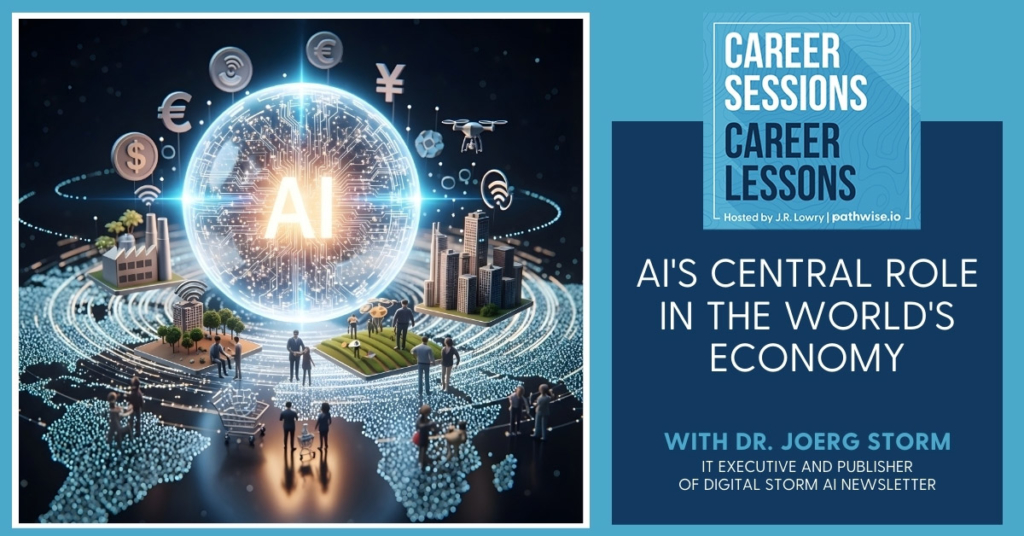
In this time of ever-evolving technology, every working professional will encounter AI in some shape or form. As we go deeper into the age of AI, what is the role of such tools in shaping the future of work and the entire economy? J.R. Lowry talks all about it with Dr. Joerg Storm, IT executive and publisher of the Digital Storm AI newsletter.
They discuss why AI is a career-critical tool, the uniqueness of adaptive AI projects, and the technological paradigm shifts to look forward to in the next several years. Dr. Joerg also explains why AI practitioners should remain philosophical and ethical despite their deep immersion in technology to navigate the challenges of bias and trust.
Check out the full series of “Career Sessions, Career Lessons” podcasts here or visit pathwise.io/podcast/. A full written transcript of this episode is also available at https://pathwise.io/podcasts/dr-joerg-storm
—
Watch the episode here
Listen to the podcast here
AI’s Central Role In The World’s Economy, With Dr. Joerg Storm
IT Executive And Publisher Of Digital Storm AI Newsletter
AI is everywhere these days, and it is transforming almost every industry and function on the planet. If you’re a working professional, it’s really essential that you’re incorporating AI tools into your day-to-day work and getting clear on how it’s going to impact your career journey. With me in this episode to do a deep dive into AI is Dr. Joerg Storm, a veteran digital transformation and IT executive with more than two decades of experience, primarily in the automotive and mobility sectors. Joerg authors a weekly newsletter called Digital Storm, which is available on Substack. He has amassed hundreds of thousands of subscribers globally and focuses on unbiased insights on the intersection of leadership, technology and AI. Let’s get to our conversation.
—
Joerg, welcome. Thanks for joining me on the show.
Thanks for inviting me.
Absolutely. I’m always excited to have a conversation about AI and we will get to that in a minute, but give us your brief background first.
I think my professional journey began more than twenty years ago at the crossroads of technology and business. I started in IT leadership role, eventually becoming head of an IT infrastructure of a financial service institution. I was also in charge of the European wholesale retail IT infrastructure of a well-known premium car company in Germany, Stuttgart, where I helped, for example, the company through digital transformation scaling system managed cloud migration, and ensuring security across the continent with maybe different.
I was pretty fortunate that to work on nearly every continent, Europe, Asia, Americas, and especially twelve years in Asia. This multicultural exposure shaped not only how I lead teams, but how I think about innovation. Now, I focus on education, strategy and communication tool. I founded, for example, Digital Storm Weekly, an AI newsletter, which now has 550,000 readers to dedicate my time to make other people understand AI for decision makers and across my platforms on LinkedIn. I share my perspective on AI, digital transformation to 1.3 million people.
It’s an astonishing reach that you’ve built in your journey toward AI and obviously a natural extension. Given that you started in IT, you can’t be in IT without thinking about AI these days. Was there something in particular that really drew you into this space or was it just the natural evolution of everything else you were doing?
Gen AI topic is not something that’s pretty new. It’s been there since 2022, but AI or machine learning, a lot of companies have been doing this for many years already. For me, I think it started out of curiosity and also necessities. I remember when I was working Asia, I noticed how digital ecosystems were accelerating much faster than any corporate process could adopt.
We were sitting on a big amount of data, transactions, and telemetry data, and I realized that the next great efficiency leap wouldn’t come from faster hardware, but from much smarter interpretation of AI. What fascinates me was not the automation for its own sake, but the augmentation. You use AI to empower people and not to replace them. I saw some science in the predictive analysis, for machinery, for recommendation engines and autonomous decision support in IT. I think this combination of logic and creativity has put me in now in this big AI boom came and I think I’ve been hooked ever since that time.
Where were you geographically working in Asia that you had this epiphany?
I was six years working in Tokyo at a car company and also at Mitsubishi car company, and I was six years in Beijing in a car company. Very interesting times, I tell you.
Certainly, the Japanese car market is a mature one and plays a very big role in the world. The Chinese car markets just come on like crazy outside of the US in particular. I’m in London, you’re in Germany. Chinese electric cars here are everywhere.
Not yet so much yet here in Germany. I’m very sure they will also be here very soon.
How Dr. Joerg Became Involved In AI Technology
I know you can’t talk about anything you’re doing from a current work perspective, but what are the general types of things that you’ve been involved in with respect to some of these gen AI or other recent technology developments?
Predictive maintenance is an important topic. I mentioned that before. AI-driven service optimization topics. In China, they all use WeChat while in the rest of the world, we all use WhatsApp. WeChat is not only a chat tool, it’s an operating system for a lot of other apps. We work, for example, on apps which customers can use. They can use an app to identify a strange noise in the car and get directly via AI, the data, what could this be? The front axle, rear axle exhaust pipe or they use WeChat for damages of the car. In case there is an accident, you walk around your car, you film your car, make a movie out of it, and then you say, “The front right bumper is broken.” This cost you, let’s say, 500 euro and you want to book a next appointment.
Something like this is possible. A lot of car makers are working on this area and there are lot of use cases. Outside of this corporate life, I dedicate my time to teaching also. I believe the AI understanding should not be confined to data scientists only. Through my newsletter and collaboration with some emerging AI platforms to make cutting-edge development tangible for business leaders. This is my target group, but also students alike. I think my mission is pretty consistent to make AI accessible and globally inclusive.
AI understanding should not be confined to data scientists only. Share on XI think back to the beginning of my career, knowing how to use a personal computer would’ve been probably the closest equivalent. I know I am dating myself if my appearance doesn’t already do that for me, but at the time, you would have people that’d say, “I don’t really know how to use those computer things.”
Why Human And Machine Intelligence Must Work Complementary
Nowadays, the equivalence is if you don’t really understand the crux. You don’t have to be an expert, but you certainly have to understand the kinds of things that AI can do to make you more productive, more effective. If you’re not doing those things, you’re going to get left behind in the workforce. It’s good that you put so much effort into the education work you’re doing. How do you think about the state of play in terms of the intelligence of the machines versus the intelligence of humans? Are we creeping quickly toward that crossover point where the machines are more capable than people or do you think it’s further away?
I would say that humans and machine intelligence as complementary, not competitive. Humans are, for example, very good in creativity, empathy and moral reasoning. Machines bring precision, speed and you also can scale it much better. I think the true intelligence arises when we are able to combine those strengths. We shouldn’t aspire to make machines think like us. We should design them to extend our reach to process data beyond human capacity while we are staying aligned on our human intent.
I think the danger is maybe not that machines become too smart. Probably the danger is that we humans deploy those machines without the proper wisdom. Intelligence without context is just computation. I think this is maybe the danger. When you talk about where AI take over the world at the end, we are the ones developing right now. If you don’t put the AI solutions in the proper frame context and limitations, I think it’s also our fault.
The ethical aspects of this and I’ll say societal aspects, more broadly, are tricky. How do you think about use cases? You’ve got a massive rush going on in the technology industry from the chip level on up to push as fast and far as possible because this is seen as a massive gold rush by those companies. At the same time, you read in the paper something went horribly wrong with an AI tool or all these jobs are going to be eliminated by replacing people with AI. Where are you on the optimism pessimism spectrum in terms of thinking about what happens with AI going forward?
I think I’m more optimistic in that sense. This topic is, in my opinion, extremely important. I remember the statement from Goldman Sachs. They stated the impact of AI on the global GDP is bigger than the impact of the invention of electricity and internet combined on the GDP. McKinsey stated the impact will be $4.4 trillion on the global GDP. We’re talking about the fourth or fifth industrial revolution, extremely big topic.
I’m optimistic that this will help. You mentioned something about the job losses. They’re also in the same study from, for example, the World Economic Forum. They say, yeah, sure there are several million jobs will be lost, but also several million jobs will be created. In total, the net will be more jobs created than there will be lost. I’m an optimist in that sense.
I think it’s so hard to know right now. I think in the long run, it will be a positive. The question for me is how big is the dip in the early years if the technology advances faster than people can change their value propositions or faster than those new jobs can arise. Probably the single biggest question I have is what’s the timing of all of this and what’s that end up meaning in terms of what happens in the interim?
I think nobody can answer this right now. No one knows if we would know that. I think it’s very relevant. Overall, I’m positive on this and I think this gives us a lot of chances also for humans to be even more productive and be faster. You see it in my own personal life or my work life, how AI is helping in ways that shocks me every day I’m using it. I said, “Imagine how much longer this took 3 or 5 years ago. Now you see how fast these are.”
What Makes AI Projects Different From Other Types Of Work
Its ability to increase your productivity is incredible. As you say, we’re all discovering new ways to do that every day. You have a project management background. I know you have a PMP certification, which is arguably the most well-known project management certification program. What do you think makes AI projects different from other types of project work?
I think the traditional IT project are more linear. You define scope, you execute and deliver. AI projects are mapping involved with data and you manage a lot of uncertainty at the beginning and not just tasks. This is a differentiation factor. Success of those AI projects depends on the framing, on the validation, on the stakeholder communication. You can’t really schedule discovery. I think you must design for learning. That’s why I treat AI project more like living systems to integrate feedback loops. Also, ethical reviews and humans in the loop testing throughout. This would be my bigger difference. I remember our big project we did in the past or WBS, I think there’s something you cannot do anymore right now.
Treat AI projects more like living systems. Maintain integrated feedback loops and ethical reviews while keeping human interaction involved. Share on XWhy so?
It’s not only task-oriented there are more factors. It’s not linear AI project. I think I’m more adaptive. You have to change consistently and also, we all have to learn in this topic. It is not that everyone knows, probably all the consulting companies, they’re say they know everything, but also for them, it’s all extremely new. The whole topic is pretty new. Most companies I know in the AI are still in the POC phase, there are not many implementation that already in production environment.
Do you have particular AI, architectures, tools, or frameworks that you find yourself going back to on a regular basis? When you think about all the different types of AI capabilities that are out there, what are the ones that you find yourself using the most?
I’m not a programmer. I’m not a Micro Health Cloud Asia expert. On that end, I cannot comment on that. As a user, I use gen AI regularly, for sure. They all started with ChatGPT. Now I use, for example, ChatLLM. It’s from Abacus. It’s an AI application where you have several LLMs under one. Gemini, Claude, Complexity, ChatGPT all in one. We don’t need to switch between different platforms.
These are used quite often for picture generation, Canva, for presentation, Gamma. Everyone who didn’t use Gamma, I think definitely, you have to check this out. It is shocking how good the result is if you do a presentation. I use Agent.ai for my newsletter. I wrote a small agent with Agent.ai. It’s pretty good. A lot of agents you can directly use.
How does that help with your newsletter? Just walk us through a few examples, maybe.
In the beginning, when I started my newsletter, I went to my favorite business journals like Business Insider or some German magazine. I was reading the articles and said, “This is a good one.” I have taken the newsletter and I made a summary. I made a summary out of this, a big article summary. This took quite a long time.
Now, with this Agent.ai, I have a small agent that goes through all kinds of websites and picks the ten most read, most important news and automatically makes an abstract. It just takes a second and done. Before, I took an hour with the same task. Maybe they picked a little bit of other articles, which I would take. Overall, I think the results are extremely good.
Yeah, it’s amazing to me how quickly the capabilities are developed, whether you’re writing, producing an image, video using agentic AI, which is a newer capability at least in I’ll say the popular domain of people’s awareness of it. Just the ability to link a whole bunch of things together into a workflow and get something done, it’s really amazing how much it’s advanced.
Even if you say with a picture generator, a video generation and you’re not satisfied with the results now, but maybe wait a half year and then it looks completely different. You get a much better quality, much cheaper, much faster. I think what we see here is just the beginning. I strongly believe there will be a lot of new potentials, a lot of new unicorns, a lot of new business processes, which are helping us.

Age Of AI: We are just seeing the beginning of AI. A lot of new potentials and processes are still coming out.
Keeping The Human Expertise In Technology-Driven Processes
Going back to this idea that you raised earlier about human intelligence and artificial intelligence being complementary to each other. When you’re working on one of these AI projects, how do you get the human expertise into the process versus laying it be completely technology-driven?
I’m quite a strong believer in human-in-the-loop design. Data alone does not tell the full story. The context of the data matters for me, I think, much more. We embed experts directly in the model development from the feature selection to the validation. That approach, at the end, create trust. When people understand the why behind the prediction, they’re more likely to adapt to them and also use those AI tools. I strongly believe that AI has to be built with humans and not for humans. If we do that, I think this would be then the only way or the only kind that last, in my opinion.
I think about my own experience. In Oregon, most recently in financial services, the regulators are setting a very clear expectation that you are on the hook for whatever happens. To not have a human in the loop mentality will definitely get you into trouble. I think it also comes into play in am I going to come up with the most sophisticated model that’s based on the most leading-edge technology or am I going to come up with something which maybe is a little bit less at the cutting edge, but I can at least explain?
Why AI Practitioners Should Focus On Ethics And Philosophy
It comes back to your point about being able to explain the why and I think that’s really important and is a bit of a check, if you will, on making sure that people just don’t get so enamored with the technology that they create this output that nobody really understands and therefore, you don’t have that confidence in. There’s definitely that tension, I think, in a lot of projects about how much you try and push the bleeding edge and how much you make sure that you can explain it to somebody in plain English terms. Outside of, I’ll say, AI books directly, what are the kinds of things, technical or otherwise, that you think AI practitioners need to be focused on? What disciplines are important for them as they’re getting themselves immersed in this AI world?
I think philosophy, behavioral science and also design thinking. As you mentioned before, it’s not the WBS project anymore, agile project. At the end, technical skills build AI but the humans inside, they give the right direction. It looks like thinking fast and slow, I think, shaped how I feel cognition and also ethics. If more engineers would study psychology, our systems would not only be smarter, but they probably would also be wiser. In that sense, I think paper science, design thinking philosophy, also important topics for AI practitioners they should explore.

Age Of AI: If more engineers would study psychology, our systems would not only be smarter but also wiser.
Talk a little bit more about philosophy. Why is that important for an AI practitioner?
You have to give AI proper guidelines and you have to evaluate the feedback you’re getting from the AI properly. A lot of cases, especially in the past. You saw from Google Gemini, for example, some horrible results. I think some of the reason is the training was not done properly, also not on the right way it should be done.
As we said, we are just in the start of all of this. I think this will get more and more important in the future. That’s why I think this is a very important topic. It does not have the priority at the moment because at the moment, I think all priorities on bringing the products out very fast be innovative. Sooner or later, it’ll also always come back to that point of can we rely on the results of AI? Can we trust AI?
We have a son. He always thinks AI or ChatGPT is right. He doesn’t believe me, that’s clear, but he believes everything ChatGPT is telling him and they’re telling him it would not bet that this is correct. He better check another source. Knowing that it’s trained by 70% on the records and 99% social media, at the beginning, I always thought it should have been trained on Harvard and MIT scientific research. No, it trained majority on Reddit posts, which makes me really think if everything would be written there really correctly. You can talk about crowd wisdom, but I tell my son always, “Take it as the first answer, but better double check with somewhere else.”
My wife loves to tell a story. We went on a trip to Vietnam and I was having ChatGPT help give me ideas for our itinerary. It said, “On one afternoon, go to the Citadel. On the next afternoon, go to the palace.” We’re trying to work with somebody locally to set up these two tours and the woman’s like, “You don’t need to go to the palace. You’re going to the palace today.” I said, “No, we’re going to the Citadel today.” It finally hit me that they were the same thing. ChatGPT thought it was two different things, but they were one thing. This poor woman thought I was completely missing it. We were having, obviously, a lost-in-translation moment.
My wife loves to talk about how we were let down by the advanced technology. It’s gotten a lot better since then. The risks of hallucination and wrong answers are lower than they used to be. To your point, when you’re training on things that are probably inherently biased, like some of the things that show up on social media, you’re going to have to correct for those things. It could very well be wrong. I know you’re right about AI-related ethics and we’ve talked a little bit about this already, but are there other ethical issues that you see as particularly pressing to get addressed?
I think the bias topic we would ask, but I think also the erosion of trust. Once people lose faith in AI, the adaption collapses. You probably would not trust in AI anymore. You’d probably take your Lonely Planet book out and double-check it there. We must treat transparency as definitely non-negotiable. The models should explain themselves, the data set has to be traceable and organizations need very clear accountability for those projects. Without trust, even the most brilliant AI becomes irrelevant, in my opinion.
Once people lose faith in AI, the adoption collapses. Share on XOne of the things I’m continually struck by is, particularly when I’m on Facebook and you just look at how much AI-generated content is on Facebook and how much of it is completely nonsensical. It’s hard for our brains to reset and think, “This is fake,” because you see something that somebody you know has posted or something that looks very real. It gets harder to discern reality from the made-up world that you can create in AI. I think that’s the piece that if we don’t get control of that, we’re going to lose control of the truth.
We’ll get even more complex and every day that passes by, it will get better and better. All the AI models are basically then trained on their AI-generated content, which makes it even worse.
It becomes an echo chamber, in a way. You get the AI tools all talking to the AI tools. We haven’t talked about the idea of drift, but I have to believe that at some point if the tools are just talking to the tools, they will drift into some completely made up reality.
Some scientists did the research on social media. It was 500 bots generating social media content and posting and commenting on each other and everything. What happened, the work got really very bad. It did not behave well anymore. It was a very bad social media experiment where those bots basically commented and talked to themselves.
Even short of that, I saw something. It was a time graph of the percent of content on the web being written by humans versus written by AI. It’s was like 98%, 99% humans until 2022 when ChatGPT came out. It’s been in a nose dive since then. At this point, it’s right around 50/50. If you think about it, at the point where the majority of content’s being written by artificial intelligence and these tools are just massively predictive models.
Moving To Predictor AI And Beyond
It just can ingest huge amounts of content and predict what would make something logical and compelling in narrative form. However, if they start running out of things new to talk about, it’s going to be interesting. What’s ahead? What do you think the biggest breakthroughs or paradigm shifts are going to be in the next few years with artificial intelligence?
I think we’re moving from predictive AI, what you mentioned, to adaptive AI systems that can reason, act and also collaborate given context. The rise of multimodal foundation models and reasoning will I think redefine productivity across industries. It’s not only about a probability calculation what the next letter could be, which makes sense, but it’s really taking a lot of factors in the calculation. It will be able to provide real value.
Imagine something personally a copilot that understands not only what you type but also that understand how you think. I think we will see this shift and this will change everything from, let’s say, healthcare diagnostics to decision making in big corporates. What we have now, I think there’s a good, good starting point and also, super impressive results. This is not the end of the game. There’s more coming for sure and there should be next logical step.
The difference between, I’ll say, pure analysis, which the tools are very good at now and reasoning based on that is a leap. That will be a big step forward for those tools and we will probably have even more of an effect on what people are doing at work. What are the kinds of jobs that you think AI’s going to change the nature of work? We’ve talked about that, but do you feel like there are new jobs already emerging that give a sense of where this might go in terms of how work shifts?
The invention of electricity redefined the labor work and AI will redefine the intelligent work. The routine tasks, I think, will vanish but most likely the creative and emotional work will thrive, or tasks which are clearly structured, which follow a cookbook manual. It will have a very clear process with very clearly described steps, like a chef in a restaurant like a call center, maybe even the lawyer or a tax consultant.
What is really structured, and there’s a lot of data is available, I think those jobs are, at the first step, augmented but then probably will be replaced, in my opinion. It’s only a matter of time. I think the winners at the end will be those who learn to collaborate with this artificial intelligence which we are gaining. You ask which other jobs. To design new things, to prompt correctly and also, leading alongside those machines is an important topic, I think. I have the opinion that AI won’t steal your job, but someone who uses AI will. My advice here would be to use AI daily and try all kinds of tools. This is a never-ending learning journey you are on because there are a lot of tools coming out every day. This will also help you to have a job in the future.

Age Of AI: Try all kinds of AI tools. This is a never-ending journey because new tools are coming out every day.
I think it goes back to anytime any new technology comes into play. Electricity 150 years ago, to personal computers, call it 40 years ago, 50 years ago. Now it’s all about artificial intelligence. You’ve just got to learn to use the tools that are available to you because, as you say, if you aren’t using them, somebody else will be and they’re going to get ahead of you. What are you most excited about? When you write your newsletter, what things do you think are most interesting that are going on right now?
What I think at the moment, a very interesting topic is this embedded LLM in the browser. Basically, this is the disruption of Edge, Google Chrome and Mozilla Firefox. Currently, we are searching to find the result. We get a review. If you check out the Perplexity browser or the new OpenAI browser, and again, everything we see now is still the beginning. This is really incredible.
You mentioned this Vietnam trip. You do this again, now you are in the browser in your Google map and can ask in the browser directly a prompt to your map you’re seeing there and then you would directly see the answer. It would say, “This is a walking way to the temple in Vietnam,” and the other one you would see it’s the same. I think this is only the starting point. I wouldn’t say it’s the end of Google, but because Google, with Chrome, they will come very sure with Google, Gemini and Chrome embedded. This is a very big thing for the B2C customers.
I was on a call with the person who I work with on search engine optimization and he was raising this very point of you’ll still get the impressions when your content gets used to create an AI answer, but you’re not getting the click-through. You’re not getting traffic to your website anymore. It creates a completely different dynamic. You have to create much more long-form content that can’t be answered in a simple 1 or 2 sentence description, that forces people still to go to your website.
Check Out Dr. Joerg’s Online Newsletter
I have a hard time seeing how that’s not going to have a big impact on the search and advertising world that exists in places like Google and Meta, but they’re both big players. They’re well-funded, they are as much in the AI hunt as anybody, so they’ll just figure out how to adapt. For the creator community, you are a creator. I am a creator in different forms, but it is disruptive for the creator community because now you have to think completely differently about how you attract and retain your customer base. Before we break and thank you for doing this, you want to just come back one more time to tell us about your newsletter and how people can access it?
You can find me on LinkedIn on my profile and there you also find a link where you can subscribe. What I do is basically we’re doing this some partners strategy and AI projects. Companies can use my social source for some advertising from time to time if I’m really convinced about you or the other product. I do advertising on LinkedIn or on the newsletter also. As we are one of the biggest accounts in Germany, it looks like we know what we’re talking about.
We also take over complete profiles, LinkedIn profiles for executives and our companies and to the LinkedIn strategy, to the complete design of all the posts and to make sure that their brand is seen. If you look at most of the people profile, a lot of people don’t know really how to do LinkedIn very well. There we can help to optimize the profile to the post and ensure also that they reach much more people than they would reach otherwise. These are the topics I could hit and on AI topic, for sure. We are doing the AI project for small to medium enterprises, for example, with some ideation workshops use case definitions up to the implementation.
We haven’t really talked about that, but one thing certainly when I started reading your newsletter, I realized you’re not just writing about AI, you’re also writing about digital marketing. You’ve built an expertise and how to create a huge footprint. You’ve done it for yourself, you’re doing it for others, how to use LinkedIn and community-type platforms to build that following, though something certainly that, to your point, a lot of creators are not very good at.
Not sure that so many creators are. The more was LinkedIn. I think 99% are only checking out anything, 1% are doing something, 1% are pretty active or daily active. I’m at the 0.1% doing a little bit more. I think LinkedIn is a very good tool. Before, I also used LinkedIn probably wrong. I only used it in my CV. It is much more because, in my case, I can reach decision makers, executives, global level, 30% US, 10% Germany, 8% in the UK. For example, from the telco, automotive industries. I think this is very good if you want to get more marketing present for you or your product.
We will wrap it there. Thank you again for doing this. As I said at the outset, I’d love to talk about AI because it’s just so central to what’s going on in the world right now and really important I think for anybody who’s a working professional to understand. Thank you for helping give us your lens on what’s going on with AI and for sharing your newsletter and getting that out to the huge audience that you’ve built.
Yeah, thanks for the invitation.
—
Episode Wrap-up And Closing Words
I want to thank Joerg for joining me to take a deep dive into AI and the many ways it’s reshaping our world. As a reminder, this episode is brought to you by Pathwise.io. If you’re ready to take control of your career, you can join the PathWise community. You can also sign up on our website for the newsletter and follow us on LinkedIn, Facebook, YouTube, Instagram, and TikTok. Thanks.
Important Links
- Dr. Joerg Storm on LinkedIn
- Digital Storm
- Agent.ai
- Lonely Planet
- PathWise on LinkedIn
- PathWise on Facebook
- PathWise on YouTube
- PathWise on Instagram
- PathWise on TikTok
About Dr. Joerg Storm

Alongside his executive work, Jörg is widely recognized as a leading voice on AI, technology, and future strategy. Jörg authors the weekly newsletter Digital Storm, available on Substack, which has amassed hundreds of thousands of subscribers globally and focuses on unbiased insights at the intersection of leadership, technology, and AI. He is regarded as one of Germany’s top tech influencers, with active engagement across LinkedIn and other platforms. In his work, Jörg seeks to bridge visionary thinking with pragmatic execution — exploring how emerging AI models, architectures, and governance can be responsible, reliable, and transformational in real business contexts.
