Building A STEM Career – From Med School To C-Level and Board Roles With Dr. Sheila Gujrathi
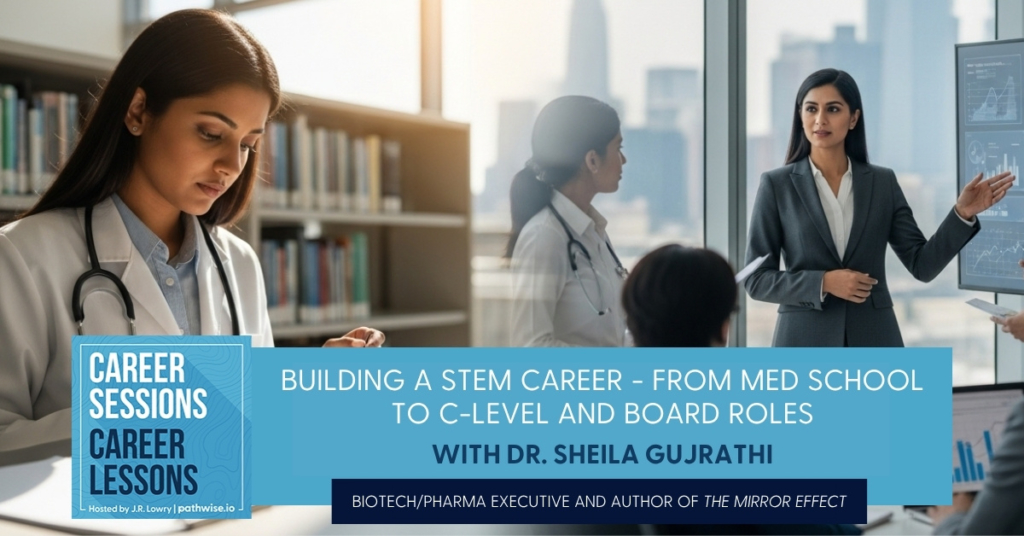
In the demanding world of biotech and healthcare, charting a successful STEM career path, especially as a woman or minority leader, often feels like navigating without a map. But what if you had access to the boardroom lessons, the personal triumphs, and the hard-won wisdom of an industry veteran? Join us as we dive into a candid conversation with Dr. Sheila Gujrathi—physician, biotech entrepreneur, and executive—to explore her journey from clinical practice to the C-suite. Dr. Gujrathi shares how she learned to trust her gut, break through her inner glass ceiling, and define an authentic leadership style, all while developing life-changing pharmaceutical drugs. Get a sneak peek into the core principles of her upcoming book, The Mirror Effect, which offers a vital roadmap for the next generation of diverse leaders seeking to not just succeed, but truly thrive.
If your executive team is navigating the challenges in this conversation, explore PathWise’s coaching for executives and rising leaders.
Check out the full series of “Career Sessions, Career Lessons” podcasts here or visit pathwise.io/podcast/. A full written transcript of this episode is also available at https://pathwise.io/podcasts/dr-sheila-gujrathi
—
Watch the episode here
Listen to the podcast here
Building A STEM Career – From Med School To C-Level and Board Roles With Dr. Sheila Gujrathi
Biotech/Pharma Executive And Author Of The Mirror Effect
My guest is Dr. Sheila Gujrathi, a Biotech Entrepreneur and Executive Healthcare Investor, Drug Developer, and Speaker with over 25 years of experience in the biotech and pharmaceutical industries, she has founded, built and run numerous biotech companies and led the development and approval of life-changing pharmaceutical drugs for patients with immunology and oncology diseases. In our discussion, we’re going to be covering Sheila’s very accomplished career journey and her book, The Mirror Effect, as well as some of the other things that she’s got going on, including her board work. Let’s dive in.
—
Sheila, welcome. Thank you for joining me on the show.
Thank you so much for having me.
From Physician To Biotech Leadership
Yeah, absolutely. Let’s start a little bit with your background. You trained and practiced as a physician before you moved into biotech leadership. What prompted the transition out of medicine into biotech?
It was a very difficult decision and transition in some ways because I had a lot of familial pressure to be a physician. Both my parents are doctors, and I was told from a young girl this was really the ideal career for me. I just really grew up my entire young childhood and even teenage life thinking this is going to be my career path. I really loved learning about medicine. I enjoyed studying medicine. The subject matter was fascinating, learning about the human body and all of the potential ailments that afflict us and just fascinating that the body is truly a miracle.
What I found was when I was doing my training, this is in my residency, in my fellowship, that my energy level and my excitement and passion for what I was doing on a daily basis were really starting to wane. Initially, I thought I was just tired and kind of in a daze. As I started really getting into the more mature parts of my fellowship and thinking about my time as an attending physician and really what I would be doing in my career long-term, I just wasn’t as excited about it.
I talk a lot about following your passion and your energy level, and we’re very complex creatures, and we have a lot of analytical skills, and we analyze everything and tie ourselves into knots. At the end of the day, just simply trusting your gut, following your inner voice, listening to that inner compass that we have is so critical. For me, it was shouting at me at one point because I was really finding it hard to jump out of bed and rush into the hospital, that this may not be the best career path for me, and I may want to explore other avenues.
At the end of the day, simply trusting your gut—following your inner voice and listening to your inner compass—is critical. Share on XI decided coming out of fellowship that I would basically do that just to give myself a chance to explore what other career options were out there for me. There are some things that would excite my passion and energy in a greater manner, and so I did. I embarked upon understanding what I could do after my medical training, and I basically consulted with my peer group as well. I thought about getting a Business degree, getting an MBA, going for an MPH or potentially taking time off or even studying alternative medicine.
I landed on actually doing business consulting, and I applied to a company called McKinsey, which just has a terrific reputation. I thought, “Instead of getting an MBA, let me go work at this company if I got an offer there,” and I did. I have an engineering background, so I’m quite analytical and I love to solve problems, and it was just like a perfect fit.
My energy level went back up to that 9 out of 10. I just really loved it. Basically, that’s how I ended up leaving medicine. Similarly, decisions that led me into the biotech and pharma area I found, again, during different parts of my career, really taking some time to understand what I’m getting really excited about has really been key for me.
Evolution Of Career Roles In Biotech/Pharma
You and I have McKinsey in common, by the way. I was there for eleven years. It’s been a long time. It feels like it’s something in my distant past at this point. Talk a little bit about some of the roles that you’ve had in biotech over the time that you’ve been doing that part of your career.
At this point, I am really pleased to say I played most roles, which has been exciting in that the breadth of roles that always every role has a new challenge. Also, it’s been exciting because oftentimes, I would be one of few women or one of the few people of color taking that role. It’s been very rewarding that I’ve been able to step into so many different leadership roles.
In the beginning days in my early part of my career, I was playing roles similar to other individuals in the biotech and large pharma organizations. I had some differences, though, in that when I came out of McKinsey, I actually started in the commercial organizations. I was in marketing and market research and planning, but what I found being a physician at my core was that I really wanted to be in R&D.
I actually moved back into development and played medical lead roles, development team leader roles, and franchise team leader roles, which was so exciting. It was a place where I got to really embrace having that commercial strategy, but very much anchored in the science, clinical medicine, and doing what’s right for the patient. I like to think of myself as a physician executive playing these different roles.
When you’re working in large biotech and large pharma, and even in small biotech, you tend to start out at these associate director roles, director, senior director, executive director. I really stepped up through my career trajectory playing those different roles. You get more leadership and management experience as you get into the senior level roles. We have something, especially within R&D, it’s like a dual track. There’s a track where you become more of a principal scientist and you have an option to really focus on science and go really into depth into research, or you can go down the leadership management track.
I pursued the leadership management track. At that point, I started then taking on executive roles. I was a vice president when I went to Bristol-Myers Squibb. I took on my first executive role as a VP and a global therapeutic area head, running all of my immunology therapeutic area. When I transitioned to small companies, I stepped into C-level roles. I was the chief medical officer of a company, then I was a co-founder and a chief executive officer.
More recently, I’ve been playing a lot of board roles, board director roles, as well as the board chair role. Different roles within the board, whether that’s chair of a compensation committee or working on the non-gov committee, and then continuing to found companies. I’ve really had the spectrum of experiences and different roles you can play within my industry.
Evolution Of Leadership Philosophy (Knowledge-based To Authentic, Vulnerable, Servant)
Talk about how your leadership philosophy has evolved as you’ve moved through companies big and small, and moved up the ranks, and now are operating in a combination of founding roles and board-level roles.
The leadership journey has been a journey for me personally. I think as a physician, and then of course as a management consultant at McKinsey, you’re thrown into dealing with Fortune 500 executives, as you know, and you have to walk into those boardrooms and you have to fire confidence. At McKinsey, we talked about really having executive presence.
That’s also true as a clinician, as a physician. When you walk into the waiting room, when you walk into a patient room in the hospital when the patients are surrounded by their families, they look to you for leadership. They want to have be inspired by your competence, that their loved ones are in good hands, and you’ve done your homework and you also exhibit care for the patient and for their family. That goes such a long way.
I think through my training, I was really embracing being a leader naturally because of the roles I was playing through that educational experience, and also the demands and expectations that are put on physicians, which are critical roles in our society. We’re incredible contributors. I’m married to a physician who’s an ER doctor, and I’m so amazed and inspired to what he does every day, helping patients and their families under incredible amounts of stress and pressure.
That was incredible. That was very helpful for me when I started my career journey. I just share that because it’s true for everyone. What I’d like to say now that leadership is independent of position, all of us can be leaders. I think in terms of my own style, initially, especially in the scientific realms, when I was in R&D, it was really around knowing my facts, really understanding the research and really being rooted in that knowledge base. That’s where my authority came from, my credibility, my confidence.

STEM Career: Leadership is independent of position; all of us can be leaders.
The challenge is that when you go into higher levels of leadership, you get away from just managing one project. You’re starting to manage a whole portfolio, and you can’t possibly know all the details of a given project. Also, you’re very involved in decision-making, which involves a lot of uncertainty and risk. We don’t know exactly what the data will play out to be in these different experiments, whether those are research experiments in animal models or whether they’re the clinical trials that we’re running.
You have to really figure out how to make decisions and quite a bit of uncertainty. I had to break out of that reliance on my knowledge base and understanding the facts and the situation at hand, more into being able to trust my team, and really being able to empower my team and find the right people to lead, to manage and thinking about situational leadership, learning from them, and then preparing myself as much as possible, looking at all the information that’s available, and then making decisions.
I started to really embrace humility, because humility can be an incredible source of strength as well. Humility, respect, collaboration, these became my core values in terms of what I leaned into for leadership. I went through a phase of what I call servant leadership, because I’m always so inspired by taking care of my employees and taking care of my patients. I get a lot of strength and courage from that. I was really leading into servant leadership, which I found very meaningful and gratifying.
Humility, respect, and collaboration became my core values—the principles I leaned into for leadership. Share on XAlthough I did think at some point, maybe I was overemphasizing the servant leadership part, because in order to really run a company successfully, you can’t please everyone around you. I learned how to be a servant leader, but still focus on doing what’s right for the business at hand and the corporate objectives that you have. Sometimes you have to have those really difficult conversations, and that’s for the employee as well. It’s also best for the business and ultimately for the patients.
Now I would say I have come back to my leadership styles being truly authentic, rooted in my core values, really coming from a place where I’m trying to serve a higher purpose, so I have a North Star that I’m very much being led by and then embracing my vows and trying to be as truthful and transparent as I can in a judicious manner. I think that’s how I would describe my authentic leadership style.
All of that that you’ve described helped form the basis of the book that you’ve got.
Yes. I’m so excited for The Mirror Effect.
Motivation & Purpose For Writing The Mirror Effect
Talk a little bit about it. I know you described it as years in the making. Give us a little bit of what led you down the path of writing a book.

I never thought I would, I never considered myself an author from that perspective and also writing a book, hopefully, that will add value for professional women and really, anyone actually in the professional arena. This is meant to be a very inclusive book in terms of the audience, although I do focus on women leaders because that’s been so much of my personal experience.
What I found when I was rising up through the corporate leadership ranks, this is whether I was in large biotech or large pharmaceutical companies, or in the small emerging private biotech space and working with investors, is that there’s no real roadmap to how to step into the C-level executive roles, the CEO role in particular, board roles. There’s no guidebook. I think that for me, personally, I did find myself feeling quite alone and lonely as I was making those transitions and growing.
I’m very excited, terrified and excited, but really also just not exactly knowing what I was getting myself into, and then learning very quickly on the job like we did at McKinsey. Thrown into the fire and you just drink from the fire hose and you learn, and that’s great. Many of us have done this as you don’t really know your careers until you step in them.
When I think about my male peers and counterparts, I do think they may have more of a network around them, and they have had more exposure to those inner circles, whether that’s through their conditioning, their experiences, like being on sports teams or fraternities or the clubs they find themselves in, their golf clubs or different professional affiliations. YPO is a great example. I didn’t even hear about YPO until it was too late.
I think it was just, again, a lot of different conditioning. I felt like maybe there was a lot of knowledge and wisdom imparted in those relationships, those mentoring and sponsoring relationships in those closed rooms that maybe I didn’t have access to. Regardless of the reasons, I wrote this book to codify and really impart the wisdom that I’ve learned through all the lessons I’ve had, both successful and sometimes not so successful, through my leadership journey.
I want to try to help set up the next generation of women and diverse leaders for success in a way that I have not experienced myself. I like to say I started writing it for my younger self, and now I’m hoping it’ll really help a broader community of my peers and the next generation of leaders who are interested in understanding how they can, again, better set themselves up for success.
I’ve heard this story certainl,y about people saying, “I could have used this book when I was younger. I wrote this book almost for myself.”
I think that’s a really powerful way to start writing a book, frankly. I encourage people who are out there thinking like they really could have used some help, some guidance along the way. That’s probably some unmet need that needs to be addressed. We’d like to talk about unmet need when we’re developing therapeutics for patients. What are we trying to address? Anyone developing a product is thinking about that similar for a drug, for medicine.
That’s true here too. To me, there was an incredible unmet need to really speak authentically, honestly, transparently in a very real way to this audience. There are a lot of great books out there, as we know, and I’ve read many of those books. I did find that I thought there was a gap, especially hearing about experiences for women who had been in those roles and what was like for them, especially when things weren’t going well. What does that mean? How do I navigate those situations?
That’s what I was trying to address. Someone who’s actually been on the front line, who’s had those experiences directly, who’s struggled with those experiences, been successful at times, not successful at times, what does that look like? What does that feel like? What have I learned on my journey? What can I impart to those next generations so they can start working on these things?
They can go into situations eyes wide open and understanding tools and resources that they can deploy and employ to help them navigate choppy waters and also feel great about themselves. They could truly live a thriving life. I also want to really paint that vision for people, that they don’t have to do it alone, and they shouldn’t do it alone. That’s something that I really wanted to share as well.
That is excellent. Tell us a little bit about how the book’s organized.
Book Structure: Knowing Thyself & Dealing With Inner Critics
The book is organized in three major parts. This came to be very naturally. I think it’s the way I also view my career journey in some respects in terms of the way I’ve learned, and I’ve looked at it in a retrospective manner. I use analogies of mirrors and that play on words. Also, it’s based on this TEDx Talk I did, which is really about understanding how we can set ourselves up for success through the power of mirrors. That’s what I talk about.
I really want to move away from this concept of shattering the glass ceiling to more of how we can empower ourselves in a way that we had used to our best ability. The theme of mirrors is throughout the book. The first section is about holding up your own mirror and holding up your own mirror really means knowing thyself, because I do believe things start and end with ourselves.
The work that we can do to really understand the inner workings of our mind and what’s transpiring in our bodies is incredibly powerful. I think it’s a lot of our journey in life, professionally and personally. I think we’re here to really grow and become mature beings. That’s what the first part of the book is getting at, raising that awareness of what’s happening for you personally inside your mind and inside your body.
That’s the first section of the book. I talk a lot there about really breaking through that inner glass ceiling and the inner critics that we all have to be truly free, to be our most authentic, powerful self, centered and grounded. Could that really lead to that authenticity, which then can form that foundation of being a strong leader?
The second part of the book is really about understanding our environments. I talk about reflect on your surroundings. That is really a very important part because, again, there was no roadmap or playbook when I was stepping into some of these very high-powered rooms in different company cultures and how was I trying to understand and navigate those environments, especially when things weren’t going well?
I really wanted to help educate younger generations that you can be in difficult situations. In fact, you should expect it that these are essentially some difficult work environments you could find. How can you, again, still continue to be your best self so you’re operating at your highest level in a way that is not only impactful for you, but also you’ll be impacting their surroundings as well?
I talk about how to read the room, understanding and paying attention to when you are having red flags or warning signs come up, what does that mean for you? How best to partner with the people that you’re working with, whether it’s your peers or your bosses, your managers, to be successful in your workplace and choosing your workplace very wisely. We are much more powerful than we think, and that we havea choice. If you can choose the environment, the cultures, the people you want to work with, I think, is very powerful.
The last part of the book is around setting ourselves up for success and making a life worth marrying. There I focus on certain areas that I think are potentially underserved for us as women and minority leaders. It’s really around a few different areas that I talk about building your network or surrounding yourself with your personal board of directors or surrounding yourself with mirrors.
The second part is really mastering negotiations in a way that you’re not compromising your integrity. The third part is harnessing your executive presence and really dealing with nervous system dysregulation that sometimes hijacks our behaviors, thoughts, and feelings. That doesn’t serve us well at all. These are areas that I felt like I spent a lot of time honing and practicing and developing. I really wanted to impart that to help others as well.
Let’s dive into some of the specifics of the book. Knowing yourself, one of the things that happens to a lot of us is we have inner critics. How do we keep our inner critics in check?
It’s so challenging, really a continuous conversation we have with these inner critics in our head. My friend likes to call it the itty-bitty shitty committee, and it tortures us. Actually, through help from coaches, I sometimes name those voices like, “There’s Negative Nancy popping up again.” My first piece of advice is really, again, raising awareness so we understand that we have all these inner critics and voices in our heads that aren’t serving us.
First of all, raising awareness and then knowing that these are not necessarily serving us. They may be there to protect us. I think they came for different reasons, but at the end of the day, beating ourselves up is never a good thing. It doesn’t serve us, it doesn’t serve our families, the people we love, and our work environments either. When you’re stepping into leadership roles, and if you’re having a very strong inner critic, that tendency to perfectionism, all those things can be really wreaking havoc on you and your employees as you’re trying to really achieve excellent outcomes and do what’s beyond possible.
Especially if you’re stretching yourself and challenging yourself, you don’t want that to take over. I found that that was happening for me personally. I actually didn’t even realize that I was sometimes operating from a place of fear. When I started to have those realizations, it was really a game changer for me because I thought, if that’s where I’m coming from, if I’m coming from this place of what I call FIDS, fear, insecurity, doubt and shame, what does that really mean if I’m not being my most powerful self?
How am I going to achieve the outcomes I want to achieve if I’m being so held back by fears and shame? That’s really how I have come to understand the inner critic, again, put in place by us, probably for very good reasons at some point in our life, but at some point, no longer serves us, and we really need to address it to be powerful leaders.
I talk a lot about, again, raising awareness, knowing that it is not helpful for you. The question is, how do you deal with them? I outline in the book a lot of different techniques. I do talk a lot about kindness, self-compassion and gratitude. These are really, I think, critically important. Many of us are very good at wielding these types of emotions and tools for other people, but not necessarily for ourselves.
I think that can be truly transformative when we spend time with ourselves thinking about not only why these things are in place, but really being compassionate for ourselves and forgiving towards ourselves, knowing that we’re doing the best that we can. Through those practices, you start to embrace higher levels of freedom and liberation that is, first of all, truly amazing to experience and counter and feel, but also actually makes you a better leader.
To help with all of this, I have created a workbook and journal that goes along with my book and actually outlines journaling prompts and exercises for each chapter to enable someone to not only read the book, and I, of course, try to summarize the key learnings at the end of each chapter, but get out of your head and onto paper and into real world exercises to make this alive for you, because I really wanted this to have some practical impact.
Yeah, I think when you add those exercises into a book, it helps make it much more of a hands-on practical read for somebody, for lack of a more eloquent way of saying it. It’s important. You bring up journaling. Journaling as lots of evidence shows is a great way to really put things in perspective, to put pen to paper. Literally, most people say you should put pen to paper, as opposed to trying to type something into a computer because it just tends to stick much more, prompts different parts of your brain.
You probably know more about that than I do being a doctor. Just the idea of putting context around something that happened that day or the day in general, or the week in general, and forcing yourself to, as objectively as possible, digest it and assess it and put some distance between who you are and what has happened.
Back to your point about self-compassion and being hard on ourselves, one of the things I took away from Carol Dweck’s book, Mindset, is separating out like, “I failed in that moment,” is very different than, “I am a failure.” If you can get yourself acknowledging when you have failed in the moment without it translating into, “I’m a failure,” then you start being able to accept these moments of failure as part of the human experience. You learn from them, you grow from them, but they don’t necessarily change who you are. They don’t define you. I think a lot of people struggle with that. When something bad happens to them, they let that bad moment define them, sometimes, they never get themselves out of it.
I know. It’s so true. It’s especially true for people who are taking on those big challenges and stepping into those leadership roles. When they have those failures, they’re even bigger failures at times, and they can even be spectacular failures. How do you recover from that? That’s defining biotech, frankly. Biotech is not for the faint of heart. You have to be incredibly resilient to be in this industry, because that’s the name of the game. Most of the drugs that we work on fail at some point in development, and you pour your heart into these things.

STEM Career: Biotech is not for the faint of heart. You have to be incredibly resilient to succeed in this industry because that’s the name of the game.
For us personally, we experience failure all the time. How do we develop that objectivity? To your point, we can be objective about certain situations. It’s very difficult for us to be objective about ourselves. Working through and moving beyond subjectivity to objectivity and getting to be that calm, centered, anchored self allows you then to assess situations objectively, because that’s the second part of the book. You can’t really go into understanding your environment if you’re really just caught up in some type of emotional vortex.
That’s why I start with knowing thyself and then going on to being objective with yourself, and then really assessing your environment. There are so many great tools and resources, obviously. It’s so much been written about gratitude, so much about compassion. I point to certain resources within the book, and as you mentioned, about mindset. My whole point was whatever works for you, embrace it, but you have to do that. I didn’t realize how important that was. I had a lot of coaches going up through my career. I had done a lot of journaling. I meditate often and regularly, but still, it’s just so important, especially when you face some of those deep, deep challenges.
The other thing I just want to make the point on this is that you don’t have to do it alone. I’ve been encouraging people to do the workbook journal with friends in a peer group or a book club because then you can have the dialogue. You get out of your head onto paper and you talk. You talk to each other about these experiences, and you reflect on something that happened the past week, and you pause and say, “What was happening for me in that moment?” If you don’t stop and assess and understand it, and then try to make some active changes and practice those muscles that are not very familiar to us, we’ll always be caught in those same traps.
It is very true. Having people around you to help you is something I’d certainly counsel everybody I talk to, to do, to not do it alone. You referenced earlier the personal board of advisors, whether it’s in that form or mentors or sponsors or whatever, friends, family. Just finding those people who will help hold a mirror up to you, to use your usage of it, but also be a bit of a cheerleader for you as well. When you’re being overly hard on yourself, they can pull you out and say, “What are you talking about? You did this, this, and this. Why are you feeling so bad about this particular thing?”
I think it’s incredibly important to, again, surround yourself with mirrors, people who have your back, who truly see, hear, and understand you, and are there for you in those tough times. Also, there are those great times to celebrate and reflect that accomplishment back to you so you can actually internalize them. It’s up to you to internalize them and really embrace it just to know how brilliant you are.
I do think surrounding yourself with mirrors, building that personal board of directors from a very young age is just paramount, I think. I know as a woman and a person of color, I really struggled to do that. I didn’t want to ask people for help. I didn’t want to be a burden or impose on them, or even wonder why they would go out of their way to help me. That’s just, again, doing a disservice to you, and people want to help you. Just embrace it, know it. Something you have to do is find your people.
Balancing Authenticity With Performance In Senior Executive Roles
You talked earlier about authenticity, being an authentic leader. One of the things I think when you get into the second part of your book, and you’re talking about understanding your environment, you are in C-level roles. You’ve got the teams, you’ve got your direct reports, you’ve got investors, you’ve got others, and there’s a bit of performance to all of that. How do you balance the performance that’s required to be in a senior role like that with the idea of being authentic, true to yourself?
It’s something, again, that needs to be learned. When you’re first stepping into the C-level role, you think, “I’m the same person. I’m just going to step out there and do what I’ve been doing.” This is very true. If you step into the CEO role. You’re like, “I was the same person I was yesterday when I was the chief operating officer, and now I’m the CEO,” but it’s not true. People look at you very differently. They hang on every word. If you are brainstorming out loud like I like to do, you can set a whole chain of events unbeknownst to you, because you said, “Maybe we should explore doing a trial in China.” A whole team is starting to work on that.
They’re booking tickets. They’re like, “Yeah, this what I want to do.” Just how you carry yourself, what you say, so much of communication is nonverbal. People are looking to you. They’re looking at your mood, they’re looking at how you’re dressed that day. It’s the reality of the situation. I very much am a big believer of let’s just be real. Face facts, know what’s happening for the employees, for the people around you.
Being very aware of that, I think, was a big lesson learned for me. I often talk about this with many of my peers. We formed a group we call The Biotech Sisterhood, and we share stories all the time. We all have this experience, that a-ha moment when we realize we do need to show up in a certain way, people are watching us. It’s like that with great power comes great responsibility. You do need to understand that.
There is this aspect to me of playing the role and performing, because you may not be having a great day at home, or you may be struggling with certain emotions, or there may be something happening in the market, but you don’t want to stress your employees out about it. You have to figure out how you’re going to carry yourself. There is some performing, I think, and I don’t think it’s a bad thing, but I think it’s, again, part of the roles we play. We do this as parents, we do this as children to our parents when we don’t want them to worry. We’re often playing different roles in our lives, but I think what’s key is that you’re doing it again from that authentic place.
You’re very clear about what your intentions are, about what your overall goals are, and you’re connected to your values while you’re playing these roles. I think that’s really where that authenticity comes from. When you’re giving feedback to somebody, and I really am a big believer in giving feedback early and often and constructively, but you have to sometimes deliver difficult messages. How do you do that in a way where you’re authentic? You may not want to hurt someone’s feelings.
If you’re coming from that place where you do want to help that person, and that’s why you’re going to be giving them this difficult feedback, that, again, is incredibly powerful, and that person will know it and feel it as well. We can be authentic leaders navigating our companies and difficult environments and positive environments connected to our values, our true North Star. Knowing why we’re there clearly connected to our purpose. That’s, to me, how we can bridge what we may perceive as a gap where there really is no gap.
I think you have to meld the two together. Ideally, you aren’t performing so far out like this that it feels unnatural to you to do every day. At the same time, particularly if you work in a bigger organization, people only get snippets of you. They aren’t having conversations in depth with you. They may see only you passing in the hallway, or only you having a conversation with somebody, and they measure the tone of that conversation from what they see, or they see how you’re dressed. Maybe they just see you passing by and it’s like, “She was dressed up today. I wonder what’s going on?”
That’s all they get. They have to infer what they feel about you from very limited information. I think that’s why there is a performance to it, whether you like it or not, particularly when you get into more senior roles. Not even in counting the whole idea of people hanging on your every word and running off and doing stuff when it’s just a whim or an idea that’s brainstormed in your head.
Yeah, it’s very true. In some ways, that you feel like that puts so much pressure on leaders because we’re not perfect. We’re not always going to have that positive face on or, or some type of mask. That’s where I say we’re working with adults and, again, it’s the culture you also want to build in your company or a culture you want to work in, where people are treated with that respect and that integrity, so that we do treat people like adults.
Sometimes you are having a bad day, and again, just sharing that, “I’m a little off but everything’s fine. Just dealing with stuff.” People appreciate that so much, that vulnerability. Obviously, Brené Brown talks a lot about this, but that strength that comes from being vulnerable because you connect with individuals, so that is also part of authenticity. You can’t be authentic if you’re not vulnerable. You can’t have intimacy unless you embrace your own vulnerability. We’re performing, but we’re performing from a place where we, again, know who ourselves and we are being authentic. That means sometimes we’re being vulnerable or all the time really. That becomes, again, part of our fabric.
Navigating Toxic Environments & Building A Healthy Company Culture
You talked earlier about biotech not being for the faint of heart, I think are the words that you used. Did you encounter or have you encountered toxic environments that you’ve had to deal with in the course of your career? How did you deal with that?
Yes, I have dealt with many challenging environments. It’s very natural to have work at different companies with different cultures, if you will. I’ve worked in very competitive cultures. Whenever you get a group of very smart people together, especially scientists, if you think about the academic institutions, even, that I was trained in, kindness and compassion wasn’t overflowing in the hallways. There’s a lot of arrogance, there’s a lot of power dynamics even in those academic institutions.
It starts when you’re at a very young age, depending on the fields that you find yourself in. I can speak to the STEM fields in my experiences there, and within medicine, it can be a tough environment to work in, in these different labs. Culture, to me, is set from the top. Who is a leader, the professor? Who has that lab or the leaders in the company and what culture are they setting?
I’m all about healthy competition, but when competition becomes cutthroat and you feel like you don’t know who has your back, or if there’s some backstabbing involved, those aren’t good behaviors. I think that erodes trust. When you erode trust and you don’t have safe environments for us to work in, I don’t really think you can truly thrive.
This is true for schools as well. When kids don’t feel safe, they don’t learn. I’ve had to pull my kids out of unsafe environments because they weren’t learning and it was really damaging their psyche. I think this is true for work environments as well. If we’re not creating a culture of safety, if it’s more of a culture dominated by a culture of fear, or again, competition that’s not healthy or a lot of gaslighting.
I talk a lot about gaslighting in the book. That really erodes the culture. What ultimately happens is that people aren’t going to perform well. You’re not going to get the best out of your employees, and they’re not going to stay at your companies for long periods of time. That’s not what we’re about anyway. We want to have fun while we’re working. I talk about living an integrated life where we can show up at work as an integrated person, embracing our professional and personal selves.
Yes, I worked in many different types of environments and that really informed then for me what type of cultures I wanted to build in the companies I was helping to lead. That was very important. You can make choices like, “I want to work in this type of company.” We want to do great work, great science, we want to develop really meaningful therapies, but we also want to have fun. We want to respect one another, we want to care for one another while we’re doing this hard work.
Value Of Board Work For Executive Effectiveness & Future Plans
You’re doing board work now on top of some of the other things that you’re doing. How have you found board work and how has it helped make you a more effective leader?
It’s been instrumental, really. I think boards are very important for companies, especially the smaller companies. This is true for any company, frankly, and the large companies as well. When you’re in small companies, you don’t necessarily have big review committees. You can get very internally focused. To have a very experienced group of board members, whether those are operators or investors who are out there, understanding the markets, talking to other companies, is incredibly helpful to have those types of perspectives to make sure you’re making the right decisions.
I always knew that and embraced that. Being a board member and a board chair, I’ve really gotten to see even more, really understand even more how important that is and understand how executives are showing up when they’re pushing their own agenda, when they’re listening, when they’re not listening, and how that impacts potentially the trajectory of the company and where they could be making mistakes from blind spots that occur.
Being on the other side, very helpful, illuminating, eye-opening experiences that I think only make me a better executive. I always encourage executives to take board roles because you learn so much sitting in those board meetings and participating in the open sessions, then the closed sessions, speaking to the shareholders and understanding what’s really important.
Executives are strongly encouraged to take board roles, as you learn far more by participating in board meetings and the open sessions than in the closed sessions. Share on XUnderstanding the responsibilities we have as executives of companies that, obviously, we have shareholders, we have a broader vision of trying to help patients in further science, but we also have to deliver value and return value to our shareholders and in a positive way. Taking that very seriously, I think, is really important. You do that as a board member because of your fiduciary responsibility in private settings, that’s usually to your investors in public setting, of course, that’s to the public shareholders. It creates a lot of objectivity for you, I think, as an executive and operator, as a board member. I think that’s critical because it just makes us better decision makers and better leaders.
I hear that a lot from people. They really feel like it gives them a complementary lens through which to view situations. You get to see how other people handle things as CEOs and as executive teams, and you learn from that. There’s a lot of hesitance to let CEOs be on boards because of companies want them focused on their own thing. I actually think you can learn from the experience of sitting on both sides of the table, if you want to think about it that way.
I think it’s definitely true. I know every time I was in the C-level or CEO roles, and I’m a CEO of a company right now, I always take so many lessons from every board meeting and I’m definitely are filing things away and taking note. It’s a great way in a way that’s not you don’t get the direct feedback, but you know that you may be doing some of those things that you’re seeing exhibited by other executives or to your point, “That was a really great way that that person handled that situation. I really liked that presentation. I really like their principles on leading.” You can embrace that as well. That’s how we learn and grow because otherwise, we’re we have to challenge ourselves and put ourselves in different environments. I really do think CEOs, even if they’re in busy companies, should have some board roles.
I agree with you. Companies obviously don’t always feel that way. You’ve got your book. What else is ahead for you personally and professionally? What are you aiming for in the next year or two?
Personally, I am going through this transition where I launched my first child to college. That’s definitely a process. I know you have older children, but it’s amazing and you’re so excited for them, but you do feel the sense of loss. I really want to honor that, for me, not in an overly dramatic way, but I appreciate that that’s going on, that things are changing in my life.
My younger daughter is now driving, so she’s also very independent. Also then, it gives me even more bandwidth and energy to apply to my professional pursuit. Very excited about this book launch. Really excited to see how impactful it can be. Get the word out. I’m doing corporate events, I’m doing events with different organizations around the country and in the world.
Actually, I will be in London. I’m doing three events there. When I’m traveling, I’m doing corporate events and other events with organizations, professional organizations and students. A lot of student groups as well, academic institutions. Really, very open to anyone who would like to benefit or hear from about the messages of the book. I try to bring books with me to every event as well.
Of course, I still love my biotech pharma career. I think it’s my passion. I love developing medicines for patients. I have a lot of deep expertise within the immunology area, developing therapeutics for patients with autoimmune disorders, also for cancer indications, neurology indications, so rare diseases. I’ve had a lot of experience.
I have started a few companies. I’ve founded some companies and helping to build them. Either I’m running one and then I’m building executive teams out for the others. I’m also doing investing work as well to really try to continue to contribute to the ecosystem in addition to the board work. At this stage of my career, I get to wear multiple hats at once, as long as it’s in a way that the bandwidth is appropriate. Right now, I’m not really taking on a lot of new things, but I have enough on my plate here between that and the book to keep me very busy and very fulfilled.
Sounds like it. Thank you. I appreciate your time and getting to know you a bit and hearing about the book.
You can order it on Amazon, Barnes & Noble. You can also get it from my publisher’s website, Amplify. The journal is also available right now.
Alright, thank you again, Sheila. It was a great conversation and best of luck with everything you’ve got. You’ve got a lot on your plate.
Thank you so much.
Yeah, absolutely. Take care.
—
Thanks to Sheila for joining me to discuss a bit about her career journey, how she transitioned from medicine to consulting and into biotech, her book, The Mirror Effect, as well as some of the other things that she’s got going on right now. A lot is a short answer. As a reminder, this episode is brought to you by PathWise.io. If you’re ready to take control of your career, join the PathWise community. You can also sign up for our newsletter and follow us on social media at LinkedIn, Facebook, YouTube, Instagram, and TikTok. Thanks.
Important Links
- Dr. Sheila Gujrathi
- The Mirror Effect
- Mindset
- The Mirror Effect on Amazon
- The Mirror Effect on Barnes & Noble
- The Mirror Effect on Amplify
- PathWise on LinkedIn
- PathWise on Facebook
- PathWise on YouTube
- PathWise on Instagram
- PathWise on TikTok
About Sheila Gujrathi

She serves as executive chair of Ventyx Biosciences and Lila Biologics and director of Janux Therapeutics. She previously served as chair of Turning Point Therapeutics (acquired by Bristol Myers Squibb for $4.1B), ADARx Pharmaceuticals, and ImmPACT Bio (acquired by Lyell). Dr. Gujrathi is the co-founder and former CEO of Gossamer Bio. Prior to Gossamer Bio, she served as chief medical officer of Receptos (acquired by Celgene for $7.2B). At Receptos, she led the advancement of the pipeline, including Zeposia®, which is approved for multiple sclerosis and for ulcerative colitis. Previously, she was the immunology therapeutic area head at Bristol-Myers Squibb and held multiple roles in immunology and oncology at Genentech. Earlier in her career, she was a management consultant in McKinsey’s healthcare practice.
Dr. Gujrathi received both her M.D. in the accelerated Honors Program in Medical Education and her B.S. in biomedical engineering with highest distinction from Northwestern University where she was the 2024 commencement speaker. She completed her internal medicine internship and residency at Brigham and Women’s Hospital and Harvard Medical School and additional fellowship training in allergy and immunology at the University of California, San Francisco (UCSF) and Stanford University.
Dr. Gujrathi has earned multiple leadership awards, including Corporate Directors Forum Director of the Year; Healthcare Technology Report Top 25 Women Leaders in Biotechnology; Athena Pinnacle Award, and was named among the Fiercest Women in Life Sciences. Most recently, she was inducted into the 2025 American Institute for Medical and Biological Engineering (AIMBE) College of Fellows Class of 2025, and was named as a 2025 Bloc100 Luminary honoree. Gujrathi is passionate about making the working world safe and inclusive for women and other minority groups. She is co-founder of the Biotech CEO Sisterhood, a group of transformative trailblazing female CEOs, and the South Asian Biopharma Alliance.
