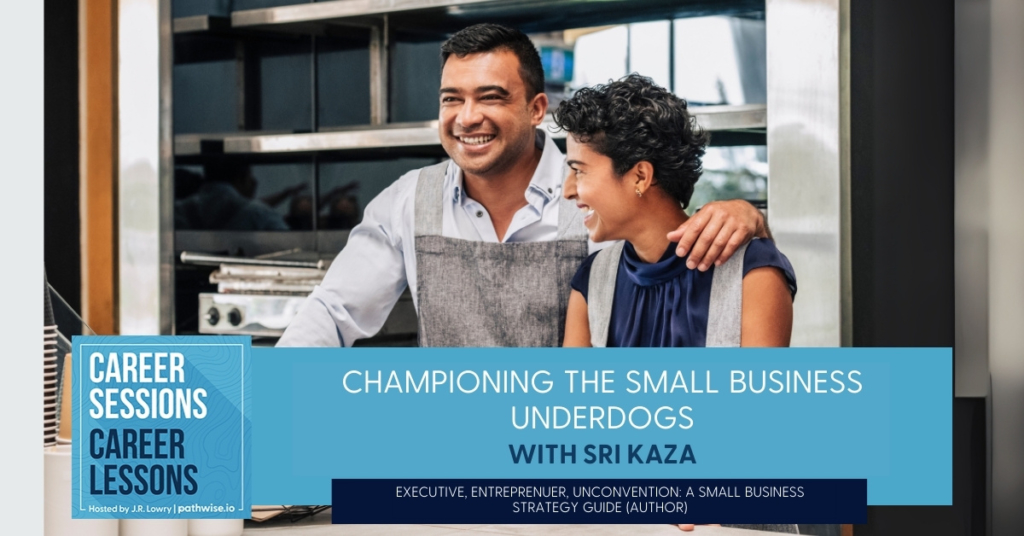
Championing The Small Business Underdogs, With Sri Kaza
Small business strategy is getting a rethink: underdogs can win when they obsess over positioning, proximity, and purpose rather than scale alone. Sri Kaza, author of Unconvention: A Small Business Strategy Guide and longtime small-business advocate, traces his path from McKinsey to Viking and explains the three “Underdog” principles that power niche resilience. He illustrates those ideas with stories like Toshi’s Yakitori, breaks down real-world lessons on customer acquisition costs and product-market fit, and shows how AI and intimacy can democratize entrepreneurship.
Practical, candid, and strategic, this conversation offers a playbook for owners, leaders, and emerging founders who want to turn small advantages into lasting success.
Check out the full series of “Career Sessions, Career Lessons” podcasts here or visit pathwise.io/podcast/. A full written transcript of this episode is also available at https://pathwise.io/podcasts/sri-kaza
—
Watch the episode here
Listen to the podcast here
Championing The Small Business Underdogs, With Sri Kaza
Author Of Unconvention: A Small Business Strategy Guide
My guest is Sri Kaza. Sri is a seasoned business leader and small business advocate with a background in corporate strategy and entrepreneurship. His new book, Unconvention: A Small Business Strategy Guide, draws on his extensive experience, challenging conventional corporate thinking and empowering small businesses to succeed by staying true to their unique strengths. In our discussion today, we are going to be talking about the challenges and opportunities that small businesses face today, Sri’s book, and his own career journey. Let’s get going.
—
Sri, welcome and thank you for being on the show with me. It is a good opportunity to get to know you and talk about your work with small businesses.
Thanks for the opportunity, J.R.
Before we dive into that small business discussion, give us a quick overview of you.
I was at McKinsey for a big chunk of my career. That formed my thinking about business and being a business strategist. In the last ten years of my career, while I’ve been leading big companies, those companies have been working with small businesses, and I have grown very attached to many of the entrepreneurs that I have touched in that time. After having sold the last company I was leading, I am sitting in a place where I want to advocate more for entrepreneurship and small businesses. I am pretty excited about how I can be helpful and the advice I can pay forward to entrepreneurs in the future.
The Road Less Traveled: Finding Impact In Smaller Firms
Even while you were at McKinsey, and you talk a little bit about this in the book, while everybody else was trying to serve these big whales, the Everest clients, as you called them, you gravitated more toward the smaller firms where you could have a more focused impact. What sparked your interest in the small business space? It goes back even to the McKinsey days.
It does. They talk about the road less traveled, by Robert Frost. These areas that are unexplored or maybe underserved are a different way to describe it when it comes to small businesses. I cannot have told you any of this even while I was still at the firm. I loved being there and working with big problems and interesting clients. All of that was fantastic for me. A lot of times, you are trying to do something career-wise, and it does not fit your personality, and it does not fit the things that make you happy.
I know many folks at McKinsey who spent time there said, “This isn’t for me,” and they went on to do other things. For me, there were points in time when I said, “Is this for me?” What I found was that by working with smaller clients and working with people who I could be a lot closer to, and problems that maybe bigger companies had solved one way, the smaller company might actually be able to solve in a different way, and I could be creative. That was what I enjoyed. When I left, it was not because it was a place I did not enjoy. I left because there was an opportunity to work on something that was another interesting and creative way to solve a problem.

Sri Kaza: Working with smaller clients allowed me to be closer to them. Problems that bigger companies solved one way, smaller companies might solve differently, and I could be creative.
I encountered, certainly in my time at McKinsey, you would have occasions where you would go work with a big client, and somebody up here wanted the work done. Someone down here that you were working with day-to-day did not want to have a lot to do with you. You felt foisted on them from above. Those situations were always difficult.
I would tell you one of my favorite clients was an electrical equipment distribution company. I don’t remember how big they were. It doesn’t matter. When those guys hired us, it was a big decision for them. When we told them, “We want a team room, this is what it needs,” literally, on day one, they cleared out one of their biggest open spaces for us and gave us that whole room, tons of desks, and had people assigned.
They asked who we wanted, we told them who we wanted, and they were there, like, “We’re here to help.” They put so much care and thought into that project, and it makes it a lot easier. I know people have their digs at consultants, and you’re paying them to tell you what you already know, but these guys made sure they got good value out of us. For me, that made it rewarding. That’s probably one of the companies that I worked with over the years, the one that stands out for me, that was in that same space that you gravitated toward. Not a huge player, but looked to us for game-changing guidance.
To simplify what you said, you worked on something that did not just matter to you and your team, but to everybody around you. It mattered when something mattered. You feel like you are part of a team, and you can win and lose together as a team. I know many people who played sports in high school or in college, or even professionally. When they get to the business world, they’re looking for that and may not be able to find it. You can recreate that where you are working with a team that you care about, and you are working on something that you all agree matters. That makes a huge difference in your satisfaction and your happiness, and the ability to deliver.
Simplify what you said until you worked on something that mattered not just to you and your team, but to everybody around you. Share on XThe Shifting Small Business Landscape: Opportunities In The AI Era
Talking about the small business landscape, you’ve looked at this from a variety of lenses. Your consulting time, you’ve sold credit products, you’ve sold analytics, and you’ve done a bunch of things over the years, looked at the space in a variety of contexts. What is your take on the current state of play in the small business landscape?
The view has now meaningfully shifted. It comes from COVID. I had been helping small businesses at that point in time for maybe 5 or 6 years. COVID comes and starts to shut down tons of small businesses. I have reams of data and good insights into what businesses should survive and which ones will last. I was lucky enough to be involved in some of the PPP planning to try to get money to these small businesses, and everything up to that point.
Even during the process of working with the government through some representatives, on how to get them what they need to survive, the whole world disappoints them more than anybody. I had a feeling of doom and gloom for small businesses. If you subscribe to much of what I learned in business school and at McKinsey is that scale matters. There are big moats that big companies create.
There are barriers to competition, and all of this is an inevitable trend in everything in the world. We are coming out of big companies. I was worried for their existence. What I saw coming out of COVID, companies that did not get the help, the PPP, businesses that did not seem to stand a chance at surviving, somehow survived anyway, mostly because they had customers that valued them. They did not have to have a bazillion customers to value them.
They did not have a business that was dependent on having a massive scale. They had a business that was built from within and their own personalities. It flipped my mindset around, “Wait a minute. What does it actually take to survive?” Today, when I look at the small business landscape, I think small businesses probably employ maybe 40% of people, and the big ones, I don’t know, 60%. I think that is going to flip in the next couple of years.
All of these people are worried about AI and big banks saying, “We don’t need service workers and we don’t need all these people,” and they are going to let all these people go. Maybe that is going to happen. What is amazing now is that individuals who focus on something they love and are passionate about and connect with a smaller community of customers. You can create new services for people, new products for people, and new offerings for people. Smaller-scale tasks can be done much more effectively with AI than ever before.
You do not have to have a 40-person organization to have a services company. You can have a 3-person or 4-person organization as a services company. Now will be the time for people to become entrepreneurs in ways that they had not been before. Not very many people we discussed will be entrepreneurs to go compete with the Anthropics out there or the OpenAI. You are not going to do that. You are going to go out there and create something brand new that does not have a competitor. It does not have to be huge, but it will be much more rewarding than working in a job where your company is looking to replace you with AI anyway.
If you think about it, I will draw the comparison to Amazon Web Services. There are only a handful of big cloud providers in the world. There will likely only be a handful of surviving AI technology providers in the same spirit because the investment required to stay at the leading edge is monumental. In the same way that the investment required in the data center businesses is monumental, millions and millions of businesses tap into AWS.
You can be a one-man band, a one-person band tapping into AWS and using it for your hosting. In the same way, I think you are going to have people taking advantage of these AI tools. To your point, you can get a lot more done with AI. It takes some of the scale requirements out of having a business because a lot of the manual work that comes with running many businesses, you can potentially get rid of and automate completely. It makes it much more possible.
It is fantastic. I did not think too hard about these examples with AI, but I did actually when we had this shift to something called Robotic Process Automation, another big technology is coming. Everyone is going to lose their jobs. It reminded me of a couple of different stories. One is, if anybody has not read it, maybe read Player Piano by Kurt Vonnegut.
It is an old school book about automation, robots playing the piano, but you still have all these humans at the end of the story that they are managing. One of my favorite analogies is that, at some point, Rockefeller and his company created a standard design for kerosene. I think he called it Standard Oil in this story. Before then, it was nearly impossible to have bars and taverns open at night. Now that you have this wonderful new technology that enables, who knows what, like it’s burning a lamp, but so many more bars and taverns were able to open and operate because of this one invention.
Even though he became a monopoly and was a world beater and had to be broken up because of anti-competitive practices, that innovation enabled massive amounts of new business. I think we are on that same cusp. That is when you ask the question, “Where are small businesses today?” The current ones have to adapt because the world is going to change around them in a meaningful way. There are also tons of opportunities for people to do new things with the tools that are coming out from these big companies.
The world's going to change in a meaningful way, but there's also tons of opportunity for people to do new things with the tools that are coming out. Share on X“Unconvention: A Small Business Strategy Guide” – The Inspiration
Let’s use that as a segue into your book, Unconvention: A Small Business Strategy Guide. What was the original inspiration behind it? I think it goes beyond COVID, right?
Yeah. When I first started thinking about it, I was like, “Maybe I will write an advice book on how to lead or how to solve business problems.” As I was getting into it when COVID came around, and I learned so much about the spirit that could overcome these business trends that I was so confident in, I realized my conventional thinking from spending all this time with big businesses was that scale is what is going to matter.
Efficiency is going to matter. I realized there is a totally different way to win for these small businesses. That is not against any of these business principles, but they take advantage of a couple of things small businesses have that big businesses never will. When I started to understand a little bit more about what those survivors post-COVID got and how they got those things, I tried at first, actually, with a whole ton of data.
I had reams of data from small businesses that had come to us for loans, given us their whole business practice and their cases, and so on. In some cases, you could see that a lot of these companies should or should not fail because they did not have the right setup, the right market direction, or the right strategies for them as a business. There were so many outliers that you have to dig in to understand that, “They were not following your traditional strategy. They were building customer loyalty directly.”
They were creating something more community-driven or had so much more impact that their customers at some point recognized that, “I cannot lose this business that is in my life.” Nobody would ever rally around a Walmart to say, “We don’t want to lose Walmart.” They would rally around their local dining and restaurant, where they had to go to get takeout.
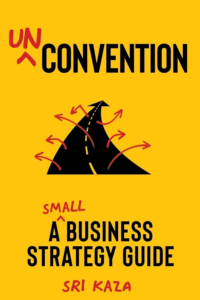
The genesis of the book was taking a bunch of my corporate strategies that I have learned. Anybody who is interested in business could read this and get a primer on my 5 or 6 favorite corporate frameworks for thinking about business, and some good big business examples of them from my experiences. The book was intended to say, “These are great in big business. They apply to small businesses, too. It is not like the small business owners do not play by the same rules.”
In this case, what I was able to show was that they were able to take something in a place where they are disadvantaged and find their advantage, still follow the same rules, but win in their own way. As you said, it is very similar to when I was at McKinsey, going and working for smaller corporations. They were behind the big guys, but they could still win if they found a different and unique path.
Underdog Principles For Small Business Success
You talk about underdog principles as being core to the book. You introduced that early. Do you want to walk us through your framework?
The principles are, and I apologize for being cute with them, it’s positioning, proximity, and purpose. Those three Ps, if you will, those principles around positioning, it is about being differentiated and unique. What I mean by that is you have to have some place in the hearts of your customers that is unique. Most of these small businesses that did well are irreplaceable in terms of what they do.
You've got to have a unique place in the hearts of your customers. Most of these small businesses that did really well are absolutely irreplaceable in what they do. Share on XMaybe it is because they are down the street, and you cannot find another place that is down the street because there is only one place there. It could be something that is very niche, and there is only one place in the world to get it. One place in the city, or the state, or whatever, to go get it. Whatever that is, it is unique to your customers, and it is important to your customers.
The second one, proximity, is that when you deal with your customers, you are closer to them than any big business CEO ever could be. You have the ability to be intuitive and make decisions quickly. You have the full context as opposed to charts, data, and statistics that big businesses have. Knowing your customer’s feelings or understanding those feelings translates to very good decisions if you can stay connected to them.
The last one was purpose. The purpose is about, I do not want to give people the idea that they have to be grand. They have to go try and change the world with their venture. The purpose is something that is beyond profit. It is more than just trying to earn money. What is the first most important thing? Embrace what your real purpose is before you have to go and say, “Go tell everybody what it is.”
Some of the examples I have are, “Look, the purpose of my having this business is so that I do not have to have a boss.” That is great. Actually, that is fantastic. Be comfortable with that and recognize that what you are trying to do is you are trying to provide for your family. You want to be your own boss and then make your business decisions around that, as opposed to learning externally that these are the right strategies and these are the kinds of things that you do, because then those guys are not trying to optimize for you, trying to be your own boss.
Those guys are not trying to optimize for you, whatever that mission might be. Maybe it is that you are an Ethiopian chef who has a nice restaurant and you want to bring Ethiopian food to the community, and there is not a lot in town. Maybe that is it. You are not sitting there worrying about your marketing strategies and getting MROI. You are worried about how to get more people to try and embrace my cuisine? Bring that into your decision-making with purpose.
Challenging Conventional Business Thinking With Purpose
Stories were a big part of the book. I know we were talking before we started recording about how central that was to the finished product of Unconvention. Maybe you have a Japanese restaurant that you like to frequent in LA, a Yakitori restaurant. I want to tell you a little bit about that story and how they challenged your thinking with some of this unconventional.
Toshi is a fantastic Yakitori chef. People who know Japanese food may know Nobu and his restaurants. He would dine at Toshi’s place. He is a huge fan because of the level of quality and care that goes into the food preparation. I did not know any of this when I got to LA. I moved down to LA more than ten years ago now.
When I got there, I thought I was going to lose out on the food scene because I thought I had all this access to great food in San Francisco. I saw this Yakitori place. I dragged my wife out there, saying, “Yakitori is what I love, this is what I did when I was in Japan.” There are some fantastic ones there. I went in and I was melted away by the quality of the food. It was a place for us, and we would go on a date night there frequently.
I noticed early on that he did nothing to promote his restaurant. The reviews were not great. I looked at Yelp, and I was like, “People like this place, it’s fantastic food.” The reviews were never about the food. They were always about, “People ignored me when I got there,” or “The line was long,” or “I did not have reservations, but I saw empty seats and they still did not seat me.” All kinds of different things about the service that they did not get.
In time, because of the way I thought about the world, I felt like he was operating inefficiently. He is not squeezing out his profit margins. He is not getting service help to do the low-value tasks, like bringing the food to the people. He would come out himself and bring the Yakitori, or even sit at a table. It is the odd things that I would be critical of in my mind.
As I saw the principles come out into play with the businesses I had been consulting for, and I found myself standing on the street waiting for my takeout order from Yakitori-ya, which, by the way, takes takeout orders from a place where the food is best when it comes right off the grill and comes to your plate. I mean, the reason he comes runs out and puts it on a plate. Takeout orders are like, “I’m doing this because I do not want to go out of business.”
I saw my buddy on the street, too, waiting for his takeout order. We talked about it. I realized that I am out there as one of those people who is out there trying to save a business that he cares about. That this is part of what they are, a piece of our lives. My friend said, because he and I were debating all of these issues around, like, “Why doesn’t he go and work on this? Why does he not do these things?” He says, “He does not need more customers. In fact, he does not need the people who read Yelp to make a decision on the food. He does not even want them. He wants people who value the experience there and want to have that interaction.”
Understand the quality of what he is preparing. That appreciation for the graft that he is bringing to his Yakitori.
If people do not appreciate that, then he is fine not to have them. When I started to look at it from the perspective of if I were running this business as a business owner, yes, all of this stuff is wrong. If I were running this business as a person who loves the art and the craft of Yakitori, I would be doing it 100% right.
He has more than enough customers who appreciate that, who are not at all worried about all of these other little things that, “Yes, you could tweak this and yes, you could tweak that.” He has got more than enough customers for that. That is why he thrives, as opposed to buckling under some difficult time during COVID. Sure, it was painful. I do not want to say that everything went easily for any small business owner, but the ones that made it through had content customers who appreciated them and appreciated what they cared about.

Sri Kaza: Not everything went easy for any small business owner, but the ones that made it through did so because they had customers who truly appreciated them and what they cared about.
I think COVID is a problem for a lot of businesses. We had a sushi place near our house in the US, where I had a lot of sushi during the COVID era because they got set up for delivery, which they did not have prior to that. That was how they got through. We tried to support them in the same way that you were standing outside Toshi’s restaurant waiting for your takeout food. It’s a great example.
You make this point in the book, and in a few different ways, there is a difference between your regulars and the rest of your customers. For a lot of small businesses, having a smaller number of deeper customer relationships is more important than having a lot of superficial ones. At the end of the day, particularly in the COVID era, the businesses with a smaller number of deeper relationships are the ones that got through.
The ones that everybody was willing to let die because they did not have that emotional connection to it, whether it’s a restaurant or a bookstore, or whatever. You cite a number of examples in the book. Those are the ones that had a harder time getting through. Those are the ones that are probably more prone to the risk of turning into some passing fad because they do not have something that people have connected to.
That’s right. You know who to serve. It is okay to lose some customers who are outside of what you value. Do not chase them away, but go make sure you satisfy the ones who love you, where you are important in their lives.
Meaningful, Unique, And Defensible: The M.U.D. Framework For Small Business Survival
Link this to one of your other frameworks that you have in the book, MUD, I call it. Maybe you call it MUD, Meaningfulness, Uniqueness, and Defensibility, because I think in some ways, this also highlights what these businesses need to survive. It is a daily battle to survive in most small businesses.
I struggle because I wrote the book as though, “This is great. You can succeed. Anybody can succeed.” That is, obviously, the data would tell you, “No, that is not true.” The common thread about these stories is that they are about meaningful people. They are unique enough. The defensibility is one that, as a small business, if you have taken up an area, I like the innovator’s dilemma and some of the things that we were talking about earlier when you say, “Look, innovator’s dilemma, big companies ignore a lot of different blind spots in a community.”
Your defensibility may be that you are small, and you are not worth trying to replicate. It won’t get anybody who is willing to do it anything more than they already have. Defensibility is a little different. It is maybe being on parts of the map that people do not care about, but you have to be meaningful to the customers that you serve.
I think about sitting on the side of the soccer field or a baseball or softball game when my kids were little, and you start talking to the other parents, and you notice that some parents always seem to be there in the late afternoons and have complete flexibility over their lives. You and I had that shared heritage of McKinsey.
I would have moved heaven and earth to be able to make a late afternoon game that one of my kids is involved in. You start talking to them, and you realize they have built a niche for themselves. They have a very loyal customer base. We had one guy that is a friend of ours, he was an excavator. He was probably one of the richest guys in town.
He made a ton of money digging basements, knocking down buildings, and knocking down houses in a town that was doing a lot of teardowns, but he got his job done. He came when he said he would show up. He did everything he needed to do. All the general contractors would hire him because they wanted somebody who was going to show up and get the job done for them, because they could not start their work until the basement was poured.
It is the customer’s needs. They can trust him because he has built the reliability and that closeness of being the guy in town. It matters. If you do not do that, if you are trying to follow formulas like the bigger businesses do, I mean, internet ads and outbound calls, trying to get, none of that is going to work. What is going to work is, I hate to say, classic and old-fashioned, because it is not classic and old-fashioned. It is specifically building trust and being reliable. Do the things that the people around you care about.
I am imagining, as you describe him, that his purpose was to be his own boss and live the life that he wants with his kids. That is a realistic and real purpose. If you can share that with even your customers, saying, “Look, my purpose is I am taking care of my family. I know you need me to come in and excavate that day, but that is the state finals, and we are not going to be there. My team all have kids on that team. We will do it another day.” Your customers are like, “Of course, what was I thinking? I did not realize. Let’s move the project.” You are part of the same community. They understand each other. You do not get that with big businesses.
You almost never do. Some of them have built a very strong purpose into their ethos, a company like Zappos that you mentioned in the book, a company like Patagonia. People develop an emotional connection to them and a lot of brand loyalty. It is hard for most bigger businesses because at some point, they get to the point where their shareholders, private or public, want them to focus on the financials ahead of other things. The beauty of a small business is not just time freedom. It is also the fact that you have the ability to stick to your purpose more deliberately and say, “I am going to make a different trade-off on purpose versus profit.” I know that it is for a lot of people, especially in this era, that it is important to people.
You called out Zappos, for example. Zappos was great. They delivered on their purpose, but then that was the purpose they told everybody they had. The real purpose, at least in the eyes of the stock investors, was to grow and be profitable. They had to veer away from their purpose to get there. As they did, it blew up because it could not hold on to both. What you have as a small business owner is a purpose that you have one person to worry about, that is, the owner.
You can evolve that purpose over time. There is another story in the book about a friend of mine who had one purpose when he left his company to go do a startup and get somewhere. Along the way, with retrospect and self-reflection, he decided his purpose had changed. You can do that. You can make the adjustment, and it can still be fulfilling. It actually becomes more fulfilling when you realize that maybe your purpose has changed.
Bringing that purpose in, whatever it is, it can evolve. In a small business, sometimes that is an evolution that helps make the business stronger. Sometimes it ends up eroding the business because people feel like you have forgotten what your roots were, and they want you to go back to what you were once before. That is particularly true where they have got that connection through a purposeful experience. You talk about some of the businesses and how they created this. They were so zeroed in on the experiential part of their business model, their service delivery model, that was a very core part. That can work for you or against you if you end up deciding to change it at some point.
You will see it with restaurants. There are so many restaurants that do well with their first store that somehow they believe that they should franchise. If that was the mission for this thing to be global and everywhere, maybe, great. If the goal or the purpose was something different, and you start to lose sight of that as you try to franchise, it falls apart.
You see so many more of these people who attempt to franchise a unique model, see it fall apart because they forget that part of it was the community that they are in. Part of it is the location that they are at. Part of their secret formula does not translate to a franchise business model. They need to be thoughtful about that as they go and say, “What do I want?” I am not saying do not pursue it, but ask yourself first, “What is your purpose?”
We have certainly seen instances with restaurants here in London that get bought by private equity. They are very successful. They managed to set up 4, 6, 8, and 10 locations around the city. Everybody raves about them, and private equity money comes in and says, “We can turn 10 into 300 around the entire country.” It goes into this massive growth expansion. It is very difficult when you go from 10 to 100 or 200 or 300 and not lose your soul. That seems to be a recurring theme with some of the restaurants that people start loving. They realize, “They are everywhere. It does not feel special anymore.” It is faceless.
That is right. Being special is a big key to your ingredient. Scaling up does not make a huge difference. It does not even help you. There is a good story about, I do not know if anybody knows about, Umami Burger. I did not incorporate this one into my book, but that is one where it was a great product, a great experience for people, but then they blew up, went huge, and then collapsed pretty dramatically, even though it was a fantastic experience for people at the start.
The Economics Of Entrepreneurship: Customer Acquisition And Pricing For Value
It is like whatever the Gartner Hype Cycle is for restaurants, they go into those few locations, the hype builds, and they expand. There is a period of time where they will manage to work well with a larger number of stores, and then everybody tires of them, and then they slowly fade away. There are some economic lessons in your book as well. We have been talking a lot about the emotional components of things, but you talk about customer acquisition costs and pricing for differentiation. Maybe share a story or two about those things, because the economics do have to work.
Economics totally have to work. I have a lot of conversations with aspiring entrepreneurs. I love and I hate telling my story of my struggles when I started up the business, Talytica. As an entrepreneur, especially, sometimes you forget what your time is worth and what your time is being used on in your overall thinking about the business. Most established entrepreneurs know that one of their number one jobs is promoting the business.
Maybe it is every day you are out there talking to new clients and trying to win new clients, or maybe it is after somebody has dined with you or used your service, you say a few things to make sure that they feel like they have been taken care of, and it drives some loyalty. Whatever that is, most established entrepreneurs know that they have taken a place there.
When I was building out my startup, it was a data analytics product, pretty complicated. I thought it was of very high value. We will get into all the details on how it works, but the story, including in the book, is about how I was out there spending 6 to 9 months convincing some businesses to start using the product. It was a long sales cycle, but we would convince a good number of them. It was a nice, good value revenue when we would land them.
When I started to raise funds after landing, I had more customers. I had a meeting with an investor who said, “Wait a minute, your customer acquisition costs look low, but you are missing one of the biggest dollars, which is the time that you are spending trying to acquire them.” He did the math with pieces, “How many of you would be needed to be able to scale from your, whatever, five-ish customers to twenty?”
I thought, “You can do this math. I need four more of me.” He goes, “Four more owners is not possible. You are going to form more, very less efficient, less engaged people, even if you are paying them, they are not going to be as good as the founder in selling the idea, the product, any of that stuff.” As he walked me through that, we did the math again, saying, “To acquire a customer, I’ve got to spend six months trying to sell them. I can probably cover maybe three customers that eventually close over those six months.” Mathing it out, I was like, “Unless I am paying my salespeople $20,000 a year, it is not worth it.”
When we talk about customer acquisition cost, even if it is a fantastic product that solves wonderful problems, bringing your product into the minds and consciousness of your customers is quite expensive. In many examples, it is more costly than it is to make your product. It may even be more costly than the margins you are going to earn on your product.
You have to be very thoughtful, especially as an early entrepreneur who is trying to build a cool product to solve a problem. Yes, you have solved the problem. Yes, solving that problem is worth a certain amount of money. Finding the people who have that particular problem and convincing them that you are the product for them is really hard. You always need to think about that customer acquisition cost in the design and how you are going to get to market.

Sri Kaza: Solving that problem is worth money, but finding people who have that particular problem and convincing them that you’re the product for them is really, really hard.
My story was that when I realized the customer acquisition cost was way too high for this complicated product, we shifted our focus to a much easier-to-sell product. It was a lower price point, but that worked. It allowed us to continue to do what we wanted to do, which is help these small businesses do things better in hiring. We had to give up on the grand problem that we were trying to solve because it was too much effort to win over people to even try it out.
I was actually on the phone talking to somebody earlier who is focusing on a business in the wealth space. One of the challenges, we talked a little bit about the historical robo-advisors that popped up, I do not know, ten years ago. Very few of them, the ones that survived, got bought by somebody. You can call that surviving in a fashion. Most of them failed because the customer acquisition costs were brutal. They could not make the math work.
That is true for a lot of businesses. It is very difficult to make that work. I loved your examples in the book about different ways of driving spending. One was expensive and one was much cheaper. You need to think about sometimes very creative ways to bring down your customer acquisition costs. If you cannot, then you may not have a viable business.
The solution for the small business, which is very different than the big ones, is knowing your customer base better. Personally, you know how some of them found you, and what their journey was before they got to you. In the small business space, taking that knowledge and then investing your, I call it marketing dollars, but it is not always marketing.
It is your time, your focus on getting the message out. Knowing those steps in the journey, where they get their advice. Let’s say you are a lawyer, a person who does real estate work. You probably want to go and be a lot closer to the three other brokers in town, real estate brokers, because you get half of your leads from one broker. You might as well go and introduce yourself, spend time, and develop relationships with the other three, if that is where you need to get your next round of clients.
A bigger business, they are going to look at some charts, they can look at some data, they are going to move things around, and decide whether to spend or not spend. Small businesses can go by gut, but I put in a book, this framework on the customer journey, because it was so powerful for me to think about it in terms of how the customer is. You then realize, “That is where I should be putting my time in dollars.”
There are a couple of important points in there, thinking through that whole thing in dollars, and also thinking about the customer journey. That is partly a process exercise, but it is also partly an experiential exercise. You go back to your Japanese restaurant, where people would come into the restaurant and they would not get this warm and fuzzy from the person who was, I guess, the guy’s wife, who was working front of house, and they would walk out, and then they would put a thing up on Yelp saying, “These people were rude. They would not even seat us, even though the place was empty.”
In reality, they were not the target customer for that business. It did not matter so much. Thinking about that journey and the experience, they were deliberate about it. They realized they would also put their best customers at the bar. They put their very best customers right in front of Toshi. They were deliberate about it. They were not meeting the needs of people who they did not think were going to be a regular clientele for them. I think all those small businesses make those choices.
If your choices are that, sometimes it is not easy to make a choice like that because you are located in a very expensive place in real estate, and you have tons of foot traffic. Just knowing that, “Yes, by the way, I did pick an expensive place in real estate. I know lots of foot traffic is a big part of my business. I need to solve for the foot traffic.” That is another way to think about it. It all comes down to knowing your purpose and applying what you know intuitively, with these frameworks. We will get these guys a good distance.
The Marriage Counselor’s Secret: Redefining Value And Pricing For High-Net-Worth Clients
It comes into pricing as well. I will tell you a funny story. I was interviewing a guy on my show, maybe eighteen months ago, based here in the UK. He is a business coach. He was talking about a friend of his who was a marriage counselor. She was saying to him, “My God, I work my ass off. I charge people whatever, £200 an hour, multiply that out. I can make an okay living, certainly, but not anything that is life-changing.
Through a series of conversations, somehow they came up with this idea of taking a very different spin on the marriage counseling business, where she basically went to some of her wealthier clients and said, “What are you worth?” They would come back with a number of £5 million or £10 million. She would say, “What is it worth to you not to get divorced?”
That is brilliant.
They would say, “We have got £10 million. If I take half and my spouse takes half, then that is £5 million.” She is like, “What if I charged you a hundred thousand dollars a year to make sure that you did not get divorced?”
She at least got them to think about the value for a minute.
She changed her complete business model. I am using somewhat made-up examples, Sri. The figures are somewhat made up, but they are not far off. She ended up going from having hundreds of clients to having a few dozen that were paying her a truckload of money because it was financially important to them not to get divorced. She flipped the entire proposition on its head.
That is amazing. Her new purpose is “We are going to save the marriage and we are going to find a way for you two to stay together,” as opposed to, “What are you going to get out of this marriage?” She found customers who valued that.
Divorce prevention.
That is so awesome. I was going at it a little differently, which is mostly a sales pitch, which is you go and you put your, I was thinking maybe take your rate up to £400 instead of £200. When people balk, then walk them through that logic and say, “Look, I am saving you half a million. It is £400 an hour. That is nothing.” I like the second one better because it also chased off a bunch of clients. It is like, “I can work less, make more money, and be happy,” whose purpose is that? That is hers. If it works less, make more money, a fantastic purpose.
From McKinsey To Viking Cruises: Lessons In Leadership And Growth
We have talked a bit about your time at McKinsey. We talked a bit about your time at Talytica and some of the work you have done since then in terms of providing financing products to small businesses. I am curious to hit that in-between point where you left McKinsey and went to work for Viking Cruises.
Viking was this opportunity that seemed super exciting to me at the time. Go create something that did not exist. As I said before, you go to a smaller business, and Viking was a river cruise company at that time. It was led by a very ambitious CEO or founder/chairman who wanted to go and compete with the ocean cruise companies. For context, building a little river cruise ship costs you about $40 million. It is expensive, but you made a lot of money on it.
To build an ocean cruise at a minimum, you are talking half a billion dollars. This is a totally different scale game to play. If you are a home builder who builds single-story homes, you do not just jump in and say, “Now I am going to go build an office building.” People do not do that, but this is what his vision was. It was super exciting to me to say, “There are financing problems, there are marketing problems, and all these different challenges to go do something like this.”
He had a very unique way to go about solving it. I said, “I want to be part of this.” I joined. For me, what I got was this wonderful opportunity to see entrepreneurship in action, like real leadership through vision and belief. I had a lot less of the charts and data that I was used to from a McKinsey perspective, but still saw the success. That challenge was fun for me in that transition. While I was focused on the problem, growth, and hitting business metrics, what I missed out on was the development of the people around me, the growth of the whole organization, and being present with the team on the fun journey.
I was there for my own engagement in the journey. I liked that I had a big impact on the business, but not enough impact on the team around me. It was a short stint with them because we got that business launched. The next year did not have another ocean cruise getting built because we started to build the one that we had succeeded with.
For me, it was different in that I learned to see things on a longer scale. I learned to work on a bigger, complicated business problem. I learned a bunch of blind spots on when I am growing and when the business is growing, the people who are there are also expecting to grow and learn and get something more than just, “We finished the thing as a team.”
When a business is growing, the people within it expect to grow, learn, and gain something more. Share on XThose lessons stuck with me in later roles, as we did in McKinsey, you did not see it. Thirty percent of our time in McKinsey is coaching and developing teams. When you come back and you say that is actually a big part of any role, it is not just what I did at the firm. I got a lot better at bringing my team along with me, and there was less work for me when they were more capable of doing things than they were when I got there.
When you leave a consulting firm, everybody goes through a little bit of an adjustment period. I left McKinsey. I went to work for Fidelity Investments. I would describe my transition as reasonably smooth in the scheme of things, but I definitely had some of these a-ha moments when you realize the way that you would talk to a McKinsey analyst or a McKinsey associate and pile work on them because they were super capable and super energized.
It was not the way you could talk to a team of people who were making $80,00, $100,000, $120,000 a year, which is in the scheme of things relative to what a higher-paid McKinsey person with a lot of ambition would be making and would be willing to do with it. It was not true. I remember having some of those growing pains as I transitioned out of consulting.
It was a fun experience, though. That set me off on trying to pursue entrepreneurship for myself. I learned a lot from it, but it was a good transition for me.
What are you up to these days, and what is ahead for you?
I want to get into something in the finance space again. For the most part, I am promoting the book. I want to encourage entrepreneurship, and I am taking on roles, such as recently getting on the board of a business that supports anti-fraud measures for small businesses. They have a fantastic data set. They plug in with a lot of financial services firms and payment firms to protect small businesses from fraud or misuse of their data. It is a pretty fantastic organization to be part of, but I am an advisor, so I am not spending as much time with them as I am being a mentor and promoting the book. I think my next role will probably be back in the financial space if I go back to work.
Embracing Your Unique Strengths: Advice For A Fulfilling Professional Journey
Coming back to a couple of last questions. Overall, what do you want readers of your book to take away about the small business experience?
I am hopeful that if somebody were to go through my book, they actually think about their own business or a business owner that they know, like, or appreciate. It is set up with a number of prompts to get you thinking about how to do the thing that you love and map it to your business success, too. The takeaway, as I have heard from a few of the pre-readers, is that I want you to have notes.
Maybe you take a sticky, maybe you have a highlighter, or maybe you’re on the side, writing notes. I think we are even going to have a companion workbook to go with this thing. That is the top feedback as well. “I read it, and I had a whole bunch of good ideas. I need to go back and do something with them.” If I were to get anybody to walk away with two new ideas that they can actually turn into reality for their business, that would make me so overjoyed that people are doing things that I learned something, or it sparked a thought for me that I actually went out and did.
More generally, for our audience tuning in, maybe who are earlier in their career than you or I, what advice would you give them about how to make the most of their professional journey?
I will take what I learned from my McKinsey experiences, plus what I talk about in the book, which is that there are things about you that are unique. There are things about you that are important to improve, to fit in with, and be successful. Know what to work on. Pay attention to what it is that you have to do better, and do not ignore the feedback.
You are going to take the feedback and log it, but know what to work on, and then embrace the things that are actually special and unique about you. Just like I say in the book for the small business owner, I say for an individual, what I learned was, “I love spending time with people. I love solving problems.” When I think about my career, I see some of the things that I figured out how to transition and be more successful at were to frame everything in terms of things that I enjoy doing.
We talked about career progression and the development of people. That is a fun set of problems to solve. If you think about it from the perspective of your team, great, engage, but know what your strengths are. Know what gets you excited. Be conscious of that, that is my advice to the audience, and find ways to highlight that in what you do day to day. Find ways to go and make sure that is what you are doing with your time.
Good advice on which we can close. Thanks for doing this with me, Sri. It is good to get to know you. I enjoyed reading your book and hope it has a successful launch.
I appreciate it a lot. Thank you, J.R.
—
Thanks to Sri for joining me to discuss the small business landscape, his book Unconvention, some of its many lessons, and a little bit about his own career journey as well. As a reminder, this episode is brought to you by Pathwise.io. If you are ready to take control of your career, join the Pathwise community. Basic membership is free. You can also sign up on the website for our newsletter and follow us on YouTube, Instagram, TikTok, Facebook, and LinkedIn. Thanks.
Important Links
- Sri Kaza’s website
- Player Piano
- Unconvention: A Small Business Strategy Guide
- PathWise on LinkedIn
- PathWise on Twitter
- PathWise on Facebook
- PathWise on YouTube
- PathWise on Instagram
About Sri Kaza

He later transitioned to executive roles, including a leadership position at Viking Cruises, before shifting his focus to small business support. Sri founded Talytica, a data analytics startup that helped small businesses assess job applicants, and led the employment tax credit division at Tax Credit Company (now part of Experian), supporting thousands of businesses in securing government incentives. Most recently, as CEO of ForwardLine Financial, he scaled the private equity-owned company and guided its sale to new investors.
His new book, Unconvention: A Small Business Strategy Guide, draws on this extensive experience, challenging conventional corporate thinking and empowering small businesses to succeed by staying true to their unique strengths.
