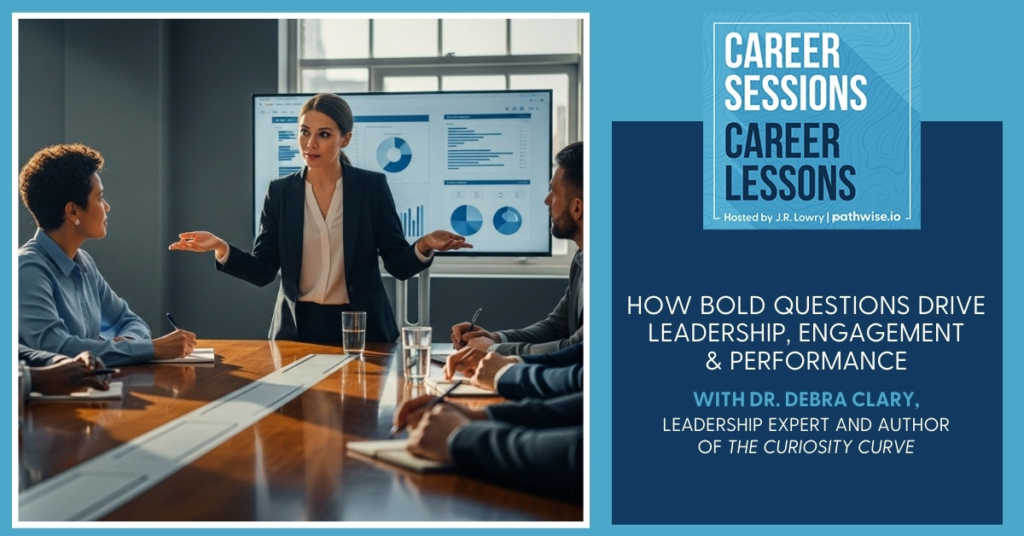
How Bold Questions Drive Leadership, Engagement & Performance With Dr. Debra Clary
Curiosity isn’t a soft skill. It’s a strategic advantage.
In this episode of Career Sessions, Career Lessons, JR chats with Dr. Debra Clary, author of The Curiosity Curve: A Leader’s Guide to Growth and Transformation Through Bold Questions, and explores why curiosity is the missing link in leadership, engagement, and high performance.
Drawing on four decades of corporate leadership experience, Dr. Clary explains how curiosity directly impacts employee engagement, innovation, decision-making, and organizational culture.
Together, they discuss:
- The research-backed link between curiosity and performance
- Why 65% of millennials report being disengaged at work
- How leaders unintentionally kill curiosity
- The difference between exploration and execution
- The four components of the “Curiosity Curve”
- Why “I don’t know” may be the most powerful thing a leader can say
- Whether AI enhances or diminishes critical thinking
- How to build a culture of curiosity during transformation or change
- Practical questions leaders can ask to assess curiosity in candidates and teams
Dr. Clary also shares how organizations can measure curiosity through diagnostics, activate “curiosity ambassadors,” and create alignment from the executive team down.
If you care about leadership development, culture transformation, employee engagement, innovation, or becoming the kind of leader people actually want to work for, this conversation is for you.
Follow the podcast for weekly leadership and career insights.
Explore PathWise’s workshops on team communication and collaboration to bring the ideas from this episode to your whole team.
Check out the full series of “Career Sessions, Career Lessons” podcasts here or visit pathwise.io/podcast/. A full written transcript of this episode is also available at https://pathwise.io/podcasts/dr-debra-clary
—
Watch the episode here
Listen to the podcast here
How Bold Questions Drive Leadership, Engagement & Performance With Dr. Debra Clary
In our episode, we are going to be talking about curiosity. If you know me, you will know that curiosity is one of my core values and something that I am passionate about. I am excited to welcome our guest, Dr. Debra Clary, who is an accomplished marketing executive, board director, and speaker, and who has also just published The Curiosity Curve: A Leader’s Guide to Growth and Transformation Through Bold Questions. Curious? I did that on purpose. Let us get going.
—
Deb, welcome, and thanks for being on the show with me.
Thank you.
Looking Back To Dr. Debra’s Career Journey
Looking forward to talking about your book, The Curiosity Curve. Before we do that, give us a quick download on you.
I was born and raised in Michigan. I went to college, went to graduate school, and right out of business school, my first job was driving a route truck. I drove for Frito-Lay. I went from grad school to a teamster, but at Frito-Lay, they started everybody at the bottom. I was at the bottom. The truck became my classroom. It is really how I learned to manage a P&L, how to build relationships, and how to manage my time.
I spent ten years at Frito-Lay in various sales, operating, and marketing roles, and then was recruited away by Coca-Cola and spent almost a decade there in operating and marketing roles. I went to the hard stuff. I went to Jack Daniel’s. I left Atlanta, Georgia, for Louisville, Kentucky. I was at Jack Daniels for about three years as VP of strategy. I really began to notice or wonder what made leaders great and what made cultures great. What was the reverse of that?
Why were some leaders not as optimal as others? I decided to go back and get my doctorate in leader development and org design. I had all of the hopes of just trying to understand human behavior and how I might be able to be a better leader, or how I might be able to contribute to others to be a better leader.
After I graduated, I went to work for Humana, which is a hundred-billion-dollar healthcare company. I mended my evil ways by going into healthcare after alcohol. I spent about ten years leading the Leadership Institute, which was leading and directing the development of our top 600 leaders in the organization.
We got a new CEO, and he called me one day and said, “I am going to be offboarding and onboarding executives like CEOs do.” He said, “I need you embedded in my team.” For the next eight years, I was embedded in that team, and every day, day in and day out, it was about how to stay aligned. How do we create a high-performing team? That is a little bit about my background.
I hear these stories about people who have come up and worked in these leadership development organizations within big companies, and I just think that must have been incredibly rewarding to do that. What were, for you, some pretty different places? There was a brief stop at Papa John’s in there. If I read right on your bio, Frito-Lay, Coca-Cola, Jack Daniels, Humana, what were the threads that connected those experiences together?
The first three were all about the consumer. When I was approached by Humana and started this leadership institute, I was a little hesitant because healthcare for me was about transactions, and it was about insurance. Humana at that time was saying, “We are going through a transformation. We are moving away from transactions and wanting to build relationships with our clients and our members.
With your consumer-facing background and understanding of consumer design, that is why we think you would be perfect to lead this institute.” It was an opportunity to take at that point two and a half decades of experience and now overlay it into a completely different industry, but one that was about change and transformation. In 2019, I took a trip to Europe, and I was on a train from Rome to Florence.
As I spent another week in Italy, I began to observe that Europeans and Italians converse differently from Americans. They are in conversation, they are in debate, they are challenging one another, but they still walk away and are colleagues. I went back to work the next week, and I am sitting in the boardroom next to my CEO. He says, “Do you think curiosity can be learned or is it innate?” I said, “I do not know, let me go see what I can find.”
I started pulling some articles and some research. At the end of that week, Gallup, which measures engagement scores, reported the lowest level of engagement in the history of reporting. I began to wonder, could the missing piece be curiosity? I commissioned a group of researchers to answer the question, what is the relationship between leadership, performance, and curiosity?
It took them about three months, and they came back and said, “Your hypothesis is true. There is a direct correlation between those three variables.” What that means is that a leader’s level of curiosity drives performance, specifically around engagement, attention, innovation, and decision-making.
A leader’s level of curiosity drives performance around engagement, retention, innovation, and decision-making. Share on XFor me, curiosity has always been something that has been central to the way that I have tried to lead. That was one of the reasons that I wanted us to have this conversation. When you are a leader, and you give the answers too easily, or you just tell people what to do, or you give them advice, you take away their opportunity to learn and grow.
When you take away their opportunity to learn and grow, I think you take away some of their engagement, whether they realize it or not. Reading that in the book, I thought it made complete sense because it is a cop out to just tell your team what to do. Ultimately, you are cheating yourself in the long run because you are not allowing them over time to make your life easier. It feels like a loss. A lot of people just do not get it.
When I work with the executives and leaders, I try to reassure them that it is not their fault. We are taught to be incurious, and we have time constraints. When someone comes to us with a problem, we just give them the answer. When we do that, we are playing the short game because when you answer, you have solved one problem.
If you thought about playing the long game in terms of asking questions to lead them to think differently for themselves, you are building their confidence, and you might be getting better solutions than what you might know. When we saw that Gallup report come out, we saw that 35% of the work population, at least in the US, is made up of millennials. From 29 to 40 and 65% of them report they are disengaged at work.
We are losing that group. We pulled the group together to do a focus group, the millennials. We said, “What is the source of your unhappiness?” The number one response was, my leader does not know me and does not care to know me. “Do you mean like they do not know your personal life, they do not know you have a dog?” They said, “No, they do not know what I can contribute to the problem. They do not know what my aspirations are to grow with the organization.” We shut down, and we just take direction. Knowing that, we cannot change it.
How The Curiosity Curve Came To Be
The curve itself is part of the title, but it is a core foundation of the book, just in terms of the correlation that you describe. Talk about how that really came to be. Was that the research that you referenced earlier, or was it something separate that you did to create that curve that shows up early in the book and became the title?
There are multiple reasons why we call it the curiosity curve. One was the research and the data. The more we looked at this, the more we realized there is actually a curiosity set point. What I mean by that is if there is not enough curiosity, you are lacking innovation. If you have too much curiosity, then nothing gets done. We describe the importance of having optimum curiosity. In the book, I described a man I used to work for at Coca-Cola.

He was the president of Coca-Cola. I had a chief of staff role, which was a coveted role to have as a young professional coming up in the organization, because you are going to learn a ton, and you are going to be exposed to a lot. The point of the story is that the first Monday I go in, I am working with him, he is just ideating, and I am writing it down as fast as I can.
I leave the office, and I start trying to execute, pull information, go back next Monday, and start to share what I learned. He says, “No.” He would describe something else. This went on for three weeks. I am just missing the mark. I am not helping him at all. I called the old chief of staff, and I said, “I do not know how to work with Tom.” He says, “What is going on?” I share that he has all these ideas, and then I come back and try to execute on them.
He says, “I should have told you. Do not take any action unless he asks you three times for the same thing.” I learned he was in exploration, and I was there just to listen to his thinking, but take no action. I really learned that through getting underneath curiosity in our research, some people are explorers, and you need them on the team. There comes a time when you have to say, “Which of these ideas are we going to execute?”
Common Misconceptions About Curiosity
I had a boss once who said, “If I ask you to do something once, maybe ignore me. If I ask you to do something a second time, I want you to do it. If I have to ask you to do it a third time, we are in serious discussions about your future here.” You have got to figure out if this is a one-time guy or a three-question guy. What are some of the misconceptions about curiosity that you want to help put to bed?
People think that curiosity is a luxury or that curiosity is a nice to have, or one day, when I get a little bit of time, I am going to be curious. Our research shows that curiosity is really a strategic advantage. I believe that curiosity will extend your competitive edge if we understand the framework and we lean into it.
Talk a little bit about the framework that you walk through in the book.
The Curiosity Curve is made up of four factors. We rallied around this and actually created a diagnostic tool so that we can measure your current level of curiosity for an individual, team, and organization. It is made up of four factors. One is exploration, which we’ve just talked about. You are working with someone who is in that mode, and they say, “I wonder about, would it not be interesting?” They are out there exploring.
The next one is inspirational creativity. These are people who can take diverse information and think about how something might work against something else. In the book, I talked about Dr. Joan Kelly during COVID. Dr. Joan Kelly knew about the hospital setting, but with COVID, everything was turned on its head. She said, “How do we keep our staff safe? How do we keep our employees safe and our patients safe?”
They said, “How do airlines do it?” She took hospitals and airlines and had multiple conversations, and then began to implement what airlines did to keep their people safe inside a tube flying through the air. The next one is around focused engagement. Focused engagement is one of two things. One is, am I fully dialed into what you are saying? Am I making contact? Am I suspending judgment and just focusing on what you have to say?
Focused engagement also means can I go get it done? The last one is openness to new ideas. You are working with someone who, when you say, “I would like to talk to you about an idea,” they say, “I would love to hear it. Tell me more.” How open are we to understanding other people’s points of view or ideas that they might have?
It is lovely to know what your score is as an individual, but if you know it from a team, that is when real power happens. In any diagnostic tool, it is about knowing oneself and knowing others. We have created this tool so that the team can understand if we want to create a culture of curiosity and what our current state is. What are the activities we need to put in place? Let us measure it again in a year.
How does a leader identify where curiosity is abundant in an organization, where it is flourishing, and where it is not? Maybe within themselves and within their teams.
You can certainly take the assessment, but if we put that aside, the characteristics of curious leaders are those that welcome questions. They actually leave space on the agenda for questions. They are the ones who are modeling it by asking what questions we have not asked that we should be asking. They also reward those who challenge the status quo, like, “I do not think that idea is going to work. Let us talk about that,” they are rewarding that, and they are just creating an environment where people feel that they can make a contribution. The best thing a leader can say when asked a question is, “I do not know.” That shows vulnerability and also, “I do not know, but let us explore it as a team.”
Which gives people permission, A, to not know all the answers and, B, to go explore the answer to whatever question has been posed.
The reason I think that leaders do not do it is that there is this concept that leaders have to have all the answers, and you are going to look less than a good leader if you do not have all the answers, especially if you are speaking to a board or you are speaking to the executive team. It is just not true. The most powerful leaders are those who say, “I do not know, but I want to explore it.” It is modeling that it is okay not to have the answer.
You make the point in the book that curiosity is a prerequisite for empathy. Talk a little bit about that and about any other leadership behaviors that show a heavy correlation with curiosity.
I started out doing this research to try to understand how we could help organizations. It quickly expanded and also narrowed in the sense that curiosity is about building relationships. Do you think about what we are doing now? We are building a relationship because you are asking me questions. We are getting to know each other in a dating relationship, with a spouse, or as a parent, in terms of how we interact with our children. The thing that I found most profound about all the research is the power of curiosity to build relationships and the power of curiosity to gain new knowledge.
How AI Is Augmenting Curiosity
You made the point earlier that engagement is in decline and curiosity is in decline. When I read that in the book, the immediate thought I had was that AI is basically wiping out the need for critical thinking because it just comes back to what we talked about earlier. It is like the boss giving you the answer. It allows you as an individual to play the short game and not to play the long game of actually exploring things and having those neurons connect in your brain. What is your take on the role that AI is having on curiosity?
It actually is augmenting curiosity. AI is based on questions, and questions are based on curiosity. To begin with AI, you have to have a question or an idea that has come up through your curiosity. It will come up with something, but you still have to put a finer point on it in terms of the ending. The way I work with AI, I think AI is the middle, but I have the question at the beginning and then discernment at the back end to say, “Does this really work?” I am fortunate that I had four decades in corporate America. I have this experience. I can look at that and say, “That is not quite right,” or “I had not thought of it that way. I am going to now dig a little bit deeper.”
At the end of the day, like a lot of things, it comes down to whether you use the tool in a way that pushes you to be better or whether you use the tool in a way that just pushes life to be easier for you. There is a lot of the latter going on, which is unfortunate. Hopefully, people will eventually settle in with everything going on with AI tools and stop using them to do things that are not useful at all. They should not use them as a crutch for just doing the work and digging in and learning and asking questions and building experience in a way that will benefit us in the long run. It is too early to tell.
What I have found with AI early on is that it is very gracious, and it thinks you are amazing. You type in something, and it says, “That is such a great idea.” Now I will say, “Here is an idea. I want you to interrogate it.” It helps me to be a witness to what is not right about it.
Creating The Right Environment For A Curious Team
Coming back to broader work settings, what are some of the things if I am a leader and I feel like curiosity is not at the level that I would like it to be, how do I surface the things that are barriers to curiosity and focus on removing them and creating the right environment for my team or my broader organization?
When I am working with a CEO or an executive, I will ask them where they see curiosity showing up and where they see it being stifled. I have a conversation with their mindset around that. If they are open to it, I ask them to take the curiosity assessment for their organization. When you do curiosity assessments by teams or departments, because curiosity is contagious, you will see departments with high curiosity, and you will see departments with low curiosity. As opposed to having a blanket program across the whole organization, I will say, “Why don’t we start with the marketing department and just have a conversation with them in terms of how they would like to create a culture of curiosity within their team?” We begin in that way.
What are some of the other exercises and practices that you apply when you are working with a team or an individual on reigniting their curiosity?
It begins with the conversation of why this is important to you. What value do you see in creating a culture of curiosity? I let them articulate it. I know why it is important, but having them articulate it is key. It is also about whether you had a culture of curiosity. What do you think the outcomes would be? Higher engagement and performance. I ask questions to pull it out of them and get their commitment to creating a culture of curiosity. I will ask them on a scale of one to five, with five being the highest, how committed you are to changing your culture.
If they say, “About one or two,” it is probably not the right time to come in and do some type of intervention. If they say it is incredibly important, it is a five because we have this huge transformation or we have a merger coming up, then you say, “This is really important to the individual.” The point of this is that first, I establish what role they think curiosity will play in their organization, and what the benefits are of having that.
When you start doing that, what tends to dictate whether those efforts become successful or whether they sort of run out of steam?
Eighty percent of all change initiatives fail. Curiosity would be right up there with them. That is why I always start with the executive team, because leadership and culture are synonymous. As goes the top of the house, so goes the organization. I always start with the executive team first and gain their commitment. We do a two-day workshop around alignment and around curiosity, and what are the outcomes? They actually create operating commitments in terms of how they will show up differently as individuals and how they will show up differently as a team. From there, we move to the next part of the organization.
When you are working on cascading it down to the organization, a lot of times it gets watered down. Any change initiative gets watered down as you cascade it down through the levels. How do you work to make sure that when you are doing that with a team and cascading it down to the organization, you do not lose the power of what you started with at the core?
It is one of having individuals within the organization, like ambassadors, curiosity ambassadors.Just like engagement ambassadors, is that continuously putting it in front of the organization on why this is important is key. As with any change initiative, it is about repetition. Mother is the source of all learning, and repetition is the source of all learning.
Repetition is the source of all learning. Share on XIt is that sense of continuously having ambassadors push it out in the organization. In the change leadership model, they say that you only need three percent of the organization enrolled to make real change happen. I think about what the size of the organization is. Can I get three percent pushing the idea forward?
That is a powerful statement. It is a little bit counterintuitive, or at least hard to believe on the surface, that you can effect change with only three percent of people. When you think about a 1,000-person organization, that is 30 people. Those 30 people are really driving the activities of the other 970. It is a powerful measurement when you think about it.
When I was in corporate, when we would do change management, you might be familiar with network theory. Network theory is understanding who in the organization has the most connections in terms of the network. You start with network theory, and you find out who the most influential connectors are in the organization. Those are the individuals that you tap into to help you with the change.
Questions To Ask About Curiosity
Curiosity obviously has questions as a core part of it. What are your favorite questions to ask?
I like asking when the last time somebody changed your mind? What that tells me about the individual is that they are open to new information that might influence them to have a different perspective.

Curiosity: Always be open to new information. This could give birth to different perspectives.
It is like a meta curiosity question.
I had the good fortune to work with a large recruiting firm out of the Northeast, and they said, “At the end of the presentation, could you take us through some questions we should be asking candidates to see if they are curious?” We crafted a list of questions, and they said it has been profoundly helpful to understand someone’s level of curiosity.
It is a great question. I have not used that one ever. I will have to put that into my repertoire.
I have grandchildren now. I will ask them a question, and they will say, “I do not know.” I say, “If you did know, what would you know?” They come up with something. It is like asking another question to move them forward.
Are there moms rolling their eyes as you are doing this to their children?
Of course. I was that mom when we were growing up.
You say, “I have developed my skills since you were teenagers.”
I have changed. I have grown. I have evolved.
Ultimately, for someone who is picking up The Curiosity Curve, what do you really want them to gain, whether professionally or personally?
Curiosity will save us. It will build relationships. It will build organizations, and it will build results.
Coming back to this idea of questions, what is a bold question that you would want the audience to start asking themselves after hearing this conversation?
We have 85,000 thoughts a day. Eighty percent are the same thoughts we had yesterday. When they get a thought in their head, I would encourage them to say, “Is that true?” If it is true, say, “Who would I be without that thought?”

Curiosity: We have around 85,000 thoughts a day, and 80% of those are the same as yesterday. Learn to determine which ones are true and which ones are fabricated.
What if I were to say, “Why did I have that in my head today, given that I did not have it yesterday?” What has changed since yesterday that is making me think of this now?
The problem with the mind is that things pop into your head, and a majority of them are negative. You are thinking something negative about yourself or about somebody else. That is when I say, “Wait, I am in control of my thoughts. Right now, I have got 80,000 thoughts that are coming in and out, and I am not managing that traffic.” I have just made this intention to say, “Is that true?”
Truth is getting harder to discern right now. Asking yourself that question, I think, is especially important at the moment.
It is one about challenging our beliefs and our values. Especially coming into the holidays, you are going to be sitting around the table with uncles or brothers or sisters who do not share your opinion. You might be dreading that. What I encourage people to do is go in and think, “I am going to ask questions to understand their point of view.” I do not think I will be influenced, but what is going to happen is I am going to have a greater understanding of where they are coming from, and what is better than deeply understanding each other.
Seeing Curiosity As A Strategic Advantage
One last question, pull your mic a little bit more in frame because the whole time we have had half the button showing. I want our audience who is watching this to be able to see that your button says, “I’m curious.” Any last advice you want to dispel before we call it?
I would encourage people not think of curiosity as a luxury, but a strategic advantage.
Do not think of curiosity as a luxury but a strategic advantage. Share on XA strategic advantage and not a soft skill, right?
Yes.
It is very much something that can be a huge benefit to you. By the time this comes out, the audiobook will be out, so people can read your book in physical form. They can e-read it. They can listen to it, whatever works for them. I am sure they will gain a lot of wisdom from it. They will certainly enjoy the stories that you have intertwined in the book as well.
Thank you so much for having me.
Take care.
—
Thanks to Deb for joining me to discuss curiosity and how leaders, teams, and even you individually can re-spark your sense of curiosity and your sense of wonder. If you want to learn more, as I mentioned at the very end, you can find Deb’s book wherever you buy your books. As a reminder, our episode was brought to you by Pathwise.io. If you are ready to take control of your career, join the Pathwise community by visiting Community.Pathwise.io. You can also sign up for our newsletter and follow us on LinkedIn, Facebook, YouTube, Instagram, and TikTok. Thanks, have a great day.
Important Links
- Dr. Debra Clary
- Dr. Debra Clary on LinkedIn
- The Curiosity Curve: A Leader’s Guide to Growth and Transformation Through Bold Questions
- PathWise on LinkedIn
- PathWise on Facebook
- PathWise on YouTube
- PathWise on Instagram
- PathWise on TikTok
- PathWise on Twitter
About Dr. Debra Clary

A former Fortune 50 executive, Debra spent three decades leading strategy, operations, marketing, and leadership development at Frito-Lay, Coca-Cola, Jack Daniel’s, and Humana. She understands performance pressure from the inside and why most performance fixes miss the real issue.
She is the creator of the Curiosity Curve®—a research-backed framework and assessment that measures how leaders and teams think, decide, and adapt. Her work shows that when curiosity is constrained, decision quality, collaboration, and innovation decline.
Debra works with organizations at critical inflection points, helping leaders see where curiosity is thriving, where it’s being unintentionally shut down, and how that directly impacts results. Her book, The Curiosity Curve, will be released by Fast Company Press in October 2025.
