Building Your Resilience Plan With Dr. Marie-Hélène Pelletier
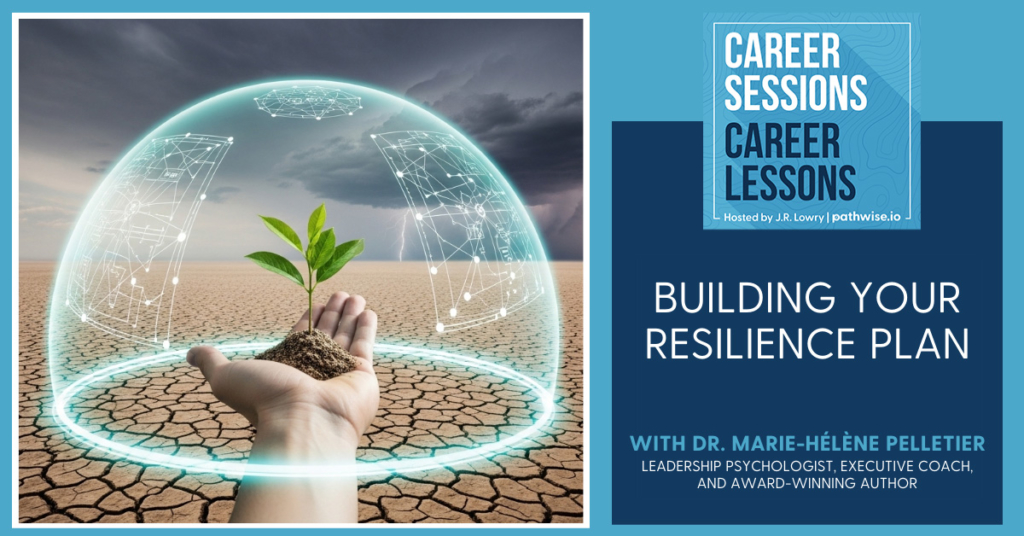
We hear a lot about the need for resilience these days, but simply wanting to be resilient isn’t enough, in fact, the pressure to always bounce back can be counterproductive. In this exclusive interview, Dr. Marie-Hélène Pelletier, a psychologist, leadership expert, and author of the award-winning book The Resilience Plan, challenges the notion of resilience as an innate trait.
Discover why viewing resilience as a strategic state, rather than a personality feature, is key to sustained well-being and performance.
Dr. Pelletier dives into the intertwined nature of professional and personal life, the dangers of underestimating demands and overestimating supply, and provides actionable, research-backed advice on creating your own strategic resilience plan.
Learn how small, deliberate actions can build momentum and how leaders can foster a culture of prevention rather than just treating burnout after the fact.
Explore PathWise’s workshops on burnout, wellbeing and work-life balance to help your people apply what Dr. Marie-Hélène Pelletier shares in this episode.
Check out the full series of “Career Sessions, Career Lessons” podcasts here or visit pathwise.io/podcast/. A full written transcript of this episode is also available at https://pathwise.io/podcasts/dr-marie-helene-pelletier/.
—
Watch the episode here
Listen to the podcast here
Building Your Resilience Plan With Dr. Marie-Hélène Pelletier
Leadership Psychologist, Executive Coach, And Award-Winning Author
We learn a lot about resilience these days. We’re told we need to be more resilient and we all tend to believe or want to believe that we are. However, in some ways, the very pressure of feeling like we need to be resilient actually makes us less so.
To discuss that, our guest is Dr. Marie-Hélène Pelletier. Throughout her career in management and psychology, Marie-Hélène, MH, as she calls herself, has spearheaded dialogue on the crucial and intertwined issues of leadership, resilience, and work performance. Her recent award-winning book, The Resilience Plan, was named a top five book to read by Inc. Magazine and Forbes. Let’s dive in.
—
Marie-Hélène, MH, welcome and thank you for doing the show with me.
It’s a pleasure to be here.
I’ve been looking forward to this conversation. I really enjoyed your book. I need to actually go back to it more carefully because I’m giving a presentation on burnout and as we’ll talk about resilience and burnout, they are two halves of the same coin, if you want to think about it that way. Before you dive into your book, why don’t you give us a quick background on you?
I am a Psychologist, a Leadership Expert and Workplace Mental Health Strategist. My background is both psychology and business. That informs my executive coaching work, my psychology work and of course the keynotes that I have the chance to present a lot. I’ve worked in private and public sectors, all levels of management which is usually not the case for most psychologists who have mostly been in clinical work.
No, I’ve done it all. I’ve managed a call center, I’ve been a middle manager and I’ve been in a C-suite. That gave me direct experience but also really good perspective on what professionals and leaders are dealing with.
I worked in a call center organization at one point earlier in my career as well. I loved being on the call center floor, just the buzz of it all.

The buzz is on a good day. On the other days, it’s entering a fire, isn’t it? It’s great experience. I agree. It certainly has a lot of energy to it.
I got very used to it. When I would go into an office now and it’s really quiet, it’s almost disturbing and it’s become more so like that on any given day with most places, you’ve got some people in the office and some people working from home. It’s half full at best.
It’s true. Yes, it has changed.
That’s not what we’re here to talk about. We’re here to talk about resilience. You have a book, The Resilience Plan. Talk about your definition of resilience. I know you describe it not as an innate trait.
Defining Resilience
That’s right. There are many definitions in the academic articles if you take the time to just look at all the options. That’s a great place to start. The one that most researchers and people in the industry as well are using is our ability to go through adversity and come out even stronger. Now there are a few pieces that are important with this. Adversity, we often think about it as an acute difficult moment, and that’s true, it includes that, but it’s not necessarily that. It can also be chronic demands and it can be demands that are in themselves positives, but they are demanding.
There is this other part that we’re coming out even stronger. We’re learning from this experience. That’s an important part to this as well. We’re growing, which connects with the growth mindset that we know from research is so important. It dives into various areas like developing the capacity for resilience before that moment of adversity comes and then implementing it so that you can get the results and the outcomes. There are different parts to it, but that’s the definition I use as a starting point.
Develop the capacity for resilience before adversity arrives, then implement it so you can achieve the results and outcomes you need. Share on XYou haven’t really taken a definition that’s, I’ll say all that different from what’s in the research literature. You’ve blended it together.
It is entirely research-based because that’s where one could argue we gain knowledge about what is effective, what makes a difference, that thing. Yes, I wanted to start from a definition that is fairly universally used and makes sense, but the key component is that okay, once we have that definition, once we know from research the kinds of things that would make a difference, that’s nice. A lot of us know this, not just people in the field itself. The challenge often comes in the implementation and that’s translation, if you will, that I come to contribute to given both my background in psychology and business.
A lot of people would argue that they are better than average drivers. I think similarly, a lot of people might argue that they are better than average resilient, but you make the point that feeling like I’m already resilient can actually work against you.
The Trap Of Feeling Already Resilient & The Need For Proactivity
I do because, number one, when we start thinking that we are resilient, it usually is in part true. Most humans have a lot of resilience in them. That’s wonderful. When we tell that to ourselves, however, a bit of the trap is that we start thinking that this is a personality trait. This is who I am. Obviously, if it is a personality trait, I don’t need to work on it to make it better or invest in it because it’s in me already.
The thing is we do know from research also that, no, resilience is not a personality trait. It’s influenced by some personality traits. If we are a bit more optimistic as an individual, which is a personality trait, it will tend to brewing our resilience up a bit more. Even then, and that’s it, the rest of it is mostly a state that we can influence.
Now if we see it as a state, it opens up everything. It opens the fact that we can be proactive about it. It will fluctuate during our lives and that’s normal that it does, so we don’t have to worry when it doesn’t, but we do want to take action if it’s lower. Another part of this overall perspective, sometimes the academic research has been less paying attention to it is more and more it’s starting. We’re starting to see it. It’s a reality that you’ve seen in your call center experience that I’ve seen in that and in so many other experiences we’ve had, that resilience is not just in us as individuals.
We are in a context, we’re in a work context, we’re in a team, we’re in an organization, we’re in a country in a moment in time. All these aspects of the overall context are influencing how am I doing here as an individual and vice versa. I am also influencing others around me. Right now, I’m talking about the work context, but the personal context is also part of the picture.
The Double Helix Model
You use that double helix to describe that intertwined nature of professional and personal and some of the things that ultimately are the rungs in that double helix ladder that play into this. You also talk about supplies and demands in terms of how well you’re positioned, I guess, to deal with adversity. You want to talk a little bit more about some of that?
The first part that you were mentioning, it was a visual really that I was looking for. When you write a book in particular, you start thinking about how can I represent the model in a way that is a good visual that you can easily pick up on. The one that jumped as a best fitting model was, for people who are just reading, but is this image that we often see for the DNA? You have the two sides that are twisting and then you have the four rungs and that JR was mentioning.
The way I then describe it is I say the two sides. The two sides of the ladder, if you want. One is the professional and one is the personal. That’s the first key component when I work with individuals who come to me for work reasons, of course, we’re going to talk about a lot of that, and the personal is connected with it. Emotions don’t have lanes. It’s not like things that live on the personal will stay there.
The reality is that they are connected and we need to really think of it this way. Part of what will give us the resilience is do we pay attention to what are my values, my sources of supply and demand, I’ll come back to this, my context. Once we have this and that helix twists just like the DNA, then it gives us the resilience to go through adversity and come out even stronger.

Resilience: Part of what gives us resilience is paying attention to our values, our sources of supply and demand, and our context. When these align—when the helix twists, just like DNA—we gain the resilience to face adversity and come out even stronger.
Of course, the fascinating part is that in nature, plants do that too, too. They will twist themselves in helix to be even more resilient to the elements. Anyway, the image just fits in a number of ways and that’s what led to how to think about that resilience planning piece. One of the parts that you were just mentioning as well, looking at your sources of supply and demand.
The reason why this came up, there’s many, but one of them is that often, very producing capable, highly functioning individuals, which is a lot of people tend to think about, if I ask them, “How many demands do you have,” they will usually list for me two or three things that are challenging on the work front and they’ll stop talking and then I’ll say, “Okay.”
Now being true to the helix model that we were talking about, I’ll say, “Tell me about three demands you have on the personal side.” They’ll name three difficult things going on the personal side. They worry about their parents, maybe you or whatever it is. I’ll say, “Go back to work. Name as many as you can of the demands you’re facing.” They’ll actually add quite a bit more. We’ll do the same on the personal. I’ll say, “Add positive demands on both.”
At work, you may not have listed that you were just given this opportunity to work with this very large client, which is extremely exciting, but it’s a demand. Obviously, it will drain more energy, time, cognitive resources, all of this. You’re happy to invest it, but it’s still an additional demand. We do the same on the personal side. You see, even as I said this right now, we probably all thought of some level demands that we were not even seeing on our radar, but we suddenly have more clarity on the reality of all the demands we have.
Just like when we deal with anything at work, we want to have full visibility on what we’re dealing with, not just the high-level or the top three things. We tend to basically underestimate the demands. I do the same thing on the supply side. What brings you energy at work, personal life and all this? We’ll have access to worksheets that come with the book. They are very self-explanatory. They can be used with or without the book. That’s simple exercise, but so many have gotten back to me and said how that in itself gave them clarity to approach things differently and invest in their resilience.
If you think about those people, like you say the high achievers who probably think I got this, and then you start going through this exercise as you’ve described, they start to realize maybe I don’t have this as well as I think I do, or I don’t have as much of a shored up foundation to deal with something that might come at me from this long list of things that you’ve worked through with them.
On the flip side, you have people who don’t see themselves as resilient, who are more affected by the negative self-talk and other inhibiting behaviors. How do you work with them and get them into this process?
You’re right that most of the time, I am dealing with the first category that you talked about, individuals who tend to think, “I’ve got this,” then do the exercise and what they realize is slight different wording, but it’s, “I just realized there are 2 or 3 extra things I can do to have this even more. That’s extremely reassuring because suddenly, I have control over how I can be even more confident about my ability to go through this adversity right now.
Sometimes it will happen that it’s not like the individual is thinking they have no resilience at all. It’s more the having parts of what I do right now that feel like I don’t have it in me to deal with thing. It would be the same if we were looking at no resilience at all.
The additional piece that sometimes comes with that sense of, “I have no resilience at all,” is the person may actually be depressed because then, that can change the lens so dramatically that it’s not about do you actually have resilience or not. It’s how you’re thinking about it. We need to deal with the depression before the resilience in that situation.
If we’re thinking that we just don’t about a specific situation, a good place to start is to step back and look for what’s working well and look for even the small parts of what’s working well. In the spirit of having fuller visibility, if we’re now in the mode of thinking we’ve got nothing, it’s not going at all, forcing ourselves to explore the other side of the picture will start giving us better visibility and that’s very important.
Forcing ourselves to explore the other side of the picture improves our visibility, and that is very important. Share on XI would say that’s the first question I would ask and look for what is going well. Even the small things, even the 1%, 10%, it doesn’t matter. Small things that are going well because often we can build from there the same way we do in business. It then becomes very specific to that particular situation, what’s going on? What have you tried so far? What’s been happening and where can we do things differently or change the dynamic or be creative in a different way? It will depend on the situation, but we’ll want to change something.
There’s been a lot more focus, particularly on the back of the COVID pandemic, where well-being and mental health was a big focus. At the same time, it still feels like there are a lot of things that companies are doing just in the common workplace culture that really work against the idea of helping people remain resilient. What do you think the biggest cultural offenders are in most companies?
Workplace Culture Offenders
If this was a choose your own adventure and we had our audience with us and I said, “Are you going to say it’s workload, culture or growth and development opportunities,” most people will say workload. They’ll be right. That’s very often the first biggest offender. The two others are actually top three, I would say. The workload is often the conversation that’s not happening and it’s not happening for many reasons we can all understand.
For example, I’ve been teaching Executive Education at the University of British Columbia for a number of years and often, when I start speaking with leaders about what keeps them from having this conversation, and I partially understand having been there, you worry that you’re going to open the floodgates. There will be so many demands for us to change things that it’ll be absolutely impossible and it’s better to just keep the lid on it and not talk about it.
However, this is not helpful either. The shift that tends to happen, and even as people sometimes reflect on their own experience on the workload piece specifically, is that we often do not need a change that is that large to create an effect that feels significantly different. We want to keep this in mind. It’s okay in our communication with the team to express how we want to keep in mind.
We often don’t need a change that large to create an effect that feels significantly different. Share on XWe won’t be able to change everything, but we want to be creative about what we can possibly modify and work together to find what these pieces are. If I get one notch more concrete, often a good place to start is what are the biggest pain points within that pain point? We don’t try to fix the whole thing. We’re looking for one part of that process, maybe the worst, maybe one demanding part of this process that we’re just going to tweak slightly to make a bit better.
I’m going to go to a call center experience since that’s the theme of the how we started. Call centers will have procedures for most things, really. There will be certain demands that will come very rarely. They’re not standard every day, every conversation type thing, but there is a process for those rare situations. Now those rare situations often are also very delicate. They’re tricky, they’re sensitive, they’re high stress for the agent who’s dealing with it.
Can we, even though they don’t happen often, pick up on one of those more rare, look at this process, find, discuss the point where all of us get nervous when this is what we need to do and how can we switch this to make this better? Can we be two agents when we get to this? One puts work to the side for moments, so we do this with two heads while the main person keeps going. Suddenly, it relieves most of the stress of that process.
A lot of companies try to come at this more from the perspective of some HR program, a mental health app or an employee assistance program. What’s your take on how those work and where they don’t work?
I see this a lot in my work consulting with organizations on their mental health strategy. You want to have a mental health strategy within the organization that will guide what these programs are and you will want that strategy to be aligned with the business strategy of the organization. These are not major shifts, but when you have these types of alignments, then it helps everything make more sense and become more useful.
Some of the supports that you were mentioning, they make sense. It can be very helpful. They will be meaningful if they’re aligned with what the organization does. If they’re aligned with the leaders in here that talk about it, use these supports as well themselves and they will not be just standalone programs that exist, then the rest of the time, we don’t talk about burnout culture or growth opportunities, for example. No, we do that too.
Now it becomes a whole and a strategy with tactics that are connected with each other that give them meaning. Specifically, as a leader or a team member, you don’t need to be in a leadership role. What we can all do is if we have a strategy, let’s learn a bit more about it. If not, let’s learn about what the programs are and therefore, if we are in a situation where we can share this information, connect it with what we do.
For example, if we know what challenging project is happening with very high demands three months from now, can we remind everyone we have access to an employee and family assistance program? If you already know you’ve got lots of demands also in your personal life that will be an even more demanding time, let’s allow each other, we don’t need to know or tell each other, but maybe we make an effort to do a session between now and then to do our own check-ins. That is both helpful personally, but helpful as a team because we opened up about the fact that we now need to invest proactively to manage those additional demands.
The Importance Of Prevention Vs. Treatment & Avoiding “Sprint Mode”
A lot of times, those programs are really focused on after-the-fact situations. They’re focused on treatment, not necessarily prevention, to use overly simplistic words. When somebody’s at a point of needing an employee assistance program, something’s already happened. That’s more of a dealing with that something that’s already happened as opposed to trying to stop it from happening in the first place.
I feel like, at least from my own work experience and having seen people go through all sorts of issues and struggle with many things professionally and personally, and to your point, the interconnection of the two adding up in a way that 1 plus 1 being more than 2 isn’t a good thing, it seems like we’re not focusing enough on the little things every day that build.
Your example of a project, if you’ve got a big project that’s a months-long project, you can’t run that thing like a 3 or 6- or 12-month sprint. It’s the reason we’ve got this phrase, it’s a marathon, not a sprint because if you burn people out at the beginning trying to run too hard, they’ll never get to the finish line. I think it feels like a lot of corporate cultures, they’re trying to push everybody to operate in sprint mode all the time. It’s just not doable.
No, it isn’t. It’s an interesting observation that we all need to keep in mind. That brings us to what I was mentioning earlier about this is a system, and we are in this system and let’s say we’re an individual in that of culture. First, I would say, well keep in mind that even though the employee assistance program tends to be used in a reaction type of way, we, as individuals, it’s part of your coverage. You can use it proactively.
You could decide that you’re going to do a session quarterly or once a year a check-in if you will, the same way you do check-ins for your teeth or your physical health. You could decide that you can take this back in your hands. I would go with that approach as well with regards to, “If I am in a culture that is wanting to treat a marathon like a sprint, which I know I cannot run a marathon at the sprint speed, then I have to take this in my own hands.
I have to look for the ways that if I decide to stay in this role and in this team, so I do have performance expectations and all that, okay fine, but I’m going to look for the ways in which I can do this in the way that continues to be healthy for me. I might have a conversation, if possible, with my leader to see, given their visibility on where do we have flexibility, where do we have buffers, can we build more buffers? Not just for me, but for all of us as a team thinking about this.
Sometimes the leader, as much as they’re trying to think about all the things, not always. We are a team and we can bring ideas forward. In fact, we know from research that actually it will contribute potentially to your satisfaction. Something to think about. Bottom line is we cannot just leave the way it’s going to be in the hands of the rest of the system. While it’s not entirely in our hands, that’s true because we’re influenced by the system, it’s also not entirely in the system. We have some agency and we want to take it. Sometimes, that agency means not staying in that particular environment.
We saw a lot of resilience and burnout problems with frontline workers, caregivers, and others during the COVID pandemic. Who are you seeing from your travels and discussions with leaders? Where is this showing up as a particular issue right now? Any particular roles job types, industries, levels in the organization that seem especially vulnerable?
Everyone. You can find articles and research about pretty much every industry, every type of roles because yeah, of the particular context that they’re in, these particular demands that they’re facing and all this. The pandemic, and specifically the healthcare workers, was a very intense, unique moment where their particular skills were in such demand that put the workload through the roof, so to speak.
Not everyone, but a lot of people, enter these types of roles because they really care. They really want to make a difference. It connects even more closely to who they see themselves as being. At times, that makes maintaining boundaries even harder. That potentially contributed to how challenging this was in this particular context. That being said, as of now and even prior, it can be any of us. It’s worth investing proactively in
Definitely worth investing. I’ve certainly seen that from my own personal experience. Just having some sense of your support network. I’ve done a lot of focus in the business resilience and how you make sure you can keep a company running something bad happens. I think a lot of those same principles can be applied.
People just don’t necessarily have that experience or toolkit and don’t really figure out how to do it until they go through one of these moments of adversity, either a crisis or a sustained period. Let’s talk a little bit more about the approach that you take with people in terms of building this plan, the resilience plan that’s in your title.
Developing The Strategic Resilience Plan: Pillars, Values, & Doable Actions
It’s interesting because the way the book emerged is exactly through conversations like this. I was having with my clients about resilience and saying, “How can complicated can that be, really, MH? I know what I need to do it.” “Are you doing it?” “No, I can’t. I don’t have time.” At some point, I found myself using the analogy of a business context saying if we were in a business situation and we have this new idea for this new product, would we just say, “Great, we’ve got this idea for a new product, let’s go and launch it,” or would we say, “We have a great idea for this new product.
Let’s look at who else is offering anything similar to this? What is the demand for it? How much are people willing to pay for it? Which demands or pressures in the near or far future may influence the demand for it?”
We would do all this great and then we would build a strategy on how we’re going to bring this wonderful product to the market with tactics that makes sense given this context. With our resilience, we need to do the same thing. We cannot just say, “Yes, I want to invest in my resilience. Go.” That doesn’t work. Our lives are full.
Similarly here, and even for people who are very familiar with this approach in a business sense, it did not necessarily translate. It’s only when we digest it in a very detailed way this way that we’re like, “Yeah, okay, I guess I could do this here and maybe I should and then I will.” Basically, then, in the book, from a high level perspective, what we’re doing is creating your resilience strategy, which becomes, using again the helix model we were talking about earlier, it’s aligned with your values.
Your model, JR, will be different from mine. Your model now will be different from your model in six months from now because life and demands will change. That’s just the way it is. It’s normal. However, it will be aligned with our values, just like it would be in a business context. It will be taking into account our actual sources of supply and demand, much like what we talked about.
It will take our context into account so that when we create that plan, and I’ll give you an example in a in a second, but we’ll have, usually I say three strategic pillars, much similar to what we often get to in business, and then at least 1 tactic or action for each that is doable. Not a wish, but something that is actually practical and doable for you. That gives people a real plan, real for them because it’s connected with their context that they can go implement and they do, and then they’re ready for their next iteration. Just like in business, we would evolve it six months from now. That’s this notion of creating a strategic resilience plan.
How do you help people identify the weak pillars in that multi-pillar framework that’s going to help keep them resilient?
It emerges. The worksheets actually just allow to do that. I’ve made them simple. Everyone, they are simple. I know everyone’s mind is very full with lots of things to do. Literally, if you’ve got a long flight, you can go through this book, do the exercises and come out with your strategic plan on the other side. I’ll use an example. People will start listing their values and let’s say the value, influence, power, family, relationships, health, let’s say.
Usually, I encourage them to make the list a bit longer but just for this purpose. They start going through their sources of demands and realize the lists are much longer on both the personal and the professional side, including demands they would rather not have and demands that are positive. The sources of supply are actually much less than they thought. They underestimate the demands, overestimate the supply.
Now they start, okay, start seeing the picture and they look at their context to understand better what makes it easy and hard in their particular situation. That picture starts being a bit more obvious. “I value relationships and family. I put most of my time in the work-related demands and while time with my family would give me a supply of energy because I always love it when I do, I’m not doing much of it right now and haven’t been for the past six months.”
For this particular individual, it might lead to a pillar that will be called quality family time, maybe, and then with actions that will be realistic for this context. I worked with one individual who realized that they were, at times, working from home and at times a family member would come into their office to speak and they would listen to them with their hands still on the keyboard looking, but keep them going.
They realize, “I’m going to stop doing this when a family member comes,” unless the door is closed because it’s a meeting or a podcast with JR. The door will be open. “If someone comes, I’m standing up, I’m fully with them for these few minutes and now, that’s aligned with my values, my quality time.” There may be others, but that’s an example where you see how doable this is. It’s not like I’m taking five days off every week to spend time with family. I’m finding what is possible given my context.
I have a friend who solved the getting interrupted when working at home problem by installing a light system outside the door. It was a bit of a family joke. I don’t remember what color was what, but like one color was, “Feel free to come in. I’m not on a call or anything.” One color was, “If it’s important, you can come in, but only if it’s important.” One color was, “Do not come in unless it is an absolute emergency.” It worked in terms of making sure that at least everybody understood the rules. They knew that they could come in when that first light was on and it wasn’t a phone call or some critical moment that she happened to be in.
That’s a fun one. In this example, it would also lead to what’s your commitment. I was thinking green, yellow, red, potentially.
You’ve got to honor the first light.
If you’re saying green, are you doing the green thing or you’re treating it like a yellow? If this is green, you’re there.
You’ve got to take your hands off the keyboard.
That’s right.
You talk about the importance of a small move, somebody can absolutely make now to begin building resilience. Talk about how that plays into your approach.
The Importance Of Small Starts For Building Momentum & Self-Efficacy
Sometimes in workshops, people will start working on their plans and we’ll talk about what, what they’ve got so far and that thing. Inevitably we’ll have the classic, “I’ve not been exercising, I’m going to go to the gym three times a week.” How realistic is that? Often I’ll ask, “On a 0 to 100 scale, how certain are you, you’re going to do this next week?” That number is usually low. My number is, “You’ve got to be 85% sure you’re going to do it.”
If that’s not 85% sure, percent scale it down. You want to be more active. Even once a week at the gym is not certain 85% because it actually takes more time than we all think. Maybe it’s going to be something entirely different. Maybe taking care of your physical health will start by when you wash your hands, you’re going to take five deep breaths and that is the one thing that is doable.
It needs to get to a point where you can actually start, you will build from it. If your meditation is only those five deep breaths, it’s better than nothing. It’s not as many benefits as a longer meditation on a regular basis. What you’re doing is you’re starting a momentum. You’re starting to send the message to yourself that I can make these changes. I can invest in my resilience. You’re developing your self-efficacy as it relates to building your resilience in a strategic way. That’s why those very small starts are so important. That’s why it’s in there. You start smart, but you start.

Resilience: By investing in your resilience, you’re building your self-efficacy in a strategic way—and that’s why these very small starts matter.
How do you prevent backsliding? You’ve got things going, you’re starting to build momentum. You’re doing these small changes that build on each other and then something hits you.
Preventing Backsliding
If we were in a business context and we were asking that to a team we’re working with, they would say, “We plan for them, we expect them, we buffer for them.” Same thing for our strategic resilience plan. A change is rarely, in psychology, it’s never a straight line. It will overall trend up, but it’ll be up and down and that’s normal. It’ll be even more up and down if the context changes.
If you are traveling for work, if you’re going on vacation in your personal life, if something else is happening that’s just changing the routine, the regularity, the control you have on your schedule, these will happen. That’s normal. We don’t worry about it. If we were planning to do it today, let’s say we were planning to remember to do that five deep breathing situation when washing our hands and completely slipped our mind today, it’s on our plan. We keep it on the radar, we go back tomorrow, that’s it. We don’t worry about it. It happens.
One of the things I’ve heard people say with respect to exercise, I hear this from the Peloton instructors, “It’s okay to skip a day or 2 but never 3.” That gets in your head at when they say it enough about just keeping up that regularity of it. It’s like you are going to have a day where you just can’t do it. Maybe you have 2, but don’t let it turn into 3 because once it turns into 3, it’s going to become 4 or 5, 6 and then you’ve just lost it. I think you can apply that to non-exercise things too. You give yourself a little bit of self-compassion sometimes, but you can’t let yourself just completely go off the rails.
In a psychological perspective here, there are a couple of things that guidance I would give is you try it every day and if you missed one, you don’t let that change anything for the following day. You try it again the following day. The difference in a commitment to going on your bike for exercise that’s right here in the house, in the psychology, there might be many other variables that will influence what’s happening and make it less possible. You may skip it for three days. You never know. If that happens, there’s day four. Get back on it on day four.
That’s one. The second thing is from a psychology perspective, if it looks like you’re actually missing a number of days, sometimes that’s an indication that behavior you were hoping to try it was actually too big. It was not an 85% sure you were lying to yourself, which sometimes highly performing individuals do often. You may need to scale it back down to make it something even smaller that’s even more doable. You’re back to, “I’m able to do it, I can build from it,” and then we’re in a better path.
Apart from measuring the activity, the exercise or the moments of family or whatever happens to be part of your resilience plan, how do you know if it’s working if you don’t have something challenging it? Things are going okay, but how do you know that you’re actually building resilience other than measuring the activities?
The measuring the activities, keeping an eye on your plan, yes, will be one thing. Before you started your plan, you’ll notice how you were feeling. You’ll notice that you were running around with no focus from one thing to the next. You were not feeling satisfied with how your day had gone. You would get home, eat dinner, and just work more in the evening just because it feels like I haven’t accomplished enough or whatever. That would be challenging for sleep after.

Resilience: Measure your activities, keep an eye on your plan, then implement it. Over time, that plan builds your resilience.
You would notice that perhaps you were more impatient than you want to be in your interactions with others. You may notice you’re using more alcohol than what you want. You would notice things like that. That’s a general sense that it’s not how I want to feel in my life. You implement that plan and that plan gives you that additional resilience over time. You’ll notice that you are feeling, and people are saying that feeling more in control, more satisfied with their plan, more clear on what they’re doing.
They’re not doing, often the plan leads to better boundaries for many, that’s a pillar here, and they express it differently given their context. They will experience that different feeling of being more in control, happy with what they’re doing, not controlling everything, but leading their own life and having it more aligned with their values, which we know also from research leads to more happiness.
Is a part of your process going through with people the indicators that they’re starting to lose control, drinking more alcohol, becoming more irritable, some of the ones you mentioned before? Do you go through a structured process of having them try to list out what those things are so they can test themselves and see whether they’re starting to veer off course?
Yes. It usually will come out in the initial conversation where we’re discussing what’s the situation, what’s going on? In my work, whether I’m working as a psychologist, there’s still the coach thinking over here. Whether I’m working as a coach, there’s still the psychologist. The business and the psychology come together no matter what. Basically, it’s just that on the psychology side, we’ll be dealing with psychological issues and the coaching side will be dealing with work goals.
Yes, we will have these conversations because sometimes the individual will come and express it that they’ve noticed, sometimes they will not. They continue to either only see what’s working well or have a bit of a lens that makes them think that everything is still somehow only visible to them, experienced by them, but with no outside impact. It’s important to have just good, clear visibility all around so that we can decide what the next step is. Yes, I do ask these questions. If the information’s not coming out itself.
It’s important to have clear visibility all around so we can decide on the next step. Share on XAre you comfortable sharing some parts of your own resilience plan?
It varies. I’ll tell you one for right now but I want to go back to one that for me was a actually a beautiful learning moment because I’m not always like this. When I launched the book, which is my only and first book. I’ve never done a book before. I know nothing about the process. I’m going through learning as I go, like any first author. About six months pre-launch, many people had told me, “When you’re around the launch, don’t schedule as many other things because you’ll be busy with the launch and you’ll be very demanding and all these things.”
I was like, “Yeah.” Usually, if someone says this to me, I’m like, “The launch is the launch and then I’ve got all my other things to do, which I will do.” No, this time being very much immersed in my book, I thought, “I need to walk that talk.” I created a resilience plan for the launch of the book for how I would be around that time. One of the pillars was to schedule less and so I followed the plan.
I’m so lucky that I did, so glad that I did because what I could have done, all the things, I think I would’ve been fine, but different from colleagues from before, did not need to take weeks off after to recover from it. Most importantly for me, I got to enjoy it as opposed to doing all the things and mostly just trying to stay afloat. That was a, I think, for me, personally, a beautiful implementation of the book.
That worked well. Right now, in general for me, there’s often an element of spending time outside in nature. It’s a strong piece for me. Meditation’s also a really good one, which I scale. More time. Less time, not zero, just very small. That allows me to have a bit of that flexibility. There are other pieces, but these are some examples.
I will admit I have not gone through all your worksheets yet, but just thinking about how I’ve managed this over the last 10 or 15 years of my life and how it’s changed as kids have grown, left the house, all of those kinds of things that happen. Parents are getting older, changed jobs, changed countries, certainly, there’s always been a consistent theme of exercise in some form.
At the moment, mostly it’s been running. I’m not running at the moment due to an injury, but running for me is something that I can do anywhere in the world. It doesn’t require a lot of equipment. You can do it a few times a week. You get regularity. I like to hike. I know you like the outdoors. Hiking for me is obviously more episodic, but when I finish one of those trips and I come back and I need a little bit of a just mental lift, I pull the pictures out.
I love looking at the pictures from the hike and that’ll carry me off months until I go on the next trip. Those things matter. Sleep matters. Those are the things I think that, at least in terms of some of the personal things I do, apart from wanting to make sure I’m spending enough time with friends and family and getting that social lift as well.
I tend to operate, I would say in general, in the yellow zone, not completely off the rails, but definitely running a little hard most of the time. I’ve learned to do it over the years. The problem with that is that you’re that much closer to the red zone. When you find yourself skewing toward the red zone, sometimes you can’t pull yourself back inside in time. That’s when things tend to go awry.
That’s a good way to describe it. I think many of us are or have been in that exact zone. If I said by magic, you have to nothing to worry about how it happens. If by magic, we could move you just at the edge of the green, so you’d be in the green, but doing all the things you’re doing right now, but instead of edge of yellow to red, your edge of green to yellow, you would take it, you’d say, “Yes, MH. Do it.”
That’s often what, just paying that very deliberate attention to all these elements and creating your own plan will do. You get to do all the same things with more energy, enjoying them more, less worried about whatever else could happen. That pushes you into the other range because you’ve got this buffer. It’s just doing the move. You’ve got a long flight. You can do it.
Team Resilience For Managers
I’ll remember that the next time I want a long side if I don’t get to them in between now and then. You have a chapter in the book about team resilience. For the managers out there who might be reading, what are a few things that they can either do or stop doing to help their teams become more resilient?
Yes, so important. As a leader, even you doing the work of this book for yourself and sharing with your team that you did will be a very strong indicator. As a leader, we know, same as a parent, what you do is way more powerful than what you say. The book is built, even those chapters, the other chapters, so that you can have moments of conversations with your team.
You could use the book to have conversations about resilience. It could be as simple as this or use the questions just for your own self-reflection. Specifically, as a team, one of the things you can do to just start is for your next team meeting, literally to just have on the agenda resilience or team resilience, and take two minutes to indicate how this is important for you. You want to find ways to make our resilience as a team even better.
Now what you’ve done is you’ve put it on everyone’s radar and you can make it very practical. I’m saying this because we’re going to have these demands in the next two quarters. It will be very demanding on all of us. The more proactive we are, the better. Who could argue against this? This is what we say in business. It just applies the same way for us as our resilience here.
That’s especially true as AI is making its way even more into most people’s work. That in itself is a reason to talk about this. Putting it on the agenda would be one sharing the work you do for yourself, again, puts it on the radar for everyone. One concrete suggestion that I quite like is you identify with your team.
If you already know, fine, but you can also ask them. Sometimes they’ll give you a good read. What did they see as one especially high-demand time in the next few months or next year? Maybe the project you’re thinking about, but maybe something else.
Let’s look at this in more detail. Let’s plan at the next team meeting to talk about it for a bit longer and look at all the ways in which we can modify things, modify demands and supply before so we can get there not exhausted, not our usual, “We’ve kept going, now it’s even more demands.” No, let’s go there with an even better buffer. How can we do this? Can we move other deadlines? Can we ask for more help? Can we only do one part of something as opposed to the whole thing?
What can we do to get there with even more energy and resilience while we’re there? What can we do to maintain it so we don’t finish it completely exhausted? We plan for this instead of saying, “November is always this month of the year and that’s the way it is,” let’s start talking about it well before so we can change how this is going to feel this year and then learn from it for next year.
We have some of the links to the exercises so that if people want to do that and they just want to do that on a standalone basis, they can do that. We’ve talked a lot about the topics in your book. It was a great book. As I said at the outset, I really enjoyed it. What else are you reading right now that you would recommend?
There are two that one that is always on my desk and I would recommend it to everyone. It’s called Mind Over Mood. It’s not a recent publication, it’s a republication at this point. The second edition. The authors are Greenberger and Padesky. This is a book that I would say everyone, leader, individual contributor, family member, is useful to have in our library so that we can pull it when needed.

It’s a practical workbook that is based on cognitive behavior therapy. You don’t have to read it, one covers the next, but it can help us in any situation in life, personal or work. Even just having the book, if you work in a work environment and having it there creates a start for a conversation about let’s pay attention to our own mental health and resilience. Of course, you could also have my book on that shelf, but that’s one book I would recommend, for sure.
Thank you, MH, for doing this. I appreciate the opportunity to get to hear more about your work and get into some of the topics that you cover in the book. It’s available on Amazon, like everything is. It’s available in bookstores. People can find it wherever they buy their books. We also have a link to the worksheets.
Great. Thank you. It was a pleasure, JR.
Yeah, absolutely. You take care.
—
I want to thank Marie-Hélène, MH, for joining me to discuss how you can develop a resilience plan. As a reminder, this episode is brought to you by PathWise.io. If you’re ready to take control of your career, join the PathWise community now. You can also sign up on the website for our newsletter, follow us on LinkedIn, Facebook, YouTube, Instagram, and TikTok. Thanks.
Important Links
- Dr. Marie-Hélène Pelletier
- The Resilience Plan
- Free Book Worksheets
- Mind Over Mood
- PathWise on LinkedIn
- PathWise on Facebook
- PathWise on YouTube
- PathWise on Instagram
- PathWise on TikTok
About Dr. Marie-Hélène Pelletier

Marie-Helene is a Member of the Global Clinical Practice Network of the World Health Organization, and past Director on the boards of the Canadian Psychological Association and the International Association of Applied Psychology. She has presented and authored and co-authored a number of industry and academic publications and has won numerous academic and industry awards. Dr. Pelletier a member of the Harvard Business Review Advisory Council, an opt-in research community of business professionals. She has also taught leadership resilience for many years at the University of British Columbia’s School of Business. Her recent award-winning book, The Resilience Plan: A Strategic Approach to Optimizing Your Work Performance and Mental Health, was named a “Top 5 Book to Read” by Inc. Magazine and Forbes.
