The Beliefs Holding Leaders Back And How To Break Through Them, With Muriel Wilkins
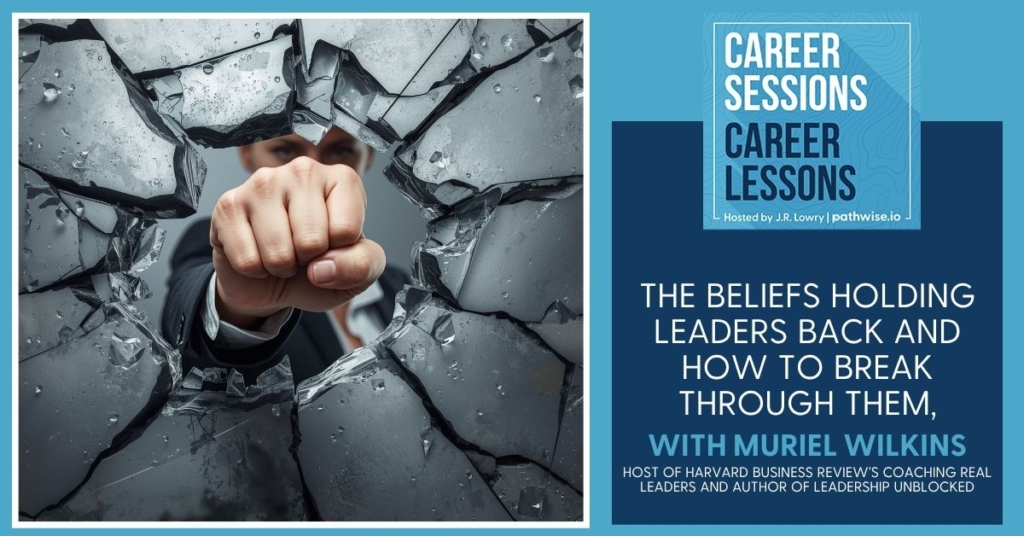
What’s really holding leaders back? According to executive coach Muriel Wilkins, it’s often not skills, strategy, or experience, it’s hidden beliefs. In this episode of Career Sessions, JR Lowry sits down with Muriel Wilkins, executive coach to senior leaders, host of Harvard Business Review’s Coaching Real Leaders, and author of Leadership Unblocked. Drawing from more than 20 years of coaching C-suite executives and analyzing hundreds of leadership cases, Muriel explains how deeply and often unconscious beliefs can quietly limit how leaders show up, make decisions, and work with others.
In this conversation, JR and Muriel unpack:
- The seven “hidden blockers” that often derail leadership effectiveness
- Why beliefs matter more than leadership tactics
- The difference between behavior and the belief driving it
- Why high-performing leaders often struggle with perfectionism
- How the belief “I know I’m right” can undermine collaboration
- How uncertainty and layoffs are amplifying leadership pressure today
- The mindset shift that unlocks leadership growth
- The framework for responding to challenges
If you want to become a more effective leader and experience leadership with greater clarity and ease, this conversation offers a powerful place to start.
Follow Career Sessions for weekly conversations on leadership, career growth, and navigating the future of work.
If your executive team is navigating the challenges in this conversation, explore PathWise’s 1:1 leadership and executive coaching.
Check out the full series of “Career Sessions, Career Lessons” podcasts here or visit pathwise.io/podcast/. A full written transcript of this episode is also available at https://pathwise.io/podcasts/muriel-wilkins/
—
Watch the episode here
Listen to the podcast here
The Beliefs Holding Leaders Back And How To Break Through Them, With Muriel Wilkins
In this episode, we’re going to be talking about getting unblocked. What I mean by that is unlearning the behaviors that hold us back professionally, things like feeling like we need to be the smartest person in the room or being afraid to make mistakes. Our guest, Muriel Wilkins, has a lot of experience in this area as a Coach, as well as a new book that examines seven common blocking behaviors and what to do about them. You may also know Muriel from her Harvard Business Review-associated podcast, Coaching Real Leaders. She has some serious street cred in terms of working with people on these blocking issues and others. Let’s dive in.
—
Muriel, welcome. Thank you so much for being on the show with me.
Thank you. I’m so delighted to be here with you.
We’re going to jump into talking about your new book pretty quickly, Leadership Unblocked, but before we do that, why don’t you just give our audience the quick background on you?
Sure, absolutely. Most of the work that I do is one-on-one with primarily C-suite leaders or folks who are aspiring and not that far away from being in the C-suite as an executive coach, as an advisor to them. Before I jumped into this work, I had my own stint as a leader in the corporate world, as well as having spent quite a bit of time as a strategy consultant and working in the fields of marketing and strategy.
You’ve been doing coaching for a long time. This is not your first book, but give us the pitch for the new book, Leadership Unblocked.
Hidden Beliefs As “Blockers” Of Leadership Performance

First of all, I did not intend to write a second book. If you had asked me years ago when I got done writing my first one, “Would you write a second one?” I was like, “Absolutely not, never again,” but then an idea captures you. For me, which is the essence of this book, is what I found is that while I was working with a lot of leaders who wanted different results and were very action-biased to take those results, what I found was that their behavior or their new way of leading was not sustainable.
The underlying root of the way that they were acting had not fallen into full alignment with the goals that they wanted, and those underlying roots being their beliefs. This book is basically about how do you understand and break through the beliefs that potentially are holding you back from leading as effectively as you can. That’s really the point here.
That quote from the Civil War I’m not going to get it exactly right but something to the effect of, “We’ve met the enemy and it is us.” This is a little bit of the same thing. People thinking that maybe they’re being held back by some form of external circumstances, but at the end of the day, it’s their own hidden blockers that are getting in the way of that.
Also, that contributes. I’m not here to say that that’s the only issue, but it certainly is you, and the way that you are, or the way that you go about things and respond to things, is the one thing that you have under your control. Why not start there?
You organized the bulk of the book around seven blocking behaviors, each with a story of somebody that you had worked with in the past. Can you give us the quick tour on at least some of the seven? I won’t pressure you to name all seven off the top of your head.
Common Hidden Blockers
I have my little cheat sheet here, so all transparency. The seven hidden blockers are the beliefs that one can carry, and one person can carry all seven of them. In fact, when I wrote the book, I was pretty convinced that I had two of them, pretty sure about it, and by the time I was done, I’m like, “Yes, I have manifested all seven of these at some point or another, sometimes all together at the same time.”
It’s not to say that these are the only seven beliefs that exist, they are just an appetizer and the ones that I saw most commonly among the folks that I worked with when I analyzed a sample of 300 over the past 20 years. It’s important to understand there’s a difference between the belief and the behavior or the personality. The behavior is what we do. The belief is what comes before what we do. It’s what we’re thinking, and we might not necessarily be conscious about them, which is why they are hidden.
When I looked across all of these clients, there were seven that came up, and they sounded like, “I need to be involved,” or, “I don’t belong here.” Another one was “I can’t make a mistake.” One that was quite surprising that came up was, “If I can do it, so can you.” The belief of “I need to get it done now.” they were that type of flavor, and you can see how simple they are, they almost seem inconsequential, like, what’s wrong with, “I can’t make a mistake?” What’s wrong with, “If I can do it, so can you?” There’s nothing wrong with them. It’s really a question of are they serving you well in the situation that you’re in, and given the type of leader that you either want to be or need to be to move towards the results that you’ve desired.
Take the one about not being able to make mistakes., to a degree, we all aspire to be excellent in what we do. That’s healthy. If you take it too far where it turns into just perfectionism all the time, or just a crippling fear that if you don’t do something exactly right every single time, that everything’s going to come down on you like a house of cards, that’s not healthy. It seems like a lot of this was people who were taking things that might have been okay in small doses and making them so prominent a feature in the way that they manage that it became a negative.
It could have been okay in small doses, or it could have been okay in a different role. I think about my first job out of college. I was an individual contributor. I literally was responsible for, and I’m dating myself here, making sure that the message, the direct marketing message, on the premium bill that insurance policy holders got every quarter was the right marketing message that we wanted sent. That was my sole responsibility.
In that situation, did the, “I cannot make a mistake” belief serve me well? Absolutely. I was responsible for one sentence. That typo, if there was a typo, could have made all the difference in the world in terms of my career. Fast forward to now, many years later, where I’m not responsible for just the one sentence, I’m responsible for running a whole business, and I’m responsible for managing my team and managing our strategy, managing my firm, as well as managing my clients and the work that goes into that. There is no way that I can laser focus on every specific thing. The question becomes, can I use that belief universally in the way that I lead? The answer is I could, but it would hold me back from leading at the scale at which I am operating now.
Are you seeing any one of the seven more frequently in your coaching work right now?
Impact Of Uncertainty On Decision-Making And Leadership Behavior
A lot of people ask me do I see one that happens more often than not, and the answer to that is no, like they’re pretty equal opportunity. For right now, I would say that this particular year, and this is why a lot of this is contextual, there has been a lot of both, “I can’t make a mistake,” and, “I need it done now.” The “I can’t make a mistake” is very interesting because if I were to describe one word that people have felt this year, it’s around feeling a lot of uncertainty.
When there’s a lot of uncertainty, people react a lot of ways as of they don’t want to make decisions, they don’t want to make plans, they don’t want to put a stake in the ground because why? What if we make a mistake? What if we make the wrong move? And so that’s what I have seen a lot happen at the higher level or, “What if I say the wrong thing to the organization?”
When there’s a lot of uncertainty, people react in many ways, often avoiding decisions and plans, and hesitating to take a stand because, what if they make a mistake? Share on XThat’s on the one hand where i’ve seen it. The “I need it done now” is happening at a micro level where there have been so many layoffs, etc., and teams are operating with not a lot of resources, and yet the leaders that I work with are still expecting everyone to deliver in the same way that they did when they did have all the resources. This urgency around having things done, even though the resources aren’t there, is a big one.
I’m also seeing this sense of, “If we don’t do it now, something disastrous is going to happen,” which is not always the case. The other part where i’ve seen really the, “I need it done now,” cause, quite frankly, a lot of disruption this year is if we just look at the way that layoffs have taken place. If we really dig down, part of it is this notion of, “It needs to be done for some reason with a level of urgency.”
Therefore, we’re not going to be careful about the approach that we take to the layoffs. That’s some of the ways where people dismiss or don’t even aren’t even aware of how some of these hidden blockers not only play out in individual leadership but , quite frankly, in the leadership culture as a collective group of leaders.
You built the 7 core chapters of the book around 7 individual individuals. Do you want to describe one of these blocking behaviors and how you worked with the person on that particular one just as an example?
Sure. One of the blockers, which I didn’t name before, but it’s one that, quite frankly, serves a lot of the folks that I work with really, really well until a certain point, is the belief, “I know I’m right.” The, “I know I’m right,” as you might imagine, is the person who is used to having the answer. They have been praised and valued and demonstrated their worth on knowing what to do, of being able to come up with solutions and then drive those solutions forward.
Where it tends to come up is when they have to get buy-in from others or influence others. In the book, I share the example of one of my clients who we’ll call Phil. That’s what I call him in the book, that is not his real name. Phil comes from a background of being able to really having an uncanny ability to see around corners. He was using that in trying to drive some of the things organizationally he sat at a very high level in the organization.
However, it was being noticed, particularly by his boss and his peers, that he just was shutting people down. His breakthrough really came from understanding that what he might be considering a waste of time is a waste of time if he understands his role as being, “I am here to give the answer.” His role is to make sure that the team of leaders aligns around a common goal and aligns around a plan to get there.
That word alignment is what made the difference because I basically asked him, “If you needed to get to alignment, what would you need to believe to get there?” I remember he was like, “I would need to make sure that they feel like they understand what’s going on,” which means then what? Well, they have to be able to ask the questions. They need to be able to discuss it. They need to be able to come up with some of the answers, or at the very least understand how what I’m suggesting is reinforcing what they are thinking.
What it basically led to is his ability to then stretch out the discussion, create more breathing space and more room in the discussions rather than it be mandates from him, which, quite frankly, were counterproductive and working very much against the very thing that he wanted, which was to get to a solution.
A lot of leadership books, will focus on skills and tactics, you focused more on mindset. What does a mindset-focused approach in your book make possible that a skill or tactics-focused approach can’t?
You’re a runner so you’ll appreciate this. I think the mindset is the last 2 to 3 miles in the race. I have no issues with skills training and competency-based development, which of course is necessary. It’s only going to get you so far. Most of the folks that I work with at this point, they are highly successful. They are highly successful, but what they want, what they’re very interested in, is optimizing their performance.
They could keep doing what they’re doing and it will be fine. The issue is if you want to optimize, and if you want to optimize, there’s almost this like money that’s left on the table, which is this mindset piece which they haven’t really tapped into. I do look at it as the last couple of miles to fulfill the potential that you can have as a leader if you choose to. It’s a level of agency there. That’s one.
I think the second thing why I find mindset to be important in addition to skill. Skill will teach you how to do something, but what the research has shown is that what you think about what you’re doing is as important, if not more, than what you actually do in order to get results. Again, everybody I work with is very results-oriented. When they understand that, they take a different approach. Why is it important? The way we think determines how we experience anything.

Limiting Beliefs: What you think about what you’re doing is as important, if not more important than what you actually do to get results.
A lot of my clients, they’re getting the results, etc., but they also may be experiencing a level of frustration that is unsustainable for them or a level of irritation. There’s just a malaise. Even if they’re not changing what they do, there is a difference in experience in how they experience leadership, not as challenging, not as difficult, not as arduous.
When you look at leaders, “Who do you want to be?” They’re like, “There was somebody I worked with and they’ll say they just seem to just like every day come in and yes, they have so many challenges, but they glide through the place.” my clients are like, “What do they do? I want the ten-step checklist.” I’m like, “We can get to that, but if your mindset is not aligned with having that type of ease, it’s not going to work.” that’s what I’m also interested in, is the skills will not teach you that. The mindset is what dictates how you experience even being a leader.
I know the book, as we’re recording this, has been out not all that long. I would imagine you’re already hearing from readers who read the book and probably are squirming in discomfort a little bit as they’re reading the book. What do you say to them when you have these conversations or, frankly, our audience who might be reading this about how to lean into that discomfort and not just stick their heads in the sand and ignore it or get defensive about it?
One of the things that I am hearing from readers along with like, “I see myself,” and they’re cringing, is that they’re not alone. I think sometimes when we think it’s just me, it compounds what’s happening. Probably one of my reasons for writing the book the way that I did is to show with people like, “Listen, you’re actually not that special, this happens a lot.” guess what? It’s okay. It’s normalizing it a little bit.
I think it’s, “Okay, well, what do you want to do?” you have agency around this. Do you want to experience leadership differently? Do you want to drive to your outcomes differently? What do you want? If so, here’s a way that you can approach it. The discomfort piece, to be honest, like whether it’s readers or my clients that I work with, when they’re like, “This is uncomfortable,” or “I don’t like this,” I say, “That’s okay.” That’s okay. It’s okay.
It’s okay to be uncomfortable, and particularly with leaders, it’s so important that we understand that a huge part of leading and that what might be even very unique to leading is that you’re always holding a tension. That’s a big part of it. Like if I were to define leading as what do you actually do, to me it’s you’re constantly holding a tension.
Tension As An Inherent Part Of Leadership (And The Need To Embrace It)
The question is how do you hold that tension? What I find is many people, including myself at times i’ve evolved a little bit around this but resist the tension. They don’t want the tension. They want the tension to go away. They want the challenges to go away. Why I say it’s okay to be uncomfortable? If you’re not really working with a tension, you’re probably not leading, quite frankly. Number one.
Number two is if you want to be able to do this in a sustainable way, get comfortable with tension. Just get comfortable with it. Embrace it even. Those leaders who you see that they look like they’re just gliding through their day, every day, all the time, it’s because they embrace it. They look forward to it. They’re like, “Bring it on. Where’s the tension?” That is what they see. If not, don’t be a leader, because to me, that is a huge part of the job description.
It’s okay to be uncomfortable. If you’re not working through tension, you’re probably not leading. To sustain leadership, learn to get comfortable with tension and even embrace it. Share on XIf you’re not feeling some level of tension, you’re probably not pushing the envelope enough. You’re probably letting everybody live in their comfort zone too much.
I actually think if you’re not feeling the tension, you’re not looking in the right places. I don’t even think you’re not it’s not about pushing the envelope. The tension is there whether we like it or not. You are likely either ignoring a big part of what’s happening, you’re not facing reality. Even in “good times,” when, let’s say you brought up the economic context before, and markets are doing well, economy’s doing well, what’s the tension? The tension is, “Now we are flowing with, let’s say, cash. What do we do with it?”
That’s a tension. Do we sit on it? Do we spend it? Do we rehire? There’s always these two in the school of thought of polarities, and we’re constantly trying to figure out what is the right balance for any given situation. Now, here is the thing. If the world wasn’t changing all the time, which it is, we wouldn’t be experiencing tension, but change is constant. That’s another thing that leaders who glide, who flow, and who really can operate with ease, they accept that change is constant.
Rather than, “We’re doing this one thing and this is the way it’s going to stay.” It’s not. You’re holding both stability and change at the same time. To me, the tension is always there, and it’s not a bad thing. People think about tension as something bad. It’s not bad. It’s just more that you’ve got to be able to have the capacity to hold it. To me, that is a sign of maturity because there’s complexity there.
If you had to boil down for somebody who is reading, what’s one thing you would want them to take away from the book that they can apply in their work life?
What I would say is the challenges will never go away. How you respond to the challenges can make a huge difference, and that is something that’s under your control. Focus on what you have under your control, and one of the big primary pieces of what you have under your control is how you think about yourself, about others, and about the context that you’re in in any given situation. Start there.
You have a very well-known podcast, Coaching Real Leaders, but for anybody who’s not familiar with your show, give us the quick premise on it.
Coaching Real Leaders, again, never set out to be in the podcast world whatsoever. It actually came out as an idea that my son had during the pandemic. I was doing a coaching meeting with one of my clients on Zoom, and he walked into my office even though I had a big sign on the door that said nobody come in. He asked me later, he was like, “Mommy, did you ever think about like uploading the videos to youtube?” I was like, “Absolutely not. They’re confidential,” “But so many people could learn from them.”
There’s this notion of coaching is done behind closed doors. It’s actually a privilege to have a coach. It’s not cheap. The folks that I work with, they are very senior. I thought, first of all, we talk about coaching, nobody really knows what happens behind that door. Secondly, what if we were able to give access to coaching to more people in a way that A) They can understand again that they’re not alone, and B) In sharing these stories, understand maybe have a better sense of how they could respond to the challenges or the situations that they’re facing.
That’s what the whole premise of the podcast is about. I coach real people. They’re not my day-to-day clients. They are people who really apply to be coached for one-time session. It’s unscripted. I meet them for the first time when we press record and we have a real coaching meeting, a one-time coaching meeting, which, again, is not the norm of my daily practice. They come with a particular situation or issue that they’re dealing with, and I try my best to coach them through it in a way that helps them move forward.
As you said a minute ago, these are deeply personal conversations. You’re disguising names when the people are on your show, but you’re not disguising voices. Anybody who knows them is going to know who it is. How do you get people comfortable with the fact that they’re airing their stuff for the world?
The Difference Between Behavior And The Belief Driving It
I don’t know. I think that anyone who comes to coaching, there’s a dissonance that they’re experiencing. There’s something that they need support on. I think when you need support, if it gets to that place as I say, the cliché, you get tired of being tired, you hope that you find support somewhere. Now that I’m ten seasons in, now people are like, “Okay, i’ve heard her 82 times, so I think she might be able to help me.” maybe they are like, “At least I know what her approach is.” I think that’s what gets them in the door, they are ready for some coaching.
I think, secondly, then the job becomes mine, which I bring to the coaching, which is no different than I do with anybody who I coach. I bring a certain level of neutrality and non-judgmental perspective that gets them in a place where they feel okay sharing what they’re sharing and forget that this is being recorded. I have to do the same, by the way. Every time I do these coaching meetings for the podcast, I have to put out of my mind that we’ve had 6.2 million downloads.
The risk is if I think about that, do I become performative? Do I start responding more to the audience rather than the person who’s sitting in front of me? If that ever gets in the way, I’m stopping to do the podcast because that is not in service of my client. At the end of the day, for those 90 minutes or 2 hours, they are my client, just like my paying client. I owe them my presence as a coach, not my presence as a podcast person.
What are some of the big things you’ve learned from doing the show and coaching this population that add to what you’ve learned from your more traditional coaching work?
One of the things that I think i’ve learned in doing the show is this has been a huge practice for me in vulnerability as a coach. When I started, my biggest concern I had to use what I share in Leadership Unblocked. I had to coach myself around, “Muriel, what is going on here?” I was feeling this angst of like, I was feeling an angst and I didn’t know what the angst was about. This was after I had pitched the show, it had been approved, so I was committed at that point.
I had to deliver and I was starting to feel this like “Ugh.” was the angst that I couldn’t coach? I was like, “No, that’s not what it is.” The angst was, “What if the entire coaching community throws tomatoes at me and says ‘That’s not coaching, what are you doing?’ and ‘That’s bad coaching’?” I had to recalibrate. You want to talk about beliefs? The reframing for me was. I do believe in how I coach. The belief shouldn’t be fake.
This is true. I have never espoused that my way of coaching is the way of coaching. I am in no form suggesting that what I’m putting out on the podcast is the way. Everybody should follow this? Not at all. It is Muriel’s way of coaching. Do I believe that it will work for some clients and may not work for others? Absolutely, and I’m cool with that. Hopefully, the ones who come on the podcast, it works with, it vibes with.
That then released me from really playing to anybody else’s agenda and more play to my own. At the same time, I also felt a certain level of responsibility to the coaching universe because I do believe in the profession and what we do. I had to make sure that I presented it in a way that’s still authentic to me. That reframing helped me lean into it with more comfort and made the vulnerability more palatable rather than causing angst.
You’ve got a community as well that you have set up for people who want to go deeper. You want to give us a quick overview of that?
Yeah, absolutely. When I started the podcast, what I was finding people were messaging me and saying, “Here’s what I thought about this episode, and what were you thinking when you did this?” I heard that like people were starting up like almost like book clubs for the episodes where they would have these discussion groups. I thought, “I wonder if people would want to know what I was thinking as I was doing that coaching.”
Lo and behold, I put it out there and there are bunch of people who are interested in unpacking the episodes and understanding what is the coach thinking as she’s coaching. Again, this for me was a place of accessibility as well, so it’s probably one of the least expensive membership communities out there. I purposely have kept the fee very low, and it’s discussion-based.
We just get together and talk about the episodes and we also have just open discussions about anything related to leadership or coaching in terms of questions that people have or questions that I have. It’s not a huge community, we’re a couple hundred people, but it has really become just a source of fulfillment for me too, like some of these folks have become friends. I met some of them at Thinkers50 who were there, I met them in person.
As community has become more and more important for me, in fact, I sent my end-of-year email to folks who I work with, etc., and I said the theme for me has been community, I find as much fulfillment from that community as I’m hoping that they get as well. I think there’s so much learning and growth and living that happens in community and not just in isolation and solitude.
So much learning, growth, and living happens in community, not just in isolation and solitude. Share on XFrameworks For Responding To Challenges With Clarity And Intentionality
Given that AI is eating content, what it can’t deliver is a shared human experience. That’s where community comes in, and I think that piece will continue to be important even in a world that’s getting less social by the day, as everybody sits at home and talks to a computer instead of talking to other human beings.
When you talk about like growth, like how has all this helped me grow? I’m very comfortable being alone. I’m like the quintessential lone wolf. I have a very high threshold for solitude, and I don’t see that as a bad thing at all. I have come to appreciate more and more holding that tension, a full life not just as a leader but just in general as a human is having both. Being comfortable with yourself I never say by myself, I say I’m comfortable with myself and being comfortable with others. Being parts of communities and opening myself up to new communities. We met at Thinkers50, I was very hesitant about going to Thinkers50, but I opened myself up, right, to that experience.
It was what I made it out to be in terms of how I experienced it with a sense of openness because I want to be able to experience both is what’s important. It goes back to what we were talking about around the tension that you can either hold with a lot of angst and tightness, or you can actually hold it with a little more ease, and this community part has been one that i’ve been leaning into more and more in order to hold that tension with more ease.
Thinking about the work you’re doing with your clients, the podcast, the book, what are 2 or 3 things you really want people who read this to take away from the discussion?
I write about it in the book, but it’s a story that I remind myself of a lot even as I’m going through my own leadership challenges, life challenges, etc. It’s the story of the two arrows with the Buddha where he asks the student, “If somebody gets struck by an arrow, do they experience pain?” the student said yes. He said, “If he gets struck by a second arrow, do they experience more pain?” the student said yes. He says the first arrow is the challenges that we face in life or in leadership, they’re inevitable. The second arrow is how we respond to the first arrow, and that’s what causes suffering.
I share that and keep it top of mind because it is not for us to get rid of the challenges. As I said before, we don’t have that much control we wish we did, but we do not. Yet, you have the opportunity everyone has the opportunity to not experience suffering, and the way that I turn that around is you can experience leadership with more ease if you understand how to mitigate that second arrow. You do that by shifting your mindset, which will then help you shift how you respond to the challenges that are ahead of you. Focus on what you can control, which is how you respond to the first arrow and the challenges that are in front of you.
Thanks for doing this, Muriel. Really great to conversation. I loved hearing more about the book and what sparked it and the work you do with your clients on your podcast and elsewhere. Thank you for making the time.
Of course, it was a pleasure. Thank you for having me.
Thanks to Muriel for joining me to discuss her new book, Leadership Unblocked, her incredibly successful podcast, Coaching Real Leaders, and a little bit about her own journey as well. As a reminder, this episode was brought to you by PathWise.io. If you’re ready to take control of your career, join the PathWise community by visiting Community.PathWise.io. You can also sign up for our newsletter and follow us on LinkedIn, Facebook, YouTube, Instagram and TikTok. Thanks.
Important Links
- Muriel Wilkins
- Coaching Real Leaders
- Leadership Unblocked
- PathWise Community
- PathWise on LinkedIn
- PathWise on Facebook
- PathWise on YouTube
- PathWise on Instagram
- PathWise on TikTok
About Muriel M. Wilkins

