Why OKRs Fail: Puzzle-Driven Product Strategy, AI, And Building Better Products, With Radhika Dutt
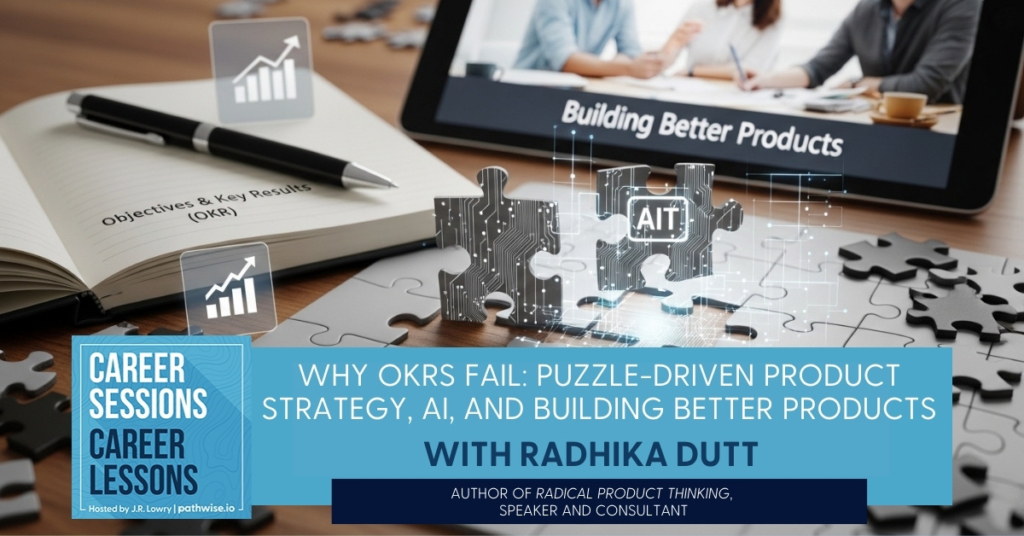
If you’re a product manager, founder, executive, or even an individual contributor navigating OKRs, AI, and innovation pressure, this episode of Career Sessions, Career Lessons offers a practical reframing of how great products and meaningful work actually get built.
Host JR Lowry sits down with Radhika Dutt, author of Radical Product Thinking, to unpack why traditional goals, OKRs, and performance targets often do more harm than good in modern product organizations.
Drawing from her experience as an MIT-trained engineer, startup founder, and product leader across industries, Radhika introduces an alternative: puzzle setting and puzzle solving. Rather than optimizing for short-term metrics, she says that the most successful teams spend more time in the problem space asking better questions, learning faster, and adapting intelligently.
Together, JR and Radhika explore:
- Why OKRs and targets could kill curiosity and innovation
- The difference between optimizing numbers and solving the right problem
- How “puzzle-driven” teams outperform “goal-driven” teams
- The dangers of AI-driven “product slop” and what humans must do better than machines
- Leadership lessons on delegation, critical thinking, and psychological safety
- AI’s impact on recruiting and culture
If your managers are working through the issues Radhika Dutt raises, PathWise offers management training workshops.
Check out the full series of “Career Sessions, Career Lessons” podcasts here or visit pathwise.io/podcast/. A full written transcript of this episode is also available at https://pathwise.io/podcasts/radhika-dutt/
—
Watch the episode here
Listen to the podcast here
Why OKRs Fail: Puzzle-Driven Product Strategy, AI, And Building Better Products, With Radhika Dutt
We are going to be discussing product development with Radhika Dutt. Radhika argues that traditional goals do a poor job of encouraging the product development we need, where curiosity, experimentation, and learning need to be more at the forefront. She will share some examples and talk about how some of the companies she has worked with have made this transition. Let us get going.
—
Radhika, welcome, and thanks so much for doing the show with me.
Thanks so much for having me here. I am excited to be here.
Looking forward to the conversation. Before we dive into some of the things that you speak on and write on, just give us a quick background on you.
Introduction To Radhika Dutt & Radical Product Thinking
My background is that I started off as an electrical engineer. I got into the startup world because we started our first startup right out of our dorm rooms at MIT. That sounds all glamorous, but the reality is there were just a ton of mistakes that we made and mistakes that I now call product diseases. When we call them mistakes, it sounds like it is only something you do. You should have known better. The reality is that these product diseases are so common.
When we call them mistakes, it sounds like something you should have known better, but the reality is that these product diseases are very common. Share on XI will give you one example of a product disease that we caught really early on. It is what I call hero syndrome. What do I mean by that? Our vision at the time, this was in 2000, was to revolutionize wireless. Back to what did that mean? It is not even clear to me. These are the vision statements we have, where it is all about really going big, scale. We thought about success then, in terms of how much funds have raised, which logos we have on our web pages, and customers.
These are the sorts of things that I call hero syndrome, but it is so prevalent. I still see this in startups. Where that led me is that, as I made mistakes along the way through startups and working at bigger companies, too, I realized we are all learning through these trials and errors. The thought was, can we have a systematic process for building world-changing products while avoiding these product diseases? That is what radical product thinking is about. That is the first book I wrote. It came out in 2021. It talks about the seven most common product diseases.
Other examples of things like pivotitis, obsessive sales disorder. There are just so many that as I start to say them, you will recognize them. What I am working on now is my next book, which is about why goals and OKRs targets, why they backfire and what actually works. That came up because a lot of people who read Radical Product Thinking said to me, “I love the long-term thinking you are talking about. I just cannot apply it in my company because we’re driven by all these short-term numbers.” That is what led me to work on this book.

I think about your story of working on a startup from your dorm room is the heart of the dot-com boom. I used to joke at the time I had three kids at that point, so I desperately wanted to participate in that space, but I did not feel like I had the financial flexibility to do it. I still live with a bit of regret of having not had that experience, good or bad, that a lot of other people got during the heart of that first real wave of massive startup expansion that you were participating in.
There is no real substitute for the hard lessons you learn in a startup environment. Obviously, in your case, that sparked some of the thinking and the work that you have been doing since then. I am living a little bit of that entrepreneurial dream now, but it is coming much later in my life than it did as a first-time entrepreneur for you.
The Inevitability Of Mistakes In Entrepreneurship & Reflection As Learning
That is such an interesting comment. I think we learn so much more from those entrepreneurial endeavors later in life. There is this amazing quote I came across just recently. It goes, “We do not learn from experience, we learn from reflecting on experience.” A lot of the learnings from that startup it is not that they hit me instantly at that time. Yes, it was a huge learning curve, etc. A lot of that processing I did actually later in life. In many ways, I wonder if you’re getting more of your learnings and experience from doing this entrepreneurship journey later in life.
Maybe. I certainly learned a lot of other lessons along the way that you would not necessarily have from life as a 21 or 22-year-old working on something in your dorm room. There is something about being a first-time entrepreneur that you’re going to make so many mistakes. Everybody that I have interviewed on this show who has gone through the entrepreneurial journey is like, “Many mistakes.” That is just inevitable.
There is one quote a mentor once shared with me. He said, “Every four years you should look back on yourself and feel completely embarrassed for all that you did not know.” That amount of time for me is more like six months. I look back at myself, usually six months prior, and say, “How did I not know that?” When we start thinking about ourselves and our learnings from that angle, we should be embarrassed by what we did not know. I find that really empowering. It makes you realize how far I come.
You went on from that startup experience to do product development in a bunch of different industries. What did all of those diverse experiences teach you about what makes product development teams effective?
The Value Of Not Knowing & Asking The Right Questions (The Puzzle Approach)
By the way, you talk about all these different industries. There was a recruiter who said to me at some point, “You really should consider focusing.” In retrospect, no, I do not think she was right at all. I think working in all these different industries helped me see patterns. The pattern was that it is not about coming into a company and knowing what the right thing to build is. Usually, as leaders or in a company, the focus is on knowing.
We don't learn from experience. We learn from reflecting on experience. Share on XWhereas for me, the biggest learning has been not knowing and asking the right questions. How do you figure it out? That has been the pattern that has really stayed with me, being able to go into any industry, ask the right questions, and then figure out that puzzle. I guess, even as I talk about it, and I had not honestly thought about it in this way, this is the first time I am saying this out loud.
It makes me realize that this whole approach to puzzle setting and puzzle solving that I am writing about in this book really comes from this diverse background and having worked in all of these different industries, because there is no way you can come at it from an angle of knowing that, “I am coming in, I’ve done this before, here is what you should build, here are your answers.”
It was always that, “I do not know, I am going to learn this together with you, we are going to figure this out, but here are the questions that I have that I genuinely do not know the answers to.” It makes others more open to asking those questions too and saying, “You’re right, we do not know the answers to this, we thought we did.”
A lot of that resonates with me. You went about that through all these different firms that you were in at the time. I got that out of McKinsey and the management consulting space, and there too, it is like you’re constantly confronted with new situations. They’re all a puzzle or a problem to be solved.
I always loved that part of the job like going into a different place and having to figure out how to build the relationships to be able to get people to talk to you honestly, how to know how to ask the right questions, how to bring all that together and think about what does this company really need and how can we help them think about what they need to do to get themselves to what they are trying to be able to do.
I’ve taken that with me in my corporate life, that ability to approach a situation, think of it as a puzzle. I guess I never really thought about it as a puzzle. I just thought about it as a problem to be solved, but knowing how to ask the right questions and having comfort with not knowing all of the answers and trying to find them through other people or through whatever means. You and I both figured that out. We just did it in very different ways. I know you’re working on a new book called Escaping the Performance Trap to dive deeper into this topic of how goals can work against you. What was the spark that set you off on wanting to write the second book?
The Backfire Of Traditional Goals (OKRs) & The “Leaders Are The Last To Know” Concept
The big spark was when readers said to me, “I feel like we want to take this long-term approach, but we just cannot at our companies.” What it made me realize was a lot of the issues that I had over the years with goals and OKRs, targets, the things that I felt in my gut, like, “It is just not working.” I was seeing people using it and seeing how it was skewing organizations. I did not have words for it at the time. I could not articulate why what I was seeing was not just a singular phenomenon, but that it was more widespread.
Once I started hearing other people say that it was not working, that goals were pushing them in the wrong direction, then I was like, “It is not just me.” By the way, this happens so often. If you say OKRs are not working for you, what you will hear, the common refrain goes, “If OKRs are not working for you, you’re doing them wrong.” Basically, if you just set the right goals, everything would be just fine. I realized someone had to say the emperor has no clothes. That might as well be me.

Why OKRs Fail: If you say OKRs aren’t working for you, what you’ll hear is, ‘If OKRs aren’t working for you, you’re doing them wrong.’ Someone had to say the emperor has no clothes.
I will share one big thing that made me realize goals and OKRs do not work. Andy Grove, the legendary CEO at Intel, wrote, “Leaders are the last to know.” Why is that? It is because when you set a target, everyone’s incentive is, “I want to show you that I’m a high performer. I have achieved those targets.” When that is my incentive, I want to show you all the numbers that are proving, “Everything is working well.”
What I am doing is basically looking at those positive numbers to show you, “I’ve hit those numbers.” What I am subconsciously doing, not even maliciously, subconsciously, I am just ignoring those bad numbers that are saying something is not working, that maybe there is a problem here, maybe there is an opportunity, but I am ignoring that to be able to show you the positive numbers. What you need as a leader is for someone to actually look at those bad numbers and figure out that puzzle, to play detective and say, “What’s going on?”
I think being a leader in a product-focused organization is really hard. A lot of them fall back on, “Got to hit the targets, got to hit the financials, got to hit revenue growth from new products.” To your point, it works against the idea of creativity. Everybody loves to go to the examples. Pixar would be a great example. Single focus on creating movies has a very famous creative process that they follow.
It is harder if you’re in a company and you’ve got a hundred products that you’re trying to produce, a pharmaceutical might be a good example of that. That balance of how do you make sure you’re hitting your financial targets, which are important to the sustained performance of the business, but also giving people the space for creativity? I think very few companies have figured out, and very few CEOs have figured out, how to strike that balance because it is really hard.
I so agree. It really is hard. There are a couple of things that I want to unpack in that. What I’ve seen is that when you have goals and targets, this is what it leads to, either things are going well. If things are going well, you’re hitting your targets. That in turn leads to complacency because you go, “I can relax a bit. I can just milk this for a bit.” The example of that I shared recently in a talk is Marvel. They innovated. They created the MCU, the Marvel Cinematic Universe.
In creating this interconnected world from comic books that had never been done in movies, they ended up innovating and producing 10 of the top 30 highest-grossing movies of all time. What happened? Things were going well. They innovated because they were going bankrupt. Once they were doing really well and they were hitting all their targets, they got complacent. They said, “Great. We’ve arrived. Let’s milk it.” They started producing one shitty movie after another.
I’ve lost count of how many Captain Americas there are at this point. We are at least up to Guardians of the Galaxy 3. I am sure there is a fourth that will come out at some point. It is just milking it at this point. There is no more innovation. It shows in the box office returns. The Marvels was a flop. Forty-five million box office returns in the opening weekend. That is what happens when things are going well. We hit targets, we get complacent. The other option is that things are not going well.
In that case, we’re missing targets, and then what happens? You see frantic activity. Everyone is just moving wildly in different directions. There is a lack of collaboration. I often see one team say to another, “I know you need my help right now, but we have to hit this target. Come back to me after I’ve hit that.” It ruins that collaboration where maybe what we needed to do was to deliver those things together across teams that would have gotten better results for the whole company.
The Puzzle Setting & Solving Framework (Signal Maritime Example)
The example that I really like talking about is that of Signal Maritime. Again, this was a company where I was not familiar with the industry at all. It is in the maritime space where Signal is a company that produces data so that you can figure out which shipping vessel to match to fit which cargo, so that you can maximize profits. The CEO brought me in because sales had stalled in 2023. They were setting all the right OKRs exactly as you’re supposed to. OKRs for sales, OKRs for various key product metrics.
What happened when I came in was that I could see that our focus was really on numbers, and we were focusing on the solution. When I came in, it was very clear that it is tech-savvy users who are primarily brokers. They were using the product, and we were jumping to the solution space. We were saying, “If it’s the tech-savvy user who’s using it, we know from a lot of user feedback that creating lists on our platform is really painful. The filtering process is really painful.
We had all this customer feedback. Great. Let us fix that.” The focus was jumping into the solution. The reality was, first of all, I was starting to get this gut sense that I do not think it is just about filtering. There is something more going on. We started talking to users, and we had customer interviews. This is where I was getting so much pushback from the sales team, saying, “You should already know the answers to these questions.” We wanted to explore.
The people in these other roles, what is their workflow like? What do they do? How is it different from brokers? Setting the puzzle meant talking about what the problem statement was. The problem statement was obvious. “Only tech-savvy brokers are using this.” Asking open questions, “What is it people in other roles are doing? How do they think? How is it different from our early adopters? What do those people actually need?” We did not know the answers to those questions because it was unfamiliar territory first, and we knew brokers.
This was the puzzle, and the summary of the puzzle was, how do we address the needs of the tech-averse users in other roles so that we can grow and get back to that growth trajectory we were on? Now, once we had begun to explore all of this and the nature of the puzzle began to emerge, we could actually start to solve the puzzle. As we explored this puzzle, we got a better understanding of their workflow. What do they do? Here are the basic steps that they follow.
They do not even think in this way. They think in a different way. They want to figure out, “how do I price these vessels high or low? How do I calculate my voyage?” We started to think about all this workflow. The next step was solving the puzzle. When you solve the puzzle, you ask three questions. It is like the Rubik’s Cube. Every attempt, you say, “How well did that work?” The second question is, “What did I learn from that?” This is not just data.
Do not just spit out a bunch of data saying, “This was the growth, this is the weekly active users.” This is actually more than that. What is the data telling you? What have you learned? The last question, based on how well it worked and what you learned, is “What will you try next?” Meaning, if I gave you a magic wand, what would you try next? Here is one example of how we were attempting this puzzle. We said, “We now know how they work. We’re going to attempt to automate everything so that our hypothesis is clear.”
If it’s tech-averse users, if we just automate things for them, it will make it so much easier. They’ll hopefully use it more. Sounds reasonable. The first question is “How well did that work?” We tried this out in a prototype, and the answer was that it did not work. It did not work at all. What did we learn from this? It turns out that tech-averse people actually do not like magic.
When you automate, things feel like magic. Magic is just scary because they want to know, “How did you get those numbers? I don’t understand.” This is what we learned. What will we try next? How will we adapt? The answer to that was, “We know they do not like magic. We’re going to guide them at each step. A lot of it might be automated, but at each step, it does not feel like magic.
We will still guide you through the steps.” Now this worked much better. In terms of puzzle setting and puzzle solving, by constantly solving puzzles and unlocking the next puzzle, we doubled sales in 2024 and again in 2025, and we reduced churn from 26% to 4%. This is where we can get phenomenal results. It is by puzzle setting and puzzle solving, rather than just setting goals. Goals do not tell teams, “What do I do instead?” Whereas puzzle setting and puzzle solving systematically unlock it for them.
Goals don’t tell teams what to do; puzzle setting and puzzle solving systematically unlock that for them. Share on XI would imagine that down in the trenches, you have a lot of allies right from the get-go with this because the people in the product organizations probably feel like the bosses are putting a lot of pressure on them to hit numbers, but they’re also probably putting a lot of pressure on them to deliver the product changes that they think are right. Does your work tend to be top-down, or are there instances where you create the movement in a more bottom-up way?
It definitely has to be both top-down and bottom-up, but bottom-up is almost more important. Why do I say that? Bottom-up, unless you can show leadership how puzzle setting and puzzle solving are driving results or how you’re thinking about the nature of the problem. It is a way of creating alignment with leadership in terms of how you’re solving the problem. You’re giving them control and a way of course-correcting through both the learning and the adaptations that they do not have.
By having those insightful conversations, you’re helping shift the nature of the conversation from this binary nature of “Have you or haven’t you achieved this goal?” to this way of thinking about, “We’ve tried this, here is what we learned, here is what we’re going to try next.” It is a more insightful conversation. Unless you present information in this way, leaders are going to find it way too scary to shift away from OKRs. The bottom-up approach is super important.
For leaders, too, this is equally important in that for a leader, you often hear, “You should be delegating more.” The reality is that delegation is super hard because you delegate, but how do you know that your team is able to take your delegation? Different people are at different levels of skills, knowledge, and experience. This approach gives you scaffolding.
What I found is when I give teams this scaffolding of, “How well did it work? What have you learned? What will you try next?” The answers to those questions give me the true sense of, “How good are they at solving this puzzle?” I’ve been fascinated that there have been people from these big companies, like Google and Amazon, working at smaller companies.
Once they show me the answers in this format, I realize, “Wait. I’m seeing that this muscle in looking at the bad numbers, really has atrophied.” I asked a couple of questions, and I realized that the thinking was not deep enough in terms of what you learned. “You’re quoting numbers to me, but you’re not really investigating what is going on.” I’ve had to give them more handholding.
Other people turned out to be more junior, and I realized, “Your thinking is really deep.” Now I give you a little bit of handholding in terms of, “This solution, maybe you can try a smaller attempt at this, because how you want to adapt is too big a risk. For the most part, I love your analysis. I’m going to give you bigger puzzles to solve.”
As a leader, this sort of scaffolding helps you really figure out who I can delegate to and how much I delegate. It helps you understand how much handholding to give different people. This is how you can really scale as a leader by offering more delegation where you can and giving more handholding where you need to.

Why OKRs Fail: This is how you truly scale as a leader: delegate more where you can and provide more hands-on support where needed.
There is a difference certainly between being a purely execution-focused engineer or product development person who is building something that they were told to go build and somebody who has to apply critical thinking, which is the puzzle-setting piece. In the scheme of things, that feels like the important skill that probably is lacking in a lot of organizations because they are so top-down or top-down enough that you just get people who get into execution mode.
They put their blinders on. They do not really poke their head up and say, “Are we even working on the right problem? Do we really understand what the customer is looking for? Are we clear that we’re working on something that somebody is actually willing to pay for?” All of that critical thinking, as you’re describing this, Radhika, is foundational to doing what you’re describing well. A lot of organizations just lack that.
Most places I have worked, it has been a rare group of people, a rare minority of people, who really have strong critical thinking skills. You think about what AI is doing across every industry right now, it will be better at puzzle solving than it will be at puzzle setting. If you’re a person, a human being, you have to get better at that first half of the equation because there will be more tools that will help do the second part, but they are not necessarily going to frame the problem in the right way or puzzle in the right way.
Puzzle Setting & Solving As A Defense Against AI & Product Slop
There is so much I want to unpack there because even in puzzle-solving, AI is not good at reflection. AI is great at optimizing numbers. In terms of puzzle solving, it is not the puzzle solving so much. It is the optimization of numbers that it is great at. When you talk about so many people being great at execution mode, if you’re an engineer in execution mode, etc., the reality is that it is not just execution mode that is going to be valued in the AI era. Let us talk about an engineer.
If all you are doing is coding, if that is all you are doing, the execution part, AI can do so much of that, and there is vibe coding, etc. If you’re a software engineer where you’re not just creating AI slop with a ton of hidden bugs underneath, if you are actually thinking about how to architect the system, AI is definitely not good at doing that. It is not about execution alone. If you’re a product manager, if all you’re doing is optimizing for numbers, AI is going to be great at that. You can optimize UI for clicks. You can optimize content for clicks.
You can optimize your entire product and the workflow for whatever one metric that you’re thinking about. That is not the puzzle. If you think about it, like you were saying, the puzzle setting and what is the puzzle that you’re really setting out to solve. Even in puzzle solving, if you truly think about each hypothesis and attempt at the puzzle, not just from an angle of optimizing numbers, but you’re truly thinking about, “Is this solving the puzzle?” That is where your true value-add is.
That is what you cannot abdicate to AI. Let me just share an example of what I mean by this. I want to give an example of the dating industry and dating apps. What I mean by optimizing numbers is let us talk about how the dating industry was ruined by Tinder. Tinder is optimized for the short-term metric of user engagement. They introduced this swipe-left, swipe-right feature. It is optimized for that short-term metric. User engagement was through the roof, but what it was doing was gamifying intimacy.
AI is great at optimizing numbers, but not good at reflection. Share on XThe more intimacy was gamified, the more it created this toxic dating environment where people did not think about the other person as human. It was just something to swipe left and swipe right, hot or not. It completely shifted those interactions. What has happened since is that more dating and human interactions have become toxic. Now people were feeling fatigue from the dating industry or being on dating apps. The entire dating industry has been in a slump.
Bumble recently laid off 30% of its staff. What could we do instead? If you are not just thinking about optimizing numbers, which is the AI approach. AI is going to be great at optimizing whatever number you set. Instead, if you set the puzzle, it is not just optimizing for user engagement. The puzzle is, how can I make dating a better experience so that people find matches, but also how can it be an experience that does not feel overwhelming or fatiguing? Maybe even in solving the puzzle, I am going to think about the human element.
One of the things that people talk about in dating a lot is that you put yourself out there, you might reach out to people, and then you hear crickets, just nothing back. How can you get people to respond to each other in kind ways? It might even be something like, “Just not the right fit for me right now,” or whatever it is, but in a nice way as opposed to ghosting. What else can you do to improve those human interactions and get people to think about each other as humans with feelings? That is solving the puzzle as opposed to optimizing numbers and just increasing user engagement.
I’ve been thinking about AI a lot. It is almost impossible not to. I feel like we’re at this pivotal moment in history. A stat that stuck with me that I read in the last few weeks is that AI is now producing roughly 50% of the content on the internet. All it’s doing is creating a probability-based model of what has already been created on the internet.
As AI continues to become more and more of what is on the internet, it just becomes a big echo chamber. What good is that? We’ve just ended up basically destroying what the internet was about, which is to give people the ability to express themselves. It undermines a lot of things, as we talked about with dating and the job market. I have to believe at some point there is going to need to be a pullback from all of this because it comes back to your puzzle-setting, puzzle-solving framework, which is we’re losing the plot.
We are not even solving the right problem anymore. We’ve gone so far down a rabbit hole of one particular thing that we’re not really stepping back and saying, “How do we use the internet to advance the world’s economy and to advance the world’s thinking?” Spitting out a bunch of mediocre stuff produced by an AI tool is certainly not the way to do it. Yet that is the way it’s going.
It is not just AI content slop. It is product slop. I only see this affecting society much more profoundly and increasingly. I wish I had this optimism that we can just pull back from it. There is a lot of optimism that AI is going to make us so much faster and better. I’ll give you the example of Coca-Cola. Last year, they got a ton of backlash for creating holiday ads generated by AI. Everyone looks forward to their holiday ads, and the holiday ads that they created look like AI slop.

Why OKRs Fail: What makes work less soul-sucking is being able to bring ourselves and our creativity into it—and that means puzzle setting and puzzle solving.
What did they do this year? They just doubled down on AI and created more of that. The chief marketing officer actually very proudly said, “We did that because it was so much faster to do instead of planning a year ahead. It allowed us to put something out there in a month.” If everyone does this, we’re increasingly going to get used to it.
All of our audience can take a more thoughtful approach because work is going to be so much more rewarding if we feel like we can bring ourselves and our creativity into it. As humans, we like to solve puzzles. We are not just motivated by hitting targets and numbers. What makes work less soul-sucking is that we are able to bring ourselves or our creativity into it. That means puzzle setting and puzzle solving.
Even if your company is very much driven by goals and targets, even if you’re an individual contributor, you can think about your work differently and think of your work as a puzzle you’re working on and how you’re then solving that puzzle. You can do this just for yourself and within your sphere of control, where you have that psychological safety, even with whatever small team, maybe your developers, etc. You can take that approach so that you can drive better business results, too, but also make work just better for yourself.
Bringing Puzzle Setting Into Your Work
Any last thoughts you want to leave our audience with?
The main thing about puzzle setting and puzzle solving is how you introduce this into your organization. You can start to practice it in the safety of your own desk. Just at your own desk, you can try this out. Think about an initiative as you think about how you would set the puzzle, and then your learnings as you were solving it. How well did it work? What have I learned? What will I try next? By practicing this just by yourself, then introducing it to others and getting more and more people familiar with these ideas and this mindset, you can start to spread this within your organization.
Good advice. Good way to end. A little bit less dire than our AI conversation. Thanks for doing this. This was fun.
Thanks so much for having me. This was so much fun.
Have a good day.
—
Thanks, Radhika, for joining me. It was a fun conversation. We started right on the idea of product development, and this concept of puzzle setting and puzzle solving, and quickly got into AI and ultimately into things like languages and movies. As a reminder, our episode was brought to you by Pathwise.io. If you are ready to take control of your career, join the Pathwise community. You can also sign up on the website for our newsletter and follow us on LinkedIn, Facebook, YouTube, Instagram, and TikTok. Thanks, have a good day.
Important Links
- Radhika Dutt
- Radical Product Thinking
- PathWise on LinkedIn
- PathWise on Facebook
- PathWise on YouTube
- PathWise on Instagram
- PathWise on TikTok
- PathWise on Twitter
About Radhika Dutt

